Species · Flowering plants
Karri Eucalyptus diversicolor
The scientific name of the Karri is Eucalyptus diversicolor. It is a species of flowering plant in the family Myrtaceae (myrtle family), order Myrtales.
- Scientific name
- Eucalyptus diversicolor F.Muell.
- Common name
- Karri
- Genus
- Eucalyptus
- Family
- Myrtaceae (Myrtle Family)
- Order
- Myrtales
- Class
- Magnoliopsida
- Red List category
- LC Least Concern
- Recorded in
- 4 countries
- Name status
- accepted in the Catalogue of Life

Overview
Karri is endemic to southwestern Western Australia, where most populations occur in the Warren biogeographic region.
Written 26 November 2026 from the sources listed below. Each statement was checked against the passage it cites; statements that could not be supported were removed.
Appearance
Adult leaves are glossy dark green above, paler underneath and lance-shaped. Young leaves are broadly egg-shaped to almost round and arranged in opposite pairs.[1][2]
Karri produces white flowers and woody, barrel-shaped fruit capsules.[3][4]
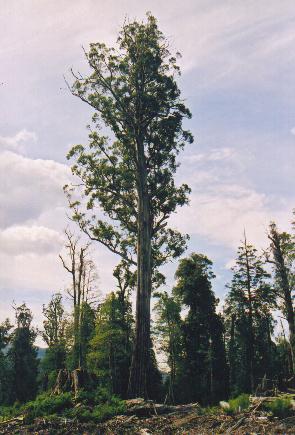
Karri typically grows to a height of 10–60 metres but can reach 90 metres. Adult leaves measure 70–135 mm long and 15–37 mm wide.[5][6]
Mature flower buds measure 11–16 mm long and 5–7 mm wide. Karri seeds measure 1.2–3 mm in length.[7][8]
Habitat
Karri grows in higher-rainfall areas receiving 900–1,300 millimetres of annual rainfall, mostly during winter. It generally dominates deep valleys between granite outcrops near creeks and rivers.[9][10][11]
Karri forests have a dense understorey that retains moisture during hot summers.[12]
Reproduction and life cycle
Karri flower buds occur in groups of seven in leaf axils. Flowering has been recorded in January, April, May, August and December.[13][14]
Karri produces grey, flattened ovoid seeds. It takes four to five years from flower production until seed release.[15][16]
Karri provides pollen for honeybees (Apis mellifera).[17]
Behaviour
Karri tends to flower after fire.[18]
Conservation
Karri forest covers less than 200,000 hectares, approximately one-fifth of its original extent.[19]
Karri is regarded as invasive in South Africa, where it can outcompete native species.[20][21]
Uses
Karri timber is used extensively in construction. Karri wood is used for flooring, furniture, cabinetry and plywood.[22][23]
Karri wood has an air-dried density of approximately 900 kilograms per cubic metre and is durable against rot.[24][25]
Karri honey is valued for its clarity, light colour and delicate flavour.[26]
Similar species
Karri has affinities with Eucalyptus saligna and Eucalyptus grandis.[27]
Classification of the Karri
| Kingdom | Plantae |
|---|---|
| Subkingdom | Pteridobiotina |
| Phylum | Tracheophyta |
| Class | Magnoliopsida |
| Order | Myrtales |
| Family | Myrtaceae (Myrtle Family) |
| Subfamily | Myrtoideae |
| Tribe | Eucalypteae |
| Genus | Eucalyptus (Gum) |
| Species | Eucalyptus diversicolor F.Muell. |
Where the Karri is found
Checklists and occurrence records place Eucalyptus diversicolor in 4 countries across Asia and Oceania. GBIF holds 767 georeferenced records of it.
Countries where it is native or its origin is not stated
Countries where it has been introduced
Regions and cities with the most records
- Western Australia, Australia 623
- Albany, Australia 35
- Perth, Australia 7
- Auckland, New Zealand 6
- Victoria, Australia 6
- Manawatu-Wanganui, New Zealand 5
- Whanganui, New Zealand 5
- Busselton, Australia 4
- Manurewa, New Zealand 4
- Northland, New Zealand 4
- Whangarei, New Zealand 4
- Canterbury, New Zealand 3
- Christchurch, New Zealand 3
7 more countries have a few records outside this range
These countries hold a few records of Eucalyptus diversicolor but lie outside the range the checklists give for it. Such records are often zoo or garden specimens, museum material or vagrants, so the species is not counted as occurring there.
Range as the checklists state it
Taiwan [I]; India [c]; Australia (Western Australia: narrow stretch from near Margaret River to Denmark)
A number beside a place is its count of GBIF occurrence records. A place without a number comes from a checklist alone. Records show where a species has been observed or collected, which can include escapes and vagrants.
Common names
English
- Karri
Names in 7 other languages
- Afrikaans
- karie
- Chinese
- 加利桉
- Esperanto
- Kari-eŭkalipto
- German
- Karribaum
- Hungarian
- Tarkalevelű eukaliptusz
- Japanese
- カリー, カリー(ガム)
- Slovak
- eukalyptus pestrofarebný
Synonyms
One other scientific name has been used for this species and is now treated as a synonym of Eucalyptus diversicolor.
- Eucalyptus colossea F.Muell.
Related species
-
 Rainbow EucalyptusEucalyptus deglupta
-
 Southern Blue GumEucalyptus globulus
-
 Mountain AshEucalyptus regnans
- River Red GumEucalyptus camaldulensis
-
 Argyle AppleEucalyptus cinerea
-
 Snow GumEucalyptus pauciflora
-
 JarrahEucalyptus marginata
-
 Cider GumEucalyptus gunnii
Compare
Questions and answers
What is the scientific name of the Karri?
The scientific name of the Karri is Eucalyptus diversicolor. Written with its author, the full name is Eucalyptus diversicolor F.Muell..
Which family does the Karri belong to?
Eucalyptus diversicolor belongs to the family Myrtaceae, in the order Myrtales and the class Magnoliopsida.
Where is the Karri found?
Checklists and occurrence records place Eucalyptus diversicolor in 4 countries, including Australia, New Zealand and India.
What is the conservation status of the Karri?
The IUCN Red List category recorded for Eucalyptus diversicolor is Least Concern (LC).
What is karri wood?
Karri wood is timber used extensively in construction, flooring, furniture, cabinetry and plywood. It has an air-dried density of approximately 900 kilograms per cubic metre and is durable against rot.[22][23][24][25]
Sources
Passages the profile rests on
- Adult leaves are glossy dark green above, paler underneath and lance-shaped. Source passage: “Adult leaves are arranged alternately, glossy dark green on the upper surface, paler below, lance-shaped” — English Wikipedia
- Young leaves are broadly egg-shaped to almost round and arranged in opposite pairs. Source passage: “The leaves on young plants and on coppice regrowth are arranged in opposite pairs, broadly egg-shaped to almost round” — English Wikipedia
- Karri produces white flowers. Source passage: “the flowers are white.” — English Wikipedia
- Its fruit is a woody, barrel-shaped capsule. Source passage: “The fruit is a woody barrel-shaped capsule 10–12 mm (0.39–0.47 in) long and 8–10 mm (0.31–0.39 in) wide” — English Wikipedia
- Karri typically grows to a height of 10–60 metres but can reach 90 metres. Source passage: “typically grows to a height of 10–60 m (33–197 ft) but can reach as high as 90 m (300 ft)” — English Wikipedia
- Adult leaves measure 70–135 mm long and 15–37 mm wide. Source passage: “lance-shaped, 70–135 mm (2.8–5.3 in) long and 15–37 mm (0.59–1.46 in) wide” — English Wikipedia
- Mature flower buds measure 11–16 mm long and 5–7 mm wide. Source passage: “The buds are oval, 11–16 mm (0.43–0.63 in) long and 5–7 mm (0.20–0.28 in) wide at maturity” — English Wikipedia
- Karri seeds measure 1.2–3 mm in length. Source passage: “are grey in colour with a length of 1.2 to 3 mm (0.047 to 0.118 in).” — English Wikipedia
- Karri grows in higher-rainfall areas. Source passage: “Found in higher rainfall areas” — English Wikipedia
- Karri occurs in regions receiving 900–1,300 millimetres of annual rainfall, mostly during winter. Source passage: “receives 900 to 1,300 millimetres (35.4 to 51.2 in) of rain per year, mostly in winter.” — English Wikipedia
- Karri generally dominates deep valleys between granite outcrops near creeks and rivers. Source passage: “Karri generally dominate in the deep valleys between granite outcrops surrounding the creeks and rivers.” — English Wikipedia
- Karri forests have a dense understorey that retains moisture during hot summers. Source passage: “A dense understorey is found in karri forest areas which retains moisture over the hot summers.” — English Wikipedia
- Karri flower buds occur in groups of seven in leaf axils. Source passage: “The flower buds are arranged in groups of seven in leaf axils” — English Wikipedia
- Flowering has been recorded in January, April, May, August and December. Source passage: “Flowering has been observed in January, April, May, August and December” — English Wikipedia
- Karri produces grey, flattened ovoid seeds. Source passage: “The seeds found within the fruits have a flattened ovoid shape, are grey in colour” — English Wikipedia
- Karri takes four to five years from flower production until seed release. Source passage: “it takes four to five years from the production of flowers to the seeds being released.” — English Wikipedia
- Karri provides pollen for honeybees (Apis mellifera). Source passage: “Karri is a source of pollen for honeybees (Apis mellifera).” — English Wikipedia
- Karri tends to flower after fire. Source passage: “the tree tends to flower after fire to take advantage of the nutrients released by the combustion of forest litter.” — English Wikipedia
- Karri forest covers less than 200,000 hectares, approximately one-fifth of its original extent. Source passage: “The total area covered by karri forest is less than 200,000 hectares (494,211 acres) which is about one fifth of its virgin growth.” — English Wikipedia
- Karri is considered invasive in South Africa, particularly in the Western Cape. Source passage: “The species is considered invasive in South Africa where it is a problem in the Western Cape region” — English Wikipedia
- Karri is regarded as invasive in South Africa, where it can outcompete native species. Source passage: “often out competing local species” — English Wikipedia
- Karri timber is used extensively in construction. Source passage: “Timber from Karri is suitable for construction work.” — English Wikipedia
- Karri wood is used for flooring, furniture, cabinetry and plywood. Source passage: “The wood is also used for flooring, furniture, cabinetry and plywood.” — English Wikipedia
- Karri wood has an air-dried density of approximately 900 kilograms per cubic metre. Source passage: “with an air-dried density of about 900 kilograms per cubic metre (56 lb/cu ft).” — English Wikipedia
- Karri wood is durable against rot. Source passage: “It is durable against rot.” — English Wikipedia
- Karri honey is valued for its clarity, light colour and delicate flavour. Source passage: “Karri honey is widely sought after for its clarity, light color and delicate flavor.” — English Wikipedia
- Karri has affinities with Eucalyptus saligna and Eucalyptus grandis. Source passage: “it has some affinity with tall Eucalypts found the wet forests of eastern Australian including E. saligna and E. grandis” — English Wikipedia
- Karri is a tall forest tree with smooth, grey to cream-coloured or pale orange bark that is often mottled. Source passage: “The bark on the trunk and branches is smooth, grey to cream-coloured or pale orange, often mottled” — English Wikipedia
- Karri is endemic to southwestern Western Australia. Source passage: “is endemic to the south-west of Western Australia.” — English Wikipedia
Data
- Catalogue of Life, 2026-10-16 XR cc by
- Global Biodiversity Information Facility CC BY 4.0
- Wikidata CC0
- GeoNames CC BY 4.0
- Wikimedia Commons per image; credit shown with each image
- Within the Catalogue of Life, this name comes from Synonymic Checklists of the Vascular Plants of the World cc by
References
- F.Muell. (1863). Fragm. [Mueller] 2: 131 (1863). where the name was published
This species in other databases
- Catalogue of Life 3BPVG
- Wikidata Q159127
- iNaturalist 147463
- World Flora Online wfo-0000954826
- GRIN 15895
Page built on 27 November 2026. See how the catalog is made and all sources and licences.
Cite this page
ScientificNames.org. (2026). Eucalyptus diversicolor (Karri). Retrieved November 27, 2026, from https://scientificnames.org/species/eucalyptus-diversicolor
“Eucalyptus diversicolor (Karri).” ScientificNames.org, 2026, scientificnames.org/species/eucalyptus-diversicolor. Accessed 27 Nov. 2026.
ScientificNames.org. “Eucalyptus diversicolor (Karri).” Accessed November 27, 2026. https://scientificnames.org/species/eucalyptus-diversicolor.
@misc{scientificnames_eucalyptus_diversicolor_karri,
  author = {{ScientificNames.org}},
  title = {Eucalyptus diversicolor (Karri)},
  year = {2026},
  url = {https://scientificnames.org/species/eucalyptus-diversicolor},
  note = {Accessed 2026-11-27}
}