Species · Flowering plants
Flooded Gum Eucalyptus grandis
The scientific name of the Flooded Gum is Eucalyptus grandis. It is a species of flowering plant in the family Myrtaceae (myrtle family), order Myrtales.
- Scientific name
- Eucalyptus grandis W.Hill ex Maiden
- Common name
- Flooded Gum
- Genus
- Eucalyptus
- Family
- Myrtaceae (Myrtle Family)
- Order
- Myrtales
- Class
- Magnoliopsida
- Red List category
- NT Near Threatened
- Recorded in
- 30 countries
- Name status
- accepted in the Catalogue of Life

Overview
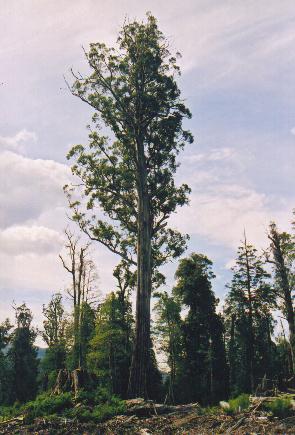
Flooded Gum is a tall flowering tree with smooth grey to grey-brown bark that becomes rough, fibrous or flaky near the base. Its glossy dark green leaves are lanceolate to broadly lanceolate, and its flowers are white.
Written 26 November 2026 from the sources listed below. Each statement was checked against the passage it cites; statements that could not be supported were removed.
Appearance
Flooded Gum has smooth, powdery bark ranging from pale grey or blue-grey to white, with rough brownish bark covering the lowest 1–4 metres of the trunk. The trunk is straight for approximately two-thirds to three-quarters of the tree's total height.[1][2]
The leaves are glossy dark green, lanceolate to broadly lanceolate, and paler underneath. They measure 10–16 centimetres long and 2–3 centimetres wide, are arranged alternately along the branches and have approximately 800 oil glands per square centimetre.[3][4][5][6]
The fruit is conical, pear-shaped or cone-shaped and measures 4–10 millimetres long and 5–8 millimetres wide.[7][8]
Reproduction and life cycle
Flower buds occur in groups of seven, nine or eleven in the leaf axils. Their stalks measure 10–18 millimetres long, and mature buds are oval, pear-shaped or club-shaped, with green, yellow or glaucous colouring.[9][10][11]
Mature flower buds measure 6–9 millimetres long and 4–5 millimetres wide. The species produces white flowers between April and August.[12][13]
Habitat
Flooded Gum mainly grows on flat land and lower slopes. Its natural habitat includes wet forests and rainforest margins.[14][15]
The species grows in deep, fertile alluvial loam soils in areas receiving approximately 1,100–3,500 millimetres of annual rainfall. It occurs in both pure stands and mixed forest communities.[16][17][18]
Uses
The timber has straight grain, moderate durability and strength, and resistance to Lyctus borers.[19]
The species has been successfully cultivated in plantations in wetter parts of Sri Lanka, particularly the Badulla and Nuwara Eliya Districts. It is also extensively planted in South Africa and Brazil.[20][21]
Plantations in Uruguay produce lumber exported to the United States under the trade name Red Grandis.[22]
Diet
Flooded Gum provides food for paropsine beetles in the family Chrysomelidae and Christmas beetles.[23]
Behaviour
Christmas beetles can cause defoliation of Flooded Gum trees along Australia's east coast. The steelblue sawfly and leafblister sawfly preferentially attack young trees.[24][25]
Beekeepers report that bees travel at least 32 kilometres to reach some plantations of the species.[26]
Similar species
Eucalyptus saligna resembles Flooded Gum and overlaps its range in the southern part of its distribution. Eucalyptus saligna has narrower leaves and more bell-shaped fruit with protruding valves.[27][28]
Eucalyptus deanei can be distinguished from Flooded Gum by its entirely smooth bark and wider adult leaves.[29]
Classification of the Flooded Gum
| Kingdom | Plantae |
|---|---|
| Subkingdom | Pteridobiotina |
| Phylum | Tracheophyta |
| Class | Magnoliopsida |
| Order | Myrtales |
| Family | Myrtaceae (Myrtle Family) |
| Subfamily | Myrtoideae |
| Tribe | Eucalypteae |
| Genus | Eucalyptus (Gum) |
| Species | Eucalyptus grandis W.Hill ex Maiden |
Where the Flooded Gum is found
Checklists and occurrence records place Eucalyptus grandis in 30 countries across Africa, Asia, North America, Oceania and South America. GBIF holds 9,485 georeferenced records of it.
Countries where it is native or its origin is not stated
- Australia 6,845
- Democratic Republic of the Congo 32
- Ethiopia 18
- India 7
- Indonesia 6
- Malaysia 4
- Morocco
- Papua New Guinea 4
- Reunion 4
- Rwanda 3
- Tanzania 9
- Zambia 5
Countries where it has been introduced
- Argentina 2
- Bangladesh
- China 13
- Colombia 2,309
- Ecuador 4
- Honduras 1
- Mauritius 1
- Mozambique 4
- Myanmar 1
- New Zealand 25
- Peru
- South Africa 79
- Sri Lanka 6
- Taiwan 1
- Thailand
- United States 102
- Vietnam
- Zimbabwe
Regions and cities with the most records
- Queensland, Australia 3,559
- New South Wales, Australia 3,166
- Antioquia, Colombia 2,254
- Envigado, Colombia 1,767
- Itagüí, Colombia 1,767
- Medellín, Colombia 1,767
- Retiro, Colombia 1,678
- La Estrella, Colombia 1,485
- Bello, Colombia 1,084
- Caldas, Colombia 1,032
- Copacabana, Colombia 988
- Rionegro, Colombia 615
- Coffs Harbour, Australia 504
- La Ceja, Colombia 461
- La Unión, Colombia 315
- Abejorral, Colombia 313
- Fredonia, Colombia 170
- Port Macquarie, Australia 169
- Andes, Colombia 158
- Hornsby, Australia 118
- Parramatta, Australia 114
- Gympie, Australia 112
- Sydney, Australia 96
- Taree, Australia 84
- Sunshine Coast, Australia 66
- Caloundra, Australia 48
- Liverpool, Australia 42
- Newcastle, Australia 37
- Maitland, Australia 36
- Brisbane, Australia 32
- California, United States 30
- Florida, United States 21
- Gold Coast, Australia 21
- KwaZulu-Natal, South Africa 20
- Western Cape, South Africa 17
- Grafton, Australia 16
2 more countries have a few records outside this range
These countries hold a few records of Eucalyptus grandis but lie outside the range the checklists give for it. Such records are often zoo or garden specimens, museum material or vagrants, so the species is not counted as occurring there.
Range as the checklists state it
Morocco [c]; Zimbabwe [I]; Mozambique [I]; South Africa [I]; St. Helena [c]; Mauritius [I]; La Réunion [I]; China [I] (Guangdong [I], Guangxi [I]); Taiwan [I]; India [c]; Sri Lanka [I]; Bangladesh [I]; Myanmar [I]; Thailand [I]; Vietnam [I]; Australia (Queensland: Atherton Tableland, W of Townsville, W of Mackay, New South Wales: Bundaberg S to near Port Stephens); New Zealand [I]; USA [I] (Florida [I]); Honduras [I]; Colombia [I]; Ecuador [I]; Peru [I]; Argentina [I]
A number beside a place is its count of GBIF occurrence records. A place without a number comes from a checklist alone. Records show where a species has been observed or collected, which can include escapes and vagrants.
Common names
English
- Flooded Gum
- Blue Gum
- Rose Gum
- Saligna Gum
- Scrub Gum
Names in 7 other languages
- Afrikaans
- salignabloekom
- Chinese
- da an, 大桉, 巨桉, 玫瑰桉
- Japanese
- ローズガム
- Polish
- eukaliptus wielki
- Portuguese
- Eucalipto-grande
- Spanish
- eucalipto rosado
- Zulu
- Umdlavuza
Synonyms
One other scientific name has been used for this species and is now treated as a synonym of Eucalyptus grandis.
- Eucalyptus saligna var. pallidivalvis R.T.Baker & H.G.Sm.
Related species
-
 Rainbow EucalyptusEucalyptus deglupta
-
 Southern Blue GumEucalyptus globulus
-
 Mountain AshEucalyptus regnans
- River Red GumEucalyptus camaldulensis
-
 Argyle AppleEucalyptus cinerea
-
 Snow GumEucalyptus pauciflora
-
 JarrahEucalyptus marginata
-
 Cider GumEucalyptus gunnii
Compare
Questions and answers
What is the scientific name of the Flooded Gum?
The scientific name of the Flooded Gum is Eucalyptus grandis. Written with its author, the full name is Eucalyptus grandis W.Hill ex Maiden.
Which family does the Flooded Gum belong to?
Eucalyptus grandis belongs to the family Myrtaceae, in the order Myrtales and the class Magnoliopsida.
Where is the Flooded Gum found?
Checklists and occurrence records place Eucalyptus grandis in 30 countries, including Australia, Democratic Republic of the Congo, Ethiopia, Tanzania, India and Indonesia.
What is the conservation status of the Flooded Gum?
The IUCN Red List category recorded for Eucalyptus grandis is Near Threatened (NT).
What other names does the Flooded Gum have?
Eucalyptus grandis is also known in English as Blue Gum, Rose Gum, Saligna Gum and Scrub Gum.
What does a flooded gum look like?
Flooded Gum is a tall tree with smooth, powdery bark ranging from pale grey or blue-grey to white, and rough brownish bark at the base. Its glossy dark green leaves are lanceolate to broadly lanceolate and paler underneath. It produces white flowers and conical, pear-shaped or cone-shaped fruit.[30][2][3][13][7]
Is red grandis the same as Eucalyptus?
Red Grandis is the trade name under which lumber produced by Flooded Gum plantations in Uruguay is exported to the United States.[22]
What habitat do Eucalyptus grow in?
Flooded Gum mainly grows on flat land and lower slopes in wet forests and rainforest margins. It grows in deep, fertile alluvial loam soils in areas receiving approximately 1,100–3,500 millimetres of annual rainfall, in both pure stands and mixed forest communities.[14][15][16][17][18]
Sources
Passages the profile rests on
- The trunk is straight for approximately two-thirds to three-quarters of the tree's total height. Source passage: “The bole is straight for 2/3 to 3/4 the height of the tree.” — English Wikipedia
- The bark is smooth and powdery, ranging from pale grey or blue-grey to white, with rough brownish bark covering the lowest 1–4 metres of the trunk. Source passage: “The bark is smooth and powdery, pale- or blue-grey to white in colour, with a skirt of rough brownish bark for the bottom 1–4 m” — English Wikipedia
- The leaves are glossy dark green, lanceolate to broadly lanceolate, and paler underneath. Source passage: “The glossy dark green leaves are stalked, lanceolate to broad lanceolate, and paler on their undersides” — English Wikipedia
- The leaves measure 10–16 centimetres long and 2–3 centimetres wide. Source passage: “10 to 16 cm (3.9 to 6.3 in) long and 2–3 cm (0.79–1.18 in) wide.” — English Wikipedia
- The leaves are arranged alternately along the branches. Source passage: “They are arranged alternately along the branches.” — English Wikipedia
- The leaf blades have approximately 800 oil glands per square centimetre. Source passage: “the leaf is dotted with around 800 oil glands per square centimetre.” — English Wikipedia
- The fruit is conical, pear-shaped or cone-shaped. Source passage: “conical, pear- or cone-shaped fruit” — English Wikipedia
- The fruit measures 4–10 millimetres long and 5–8 millimetres wide. Source passage: “4–10 mm (0.16–0.39 in) long and 5–8 mm (0.20–0.31 in) wide” — English Wikipedia
- Flower buds occur in groups of seven, nine or eleven in the leaf axils. Source passage: “The flower buds are arranged in leaf axils in groups of seven, nine or eleven” — English Wikipedia
- The flower-bud stalks measure 10–18 millimetres long. Source passage: “on an unbranched peduncle 10–18 mm (0.39–0.71 in) long” — English Wikipedia
- Mature flower buds are oval, pear-shaped or club-shaped and may be green, yellow or glaucous. Source passage: “Mature buds are oval, pear-shaped or club-shaped, green to yellow or glaucous” — English Wikipedia
- Mature flower buds measure 6–9 millimetres long and 4–5 millimetres wide. Source passage: “6–9 mm (0.24–0.35 in) long and 4–5 mm (0.16–0.20 in) wide.” — English Wikipedia
- The species produces white flowers between April and August. Source passage: “The white flowers appear from mid autumn to late winter from April to August.” — English Wikipedia
- The species mainly grows on flat land and lower slopes. Source passage: “mainly on flat land and lower slopes.” — English Wikipedia
- Its natural habitat includes wet forests and rainforest margins. Source passage: “It is the dominant tree of wet forest and rain forest margins” — English Wikipedia
- The species grows in deep, fertile alluvial loam soils. Source passage: “The soils are deep fertile alluvial loams.” — English Wikipedia
- The species occurs in areas receiving approximately 1,100–3,500 millimetres of annual rainfall. Source passage: “The annual rainfall varies from 1100 to 3500 mm.” — English Wikipedia
- The species grows in both pure stands and mixed forest communities. Source passage: “either growing in pure stands or mixed with trees such as blackbutt” — English Wikipedia
- The timber has straight grain, moderate durability and strength, and resistance to Lyctus borers. Source passage: “It has a straight grain, moderate durability and strength, and is resistant to Lyctus borers.” — English Wikipedia
- The species has been successfully cultivated in plantations in wetter parts of Sri Lanka, particularly the Badulla and Nuwara Eliya Districts. Source passage: “grown successfully in plantations in wetter areas of Sri Lanka, particularly in the Badulla and Nuwara Eliya Districts.” — English Wikipedia
- The species is also extensively planted in South Africa and Brazil. Source passage: “Extensive plantations also exist in South Africa and Brazil.” — English Wikipedia
- Plantations in Uruguay produce lumber exported to the United States under the trade name Red Grandis. Source passage: “Plantations have also been successful in Uruguay where lumber is being exported to the United States under the trade name "Red Grandis".” — English Wikipedia
- Eucalyptus grandis provides food for paropsine beetles in the family Chrysomelidae and Christmas beetles. Source passage: “Eucalyptus grandis is a food plant of paropsine beetles of the family Chrysomelidae and Christmas beetles” — English Wikipedia
- Christmas beetles can cause defoliation of Eucalyptus grandis trees along Australia's east coast. Source passage: “the latter often defoliating trees of Australia's east coast.” — English Wikipedia
- The steelblue sawfly and leafblister sawfly preferentially attack young trees. Source passage: “both of which prefer young trees.” — English Wikipedia
- Beekeepers report that bees travel at least 32 kilometres to reach some plantations of the species. Source passage: “beekeepers assert that bees travel at least 32 km (20 miles) to some plantations.” — English Wikipedia
- Eucalyptus saligna resembles Eucalyptus grandis and overlaps its range in the southern part of its distribution. Source passage: “The Sydney blue gum (E. saligna) is very similar in appearance and overlaps E. grandis in the southern part of its range” — English Wikipedia
- Eucalyptus saligna differs from Eucalyptus grandis by having narrower leaves and more bell-shaped fruit with protruding valves. Source passage: “but has narrower leaves and more bell-shaped gumnuts with protruding valves.” — English Wikipedia
- Eucalyptus deanei can be distinguished from Eucalyptus grandis by its entirely smooth bark and wider adult leaves. Source passage: “The mountain blue gum (E. deanei) can be distinguished by its entirely smooth bark and wider adult leaves.” — English Wikipedia
- Eucalyptus grandis is a tall tree with smooth grey to grey-brown bark that becomes rough, fibrous or flaky near the base. Source passage: “a tall tree with smooth bark, rough at the base fibrous or flaky, grey to grey-brown.” — English Wikipedia
Data
- Catalogue of Life, 2026-10-16 XR cc by
- Global Biodiversity Information Facility CC BY 4.0
- Wikidata CC0
- GeoNames CC BY 4.0
- Wikimedia Commons per image; credit shown with each image
- Within the Catalogue of Life, this name comes from Synonymic Checklists of the Vascular Plants of the World cc by
References
- Hill ex Maiden, W. (1903). Forest Fl. N.S.W. 1: 79 (1903), et J. Proc. Roy. Soc. New S. Wales 52(Art. 17): 501 (1919). where the name was published
This species in other databases
- Catalogue of Life 3BPZH
- Wikidata Q482510
- iNaturalist 135371
- World Flora Online wfo-0001086255
- GRIN 15924
Page built on 29 November 2026. See how the catalog is made and all sources and licences.
Cite this page
ScientificNames.org. (2026). Eucalyptus grandis (Flooded Gum). Retrieved November 29, 2026, from https://scientificnames.org/species/eucalyptus-grandis
“Eucalyptus grandis (Flooded Gum).” ScientificNames.org, 2026, scientificnames.org/species/eucalyptus-grandis. Accessed 29 Nov. 2026.
ScientificNames.org. “Eucalyptus grandis (Flooded Gum).” Accessed November 29, 2026. https://scientificnames.org/species/eucalyptus-grandis.
@misc{scientificnames_eucalyptus_grandis_flooded_gum,
  author = {{ScientificNames.org}},
  title = {Eucalyptus grandis (Flooded Gum)},
  year = {2026},
  url = {https://scientificnames.org/species/eucalyptus-grandis},
  note = {Accessed 2026-11-29}
}