Species · Flowering plants
Yellow Tingle Eucalyptus guilfoylei
The scientific name of the Yellow Tingle is Eucalyptus guilfoylei. It is a species of flowering plant in the family Myrtaceae (myrtle family), order Myrtales.
- Scientific name
- Eucalyptus guilfoylei Maiden
- Common name
- Yellow Tingle
- Genus
- Eucalyptus
- Family
- Myrtaceae (Myrtle Family)
- Order
- Myrtales
- Class
- Magnoliopsida
- Red List category
- LC Least Concern
- Recorded in
- 2 countries
- Name status
- accepted in the Catalogue of Life

Overview
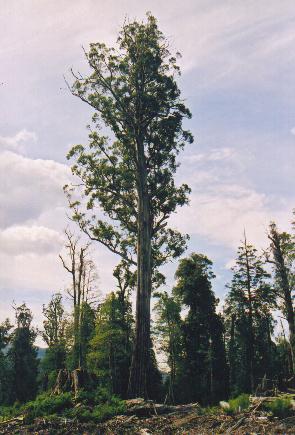
Eucalyptus guilfoylei occurs between the Deep and Frankland Rivers west of Albany, growing on slopes and ridges in coastal areas of the Great Southern region. It is distinguished from closely related tingle trees by its persistent bark and lack of a buttressed trunk.
Written 27 November 2026 from the sources listed below. Each statement was checked against the passage it cites; statements that could not be supported were removed.
Habitat
Yellow Tingle grows on slopes and ridges in coastal areas of the Great Southern region, in gravelly loam soils. It occurs as scattered trees in forested areas alongside other large trees.[1][2][3]
Associated tree species include Eucalyptus diversicolor, Corymbia calophylla and Eucalyptus jacksonii. It has also been reported growing with river banksia and Agonis flexuosa.[4][5]
The species grows best in deep red loamy soils derived from basalt and dolerite. It can also grow in light loams derived from granite and schists.[6][7]
Reproduction and life cycle
Flower buds occur in groups of seven on branching peduncles. The peduncles measure 8–23 mm long and the pedicels measure 1–4 mm long.[8][9][10]
Mature flower buds are cylindrical or narrowly egg-shaped, with the narrower end towards the base. They measure 7–8 mm long and 4–6 mm wide.[11][12]
The flowers are white or cream. Flowering occurs between November and January.[13][14][15]
The fruit are woody capsules that may be globular, pear-shaped or barrel-shaped. They measure 7–10 mm long and 8–10 mm wide and contain flattened, saucer-shaped, red-brown seeds.[16][17][18]
Uses
The heartwood is hard and straight-grained, with an oak-like yellow colour. The green wood has a density of approximately 1185 kg/m³, while the air-dried wood has a density of approximately 990 kg/m³.[19][20][21]
Similar species
Yellow Tingle is closely related to Eucalyptus brevistylis and Eucalyptus jacksonii. Unlike the other closely related tingle trees, it does not have a buttressed trunk.[22][23]
Appearance
The tree typically grows between 5 and 40 metres tall, and its trunk reaches approximately 1 metre in diameter. Tingle trees, including this species, can reach 400 years of age.[24][25][26]
Young plants have stems that are approximately square in cross-section. Their leaves are egg-shaped, dark green above and paler underneath, measuring 80–130 mm long and 55–70 mm wide.[27][28][29]
Adult leaves are lance-shaped, dull green above and paler on their lower surfaces. They measure 80–150 mm long and 15–40 mm wide, with petioles measuring 15–30 mm long.[30][31][32]
Classification of the Yellow Tingle
| Kingdom | Plantae |
|---|---|
| Subkingdom | Pteridobiotina |
| Phylum | Tracheophyta |
| Class | Magnoliopsida |
| Order | Myrtales |
| Family | Myrtaceae (Myrtle Family) |
| Subfamily | Myrtoideae |
| Tribe | Eucalypteae |
| Genus | Eucalyptus (Gum) |
| Species | Eucalyptus guilfoylei Maiden |
Where the Yellow Tingle is found
Checklists and occurrence records place Eucalyptus guilfoylei in 2 countries across Oceania. GBIF holds 199 georeferenced records of it.
Countries
Regions and cities with the most records
Range as the checklists state it
Australia (Western Australia: near Nornalup Inlet, Deep R. and Frankland R.)
A number beside a place is its count of GBIF occurrence records. A place without a number comes from a checklist alone. Records show where a species has been observed or collected, which can include escapes and vagrants.
Common names
English
- Yellow Tingle
Names in 1 other language
- Chinese
- 黄材桉
Related species
-
 Rainbow EucalyptusEucalyptus deglupta
-
 Southern Blue GumEucalyptus globulus
-
 Mountain AshEucalyptus regnans
- River Red GumEucalyptus camaldulensis
-
 Argyle AppleEucalyptus cinerea
-
 Snow GumEucalyptus pauciflora
-
 JarrahEucalyptus marginata
-
 Cider GumEucalyptus gunnii
Compare
Questions and answers
What is the scientific name of the Yellow Tingle?
The scientific name of the Yellow Tingle is Eucalyptus guilfoylei. Written with its author, the full name is Eucalyptus guilfoylei Maiden.
Which family does the Yellow Tingle belong to?
Eucalyptus guilfoylei belongs to the family Myrtaceae, in the order Myrtales and the class Magnoliopsida.
Where is the Yellow Tingle found?
Checklists and occurrence records place Eucalyptus guilfoylei in 2 countries: Australia and New Zealand.
What is the conservation status of the Yellow Tingle?
The IUCN Red List category recorded for Eucalyptus guilfoylei is Least Concern (LC).
What are some interesting facts about eucalyptus trees?
Yellow Tingle can reach 40 metres in height, and its trunk can reach approximately 1 metre in diameter. Tingle trees, including this species, can reach 400 years of age. Its heartwood is hard and straight-grained, with an oak-like yellow colour.[24][25][26][19]
How many years does an Eucalyptus tree live?
Tingle trees, including Yellow Tingle, can reach 400 years of age.[26]
Sources
Passages the profile rests on
- The species grows on slopes and ridges in coastal areas of the Great Southern region. Source passage: “Found on slopes and ridges in coastal areas of the Great Southern region” — English Wikipedia
- The species grows in gravelly loam soils. Source passage: “where it grows in gravelly loam soils.” — English Wikipedia
- The species occurs as scattered trees in forested areas alongside other large trees. Source passage: “It occurs as scattered trees in forested areas associated with other large trees” — English Wikipedia
- Associated tree species include Eucalyptus diversicolor, Corymbia calophylla and Eucalyptus jacksonii. Source passage: “such as Eucalyptus diversicolor, Corymbia calophylla or Eucalyptus jacksonii.” — English Wikipedia
- The species has been reported growing with river banksia and Agonis flexuosa. Source passage: “Other associated trees include river banksia and Agonis flexuosa.” — English Wikipedia
- The species grows best in deep red loamy soils derived from basalt and dolerite. Source passage: “grows best in deep red loamy soils originating from basalt and dolerite” — English Wikipedia
- The species can also grow in light loams derived from granite and schists. Source passage: “but will grow in light loams from granite and schists.” — English Wikipedia
- Flower buds occur in groups of seven on branching peduncles. Source passage: “The flower buds are arranged in groups of seven on branching peduncles” — English Wikipedia
- Flower bud peduncles measure 8–23 mm long. Source passage: “The peduncles are 8–23 mm (0.31–0.91 in) long” — English Wikipedia
- Flower bud pedicels measure 1–4 mm long. Source passage: “and the pedicels 1–4 mm (0.039–0.157 in) long.” — English Wikipedia
- Mature flower buds are cylindrical or narrowly egg-shaped, with the narrower end towards the base. Source passage: “Mature buds are cylindrical or narrow egg-shaped, with the narrower end towards the base” — English Wikipedia
- Mature flower buds measure 7–8 mm long and 4–6 mm wide. Source passage: “7–8 mm (0.28–0.31 in) long and 4–6 mm (0.16–0.24 in) wide.” — English Wikipedia
- The flowers are white. Source passage: “the flowers are white.” — English Wikipedia
- Flowering occurs between November and January. Source passage: “Flowering occurs between November and January” — English Wikipedia
- The flowers are recorded as white or cream and appear from November through December or January. Source passage: “Fl. white/cream, Nov to Dec or Jan.” — florabase.dbca.wa.gov.au
- The fruit are woody capsules that may be globular, pear-shaped or barrel-shaped. Source passage: “The fruit are woody, globular, pear-shaped or barrel-shaped capsules” — English Wikipedia
- The fruit capsules measure 7–10 mm long and 8–10 mm wide. Source passage: “7–10 mm (0.28–0.39 in) long and 8–10 mm (0.31–0.39 in) wide” — English Wikipedia
- The fruit capsules contain flattened, saucer-shaped, red-brown seeds. Source passage: “They contain flattened saucer shaped red-brown seeds.” — English Wikipedia
- The heartwood is hard and straight-grained, with an oak-like yellow colour. Source passage: “The heartwood is hard and straight-grained with an oak-like yellow colour.” — English Wikipedia
- The green wood has a density of approximately 1185 kg/m³. Source passage: “The wood has a green density of about 1185 kg/m3” — English Wikipedia
- The air-dried wood has a density of approximately 990 kg/m³. Source passage: “and an air-dried density about 990 kg/m3.” — English Wikipedia
- Eucalyptus guilfoylei is closely related to Eucalyptus brevistylis and Eucalyptus jacksonii. Source passage: “Although closely related to the other tingle trees, E. brevistylis and E. jacksonii” — English Wikipedia
- Unlike the other closely related tingle trees, Eucalyptus guilfoylei does not have a buttressed trunk. Source passage: “the trunk of E. guilfoylei is not buttressed” — English Wikipedia
- The tree typically grows between 5 and 40 metres tall. Source passage: “typically grows to a height of 5 to 40 metres (16 to 131 ft).” — English Wikipedia
- The trunk reaches approximately 1 metre in diameter. Source passage: “a trunk diameter of about 1 m (3 ft 3 in).” — English Wikipedia
- The tingle trees, including this species, can reach 400 years of age. Source passage: “All the tingles are able to reach 400 years of age.” — English Wikipedia
- Young plants have stems that are approximately square in cross-section. Source passage: “Young plants and coppice regrowth have stems that are more or less square in cross-section” — English Wikipedia
- Young leaves are egg-shaped, dark green above and paler underneath. Source passage: “leaves that are egg-shaped, dark green above and paler on the lower surface” — English Wikipedia
- Young leaves measure 80–130 mm long and 55–70 mm wide. Source passage: “80–130 mm (3.1–5.1 in) long and 55–70 mm (2.2–2.8 in) wide.” — English Wikipedia
- Adult leaves are lance-shaped, dull green above and paler on their lower surfaces. Source passage: “Adult leaves are lance-shaped, dull green on the upper surface, paler below” — English Wikipedia
- Adult leaves measure 80–150 mm long and 15–40 mm wide. Source passage: “80–150 mm (3.1–5.9 in) long and 15–40 mm (0.59–1.57 in) wide” — English Wikipedia
- Adult leaf petioles measure 15–30 mm long. Source passage: “on a petiole 15–30 mm (0.59–1.18 in) long.” — English Wikipedia
Data
- Catalogue of Life, 2026-10-16 XR cc by
- Global Biodiversity Information Facility CC BY 4.0
- Wikidata CC0
- GeoNames CC BY 4.0
- Wikimedia Commons per image; credit shown with each image
- Within the Catalogue of Life, this name comes from Synonymic Checklists of the Vascular Plants of the World cc by
References
- Maiden. (1911). J. Nat. Hist. Sci. Soc. Western Australia 3: 180 (1911). where the name was published
This species in other databases
Page built on 27 November 2026. See how the catalog is made and all sources and licences.
Cite this page
ScientificNames.org. (2026). Eucalyptus guilfoylei (Yellow Tingle). Retrieved November 27, 2026, from https://scientificnames.org/species/eucalyptus-guilfoylei
“Eucalyptus guilfoylei (Yellow Tingle).” ScientificNames.org, 2026, scientificnames.org/species/eucalyptus-guilfoylei. Accessed 27 Nov. 2026.
ScientificNames.org. “Eucalyptus guilfoylei (Yellow Tingle).” Accessed November 27, 2026. https://scientificnames.org/species/eucalyptus-guilfoylei.
@misc{scientificnames_eucalyptus_guilfoylei_yellow_tingle,
  author = {{ScientificNames.org}},
  title = {Eucalyptus guilfoylei (Yellow Tingle)},
  year = {2026},
  url = {https://scientificnames.org/species/eucalyptus-guilfoylei},
  note = {Accessed 2026-11-27}
}