Species · Flowering plants
Spinning Gum Eucalyptus perriniana
The scientific name of the Spinning Gum is Eucalyptus perriniana. It is a species of flowering plant in the family Myrtaceae (myrtle family), order Myrtales.
- Scientific name
- Eucalyptus perriniana F.Muell. ex Rodway
- Common name
- Spinning Gum
- Genus
- Eucalyptus
- Family
- Myrtaceae (Myrtle Family)
- Order
- Myrtales
- Class
- Magnoliopsida
- Red List category
- LC Least Concern
- Recorded in
- 4 countries
- Name status
- accepted in the Catalogue of Life

Overview
Eucalyptus perriniana grows in woodland on high, cold plains in areas that are normally snow-covered for several months during winter. Its detached juvenile leaves persist and spin in the wind.
Written 26 November 2026 from the sources listed below. Each statement was checked against the passage it cites; statements that could not be supported were removed.
Appearance
The bark is smooth and copper-coloured, often becoming white, grey or greenish as it ages. It is shed annually in short ribbons.[1][2]
Adult leaves are lance-shaped and greyish-green, measuring 80–120 mm in length and 12–25 mm in width. Juvenile leaves are arranged in opposite pairs, are approximately round and lack a peduncle.[3][4][5]
The flowers are arranged in groups of three, with cone-shaped or hemispherical caps.[6][7]
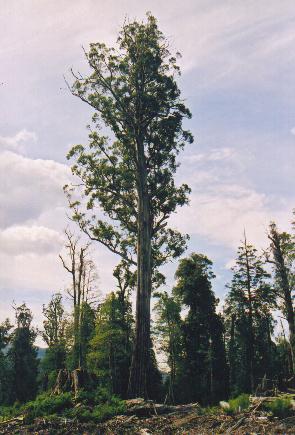
The tree form can reach a height of 20 metres.[8]
Reproduction and life cycle
The flower buds measure 5–7 mm in length and 3–4 mm in diameter. The fruit measures 5–7 mm in both length and diameter.[9][10]
Habitat
The spinning gum grows in woodland on high, cold plains. It is sub-alpine and occurs in areas that are normally snow-covered for several months during winter.[11][12]
The species is native to New South Wales, the Australian Capital Territory, Victoria and Tasmania.[13]
Conservation
Eucalyptus perriniana is listed as rare under Tasmania's Threatened Species Protection Act 1995. Approximately one thousand individual plants are known from Tasmania.[14][15]
Uses
Cultured cells of Eucalyptus perriniana can produce catechin-7-O-glucoside and catechin-5-O-glucoside through biotransformation of (+)-catechin.[16]
Classification of the Spinning Gum
| Kingdom | Plantae |
|---|---|
| Subkingdom | Pteridobiotina |
| Phylum | Tracheophyta |
| Class | Magnoliopsida |
| Order | Myrtales |
| Family | Myrtaceae (Myrtle Family) |
| Subfamily | Myrtoideae |
| Tribe | Eucalypteae |
| Genus | Eucalyptus (Gum) |
| Species | Eucalyptus perriniana F.Muell. ex Rodway |
Where the Spinning Gum is found
Checklists and occurrence records place Eucalyptus perriniana in 4 countries across Asia and Oceania. GBIF holds 782 georeferenced records of it.
Countries where it is native or its origin is not stated
Countries where it has been introduced
Regions and cities with the most records
- Victoria, Australia 235
- Tasmania, Australia 227
- New South Wales, Australia 216
- Australian Capital Territory, Australia 58
- Melbourne, Australia 8
- Canterbury, New Zealand 7
- Wodonga, Australia 6
- Christchurch, New Zealand 5
- Orange, Australia 5
- Manawatu-Wanganui, New Zealand 4
- Whanganui, New Zealand 4
- Armidale, Australia 3
- Ballarat, Australia 3
3 more countries have a few records outside this range
These countries hold a few records of Eucalyptus perriniana but lie outside the range the checklists give for it. Such records are often zoo or garden specimens, museum material or vagrants, so the species is not counted as occurring there.
A number beside a place is its count of GBIF occurrence records. A place without a number comes from a checklist alone. Records show where a species has been observed or collected, which can include escapes and vagrants.
Common names
English
- Spinning Gum
- Dargo Gum
- Round-leaf Snow Gum
Names in 1 other language
- Chinese
- 珀琳桉
Subspecies and varieties
- Eucalyptus perriniana subsp. familiaris (Alpine Spinning Gum) subspecies
- Eucalyptus perriniana subsp. perriniana (Tasmanian Spinning Gum) subspecies
Related species
-
 Rainbow EucalyptusEucalyptus deglupta
-
 Southern Blue GumEucalyptus globulus
-
 Mountain AshEucalyptus regnans
- River Red GumEucalyptus camaldulensis
-
 Argyle AppleEucalyptus cinerea
-
 Snow GumEucalyptus pauciflora
-
 JarrahEucalyptus marginata
-
 Cider GumEucalyptus gunnii
Compare
Questions and answers
What is the scientific name of the Spinning Gum?
The scientific name of the Spinning Gum is Eucalyptus perriniana. Written with its author, the full name is Eucalyptus perriniana F.Muell. ex Rodway.
Which family does the Spinning Gum belong to?
Eucalyptus perriniana belongs to the family Myrtaceae, in the order Myrtales and the class Magnoliopsida.
Where is the Spinning Gum found?
Checklists and occurrence records place Eucalyptus perriniana in 4 countries, including Australia and New Zealand.
What is the conservation status of the Spinning Gum?
The IUCN Red List category recorded for Eucalyptus perriniana is Least Concern (LC).
What other names does the Spinning Gum have?
Eucalyptus perriniana is also known in English as Dargo Gum and Round-leaf Snow Gum.
What habitat do eucalyptus grow in?
The spinning gum grows in woodland on high, cold plains. It is sub-alpine and occurs in areas that are normally snow-covered for several months during winter.[11][12]
Does eucalyptus bear fruit?
The spinning gum produces fruit measuring 5–7 mm in both length and diameter.[10]
Sources
Passages the profile rests on
- The bark is smooth and copper-coloured, often becoming white, grey or greenish as it ages. Source passage: “smooth, copper-coloured bark which often turns white, grey or greenish as it ages” — English Wikipedia
- The bark is shed annually in short ribbons. Source passage: “before being shed in short ribbons each year.” — English Wikipedia
- Adult leaves are lance-shaped and greyish-green. Source passage: “Its adult leaves are lance-shaped, greyish-green” — English Wikipedia
- Juvenile leaves are arranged in opposite pairs, are approximately round and lack a peduncle. Source passage: “The juvenile leaves are arranged in opposite pairs, more or less round and lack a peduncle.” — English Wikipedia
- Adult leaves measure 80–120 mm in length and 12–25 mm in width. Source passage: “80–120 mm (3–5 in) long and 12–25 mm (0.5–1 in) wide.” — English Wikipedia
- The flowers are arranged in groups of three. Source passage: “The flowers are arranged in groups of three” — English Wikipedia
- The flower caps are cone-shaped or hemispherical. Source passage: “The flower caps are cone-shaped or hemispherical” — English Wikipedia
- The tree form can reach a height of 20 metres. Source passage: “sometimes grows to a height of 20 m (70 ft)” — English Wikipedia
- Flower buds measure 5–7 mm in length and 3–4 mm in diameter. Source passage: “flower buds are 5–7 mm (0.2–0.3 in) long and 3–4 mm (0.1–0.2 in) in diameter.” — English Wikipedia
- The fruit measures 5–7 mm in both length and diameter. Source passage: “the fruit is 5–7 mm (0.2–0.3 in) long and 5–7 mm (0.2–0.3 in) in diameter.” — English Wikipedia
- The species grows in woodland on high, cold plains. Source passage: “Spinning gum grows in woodland on high, cold plains” — English Wikipedia
- The species is sub-alpine and grows in areas that are normally snow-covered for several months during winter. Source passage: “Spinning gum is a sub-alpine species and grows in areas which are normally snow covered for several months in winter.” — English Wikipedia
- The species is native to New South Wales, the Australian Capital Territory, Victoria and Tasmania. Source passage: “which is native to New South Wales, the Australian Capital Territory, Victoria and Tasmania.” — English Wikipedia
- Eucalyptus perriniana is listed as rare under Tasmania's Threatened Species Protection Act 1995. Source passage: “listed as "rare" under the Tasmanian Government Threatened Species Protection Act 1995.” — English Wikipedia
- Approximately one thousand individual plants are known from Tasmania. Source passage: “Only about one thousand individual plants are known from that state.” — English Wikipedia
- Cultured cells of Eucalyptus perriniana can produce catechin-7-O-glucoside and catechin-5-O-glucoside through biotransformation of (+)-catechin. Source passage: “Catechin-7-O-glucoside and catechin-5-O-glucoside can be produced by biotransformation of (+)-catechin by cultured cells of E. perriniana.” — English Wikipedia
Data
- Catalogue of Life, 2026-10-16 XR cc by
- Global Biodiversity Information Facility CC BY 4.0
- Wikidata CC0
- GeoNames CC BY 4.0
- Wikimedia Commons per image; credit shown with each image
- Within the Catalogue of Life, this name comes from Synonymic Checklists of the Vascular Plants of the World cc by
References
- F.Muell. ex Rodway. where the name was published
This species in other databases
Page built on 30 November 2026. See how the catalog is made and all sources and licences.
Cite this page
ScientificNames.org. (2026). Eucalyptus perriniana (Spinning Gum). Retrieved November 30, 2026, from https://scientificnames.org/species/eucalyptus-perriniana
“Eucalyptus perriniana (Spinning Gum).” ScientificNames.org, 2026, scientificnames.org/species/eucalyptus-perriniana. Accessed 30 Nov. 2026.
ScientificNames.org. “Eucalyptus perriniana (Spinning Gum).” Accessed November 30, 2026. https://scientificnames.org/species/eucalyptus-perriniana.
@misc{scientificnames_eucalyptus_perriniana_spinning_gum,
  author = {{ScientificNames.org}},
  title = {Eucalyptus perriniana (Spinning Gum)},
  year = {2026},
  url = {https://scientificnames.org/species/eucalyptus-perriniana},
  note = {Accessed 2026-11-30}
}