Species · Flowering plants
Wandoo Eucalyptus wandoo
The scientific name of the Wandoo is Eucalyptus wandoo. It is a species of flowering plant in the family Myrtaceae (myrtle family), order Myrtales.
- Scientific name
- Eucalyptus wandoo Blakely
- Common name
- Wandoo
- Genus
- Eucalyptus
- Family
- Myrtaceae (Myrtle Family)
- Order
- Myrtales
- Class
- Magnoliopsida
- Red List category
- VU Vulnerable
- Recorded in
- 1 country
- Name status
- accepted in the Catalogue of Life

Overview
Eucalyptus wandoo is endemic to southwestern Western Australia, where it occurs in valleys, plateaux and ridges. It is distinguished by smooth white bark, white or cream-coloured flowers and conical to cylindrical fruit.
Written 26 November 2026 from the sources listed below. Each statement was checked against the passage it cites; statements that could not be supported were removed.
Appearance
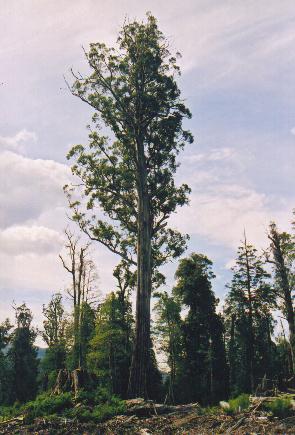
The tree typically reaches 3–25 metres in height, with occasional individuals reaching 30–31 metres. The trunk diameter at breast height is typically 80–100 centimetres.[1][2]
Adult leaves measure 75–125 millimetres long and 10–28 millimetres wide. Flower buds measure 8–14 millimetres long and 2–4 millimetres wide, while woody fruit capsules are approximately 6–10 millimetres long and 5–6 millimetres wide.[3][4][5]
Habitat
wandoo grows in sandy loams, clay loams, dark brown loamy soils and stony soils containing materials such as laterite, granite or gravel. It can tolerate slightly saline soils with salinity levels of 50–100 mS/m.[6][7]
The species commonly occurs at elevations of 100–300 metres in valleys, plateaux and ridges. It commonly forms the overstorey of open woodland mixed with jarrah and marri trees.[8][9]
wandoo is often found in medium-rainfall jarrah forests but is generally absent from high-rainfall areas.[10]
Behaviour
Ground-level hollow logs of wandoo trees provide habitat for echidnas in the Wheatbelt region.[11]
Reproduction and life cycle
wandoo produces white or cream-coloured flowers. Flowering occurs from March to June in populations north of the Avon Valley.[12][13]
Populations south of Wandering include spring-flowering trees that bloom from September to January. Summer-flowering trees south of Wandering bloom from January to February.[14][15]
The flowers require animal pollination to produce woody fruit capsules. Birds and insects both pollinate wandoo, which has a mixed mating system.[16][17]
The seeds generally disperse over limited distances within the ecosystem. They are sub-spherical to cuboid and have smooth straw-coloured to mid-brown surfaces.[18][19]
Diet
Carnaby's black cockatoos consume the flowers and seeds of wandoo.[20]
Conservation
The remaining distribution is fragmented and largely concentrated in conservation reserves, state forests, roadside verges and paddock trees. Both recognised subspecies are classified as not threatened by the Western Australian Department of Parks and Wildlife.[21][22]
wandoo is resistant to the fungus Phytophthora cinnamomi, which causes dieback.[23]
Uses
The juicy, sweet outer portions of wandoo roots were traditionally scraped off and eaten. Soaking its flowers in water produces a sweet drink.[24][25]
wandoo timber has an air-dry density of approximately 1,100 kilograms per cubic metre. It is used for railway sleepers, poles, flooring joists, beams and girders.[26][27]
Similar species
Eucalyptus capillosa and Eucalyptus nigrifunda are the species most closely related to Eucalyptus wandoo. Eucalyptus accedens can be confused with wandoo because both species often grow in the same soil types.[28][29]
Eucalyptus accedens often has orange-tinged bark, whereas wandoo is usually the larger tree.[30]
Classification of the Wandoo
| Kingdom | Plantae |
|---|---|
| Subkingdom | Pteridobiotina |
| Phylum | Tracheophyta |
| Class | Magnoliopsida |
| Order | Myrtales |
| Family | Myrtaceae (Myrtle Family) |
| Subfamily | Myrtoideae |
| Tribe | Eucalypteae |
| Genus | Eucalyptus (Gum) |
| Species | Eucalyptus wandoo Blakely |
Where the Wandoo is found
Checklists and occurrence records place Eucalyptus wandoo in 1 country across Oceania. GBIF holds 1,249 georeferenced records of it.
Countries
Regions and cities with the most records
- Western Australia, Australia 1,175
- Perth, Australia 64
- Bunbury, Australia 9
- Albany, Australia 3
- Australian Capital Territory, Australia 3
2 more countries have a few records outside this range
These countries hold a few records of Eucalyptus wandoo but lie outside the range the checklists give for it. Such records are often zoo or garden specimens, museum material or vagrants, so the species is not counted as occurring there.
A number beside a place is its count of GBIF occurrence records. A place without a number comes from a checklist alone. Records show where a species has been observed or collected, which can include escapes and vagrants.
Common names
English
- Wandoo
- White Gum
Names in 2 other languages
- Chinese
- 万朵桉
- Slovak
- eukalyptus medonosný
Subspecies and varieties
- Eucalyptus wandoo subsp. pulverea (Northern Wandoo) subspecies
- Eucalyptus wandoo subsp. wandoo (Common Wandoo) subspecies
Related species
-
 Rainbow EucalyptusEucalyptus deglupta
-
 Southern Blue GumEucalyptus globulus
-
 Mountain AshEucalyptus regnans
- River Red GumEucalyptus camaldulensis
-
 Argyle AppleEucalyptus cinerea
-
 Snow GumEucalyptus pauciflora
-
 JarrahEucalyptus marginata
-
 Cider GumEucalyptus gunnii
Compare
Questions and answers
What is the scientific name of the Wandoo?
The scientific name of the Wandoo is Eucalyptus wandoo. Written with its author, the full name is Eucalyptus wandoo Blakely.
Which family does the Wandoo belong to?
Eucalyptus wandoo belongs to the family Myrtaceae, in the order Myrtales and the class Magnoliopsida.
Where is the Wandoo found?
Checklists and occurrence records place Eucalyptus wandoo in 1 country: Australia.
What is the conservation status of the Wandoo?
The IUCN Red List category recorded for Eucalyptus wandoo is Vulnerable (VU).
What other names does the Wandoo have?
Eucalyptus wandoo is also known in English as White Gum.
Is white gum the same as Wandoo?
Yes. White Gum is an English name recorded for Eucalyptus wandoo, also called wandoo.[31]
What does Wandoo mean?
The specific epithet wandoo derives from the Noongar name for the tree.[32]
What habitat do eucalyptus grow in?
wandoo grows in sandy loams, clay loams, dark brown loamy soils and stony soils containing materials such as laterite, granite or gravel. It commonly forms the overstorey of open woodland mixed with jarrah and marri trees and occurs in medium-rainfall jarrah forests.[6][9][10]
Sources
Passages the profile rests on
- The tree typically reaches 3–25 metres in height, with occasional individuals reaching 30–31 metres. Source passage: “typically grows to a height of 3 to 25 m (9.8 to 82.0 ft) and sometimes to 30–31 m (98–102 ft)” — English Wikipedia
- The trunk diameter at breast height is typically 80–100 centimetres. Source passage: “has an 80 to 100 cm (31 to 39 in) DBH.” — English Wikipedia
- Adult leaves measure 75–125 millimetres long and 10–28 millimetres wide. Source passage: “Adult leaves are 75–125 mm (3.0–4.9 in) in length and 10–28 mm (0.39–1.10 in) wide” — English Wikipedia
- The flower buds measure 8–14 millimetres long and 2–4 millimetres wide. Source passage: “the buds are 8–14 mm (0.31–0.55 in) in length and 2–4 mm (0.079–0.157 in) wide” — English Wikipedia
- The woody fruit capsules are approximately 6–10 millimetres long and 5–6 millimetres wide. Source passage: “The fruit is a woody capsule 6–10 mm (0.24–0.39 in) long and 5–6 mm (0.20–0.24 in) wide” — English Wikipedia
- The species grows in sandy loams, clay loams, dark brown loamy soils and stony soils containing materials such as laterite, granite or gravel. Source passage: “It grows in sandy loams, clay loams or dark brown loamy soils and stony soils, that can contain laterite, granite or gravel” — English Wikipedia
- The species can tolerate slightly saline soils with salinity levels of 50–100 mS/m. Source passage: “It is able to grow in slightly saline soils and can tolerate salinity levels of 50–100 mS/m.” — English Wikipedia
- Wandoo commonly occurs at elevations of 100–300 metres in valleys, plateaux and ridges. Source passage: “It is usually found at elevations of 100 to 300 m (330 to 980 ft) in valleys or on plateaux and ridges” — English Wikipedia
- The species commonly forms the overstorey of open woodland mixed with jarrah and marri trees. Source passage: “The tree forms an open woodland where it often forms the overstorey mixed in with jarrah and marri trees.” — English Wikipedia
- Wandoo is often found in medium-rainfall jarrah forests but is generally absent from high-rainfall areas. Source passage: “It is often part of jarrah forest in medium rainfall areas but is not usually found in high rainfall areas.” — English Wikipedia
- Ground-level hollow logs of Wandoo trees provide habitat for echidnas in the Wheatbelt region. Source passage: “Hollow logs of these trees found on the ground are used as habitat by echidnas through the Wheatbelt region.” — English Wikipedia
- Wandoo produces white or cream-coloured flowers. Source passage: “The flowers are white or cream-coloured.” — English Wikipedia
- Flowering occurs from March to June in populations north of the Avon Valley. Source passage: “Flowering occurs between March and June for wandoo found to the north of the Avon Valley” — English Wikipedia
- Populations south of Wandering include spring-flowering trees that bloom from September to January. Source passage: “The spring wandoo found to the south of Wandering flower in spring and early summer or from September to January” — English Wikipedia
- Summer-flowering Wandoo trees south of Wandering bloom from January to February. Source passage: “the summer wandoo, also found to the south of Wandering, flower from January to February.” — English Wikipedia
- The flowers require animal pollination to produce woody fruit capsules. Source passage: “Pollination by animals is required by the flowers to set the woody fruit capsules.” — English Wikipedia
- Birds and insects both pollinate Wandoo, which has a mixed mating system. Source passage: “Wandoo is pollinated by both birds and insects and has a mixed mating system.” — English Wikipedia
- The seeds generally disperse over limited distances within the ecosystem. Source passage: “The seeds commonly have a limited dispersal throughout the ecosystem.” — English Wikipedia
- The seeds are sub-spherical to cuboid and have smooth straw-coloured to mid-brown surfaces. Source passage: “The seeds inside have a sub-spherical to cuboid shape with a smooth straw to mid-brown coloured surface.” — English Wikipedia
- Carnaby's black cockatoos consume the flowers and seeds of Wandoo. Source passage: “Carnaby's black cockatoos are also known to use the flowers and seeds as a food source” — English Wikipedia
- The species' remaining distribution is fragmented and is largely concentrated in conservation reserves, state forests, roadside verges and paddock trees. Source passage: “it now has a fragmented distribution and is mostly situated in conservation reserves, state forests, on roadside verges and as paddock trees.” — English Wikipedia
- Both recognised subspecies are classified as not threatened by the Western Australian Department of Parks and Wildlife. Source passage: “Both subspecies of E. wandoo are classified as "not threatened" by the Government of Western Australia's Department of Parks and Wildlife.” — English Wikipedia
- Wandoo is resistant to the fungus Phytophthora cinnamomi, which causes dieback. Source passage: “Wandoo is among several eucalypts that are resistant to the Phytophthora cinnamomi fungi commonly known as dieback.” — English Wikipedia
- The juicy, sweet outer portions of Wandoo roots were traditionally scraped off and eaten. Source passage: “The wandoo also has outer parts of the roots that are juicy and sweet and were scratched off and consumed.” — English Wikipedia
- Soaking Wandoo flowers in water produces a sweet drink. Source passage: “When the flowers are soaked for a while in water it will produce a sweet drink.” — English Wikipedia
- Wandoo timber has an air-dry density of approximately 1,100 kilograms per cubic metre. Source passage: “with a air-dry density of 1,100 kg/m3 (1,900 lb/cu yd)” — English Wikipedia
- Wandoo timber is used for railway sleepers, poles, flooring joists, beams and girders. Source passage: “including as railway sleepers, poles, wood flooring joists, beams, girders” — English Wikipedia
- Eucalyptus capillosa and Eucalyptus nigrifunda are the species most closely related to Eucalyptus wandoo. Source passage: “The tree is most closely related to Eucalyptus capillosa (inland wandoo) and Eucalyptus nigrifunda.” — English Wikipedia
- Eucalyptus accedens can be confused with Eucalyptus wandoo because both species often grow in the same soil types. Source passage: “E. accedens is easily confused with E. wandoo, and the two are often found growing in the same soil types.” — English Wikipedia
- Eucalyptus accedens often has an orange-tinged bark, whereas Eucalyptus wandoo is usually the larger tree. Source passage: “Wandoo is usually a larger tree and E. accedens often has an orange tinge to the bark.” — English Wikipedia
- Eucalyptus wandoo is a small to medium-sized tree with smooth bark, lance-shaped adult leaves, white flowers and conical to cylindrical fruit. Source passage: “It has smooth bark, lance-shaped adult leaves, flower buds in groups of nine to seventeen, white flowers and conical to cylindrical fruit.” — English Wikipedia
- The specific epithet wandoo derives from the Noongar name for the tree. Source passage: “The specific epithet "wandoo" comes from the Noongar name for the tree.” — English Wikipedia
- Wandoo is endemic to southwestern Western Australia, extending from Morawa in the north to the Stirling Range and the south coast near the Pallinup River. Source passage: “Wandoo occurs in the south west of Western Australia from Morawa in the north extending south through the Darling Range down to around the Stirling Range to the south coast near the Pallinup River.” — English Wikipedia
- An isolated population occurs east of Narembeen at Twine Reserve. Source passage: “There is an outlying population found to the east of Narembeen at Twine Reserve.” — English Wikipedia
Data
- Catalogue of Life, 2026-10-16 XR cc by
- Global Biodiversity Information Facility CC BY 4.0
- Wikidata CC0
- GeoNames CC BY 4.0
- Wikimedia Commons per image; credit shown with each image
- Within the Catalogue of Life, this name comes from Synonymic Checklists of the Vascular Plants of the World cc by
References
- Blakely. where the name was published
This species in other databases
- Catalogue of Life 3BQMY
- Wikidata Q3019374
- iNaturalist 145451
- World Flora Online wfo-0000956146
- GRIN 16107
Page built on 28 November 2026. See how the catalog is made and all sources and licences.
Cite this page
ScientificNames.org. (2026). Eucalyptus wandoo (Wandoo). Retrieved November 28, 2026, from https://scientificnames.org/species/eucalyptus-wandoo
“Eucalyptus wandoo (Wandoo).” ScientificNames.org, 2026, scientificnames.org/species/eucalyptus-wandoo. Accessed 28 Nov. 2026.
ScientificNames.org. “Eucalyptus wandoo (Wandoo).” Accessed November 28, 2026. https://scientificnames.org/species/eucalyptus-wandoo.
@misc{scientificnames_eucalyptus_wandoo_wandoo,
  author = {{ScientificNames.org}},
  title = {Eucalyptus wandoo (Wandoo)},
  year = {2026},
  url = {https://scientificnames.org/species/eucalyptus-wandoo},
  note = {Accessed 2026-11-28}
}