Species · Crustaceans
Painted Yeti Squat Lobster Eumunida picta
The scientific name of the Painted Yeti Squat Lobster is Eumunida picta. It is a species of crustacean in the family Eumunididae, order Decapoda. The name dates from 1883.
- Scientific name
- Eumunida picta S. I. Smith, 1883
- Common name
- Painted Yeti Squat Lobster
- Genus
- Eumunida
- Family
- Eumunididae
- Order
- Decapoda
- Class
- Malacostraca
- Environment
- marine
- Recorded in
- 3 countries
- Name status
- accepted in the Catalogue of Life
Overview
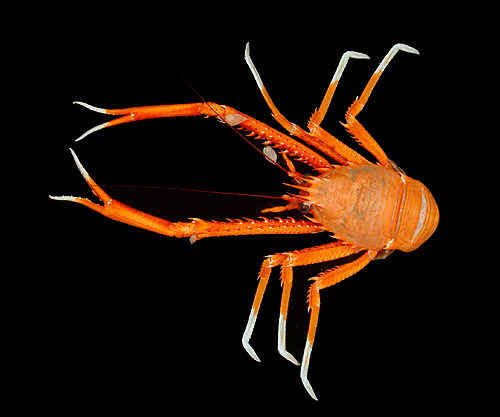
Eumunida picta inhabits deep-sea environments in the western Atlantic Ocean, from Massachusetts to Colombia, including the Gulf of Mexico. It has an orange-red body, white-tipped legs and chelae, and long, slender chelipeds.
Written 27 November 2026 from the sources listed below. Each statement was checked against the passage it cites; statements that could not be supported were removed.
Appearance
Its chelipeds are long and slender, measuring approximately four times the length of its carapace. Its pereiopods are elongated and armed with numerous spines.[1][2]
Its body is orange-red, with white-tipped legs and chelae. Its lateral carapace spines are pinkish, and its ventral surface is paler.[3][4]
Habitat
The painted yeti squat lobster inhabits deep-sea environments and is strongly associated with reefs formed by the deep-water coral Lophelia pertusa. It also occurs in association with methane seeps and cold seeps.[5][6][7][8]
It is frequently associated with the cold-water coral Lophelia pertusa. It has been observed with this coral at a Gulf of Mexico shipwreck site at approximately 550 metres depth.[9][10]
Diet
The painted yeti squat lobster is a predator and omnivore. Its animal prey includes small fish, copepods and arrow worms.[11][12][13]
Its recorded food items also include diatoms, foraminiferans and radiolarians.[14]
Behaviour
The painted yeti squat lobster perches on coral or stone while waiting for prey to approach. Its coloration provides camouflage among the branches of Lophelia pertusa.[15][16]
When it is not touching Lophelia pertusa, it is usually found within approximately one metre of the coral.[17]
Classification of the Painted Yeti Squat Lobster
| Kingdom | Animalia |
|---|---|
| Phylum | Arthropoda |
| Subphylum | Crustacea |
| Class | Malacostraca |
| Order | Decapoda |
| Suborder | Pleocyemata |
| Infraorder | Anomura |
| Superfamily | Chirostyloidea |
| Family | Eumunididae |
| Genus | Eumunida |
| Species | Eumunida picta S. I. Smith, 1883 |
Where the Painted Yeti Squat Lobster is found
Checklists and occurrence records place Eumunida picta in 3 countries. GBIF holds 86 georeferenced records of it.
Countries
Range as the checklists state it
Western Atlantic Ocean
A number beside a place is its count of GBIF occurrence records. A place without a number comes from a checklist alone. Records show where a species has been observed or collected, which can include escapes and vagrants.
Common names
English
- Painted Yeti Squat Lobster
Names in 1 other language
- French
- Crabe singe à pieds blancs, chirostyle multicolore
Related species

Questions and answers
What is the scientific name of the Painted Yeti Squat Lobster?
The scientific name of the Painted Yeti Squat Lobster is Eumunida picta. Written with its author, the full name is Eumunida picta S. I. Smith, 1883.
Which family does the Painted Yeti Squat Lobster belong to?
Eumunida picta belongs to the family Eumunididae, in the order Decapoda and the class Malacostraca.
Where is the Painted Yeti Squat Lobster found?
Checklists and occurrence records place Eumunida picta in 3 countries: United States, Guadeloupe and Martinique.
What do squat lobsters eat?
The painted yeti squat lobster is a predator and omnivore. Its recorded food includes small fish, copepods, arrow worms, diatoms, foraminiferans and radiolarians.[11][12][14][13]
Where do squat lobsters live?
The painted yeti squat lobster inhabits deep-sea environments in the western Atlantic Ocean, with a documented range from Massachusetts to Colombia, including the Gulf of Mexico. It is frequently associated with Lophelia pertusa reefs and cold seeps.[5][6][8][9][18][19][20]
Are lobster herbivores carnivores or omnivores?
The painted yeti squat lobster is a predator and omnivore.[11]
Sources
Passages the profile rests on
- Its chelipeds are long and slender, measuring approximately four times the length of its carapace. Source passage: “The chelipeds are long and slender, about four times as long as the carapace.” — English Wikipedia
- Its pereiopods are elongated and armed with numerous spines. Source passage: “The pereiopods are also elongated and both are armed with many spines.” — English Wikipedia
- Its body is orange-red, with white-tipped legs and chelae. Source passage: “This squat lobster is an orange-red colour with white-tipped legs and chelae” — English Wikipedia
- Its lateral carapace spines are pinkish and its ventral surface is paler. Source passage: “pinkish lateral carapace spines and a paler ventral surface.” — English Wikipedia
- The species inhabits deep-sea environments. Source passage: “Eumunida picta is a species of squat lobster found in the deep sea.” — English Wikipedia
- It is strongly associated with reefs formed by the deep-water coral Lophelia pertusa. Source passage: “The species is strongly associated with reefs of Lophelia pertusa, a deep-water coral” — English Wikipedia
- It occurs in association with methane seeps. Source passage: “and with methane seeps.” — English Wikipedia
- It inhabits deep water and is often associated with cold seeps. Source passage: “It lives in deep water, often in association with cold seeps” — English Wikipedia
- It is frequently associated with the cold-water coral Lophelia pertusa. Source passage: “with the coldwater coral Lophelia pertusa.” — English Wikipedia
- It has been observed in association with Lophelia pertusa at a Gulf of Mexico shipwreck site at approximately 550 metres depth. Source passage: “at a wreck site in the Gulf of Mexico at a depth of about 550 m (1,804 ft).” — English Wikipedia
- The species is a predator and omnivore. Source passage: “A predator and omnivore” — English Wikipedia
- Its animal prey includes small fish. Source passage: “waiting for small fish or other prey to come within range.” — English Wikipedia
- Its recorded diet includes copepods and arrow worms. Source passage: “copepods, arrow worms” — English Wikipedia
- Its recorded food items include diatoms, foraminiferans and radiolarians. Source passage: “It also feeds on diatoms, foraminiferans, radiolarians” — English Wikipedia
- It perches on coral or stone while waiting for prey to approach. Source passage: “perches on a coral or stone waiting for small fish or other prey to come within range.” — English Wikipedia
- Its coloration provides camouflage among the branches of Lophelia pertusa. Source passage: “Its colouring provides cryptic camouflage when it is among the fronds of L. pertusa.” — English Wikipedia
- When not touching Lophelia pertusa, it is usually found within approximately one metre of the coral. Source passage: “When not in contact with L. pertusa, it was usually within a metre (3 feet) of it.” — English Wikipedia
- The species occurs in the western Atlantic Ocean. Source passage: “The species is found in the Western Atlantic Ocean” — English Wikipedia
- Its documented geographic range extends from Massachusetts to Colombia. Source passage: “where it is found from Massachusetts to Colombia.” — English Wikipedia
- Its distribution includes the Gulf of Mexico. Source passage: “and the Gulf of Mexico.” — English Wikipedia
Data
- Catalogue of Life, 2026-10-16 XR cc by
- Global Biodiversity Information Facility CC BY 4.0
- Wikidata CC0
- GeoNames CC BY 4.0
- Wikimedia Commons per image; credit shown with each image
- Within the Catalogue of Life, this name comes from The Integrated Taxonomic Information System cc0
References
- Smith, S.I. (1883). Preliminary report on the Brachyura and Anomura dredged in deep water off the south coast of New England by the United States Fish Commission in 1880, 1881, and 1882. Proceedings of the United States National Museum. 6(1): 1-57, pls. 1-6. where the name was published
- Williams, Austin B., Lawrence G. Abele, D. L. Felder, H. H. Hobbs, Jr., R. B. Manning, et al. (1989). Common and Scientific Names of Aquatic Invertebrates from the United States and Canada: Decapod Crustaceans. American Fisheries Society Special Publication 17.
- McLaughlin, P. A., D. K. Camp, M. V. Angel, E. L. Bousfield, P. Brunel, R. C. Brusca, et al. (2005). Common and scientific names of aquatic invertebrates from the United States and Canada: Crustaceans. American Fisheries Society Special Publication 31.
- Baba, Keiji, Enrique MacPherson, Gary C. B. Poore, Shane T. Ahyong, Adriana Bermudez, et al. (2008). Catalogue of squat lobsters of the world (Crustacea: Decapoda: Anomura - families Chirostylidae, Galatheidae and Kiwaidae). Zootaxa, Vol. 1905.
- Tavares, Marcos, & and Daniel Lima. (2019). First record of the genus Eumunida Smith, 1883 (Crustacea, Decapoda, Eumunididae) from the southwestern Atlantic, with the description of a new species. Papéis Avulsos de Zoologia, Vol. 59: E20195939. Link
This species in other databases
- Catalogue of Life B84D7
- Wikidata Q3933194
- iNaturalist 459577
- WoRMS urn:lsid:marinespecies.org:taxname:158394
Page built on 28 November 2026. See how the catalog is made and all sources and licences.
Cite this page
ScientificNames.org. (2026). Eumunida picta (Painted Yeti Squat Lobster). Retrieved November 28, 2026, from https://scientificnames.org/species/eumunida-picta
“Eumunida picta (Painted Yeti Squat Lobster).” ScientificNames.org, 2026, scientificnames.org/species/eumunida-picta. Accessed 28 Nov. 2026.
ScientificNames.org. “Eumunida picta (Painted Yeti Squat Lobster).” Accessed November 28, 2026. https://scientificnames.org/species/eumunida-picta.
@misc{scientificnames_eumunida_picta_painted_yeti_squat_lobster,
  author = {{ScientificNames.org}},
  title = {Eumunida picta (Painted Yeti Squat Lobster)},
  year = {2026},
  url = {https://scientificnames.org/species/eumunida-picta},
  note = {Accessed 2026-11-28}
}