Species · Birds
Helmet Vanga Euryceros prevostii
The scientific name of the Helmet Vanga is Euryceros prevostii. It is a species of bird in the family Vangidae (vangas), order Passeriformes. The name dates from 1831.
- Scientific name
- Euryceros prevostii R. P. Lesson, 1831
- Common name
- Helmet Vanga
- Genus
- Euryceros
- Family
- Vangidae (Vangas)
- Order
- Passeriformes
- Class
- Aves
- Red List category
- EN Endangered
- Recorded in
- 1 country
- Name status
- accepted in the Catalogue of Life

Overview
The Helmet Vanga is the sole species in the genus Euryceros. It is restricted to northeastern Madagascar, where it inhabits lowland and lower montane rainforests. It has predominantly blue-black plumage, rufous wings, and a large arched bright-blue bill with a black tip.
Written 26 November 2026 from the sources listed below. Each statement was checked against the passage it cites; statements that could not be supported were removed.
Appearance
The Helmet Vanga has predominantly blue-black plumage and rufous wings. Its head, neck, throat, breast, belly, primary coverts, and wing flight feathers are solid blue-black.[1][2]
The bird has a long, broad tail with a black underside and rufous upper surface. Males and females have similar appearances.[3][4]
The Helmet Vanga measures 28–31 cm in length and weighs between 84 and 114 g. It is the second-largest vanga species, smaller only than the Sickle-billed Vanga.[5][6][7]
Habitat
The Helmet Vanga is restricted to northeastern Madagascar. It inhabits lowland and lower montane rainforests and is restricted to undisturbed humid rainforest.[8][9][10]
Recorded protected areas for the species include Marojejy National Park, Makira Natural Park, Masoala National Park, and Mantadia National Park.[11]
Diet
The Helmet Vanga's diet consists primarily of invertebrates, especially insects. Adults mainly consume large insects.[12][13]
Food delivered to nestlings can include snails, lizards, spiders, and crabs.[14]
Behaviour
Helmet Vangas form monogamous pairs. Both sexes participate in constructing the nest.[15][16]
A male Helmet Vanga has been recorded feeding its mate during courtship before copulation.[17]
Reproduction and life cycle
On the Masoala Peninsula, the Helmet Vanga has a seasonal breeding period from October through January.[18]
The species builds cup-shaped nests approximately 15 cm in diameter, constructed from woven plant fibres, mosses, and twigs. The nest is positioned in a tree fork approximately 2–4 m above the ground.[19][20][21]
A typical clutch contains two or three pinkish-white eggs.[22]
Conservation
Habitat loss is a major threat to the Helmet Vanga. Agricultural and forestry clearing is reducing the undisturbed humid rainforest habitat available to the species.[23][24]
The estimated population comprises 6,000–15,000 mature individuals. The population is becoming increasingly fragmented.[25][26]
Ecological modelling predicts that climate change could eliminate much of the species' remaining habitat within 50 years.[27]
The IUCN Red List most recently assessed the Helmet Vanga in 2018 and listed it as Endangered. The IUCN assessment reported by BirdLife also lists the species as Endangered.[28][29]
Similar species
The Rufous Vanga is considered the closest relative of the Helmet Vanga within the Vangidae family. The two species are thought to have diverged approximately 800,000 years ago.[30][31]
Classification of the Helmet Vanga
| Kingdom | Animalia |
|---|---|
| Phylum | Chordata |
| Subphylum | Vertebrata |
| Infraphylum | Gnathostomata |
| Parvphylum | Osteichthyes |
| Megaclass | Tetrapoda |
| Class | Aves (Bird) |
| Order | Passeriformes (Passerine) |
| Family | Vangidae (Vangas) |
| Genus | Euryceros (Helmet Vangas) |
| Species | Euryceros prevostii R. P. Lesson, 1831 |
Where the Helmet Vanga is found
Checklists and occurrence records place Euryceros prevostii in 1 country across Africa. GBIF holds 720 georeferenced records of it.
Countries
Regions and cities with the most records
Range as the checklists state it
Africa
A number beside a place is its count of GBIF occurrence records. A place without a number comes from a checklist alone. Records show where a species has been observed or collected, which can include escapes and vagrants.
Common names
English
- Helmet Vanga
- Helmetbird
- Helmeted Vanga
Names in 30 other languages
- Arabic
- ضغام
- Bulgarian
- Шлемоноса ванга
- Catalan
- Vanga de casc, vanga becgròs
- Chinese
- 盔鵙
- Croatian
- krupnokljuna vanga
- Czech
- vanga přílbová
- Danish
- Hjelmvanga
- Esperanto
- kaska vangao
- Estonian
- suurnokk-vanga
- Finnish
- kypärävanga
- French
- Eurycère de Prévost
- German
- Helmvanga
- Hebrew
- ונגת הקסדה
- Hungarian
- sisakos vanga
- Italian
- Vanga dall'elmo
- Japanese
- ヘルメットモズ
- Lithuanian
- šalminė vanga
- Malayalam
- ഹെൽമറ്റ് വാൻഗ
- Norwegian
- stornebbvanga
- Persian
- وانگای کلاهخودی
- Polish
- hełmodziób
- Portuguese
- vanga-de-capacete, vanga-de-prévost
- Russian
- Толстоклювая ванга, Шлемоклювая ванга, Шлемоносная ванга
- Serbian
- Kljunorog vanga
- Slovak
- vanga prilbozobá
- Spanish
- Vanga de casco
- Swedish
- hjälmvanga
- Turkish
- Satır Gagalı Vanga
- Ukrainian
- ванга товстодзьоба
- Welsh
- fanga helmog
Related species
-
 Common WoodshrikeTephrodornis pondicerianus
-
 Hook-billed VangaVanga curvirostris
-
 Bar-winged Flycatcher-shrikeHemipus picatus
-
 Sickle-billed VangaFalculea palliata
-
 Retz's HelmetshrikePrionops retzii
-
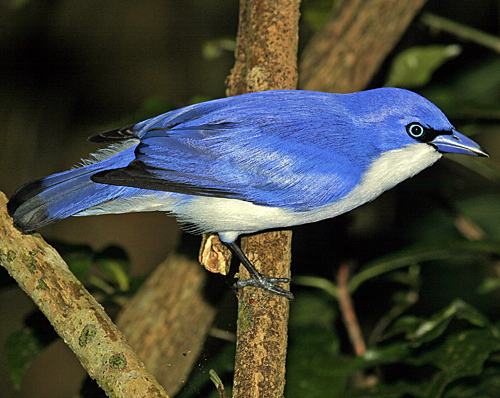 Madagascar Blue VangaCyanolanius madagascarinus
-
 Red-shouldered VangaCalicalicus rufocarpalis
-
 Black-and-white Shrike-flycatcherBias musicus
Compare
Questions and answers
What is the scientific name of the Helmet Vanga?
The scientific name of the Helmet Vanga is Euryceros prevostii. Written with its author, the full name is Euryceros prevostii R. P. Lesson, 1831.
Which family does the Helmet Vanga belong to?
Euryceros prevostii belongs to the family Vangidae, in the order Passeriformes and the class Aves.
Where is the Helmet Vanga found?
Checklists and occurrence records place Euryceros prevostii in 1 country: Madagascar.
What is the conservation status of the Helmet Vanga?
The IUCN Red List category recorded for Euryceros prevostii is Endangered (EN).
What other names does the Helmet Vanga have?
Euryceros prevostii is also known in English as Helmetbird and Helmeted Vanga.
Sources
Passages the profile rests on
- The Helmet Vanga has predominantly blue-black plumage, rufous wings, and a large arched blue bill. Source passage: “It is mainly blue-black, with rufous wings and a huge arched blue bill.” — English Wikipedia
- The head, neck, throat, breast, belly, primary coverts, and wing flight feathers are solid blue-black. Source passage: “The plumage of the head, neck, throat, breast and belly is a solid blue-black, as are the primary coverts and remiges of the wing.” — English Wikipedia
- The bird has a long, broad tail with a black underside and rufous upper surface. Source passage: “The tail, which is long and broad, is black below and rufous above.” — English Wikipedia
- Male and female Helmet Vangas have similar appearances. Source passage: “Both sexes are alike.” — English Wikipedia
- The Helmet Vanga measures 28–31 cm in length. Source passage: “In length it measures 28 to 31 cm (11–12 in)” — English Wikipedia
- The Helmet Vanga weighs between 84 and 114 g. Source passage: “it weighs 84 to 114 g (3.0–4.0 oz).” — English Wikipedia
- The Helmet Vanga is the second-largest vanga species, smaller only than the Sickle-billed Vanga. Source passage: “the second-largest species of vanga after the sickle-billed vanga.” — English Wikipedia
- The Helmet Vanga inhabits lowland and lower montane rainforests. Source passage: “It is restricted to lowland and lower montane rainforests in north-eastern Madagascar.” — English Wikipedia
- The species is restricted to undisturbed humid rainforest. Source passage: “The species is restricted to undisturbed humid rainforest” — English Wikipedia
- The Helmet Vanga is restricted to northeastern Madagascar. Source passage: “It is restricted to lowland and lower montane rainforests in north-eastern Madagascar.” — English Wikipedia
- Recorded protected areas for the species include Marojejy National Park, Makira Natural Park, Masoala National Park, and Mantadia National Park. Source passage: “Sites where it can be found include Marojejy National Park, Makira Natural Park, the Masoala National Park and Mantadia National Park.” — English Wikipedia
- The Helmet Vanga's diet consists primarily of invertebrates, especially insects. Source passage: “Its diet is composed of invertebrates, predominantly insects.” — English Wikipedia
- Adult Helmet Vangas mainly consume large insects. Source passage: “Adults mainly eat large insects” — English Wikipedia
- Food delivered to nestlings can include snails, lizards, spiders, and crabs. Source passage: “food items brought to young in the nest may be more varied, including snails, lizards, spiders and crabs.” — English Wikipedia
- Helmet Vangas form monogamous pairs. Source passage: “Helmet vangas are monogamous and seasonal breeders.” — English Wikipedia
- Both sexes participate in constructing the nest. Source passage: “Both sexes work on the construction of the nest” — English Wikipedia
- A male Helmet Vanga has been recorded feeding its mate during courtship before copulation. Source passage: “There is one record of courtship feeding by a male before copulation.” — English Wikipedia
- The Helmet Vanga has a seasonal breeding period from October through January on the Masoala Peninsula. Source passage: “The breeding season runs from October to January on the Masoala Peninsula.” — English Wikipedia
- The species builds cup-shaped nests measuring approximately 15 cm in diameter. Source passage: “which is a cup shape 15 cm (5.9 in) in diameter” — English Wikipedia
- Its nest is constructed from woven plant fibres, mosses, and twigs. Source passage: “constructed from woven plant fibres, mosses and twigs” — English Wikipedia
- The nest is positioned in a tree fork approximately 2–4 m above the ground. Source passage: “is placed in a fork in a tree 2 to 4 m (6.6–13.1 ft) off the ground.” — English Wikipedia
- A typical Helmet Vanga clutch contains two or three pinkish-white eggs. Source passage: “The clutch size is two or three pinkish white eggs.” — English Wikipedia
- Habitat loss is a major threat to the Helmet Vanga. Source passage: “The helmet vanga is considered to be threatened with extinction due to habitat loss.” — English Wikipedia
- Agricultural and forestry clearing is reducing the undisturbed humid rainforest habitat available to the species. Source passage: “this habitat is increasingly being cleared for agriculture and forestry.” — English Wikipedia
- The estimated population comprises 6,000–15,000 mature individuals. Source passage: “Their population, between 6000 and 15000 mature individuals” — English Wikipedia
- The Helmet Vanga population is becoming increasingly fragmented. Source passage: “is becoming increasingly fragmented.” — English Wikipedia
- Ecological modelling predicts that climate change could eliminate much of the species' remaining habitat within 50 years. Source passage: “Ecological modelling suggests that much of their remaining habitat will be lost in 50 years due to climate change.” — English Wikipedia
- The IUCN assessment reported by BirdLife lists the Helmet Vanga as Endangered. Source passage: “Population trend Decreasing EN IUCN Red List category” — datazone.birdlife.org
- The IUCN Red List most recently assessed the Helmet Vanga in 2018 and listed it as Endangered. Source passage: “has most recently been assessed for The IUCN Red List of Threatened Species in 2018. listed as Endangered” — iucnredlist.org
- The Rufous Vanga is considered the closest relative of the Helmet Vanga within the Vangidae family. Source passage: “The closest relative within the family is believed to be the rufous vanga” — English Wikipedia
- The Rufous Vanga is thought to have diverged from the Helmet Vanga approximately 800,000 years ago. Source passage: “which is thought to have split from the helmet vanga 800,000 years ago.” — English Wikipedia
Data
- Catalogue of Life, 2026-10-16 XR cc by
- Global Biodiversity Information Facility CC BY 4.0
- Wikidata CC0
- GeoNames CC BY 4.0
- Wikimedia Commons per image; credit shown with each image
- Within the Catalogue of Life, this name comes from The Integrated Taxonomic Information System cc0
References
- Lesson, & René Primevère. (1831). Descriprion d’un nouveau genre d’Oiseau, l’Eurycère, Euryceros. Annales Des Sciences Naturelles, Vol. 22. where the name was published
- Gill, Frank, & and Minturn Wright. (2006). Birds of the World: Recommended English Names.
This species in other databases
Page built on 28 November 2026. See how the catalog is made and all sources and licences.
Cite this page
ScientificNames.org. (2026). Euryceros prevostii (Helmet Vanga). Retrieved November 28, 2026, from https://scientificnames.org/species/euryceros-prevostii
“Euryceros prevostii (Helmet Vanga).” ScientificNames.org, 2026, scientificnames.org/species/euryceros-prevostii. Accessed 28 Nov. 2026.
ScientificNames.org. “Euryceros prevostii (Helmet Vanga).” Accessed November 28, 2026. https://scientificnames.org/species/euryceros-prevostii.
@misc{scientificnames_euryceros_prevostii_helmet_vanga,
  author = {{ScientificNames.org}},
  title = {Euryceros prevostii (Helmet Vanga)},
  year = {2026},
  url = {https://scientificnames.org/species/euryceros-prevostii},
  note = {Accessed 2026-11-28}
}