Species · Birds
Black-bellied Storm Petrel Fregetta tropica
The scientific name of the Black-bellied Storm Petrel is Fregetta tropica. It is a species of bird in the family Oceanitidae (austral storm petrel), order Procellariiformes. The name dates from 1844.
- Scientific name
- Fregetta tropica (Gould, 1844)
- Common name
- Black-bellied Storm Petrel
- Genus
- Fregetta
- Family
- Oceanitidae (Austral Storm Petrel)
- Order
- Procellariiformes
- Class
- Aves
- Red List category
- LC Least Concern
- Environment
- marine, terrestrial
- Recorded in
- 20 countries
- Name status
- accepted in the Catalogue of Life

Overview
Fregetta tropica inhabits cold sub-Antarctic seas and feeds near or beyond continental shelves. It is usually black with a white rump band, white underwings and white flanks, and has long legs that extend beyond its tail during flight.
Written 26 November 2026 from the sources listed below. Each statement was checked against the passage it cites; statements that could not be supported were removed.
Appearance
The Black-bellied Storm Petrel is usually black with a white rump band, white underwings and white flanks. A broad black stripe runs down the middle of its belly, although this marking can be broken or entirely absent.[1][2]
Its long legs allow its feet to extend beyond its tail during flight. Its legs and feet are black.[3][4]
Adults measure approximately 20 cm in length, with a wingspan of approximately 43–46 cm. They weigh approximately 43–63 g.[5][6][7]
Habitat
The species inhabits cold sub-Antarctic seas and feeds near or beyond continental shelves in waters ranging from 0 to 30 °C.[8][9]
Diet
The Black-bellied Storm Petrel is a carnivorous and piscivorous marine predator. Its diet consists of crustaceans, squid and small fish.[10][11]
It captures prey from the water surface while flying or through shallow aerial dives.[12]
Behaviour
The species slaps its belly against the water and uses its feet to change direction during flight. Members of the genus Fregetta move across waves by bouncing on a single foot in an asymmetrical motion.[13][14]
The species is mostly silent while at sea. Birds at breeding colonies produce drawn-out shrill whistles while on the ground.[15][16]
The species is strictly nocturnal while on land. It breeds in colonies and defends the territory surrounding its nest entrance.[17][18]
The species forms monogamous pairs that can return to the same nesting burrow in successive years. Birds generally return to the same nest and mate in successive breeding seasons.[19][20]
Reproduction and life cycle
The species constructs nests in cavities among loose rocks or in burrows dug into soil and peat. Females generally lay one egg per clutch during December or January.[21][22]
The egg represents approximately 26% of the female's body weight. It measures approximately 37 mm in length and 27 mm in width and is dull white with a few dull reddish-brown markings concentrated at its larger end.[23][24][25]
Both parents incubate the egg in alternating spells of approximately three days. Incubation generally lasts 38–44 days according to observations at Signy Island.[26][27]
The chick is covered in pale grey down after hatching. At Signy Island, chicks are left unattended in the nest almost immediately after hatching.[28][29]
The nestling period generally lasts 65–70 days. Two chicks observed at Signy Island fledged after 65 and 71 days.[30][31]
Conservation
Introduced mice, rats and cats threaten the species at its breeding islands. A population decline is suspected.[32][33]
The estimated global population was approximately 500,000 individuals in 2004.[34]
Classification of the Black-bellied Storm Petrel
| Kingdom | Animalia |
|---|---|
| Phylum | Chordata |
| Subphylum | Vertebrata |
| Infraphylum | Gnathostomata |
| Parvphylum | Osteichthyes |
| Megaclass | Tetrapoda |
| Class | Aves (Bird) |
| Order | Procellariiformes (Petrels) |
| Family | Oceanitidae (Austral Storm Petrel) |
| Genus | Fregetta (Frigate Storm Petrels) |
| Species | Fregetta tropica (Gould, 1844) |
Where the Black-bellied Storm Petrel is found
Checklists and occurrence records place Fregetta tropica in 20 countries across Africa and Oceania. GBIF holds 9,636 georeferenced records of it.
Countries
- Antarctica 3,572
- Australia 1,430
- Bouvet Island 20
- Fiji 6
- French Polynesia 4
- French Southern Territories 340
- Heard Island and McDonald Islands 154
- Kenya 3
- Mozambique 3
- New Caledonia 5
- New Zealand 1,789
- Norfolk Island 13
- Papua New Guinea 16
- Reunion 4
- Saint Helena 64
- Seychelles 3
- Solomon Islands 3
- South Africa 226
- South Georgia and the South Sandwich Islands 1,978
- Tanzania 3
Regions and cities with the most records
- Grytviken, South Georgia and the South Sandwich Islands 136
- Kerguelen, French Southern Territories 38
- Tasmania, Australia 34
- Port-aux-Français, French Southern Territories 26
- New South Wales, Australia 15
- Queensland, Australia 13
- Tristan da Cunha, Saint Helena 10
- Gold Coast, Australia 9
- Wollongong, Australia 8
- Port Macquarie, Australia 6
- Southland, New Zealand 5
- Richards Bay, South Africa 4
- Victoria, Australia 4
- Caloundra, Australia 3
- Sokoni, Tanzania 3
10 more countries have a few records outside this range
These countries hold a few records of Fregetta tropica but lie outside the range the checklists give for it. Such records are often zoo or garden specimens, museum material or vagrants, so the species is not counted as occurring there.
Range as the checklists state it
Antarctica/Southern Ocean
Australia
Africa
A number beside a place is its count of GBIF occurrence records. A place without a number comes from a checklist alone. Records show where a species has been observed or collected, which can include escapes and vagrants.
Common names
English
- Black-bellied Storm Petrel
- Black-bellied Storm-Petrel
Names in 33 other languages
- Afrikaans
- Swartpensstormswael
- Arabic
- نوء العاصفة أسود البطن
- Breton
- Satanig kof du
- Bulgarian
- Чернокорема вълнолюбка
- Catalan
- ocell de tempesta panxanegre
- Chinese
- 黑腹舰海燕, 黑腹艦燕
- Czech
- buřníček černobřichý, buřňáček černobřichý
- Danish
- Sortbuget Fregatstormsvale
- Dutch
- zwartbuikstormvogeltje
- Esperanto
- blankventra ŝtormopetrelo
- Estonian
- mustkõht-tormipääsu
- Finnish
- tummatyrskynpolkija
- French
- Océanite à ventre noir
- German
- Schwarzbauch-Meerläufer, Schwarzbauch-Sturmschwalbe, Schwarzbauchmeerläufer
- Hebrew
- יסעורון שחור-בטן
- Hungarian
- feketehasú fregattfecske
- Irish
- Guairdeall tarrdhubh
- Italian
- Uccello delle tempeste pancianera
- Japanese
- クロハラウミツバメ
- Latvian
- melnvēdera vētrasburātājs
- Lithuanian
- juodapilvė jūrinė kregždė
- Malagasy
- Domoimainty
- Norwegian
- svartbukstormsvale
- Polish
- oceannik czarnobrzuchy
- Portuguese
- painho-de-barriga-preta
- Russian
- Чернобрюхая качурка, Чернобрюхая океанида
- Serbian
- Crnotrba burnica
- Slovak
- búrkozvest čiernobruchý
- Spanish
- Golondrina de mar de vientre negro, Paíño ventrinegro, Paíño vientre negro
- Swedish
- svartbukig havslöpare, svartbukig stormsvala, svartmagad stormsvala
- Turkish
- Alaca Karınlı Fırtınakırlangıcı
- Ukrainian
- фрегета чорночерева
- Welsh
- pedryn drycin torddu
Synonyms
One other scientific name has been used for this species and is now treated as a synonym of Fregetta tropica.
- Thalassidroma tropica Gould, 1844
Subspecies and varieties
- Fregetta tropica melanoleuca (Gough Black-bellied Storm-Petrel) subspecies
- Fregetta tropica tropica (Subantarctic Black-bellied Storm-Petrel) subspecies
Related species
-
 New Zealand Storm PetrelFregetta maoriana
-
 White-bellied Storm PetrelFregetta grallaria
- New Caledonian Storm PetrelFregetta lineata
-
 Wilson's Storm PetrelOceanites oceanicus
-
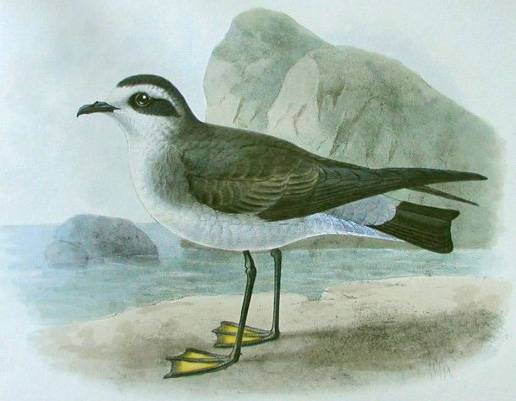 White-faced Storm PetrelPelagodroma marina
-
 Grey-backed Storm PetrelGarrodia nereis
- Polynesian Storm PetrelNesofregetta fuliginosa
-
 Elliot's Storm PetrelOceanites gracilis
Compare
Questions and answers
What is the scientific name of the Black-bellied Storm Petrel?
The scientific name of the Black-bellied Storm Petrel is Fregetta tropica. Written with its author, the full name is Fregetta tropica (Gould, 1844).
Which family does the Black-bellied Storm Petrel belong to?
Fregetta tropica belongs to the family Oceanitidae, in the order Procellariiformes and the class Aves.
Where is the Black-bellied Storm Petrel found?
Checklists and occurrence records place Fregetta tropica in 20 countries, including Antarctica, South Georgia and the South Sandwich Islands, New Zealand, Australia, French Southern Territories and South Africa.
What is the conservation status of the Black-bellied Storm Petrel?
The IUCN Red List category recorded for Fregetta tropica is Least Concern (LC).
What other names does the Black-bellied Storm Petrel have?
Fregetta tropica is also known in English as Black-bellied Storm-Petrel.
What do storm petrels eat?
They consume crustaceans, squid and small fish, capturing prey from the water surface while flying or through shallow aerial dives.[10][12]
What are some interesting facts about petrels?
The Black-bellied Storm Petrel slaps its belly against the water and uses its feet to change direction during flight. It is strictly nocturnal while on land and can return to the same nesting burrow and mate in successive breeding seasons.[13][17][19][20]
Sources
Passages the profile rests on
- The species is usually black with a white rump band, white underwings and white flanks. Source passage: “They are usually black with a white band over the rump and white under the wings and on the flanks.” — English Wikipedia
- The bird has a broad black stripe running down the middle of its belly, although this marking can be broken or entirely absent. Source passage: “A broad black stripe runs down the center of the belly, but may be broken or absent altogether.” — English Wikipedia
- Its long legs allow its feet to extend beyond its tail during flight. Source passage: “They have long legs, so the feet can be seen beyond the tail in flight.” — English Wikipedia
- The species has black legs and feet. Source passage: “The legs and feet are black.” — English Wikipedia
- Adults measure approximately 20 cm in length. Source passage: “The adult measures ≈ 20 cm in length” — English Wikipedia
- Adults have a wingspan of approximately 43–46 cm. Source passage: “has a wingspan of 43 to 46 cm” — English Wikipedia
- Adults weigh approximately 43–63 g. Source passage: “weighs approximately 43 to 63 g.” — English Wikipedia
- The species inhabits cold sub-Antarctic seas. Source passage: “The black-bellied storm petrel inhabits cold sub-Antarctic seas.” — English Wikipedia
- The species feeds near or beyond continental shelves in waters ranging from 0 to 30 °C. Source passage: “feed near or beyond the continental shelf in a wide range of water temperatures, from 0 to 30 °C.” — English Wikipedia
- The species consumes crustaceans, squid and small fish. Source passage: “diet consists of a wide variety of small animals, including crustaceans, squid, and small fish.” — English Wikipedia
- The species is a carnivorous and piscivorous marine predator. Source passage: “Its a carnivorous/piscivorous marine predator” — English Wikipedia
- The species captures prey from the water surface while flying or through shallow aerial dives. Source passage: “It feeds while in flight, capturing prey from the surface or by making shallow dives from the air.” — English Wikipedia
- The species slaps its belly against the water and uses its feet to change direction during flight. Source passage: “it slaps its belly against the water and changes direction by kicking its feet.” — English Wikipedia
- Members of the genus Fregetta move across waves by bouncing on a single foot in an asymmetrical motion. Source passage: “bouncing off the waves using a single foot in an asymmetrical bounding motion.” — English Wikipedia
- The species is mostly silent while at sea. Source passage: “They are silent mostly at sea.” — English Wikipedia
- Birds at breeding colonies produce drawn-out shrill whistles while on the ground. Source passage: “birds on the ground give a drawn-out shrill whistle.” — English Wikipedia
- The species is strictly nocturnal while on land. Source passage: “The species is strictly nocturnal on land” — bas.ac.uk
- The species breeds in colonies and defends the territory surrounding its nest entrance. Source passage: “They nest in colonies and lead a nocturnal lifestyle, while also defending a territory around the entrance to their nest.” — English Wikipedia
- The species forms monogamous pairs that can return to the same nesting burrow in successive years. Source passage: “These birds are monogamous and form long-lasting pairs, sometimes returning to occupy the same burrow year after year.” — English Wikipedia
- Birds generally return to the same nest and mate in successive breeding seasons. Source passage: “Birds usually arrive from mid‐November onward and return to the same nest and mate in successive seasons.” — bas.ac.uk
- The species constructs nests in cavities among loose rocks or in burrows dug into soil and peat. Source passage: “They build their nests in cavities among loose rocks, or in burrows dug into the ground and peat.” — English Wikipedia
- Females generally lay one egg per clutch during December or January. Source passage: “Females lay a single egg per clutch in the nest (a burrow or natural cavity) during the months of December or January” — English Wikipedia
- The egg represents approximately 26% of the female's body weight. Source passage: “the egg is around 26 % of the body weight of the female.” — English Wikipedia
- The egg measures approximately 37 mm in length and 27 mm in width. Source passage: “measuring approximately 37 mm in length and 27 mm in width.” — English Wikipedia
- The egg is dull white with a few dull reddish-brown markings concentrated at its larger end. Source passage: “dull white with a few dull reddish-brown markings at the larger end” — English Wikipedia
- Both parents incubate the egg in alternating spells of approximately three days. Source passage: “Incubation is by both sexes in alternate spells of three days” — bas.ac.uk
- Incubation generally lasts 38–44 days according to observations at Signy Island. Source passage: “the whole period lasting 38–44 days.” — bas.ac.uk
- The chick is covered in pale grey down after hatching. Source passage: “The chick is covered in pale gray down” — English Wikipedia
- At Signy Island, chicks are left unattended in the nest almost immediately after hatching. Source passage: “The chick is left alone in the nest by the parents almost immediately after hatching.” — bas.ac.uk
- The nestling period generally lasts 65–70 days. Source passage: “The nestling period lasts 65 to 70 days” — English Wikipedia
- Two chicks observed at Signy Island fledged after 65 and 71 days. Source passage: “The fledging periods of two chicks were 65 and 71 days” — bas.ac.uk
- Introduced mice, rats and cats threaten the species at its breeding islands. Source passage: “The species is threatened by invasive predators introduced to its breeding islands, such as mice, rats, and cats.” — English Wikipedia
- A population decline is suspected for the species. Source passage: “A population decline is suspected” — English Wikipedia
- The estimated global population was approximately 500,000 individuals in 2004. Source passage: “Its global population was estimated at approximately 500,000 individuals in 2004.” — English Wikipedia
Data
- Catalogue of Life, 2026-10-16 XR cc by
- Global Biodiversity Information Facility CC BY 4.0
- Wikidata CC0
- GeoNames CC BY 4.0
- Wikimedia Commons per image; credit shown with each image
- Within the Catalogue of Life, this name comes from The Integrated Taxonomic Information System cc0
References
- Gill, Frank, & and Minturn Wright. (2006). Birds of the World: Recommended English Names.
This species in other databases
- Catalogue of Life 6JLWC
- Wikidata Q1273787
- iNaturalist 4172
- WoRMS urn:lsid:marinespecies.org:taxname:212696
- Avibase bbspet1
Page built on 29 November 2026. See how the catalog is made and all sources and licences.
Cite this page
ScientificNames.org. (2026). Fregetta tropica (Black-bellied Storm Petrel). Retrieved November 29, 2026, from https://scientificnames.org/species/fregetta-tropica
“Fregetta tropica (Black-bellied Storm Petrel).” ScientificNames.org, 2026, scientificnames.org/species/fregetta-tropica. Accessed 29 Nov. 2026.
ScientificNames.org. “Fregetta tropica (Black-bellied Storm Petrel).” Accessed November 29, 2026. https://scientificnames.org/species/fregetta-tropica.
@misc{scientificnames_fregetta_tropica_black_bellied_storm_petrel,
  author = {{ScientificNames.org}},
  title = {Fregetta tropica (Black-bellied Storm Petrel)},
  year = {2026},
  url = {https://scientificnames.org/species/fregetta-tropica},
  note = {Accessed 2026-11-29}
}