Species · Fishes
Mummichog Fundulus heteroclitus
The scientific name of the Mummichog is Fundulus heteroclitus. It is a species of fish in the family Fundulidae (fundulines), order Cyprinodontiformes. The name dates from 1766.
- Scientific name
- Fundulus heteroclitus (Linnaeus, 1766)
- Common name
- Mummichog
- Genus
- Fundulus
- Family
- Fundulidae (Fundulines)
- Order
- Cyprinodontiformes
- Class
- Teleostei
- Red List category
- LC Least Concern
- Environment
- brackish, freshwater, marine
- Recorded in
- 7 countries
- Name status
- accepted in the Catalogue of Life
Overview
Fundulus heteroclitus inhabits brackish and coastal waters, including estuaries, salt marshes and tidal creeks. It can survive several hours in moist air outside water by breathing air directly.
Written 26 November 2026 from the sources listed below. Each statement was checked against the passage it cites; statements that could not be supported were removed.
Similar species
Mummichog closely resembles the banded killifish (Fundulus diaphanus), and the two species have been reported to interbreed.[1]
Appearance
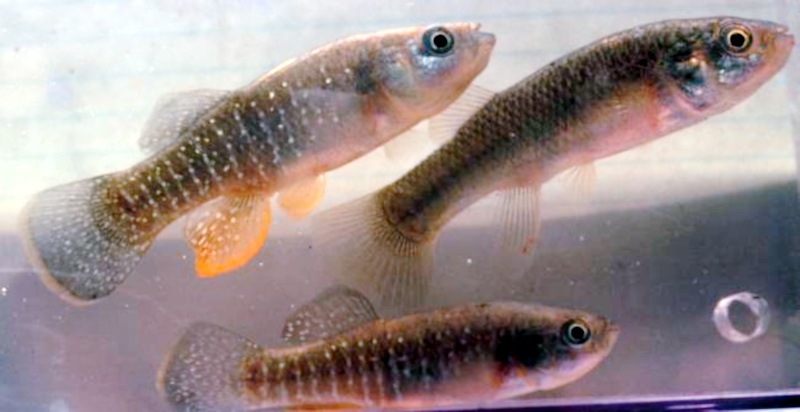
The species has an elongated, thick body and a deep caudal peduncle. Its mouth is upturned, with the lower jaw protruding when the mouth is closed, and its pectoral and tail fins are rounded.[2][3][4]
Males have larger dorsal and anal fins than females. General coloration is olive-brown or olive-green and may vary with the surrounding background.[5][6]
During reproduction, males develop dark olive-green backs, steel-blue sides with approximately 15 silvery bars, and yellow or orange-yellow undersides. Females are generally paler and lack the characteristic body bars and intense yellow belly coloration.[7][8]
Usual adult length is approximately 7.5–9 cm, and individuals can reach a maximum length of approximately 15 cm.[9][10]
Habitat
Mummichog inhabits brackish and coastal waters, including estuaries and salt marshes. Coastal habitats include muddy creeks, tidal channels, eelgrass or cordgrass beds, and sheltered shorelines.[11][12]
Tidal creeks are a preferred habitat, alongside saltwater marshes, estuaries, and sheltered shores with submerged eelgrass. The species also occurs in coastal rivers but seldom beyond the tidal limit.[13][14]
Submerged vegetation is a common feature of habitats used for spawning and feeding.[15]
Diet
Mummichog is an omnivore without a stomach. Its recorded food includes diatoms, phytoplankton, amphipods, other crustaceans, molluscs, fish eggs, small fish, insect larvae, and eelgrass.[16][17][18]
Behaviour
Individuals form dense shoals that can contain several hundred fish. Mummichogs are nonmigratory and typically occupy home ranges smaller than 1,000 m.[19][20]
During northern winters, individuals move into upstream tidal pools and burrow into mud to depths of up to 20 cm. Some individuals move into deeper waters during freezing winter conditions rather than burrowing into sediment.[21][22]
Mummichogs can survive several hours in moist air outside water by breathing air directly. Adults can also use aquatic surface respiration when dissolved oxygen falls to approximately 1 mg/L.[23][24]
Reproduction and life cycle
The spawning season extends from spring through fall, and southern populations can spawn up to eight times in a single season. Spawning occurs most frequently during high tides associated with new or full moons.[25][26][27]
Female fish attract males by turning onto their sides near the bottom and flicking their tails. Mummichog eggs are pale yellow, strongly adhesive, and approximately 2 mm in diameter.[28][29]
A female can deposit up to 740 eggs during a spawning event. Eggs may attach to vegetation, algal mats, empty mussel shells, sand, or mud.[30][31]
Eggs develop while exposed to moist air and hatch when subsequent high spring tides submerge them. Northern subspecies eggs possess adhesive chorionic fibrils that are absent from southern subspecies eggs.[32][33]
Most individuals reach sexual maturity at approximately two years of age and 3.8 cm in length. Newly hatched larvae are approximately 7 mm long and remain in the intertidal zone for six to eight weeks after hatching.[34][35][36]
Conservation
Introduced populations of Mummichog are considered a significant ecological concern in the European Union.[37]
Uses
Mummichog has been used in attempts to control mosquito populations by consuming mosquito larvae. It is commonly used in research on stress biology, thermal physiology, and toxicology.[38][39]
Classification of the Mummichog
| Kingdom | Animalia |
|---|---|
| Phylum | Chordata |
| Subphylum | Vertebrata |
| Infraphylum | Gnathostomata |
| Parvphylum | Osteichthyes |
| Gigaclass | Actinopterygii |
| Superclass | Actinopteri |
| Class | Teleostei (Teleost) |
| Order | Cyprinodontiformes |
| Family | Fundulidae (Fundulines) |
| Genus | Fundulus (Topminnows) |
| Species | Fundulus heteroclitus (Linnaeus, 1766) |
Where the Mummichog is found
Checklists and occurrence records place Fundulus heteroclitus in 7 countries. GBIF holds 15,113 georeferenced records of it.
Countries
Regions and cities with the most records
- New Brunswick, Canada 1,976
- Prince Edward Island, Canada 1,163
- Nova Scotia, Canada 1,107
- Maryland, United States 1,018
- Sanlúcar de Barrameda, Spain 949
- New Jersey, United States 709
- Massachusetts, United States 542
- New York, United States 500
- Chipiona, Spain 464
- Virginia, United States 406
- North Carolina, United States 319
- Camp Springs, United States 307
- Clinton, United States 296
- Suitland, United States 281
- Alexandria, United States 278
- Suitland-Silver Hill, United States 278
- Manhattan, United States 276
- Baileys Crossroads, United States 275
- Oxon Hill-Glassmanor, United States 275
- Bowie, United States 274
- Glassmanor, United States 274
- Hillcrest Heights, United States 274
- Oxon Hill, United States 274
- New York City, United States 268
- Arlington, United States 263
- Capitol Riverfront, United States 263
- Southwest Waterfront, United States 263
- Downtown DC, United States 262
- Cliffside Park, United States 261
- Foggy Bottom, United States 261
- Golden Triangle, United States 261
- Greater Upper Marlboro, United States 261
- H Street NE, United States 261
- Mount Vernon Triangle, United States 261
- Northwest One, United States 261
- Washington, United States 261
1 more country has a few records outside this range
These countries hold a few records of Fundulus heteroclitus but lie outside the range the checklists give for it. Such records are often zoo or garden specimens, museum material or vagrants, so the species is not counted as occurring there.
A number beside a place is its count of GBIF occurrence records. A place without a number comes from a checklist alone. Records show where a species has been observed or collected, which can include escapes and vagrants.
Common names
English
- Mummichog
- Bermuda Killifish
- Lover's Lake Killifish
- Mangrove Minnow
Names in 13 other languages
- Catalan
- Fúndul
- Czech
- fundul bermudský, fundul mumiový
- Danish
- Zebrastribet tandkarpe
- Estonian
- Triibuline fundulus
- Finnish
- siniraitakilli
- French
- choquemort
- German
- Zebra-Killifisch
- Japanese
- ウミメダカ
- Mandarin Chinese
- 底鮰, 百慕大底鮰
- Polish
- przydenka żebrowata
- Portuguese
- Fundulo, Peixe-das-salinas, Peixe-diabo, Peixinho
- Russian
- Обыкновенный фундулюс
- Spanish
- Fúndulo
Synonyms
30 other scientific names have been used for this species and are now treated as synonyms of Fundulus heteroclitus.
- Cobitis heteroclita Linnaeus, 1766
- Cobitis macrolepidota Walbaum, 1792
- Esox pisciculus Mitchill, 1815
- Esox pisculentis Mitchill, 1815
- Esox pisculentus Mitchill, 1815
- Fundulus antillarum Fowler, 1916
- Fundulus badius Garman, 1895
- Fundulus coenicolus (Bloch & Schneider, 1801)
- Fundulus fasciatus (Bloch & Schneider, 1801)
- Fundulus fonticola Valenciennes, 1846
- Fundulus heteroclitus heteroclitus (Linnaeus, 1766)
- Fundulus heteroclitus macrolepidotus (Walbaum, 1792)
- Fundulus heteroclitus var. badius Garman, 1895
- Fundulus lozanoi (Gomez Caruana, Peiro Gomez & Sanchez Artal, 1984)
- Fundulus macrolepidota (Walbaum, 1792)
- Fundulus nigrofaciatus (Lesueur, 1817)
- Fundulus nisorius Cope, 1870
- Fundulus ornatus (Lesueur, 1817)
- Fundulus pisciculus (Mitchill, 1815)
- Fundulus pisculentis (Mitchill, 1815)
- Fundulus swampinus (Lacepède, 1803)
- Fundulus vinctus Jordan & Gilbert, 1882
- Fundulus viridescens DeKay, 1842
- Hydargira nigrofaciata Lesueur, 1817
- Hydrargira ornata Lesueur, 1817
- Hydrargira swampina Lacepède, 1803
- Poecilia coenicola Bloch & Schneider, 1801
- Poecilia fasciata Bloch & Schneider, 1801
- Valencia lozanoi Gomez Caruana, Peiro Gomez & Sanchez Artal, 1984
- Fundulus zebra DeKay, 1842 ambiguous synonym
Subspecies and varieties
- Fundulus heteroclitus diaphanus subspecies
Related species
-
 Banded KillifishFundulus diaphanus
-
 Blackstripe TopminnowFundulus notatus
-
 Gulf KillifishFundulus grandis
-
 Golden TopminnowFundulus chrysotus
-
 Striped KillifishFundulus majalis
-
 California KillifishFundulus parvipinnis
-
 Northern StudfishFundulus catenatus
- Barrens TopminnowFundulus julisia
Compare
Questions and answers
What is the scientific name of the Mummichog?
The scientific name of the Mummichog is Fundulus heteroclitus. Written with its author, the full name is Fundulus heteroclitus (Linnaeus, 1766).
Which family does the Mummichog belong to?
Fundulus heteroclitus belongs to the family Fundulidae, in the order Cyprinodontiformes and the class Teleostei.
Where is the Mummichog found?
Checklists and occurrence records place Fundulus heteroclitus in 7 countries, including Canada, United States, Spain, Bermuda, Portugal and Mexico.
What is the conservation status of the Mummichog?
The IUCN Red List category recorded for Fundulus heteroclitus is Least Concern (LC).
What other names does the Mummichog have?
Fundulus heteroclitus is also known in English as Bermuda Killifish, Lover's Lake Killifish and Mangrove Minnow.
Sources
Passages the profile rests on
- The mummichog closely resembles the banded killifish (Fundulus diaphanus), and the two species have been reported to interbreed. Source passage: “The mummichog is very similar to the banded killifish, Fundulus diaphanus, and indeed the two species have been known to interbreed.” — English Wikipedia
- The species has an elongated, thick body and a deep caudal peduncle. Source passage: “The body of the mummichog is elongate but thick, with a deep caudal peduncle.” — English Wikipedia
- Its mouth is upturned, and its lower jaw protrudes when the mouth is closed. Source passage: “The mouth is upturned and the lower jaw protrudes when the mouth is closed.” — English Wikipedia
- Its pectoral and tail fins are rounded. Source passage: “Pectoral and tail fins are round.” — English Wikipedia
- Males have larger dorsal and anal fins than females. Source passage: “Males have larger dorsal and anal fins than females.” — English Wikipedia
- Its coloration is generally olive-brown or olive-green and may vary with the surrounding background. Source passage: “The colour is variable (and may even change in shade within the same individual when placed near different backgrounds) but is generally olive-brown or olive-green.” — English Wikipedia
- Males develop dark olive-green backs, steel-blue sides with approximately 15 silvery bars, and yellow or orange-yellow undersides during reproduction. Source passage: “they become dark olive-green on the back, steel-blue on the sides with about 15 silvery bars, and yellow or orange-yellow on the underside” — English Wikipedia
- Females are generally paler than males and lack their characteristic body bars and intense yellow belly coloration. Source passage: “Females tend to be paler, without bars or the intense yellow on the belly” — English Wikipedia
- The usual adult length is approximately 7.5–9 cm. Source passage: “Usual length is 7.5 to 9 cm (3.0 to 3.5 in)” — English Wikipedia
- Individuals can reach a maximum length of approximately 15 cm. Source passage: “a maximum length of up to 15 cm (5.9 in) is possible.” — English Wikipedia
- The species inhabits brackish and coastal waters, including estuaries and salt marshes. Source passage: “these fish inhabit brackish and coastal waters, including estuaries and salt marshes.” — English Wikipedia
- Its coastal habitats include muddy creeks, tidal channels, eelgrass or cordgrass beds, and sheltered shorelines. Source passage: “The mummichog is a common fish in coastal habitats such as salt marshes, muddy creeks, tidal channels, brackish estuaries, eelgrass or cordgrass beds, and sheltered shorelines.” — English Wikipedia
- The species occurs in coastal rivers but seldom beyond the tidal limit. Source passage: “It can be found within coastal rivers but seldom beyond the head of tide.” — English Wikipedia
- Tidal creeks are a preferred habitat, alongside saltwater marshes, estuaries, and sheltered shores with submerged eelgrass. Source passage: “Tidal creeks are the habitat of choice for Fundulus heteroclitus. They are also found in saltwater marshes, estuaries, and in sheltered shores where tides flow over eelgrass.” — animaldiversity.org
- Submerged vegetation is a common feature of the habitats used by this species for spawning and feeding. Source passage: “The common feature between all of these habitats is that there is submerged vegetation where the fish can spawn and feed” — animaldiversity.org
- The species is an omnivore without a stomach. Source passage: “Mummichogs are agastric omnivores.” — English Wikipedia
- Its recorded food includes diatoms, amphipods, other crustaceans, molluscs, fish eggs, small fish, insect larvae, and eelgrass. Source passage: “Analyses of their gut contents have found diatoms, amphipods and other crustaceans, molluscs, fish eggs (including their own species), very small fish, insect larvae, and bits of eelgrass.” — English Wikipedia
- Its diet includes phytoplankton, molluscs, crustaceans, insect larvae, eelgrass, and smaller fish. Source passage: “Some of the things that they eat include phytoplankton, mollusks, crustaceans, insect larvae, eggs of their own species, and vegetation such as eel grass.” — animaldiversity.org
- Individuals form dense shoals that can contain several hundred fish. Source passage: “Mummichogs live in dense shoals that can include several hundred individuals.” — English Wikipedia
- Mummichogs are nonmigratory and typically occupy home ranges smaller than 1,000 m. Source passage: “Mummichogs are nonmigratory and have small home ranges, typically less than 1,000 m” — pmc.ncbi.nlm.nih.gov
- During northern winters, individuals move into upstream tidal pools and burrow into mud to depths of up to 20 cm. Source passage: “During cold winter months in the northern parts of their range, mummichogs move to upstream tidal pools, where they burrow into the mud at depths up to 20 cm (7.9 in) to overwinter.” — English Wikipedia
- Some individuals move into deeper waters during freezing winter conditions rather than burrowing into sediment. Source passage: “Some move to deeper waters, often at the mouths of channels where the constantly moving water will not freeze” — animaldiversity.org
- The species can survive several hours in moist air outside water by breathing air directly. Source passage: “They can even survive for a few hours in moist air outside of water, breathing air directly.” — English Wikipedia
- Adults can use aquatic surface respiration when dissolved oxygen falls to approximately 1 mg/L. Source passage: “Adult mummichogs tolerate low oxygen levels down to 1 mg/L, at which they resort to aquatic surface respiration” — English Wikipedia
- The spawning season extends from spring through fall. Source passage: “Spawning takes place from spring through fall.” — English Wikipedia
- Southern populations can spawn up to eight times in a single season. Source passage: “In the southernmost populations, up to eight spawnings are possible in a season.” — English Wikipedia
- Spawning occurs most frequently during high tides associated with new or full moons. Source passage: “Spawning takes place most often at high tide and when the moon is new or full.” — English Wikipedia
- Female fish attract males by turning onto their sides near the bottom and flicking their tails. Source passage: “females may attract males by turning on their sides near the bottom and flicking their tails.” — English Wikipedia
- Mummichog eggs are pale yellow, strongly adhesive, and approximately 2 mm in diameter. Source passage: “The eggs are pale yellow, about 2 mm (0.08 in) in diameter, and strongly adhesive.” — English Wikipedia
- A female can deposit up to 740 eggs during a spawning event. Source passage: “During a spawning event, a female can deposit up to 740 eggs” — English Wikipedia
- Eggs may be attached to vegetation, algal mats, empty mussel shells, sand, or mud. Source passage: “The eggs adhere to plants, algal mats, empty mussel shells, sand, or mud” — English Wikipedia
- Eggs develop while exposed to moist air and hatch when subsequent high spring tides submerge them. Source passage: “Eggs therefore develop while exposed to moist air, and they hatch when the next high spring tides reach them.” — English Wikipedia
- Northern subspecies eggs possess adhesive chorionic fibrils that are absent from southern subspecies eggs. Source passage: “eggs of the northern subspecies have filaments (adhesive chorionic fibrils) that eggs of the southern subspecies lack.” — English Wikipedia
- Most individuals reach sexual maturity at approximately two years of age and 3.8 cm in length. Source passage: “Most mummichogs become sexually mature when two years old, around 3.8 cm (1.5 in) in length.” — English Wikipedia
- Newly hatched larvae are approximately 7 mm long. Source passage: “When hatched, the larva of Fundulus heteroclitus are approximately seven millimeters long.” — animaldiversity.org
- Larvae remain in the intertidal zone for six to eight weeks after hatching. Source passage: “They remain in the intertidal zone for six to eight weeks after hatching.” — animaldiversity.org
- Introduced populations of the species are considered a significant ecological concern in the European Union. Source passage: “due to the significant negative impacts of its introduction to the ecosystem, it is included in the list of invasive alien species of Union concern” — English Wikipedia
- The species has been used in attempts to control mosquito populations by consuming mosquito larvae. Source passage: “Mummichogs readily eat mosquito larvae and attempts have been made to use them as biocontrol agents of mosquito populations.” — English Wikipedia
- The species is commonly used in research on stress biology, thermal physiology, and toxicology. Source passage: “They are commonly used in scientific studies of stress biology, thermal physiology and toxicology” — English Wikipedia
Data
- Catalogue of Life, 2026-10-16 XR cc by
- Global Biodiversity Information Facility CC BY 4.0
- Wikidata CC0
- GeoNames CC BY 4.0
- Wikimedia Commons per image; credit shown with each image
- Within the Catalogue of Life, this name comes from World Register of Marine Species cc by
References
- Linnaeus, Carolus. 1766. Systema naturae sive regna tria naturae, secundum classes, ordines, genera, species, cum characteribus, differentiis, synonymis, locis. Laurentii Salvii, Holmiae [= Stockholm]. Vol. I, No. 1, Edito duodecima, reformata: 1-532. where the name was published
This species in other databases
- Catalogue of Life 6K3GC
- Wikidata Q939303
- iNaturalist 58642
- WoRMS urn:lsid:marinespecies.org:taxname:159306
- ITIS 165647
Page built on 29 November 2026. See how the catalog is made and all sources and licences.
Cite this page
ScientificNames.org. (2026). Fundulus heteroclitus (Mummichog). Retrieved November 29, 2026, from https://scientificnames.org/species/fundulus-heteroclitus
“Fundulus heteroclitus (Mummichog).” ScientificNames.org, 2026, scientificnames.org/species/fundulus-heteroclitus. Accessed 29 Nov. 2026.
ScientificNames.org. “Fundulus heteroclitus (Mummichog).” Accessed November 29, 2026. https://scientificnames.org/species/fundulus-heteroclitus.
@misc{scientificnames_fundulus_heteroclitus_mummichog,
  author = {{ScientificNames.org}},
  title = {Fundulus heteroclitus (Mummichog)},
  year = {2026},
  url = {https://scientificnames.org/species/fundulus-heteroclitus},
  note = {Accessed 2026-11-29}
}