Species · Birds
Weka Gallirallus australis
The scientific name of the Weka is Gallirallus australis. It is a species of bird in the family Rallidae (rail), order Gruiformes. The name dates from 1786.
- Scientific name
- Gallirallus australis (Sparrman, 1786)
- Common name
- Weka
- Genus
- Gallirallus
- Family
- Rallidae (Rail)
- Order
- Gruiformes
- Class
- Aves
- Red List category
- VU Vulnerable
- Recorded in
- 2 countries
- Name status
- accepted in the Catalogue of Life
Overview
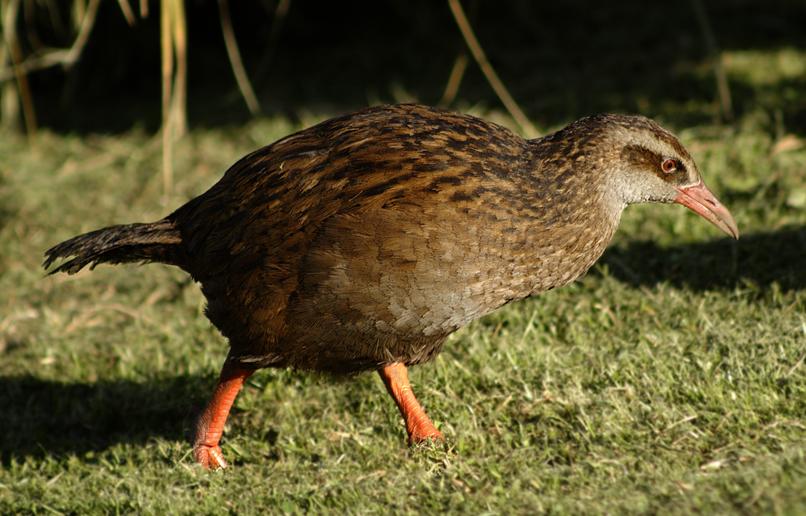
The Weka (Gallirallus australis) is a flightless member of the rail family, Rallidae. The Weka is endemic to New Zealand and inhabits forests, sub-alpine grasslands, sand dunes, rocky shores and modified semi-urban environments. The Weka has predominantly rich brown plumage mottled with black and grey, sturdy legs, reduced wings and a stout reddish-brown beak.
Written 26 November 2026 from the sources listed below. Each statement was checked against the passage it cites; statements that could not be supported were removed.
Appearance
The Weka has predominantly rich brown plumage mottled with black and grey. The shade of brown varies from pale to dark among subspecies.[1][2]
The Weka has a relatively large reddish-brown beak that is stout, tapered and approximately 5 cm long. It has sturdy legs, reduced wings and a pointed tail that it flicks almost constantly.[3][4][5]
Adult males measure 50–60 cm in length and weigh between 532 and 1,605 g. Adult females measure 46–50 cm in length and weigh between 350 and 1,035 g.[6][7][8][9]
The Weka has a reduced wingspan of approximately 50–60 cm. The Stewart Island weka subspecies is smaller than the other recognized subspecies.[10][11]
Habitat
Weka inhabit forests and sub-alpine grasslands. They also live on sand dunes and rocky shores and can inhabit modified semi-urban environments.[12][13][14][15]
Diet
Weka are omnivorous, with animal foods comprising approximately 30% and plant foods approximately 70% of their diet.[16]
Animal foods include earthworms, insect larvae, beetles, wētā, ants, grass grubs, slugs, snails, insect eggs, slaters, frogs and spiders. Weka also eat rats, mice and small birds.[17][18][19]
Plant foods include leaves, grass, berries and seeds. Stewart Island weka have been observed eating sooty shearwater eggs and chicks.[20][21]
Behaviour
The Weka uses its stout beak as a weapon. It searches around houses and camps for food scraps and unfamiliar portable objects, and has been known to take shiny objects.[22][23][24]
Weka help disperse seeds that are too large for smaller berry-eating birds.[25]
Reproduction and life cycle
Weka usually lay eggs between August and January. When food is plentiful, they can produce up to four broods throughout the year.[26][27]
Weka build bowl-shaped nests from grass or similar material on the ground beneath thick vegetation. A typical nest holds approximately four eggs.[28][29][30]
Female weka lay an average of three creamy or pinkish eggs marked with brown and mauve. The average egg dimensions are 57.7 × 39.9 mm.[31][32]
Weka chicks hatch after approximately one month. Both parents feed the chicks until they are fully grown at six to ten weeks.[33][34]
Conservation
The Weka is classified as a vulnerable species. Its populations have disappeared from extensive areas of their former range.[35][36]
Introduced predators including ferrets, cats and dogs threaten adult weka. Stoats and ferrets threaten chicks, while stoats and rats threaten eggs.[37][38]
Habitat depletion threatens weka through the modification and degradation of forests and wetlands. Motor vehicles cause significant roadkill mortality among weka in some regions.[39][40]
Uses
Māori used weka as a food source. Weka perfume and oil were used to treat inflammations.[41][42]
Māori used weka feathers in clothing and as lures for catching dogs.[43]
Classification of the Weka
| Kingdom | Animalia |
|---|---|
| Phylum | Chordata |
| Subphylum | Vertebrata |
| Infraphylum | Gnathostomata |
| Parvphylum | Osteichthyes |
| Megaclass | Tetrapoda |
| Class | Aves (Bird) |
| Order | Gruiformes (Rails) |
| Family | Rallidae (Rail) |
| Genus | Gallirallus (Pacific Rails) |
| Species | Gallirallus australis (Sparrman, 1786) |
Where the Weka is found
Checklists and occurrence records place Gallirallus australis in 2 countries across Oceania. GBIF holds 36,679 georeferenced records of it.
Countries
Regions and cities with the most records
- West Coast, New Zealand 8,147
- Tasman District, New Zealand 8,107
- Southland, New Zealand 4,579
- Paraparaumu, New Zealand 3,715
- Marlborough, New Zealand 3,690
- Wellington Region, New Zealand 3,690
- Chatham Islands, New Zealand 2,089
- Nelson, New Zealand 989
- Stoke, New Zealand 987
- Richmond, New Zealand 838
- Nelson Region, New Zealand 744
- Bay of Plenty, New Zealand 727
- Auckland, New Zealand 635
- Whakatane, New Zealand 630
- Northland, New Zealand 456
- Otago, New Zealand 199
- Blenheim, New Zealand 166
- Gisborne, New Zealand 148
- Canterbury, New Zealand 130
- Lower Hutt, New Zealand 37
- Wainuiomata, New Zealand 37
- Karori, New Zealand 36
- Wellington, New Zealand 36
- Porirua, New Zealand 26
- Gisborne, New Zealand 19
- Rotorua, New Zealand 15
- Waikato Region, New Zealand 15
- Otara, New Zealand 9
- Queensland, Australia 9
- Auckland, New Zealand 8
- Christchurch, New Zealand 8
- Dunedin, New Zealand 8
- Otahuhu, New Zealand 8
- Takanini, New Zealand 8
- Papakura, New Zealand 7
- Tasmania, Australia 7
Range as the checklists state it
Australia
A number beside a place is its count of GBIF occurrence records. A place without a number comes from a checklist alone. Records show where a species has been observed or collected, which can include escapes and vagrants.
Common names
English
- Weka
- Wek
Names in 24 other languages
- Arabic
- ويكا
- Catalan
- rascló weka
- Chinese
- 新西兰秧鸡, 紐西蘭秧雞
- Croatian
- velika kokošica
- Czech
- chřástal weka
- Esperanto
- novzelanda ralo
- Estonian
- Veeka, veeka (veekaruik)
- Finnish
- vekaluhtakana
- French
- Râle wéka
- German
- Weka-Ralle, Wekaralle
- Hebrew
- וקה
- Japanese
- ニュージーランドクイナ
- Korean
- 웨카
- Norwegian
- wekarikse
- Persian
- وکا
- Portuguese
- frango-d'água-neozelandês, frango-d'água-weka, frango-de-água-neozelandês, weka
- Russian
- Пастушок-уэка, Уэка
- Serbian
- Veka
- Slovak
- chriašteľ veka
- Spanish
- Rascón weka
- Swedish
- wekarall
- Ukrainian
- уека
- Welsh
- weca
- ang
- Wuduhen
Synonyms
7 other scientific names have been used for this species and are now treated as synonyms of Gallirallus australis.
- Gallirallus australis insignis Forbes, HO, 1892
- Gallirallus brachypterus de Lafresnaye, NFAA, 1841
- Gallirallus troglodytes Gmelin, JF, 1789
- Ocydromus insignis Forbes, HO, 1892
- Rallus australis Sparrman, 1786
- Rallus philippensis australis Sparrman, A, 1786
- Rallus troglodytes Gmelin, JF, 1789
Subspecies and varieties
- Gallirallus australis australis (Western Weka) subspecies
- Gallirallus australis greyi (North Island Weka) subspecies
- Gallirallus australis hectori (Buff Weka) subspecies
- Gallirallus australis scotti (Stewart Island Weka) subspecies
Related species
-
 Astolfo's RailGallirallus astolfoi
- Nuku Hiva RailGallirallus epulare
- Ua Huka RailGallirallus gracilitibia
- Huahine RailGallirallus storrsolsoni
- Tahuata RailGallirallus roletti
- Tubuai RailGallirallus steadmani
- Gallirallus ernstmayri
- Tinian RailGallirallus pendiculentus
Compare
Questions and answers
What is the scientific name of the Weka?
The scientific name of the Weka is Gallirallus australis. Written with its author, the full name is Gallirallus australis (Sparrman, 1786).
Which family does the Weka belong to?
Gallirallus australis belongs to the family Rallidae, in the order Gruiformes and the class Aves.
Where is the Weka found?
Checklists and occurrence records place Gallirallus australis in 2 countries: New Zealand and Australia.
What is the conservation status of the Weka?
The IUCN Red List category recorded for Gallirallus australis is Vulnerable (VU).
What other names does the Weka have?
Gallirallus australis is also known in English as Wek.
Why is the weka bird protected?
The Weka is classified as a vulnerable species. Threats include introduced predators, habitat depletion and roadkill mortality, and populations have disappeared from extensive areas of their former range.[35][37][38][39][40][36]
What does the weka eat?
Weka are omnivorous, with approximately 30% of their diet consisting of animal foods and 70% of plant foods. They eat invertebrates, frogs, spiders, rats, mice, small birds, leaves, grass, berries and seeds.[16][17][18][19][20]
What kind of diet do birds have?
The Weka has an omnivorous diet, consisting of approximately 30% animal foods and 70% plant foods.[16]
Is a weka a chicken?
The Weka is a flightless member of the rail family, Rallidae.[44]
Sources
Passages the profile rests on
- The weka has predominantly rich brown plumage mottled with black and grey. Source passage: “They are predominantly rich brown mottled with black and grey” — English Wikipedia
- The shade of brown in weka plumage varies from pale to dark among subspecies. Source passage: “the brown shade varies from pale to dark depending on subspecies.” — English Wikipedia
- The weka has a relatively large reddish-brown beak that is stout, tapered and approximately 5 cm long. Source passage: “The relatively large, reddish-brown beak is about 5 cm (2.0 in) long, stout and tapered” — English Wikipedia
- The weka has sturdy legs and reduced wings. Source passage: “Weka have sturdy legs and reduced wings.” — English Wikipedia
- The weka has a pointed tail that it flicks almost constantly. Source passage: “The pointed tail is near-constantly being flicked” — English Wikipedia
- Adult male weka measure 50–60 cm in length. Source passage: “The male is the larger sex at 50–60 cm (20–24 in) in length” — English Wikipedia
- Adult female weka measure 46–50 cm in length. Source passage: “Females measure 46–50 cm (18–20 in) in length” — English Wikipedia
- Male weka weigh between 532 and 1,605 g. Source passage: “532–1,605 g (1.173–3.538 lb) in weight.” — English Wikipedia
- Female weka weigh between 350 and 1,035 g. Source passage: “weigh 350–1,035 g (0.772–2.282 lb).” — English Wikipedia
- The weka has a reduced wingspan of approximately 50–60 cm. Source passage: “The reduced wingspan ranges from 50 to 60 cm (20 to 24 in).” — English Wikipedia
- The Stewart Island weka subspecies is smaller than the other recognized subspecies. Source passage: “The Stewart Island weka (G. a. scotti) is smaller than the other subspecies” — English Wikipedia
- Weka inhabit forests. Source passage: “Weka occupy areas such as forests” — English Wikipedia
- Weka inhabit sub-alpine grasslands. Source passage: “sub-alpine grassland” — English Wikipedia
- Weka inhabit sand dunes and rocky shores. Source passage: “sand dunes, rocky shores” — English Wikipedia
- Weka can inhabit modified semi-urban environments. Source passage: “modified semi-urban environments.” — English Wikipedia
- Weka are omnivorous, with animal foods comprising approximately 30% and plant foods approximately 70% of their diet. Source passage: “They are omnivorous, with a diet comprising 30% animal foods and 70% plant foods.” — English Wikipedia
- Weka consume earthworms, insect larvae, beetles, wētā, ants and grass grubs. Source passage: “Animal foods include earthworms, larvae, beetles, wētā, ants, grass grubs” — English Wikipedia
- Weka also consume slugs, snails, insect eggs, slaters, frogs and spiders. Source passage: “slugs, snails, insect eggs, slaters, frogs, spiders” — English Wikipedia
- Weka consume rats, mice and small birds. Source passage: “rats, mice, and small birds.” — English Wikipedia
- Weka consume leaves, grass, berries and seeds. Source passage: “Plant foods include leaves, grass, berries and seeds.” — English Wikipedia
- Stewart Island weka have been observed eating sooty shearwater eggs and chicks. Source passage: “Stewart Island weka (G. a. scotti) have been observed preying on sooty shearwater (Puffinus griseus) eggs and chicks.” — English Wikipedia
- The weka uses its stout beak as a weapon. Source passage: “stout and tapered, and used as a weapon.” — English Wikipedia
- Weka search around houses and camps for food scraps and unfamiliar portable objects. Source passage: “their furtive curiosity leads them to search around houses and camps for food scraps, or anything unfamiliar and transportable.” — English Wikipedia
- Weka have been known to take shiny objects. Source passage: “They have been known to take shiny objects in particular.” — English Wikipedia
- Weka help disperse seeds that are too large for smaller berry-eating birds. Source passage: “Weka are important in the bush as seed dispersers, distributing seeds too large for smaller berry-eating birds.” — English Wikipedia
- Weka usually lay eggs between August and January. Source passage: “Weka usually lay eggs between August and January” — English Wikipedia
- When food is plentiful, weka can produce up to four broods throughout the year. Source passage: “when food is plentiful, weka can raise up to four broods throughout the whole year.” — English Wikipedia
- Weka build their nests on the ground beneath thick vegetation. Source passage: “Nests are made on the ground under the cover of thick vegetation” — English Wikipedia
- Weka nests are constructed from grass or similar material in the shape of a bowl. Source passage: “built by making grass (or similar material) into a bowl” — English Wikipedia
- A typical weka nest holds approximately four eggs. Source passage: “into a bowl to hold about four eggs.” — English Wikipedia
- Female weka lay an average of three creamy or pinkish eggs marked with brown and mauve. Source passage: “On average, female weka lay three creamy or pinkish eggs blotched with brown and mauve.” — English Wikipedia
- The average dimensions of weka eggs are 57.7 × 39.9 mm. Source passage: “The eggs have mean dimensions of 57.7 mm × 39.9 mm” — English Wikipedia
- Weka chicks hatch after approximately one month. Source passage: “The chicks hatch after a month” — English Wikipedia
- Both parents feed weka chicks until they are fully grown at six to ten weeks. Source passage: “are fed by both parents until fully grown between six and ten weeks.” — English Wikipedia
- The weka is classified as a vulnerable species. Source passage: “Weka are classed as a vulnerable species.” — English Wikipedia
- Weka populations have disappeared from extensive areas of their former range. Source passage: “they have disappeared from huge areas of their former range” — English Wikipedia
- Introduced predators including ferrets, cats and dogs threaten adult weka. Source passage: “Predation by ferrets, cats, and dogs is a threat to adult weka” — English Wikipedia
- Stoats and ferrets threaten weka chicks, while stoats and rats threaten their eggs. Source passage: “stoats and ferrets are a threat to chicks; stoats and rats are a threat to eggs.” — English Wikipedia
- Habitat depletion threatens weka through the modification and degradation of forests and wetlands. Source passage: “Habitat depletion is caused by the modification and degradation of forests and wetlands.” — English Wikipedia
- Motor vehicles cause significant roadkill mortality among weka in some regions. Source passage: “In some regions, motor vehicles cause a significant amount of roadkill death.” — English Wikipedia
- Māori used weka as a food source. Source passage: “Weka were used by the Māori as a source of food” — English Wikipedia
- Māori used weka perfume and oil to treat inflammations. Source passage: “perfume, oil to treat inflammations” — English Wikipedia
- Māori used weka feathers in clothing and as lures for catching dogs. Source passage: “feathers in clothing and lures to catch dogs.” — English Wikipedia
- The weka is a flightless member of the rail family. Source passage: “The weka, also known as the Māori hen or woodhen (Gallirallus australis) is a flightless bird species of the rail family.” — English Wikipedia
Data
- Catalogue of Life, 2026-10-16 XR cc by
- Global Biodiversity Information Facility CC BY 4.0
- Wikidata CC0
- GeoNames CC BY 4.0
- Wikimedia Commons per image; credit shown with each image
- Within the Catalogue of Life, this name comes from The Integrated Taxonomic Information System cc0
References
- Gill, Frank, & and Minturn Wright. (2006). Birds of the World: Recommended English Names.
- Dickinson, E. C., and J. V. Remsen Jr., eds. (2013). The Howard and Moore Complete Checklist of the Birds of the World, 4th Edition, Vol. 1 Non-Passerines.
This species in other databases
Page built on 27 November 2026. See how the catalog is made and all sources and licences.
Cite this page
ScientificNames.org. (2026). Gallirallus australis (Weka). Retrieved November 27, 2026, from https://scientificnames.org/species/gallirallus-australis
“Gallirallus australis (Weka).” ScientificNames.org, 2026, scientificnames.org/species/gallirallus-australis. Accessed 27 Nov. 2026.
ScientificNames.org. “Gallirallus australis (Weka).” Accessed November 27, 2026. https://scientificnames.org/species/gallirallus-australis.
@misc{scientificnames_gallirallus_australis_weka,
  author = {{ScientificNames.org}},
  title = {Gallirallus australis (Weka)},
  year = {2026},
  url = {https://scientificnames.org/species/gallirallus-australis},
  note = {Accessed 2026-11-27}
}