Species · Amphibians
Elegant Narrow-mouthed Toad Gastrophryne elegans
The scientific name of the Elegant Narrow-mouthed Toad is Gastrophryne elegans. It is a species of amphibian in the family Microhylidae (microhylids), order Anura. The name dates from 1882.
- Scientific name
- Gastrophryne elegans (Boulenger, 1882)
- Common name
- Elegant Narrow-mouthed Toad
- Genus
- Gastrophryne
- Family
- Microhylidae (Microhylids)
- Order
- Anura
- Class
- Amphibia
- Red List category
- LC Least Concern
- Recorded in
- 4 countries
- Name status
- accepted in the Catalogue of Life

Overview
Gastrophryne elegans inhabits lowland Mexico, Guatemala, Belize, and Atlantic-side Honduras, including forests, intermittent freshwater marshes, plantations, and rural gardens. It has a small triangular head, a flattened body, distinctive dark dorsal markings, and flattened outer toe tips.
Written 27 November 2026 from the sources listed below. Each statement was checked against the passage it cites; statements that could not be supported were removed.
Appearance
The Elegant Narrow-mouthed Toad has a small triangular head and a body flattened from top to bottom. Its dorsal surface has a broad, irregularly widening and narrowing dark-brown central stripe bordered by a narrow dark line, with reddish-brown areas and dark-brown lines extending from the snout past the eyes and shoulders to the groin.[1][2][3]
The thighs have two dark bands, while additional lines on the lower legs align when the animal crouches. The underside is dark brown or black and mostly covered by indistinct, merging whitish spots.[4][5]
Each hind foot has a metatarsal tubercle and slight webbing on the fourth toe. The outer toes have flattened tips that spread outward.[6][7]
Females reach approximately 27 mm in snout-to-vent length. Males are slightly smaller than females.[8][9]
Habitat
The species inhabits subtropical or tropical dry forests and subtropical or tropical moist lowland forests. It also occurs in intermittent freshwater marshes, plantations, and rural gardens.[10][11][12][13]
It can inhabit heavily degraded former forests. In tropical forests, it lives on the ground among leaf litter.[14][15]
Behaviour
Its variable coloration helps camouflage it among leaf litter.[16]
Reproduction and life cycle
The species breeds during the rainy season in temporary pools.[17]
Conservation
The Elegant Narrow-mouthed Toad is classified as Least Concern by the IUCN. Its large population, broad distribution, and tolerance of habitat modification support this classification.[18][19]
Its population appears relatively stable, and its decline is considered unlikely to be sufficiently rapid to warrant a more threatened classification. The IUCN assessment published in 2019 lists the species as Least Concern.[20][21][22]
The species is protected under Mexico's Special Protection category. Habitat loss is identified as a threat.[23][24]
Classification of the Elegant Narrow-mouthed Toad
| Kingdom | Animalia |
|---|---|
| Phylum | Chordata |
| Subphylum | Vertebrata |
| Infraphylum | Gnathostomata |
| Parvphylum | Osteichthyes |
| Megaclass | Tetrapoda |
| Class | Amphibia (Amphibians) |
| Order | Anura (Frogs) |
| Family | Microhylidae (Microhylids) |
| Subfamily | Gastrophryninae |
| Genus | Gastrophryne (Narrow-mouthed Toads) |
| Species | Gastrophryne elegans (Boulenger, 1882) |
Where the Elegant Narrow-mouthed Toad is found
Checklists and occurrence records place Gastrophryne elegans in 4 countries across North America. GBIF holds 354 georeferenced records of it.
Countries
Regions and cities with the most records
- Veracruz, Mexico 96
- Campeche, Mexico 92
- Catemaco, Mexico 75
- Chiapas, Mexico 37
- San Andrés Tuxtla, Mexico 26
- Quintana Roo, Mexico 21
- Cayo District, Belize 12
- Toledo District, Belize 11
- Escárcega, Mexico 10
- Petén, Guatemala 8
- San Ignacio, Belize 8
- Tabasco, Mexico 7
- Teapa, Mexico 7
- Alto Lucero, Mexico 6
- Túxpam de Rodríguez Cano, Mexico 5
- Santiago Tuxtla, Mexico 4
- Sonora, Mexico 4
- Allende, Mexico 3
- Coatzacoalcos, Mexico 3
- Coscomatepec de Bravo, Mexico 3
- Córdoba, Mexico 3
- Frontera, Mexico 3
- Ixtaczoquitlán, Mexico 3
- José Cardel, Mexico 3
- Nanchital de Lázaro Cárdenas del Río, Mexico 3
- Nogales, Mexico 3
- Orange Walk District, Belize 3
- Orizaba, Mexico 3
- Río Blanco, Mexico 3
Range as the checklists state it
Middle America
A number beside a place is its count of GBIF occurrence records. A place without a number comes from a checklist alone. Records show where a species has been observed or collected, which can include escapes and vagrants.
Common names
English
- Elegant Narrow-mouthed Toad
- Elegant Narrowmouth Toad
Names in 4 other languages
- Czech
- parosnička úhledná
- Russian
- Элегантный узкорот
- Spanish
- Sapito Elegante, Sapo boca angosta elegante, Sapo-boca angosta elegante, ranita triangular, sapito triangular, termitera elegante
- yua
- múuch
Synonyms
2 other scientific names have been used for this species and are now treated as synonyms of Gastrophryne elegans.
- Engystoma elegans Boulenger, 1882
- Microhyla elegans (Boulenger, 1882)
Related species
-
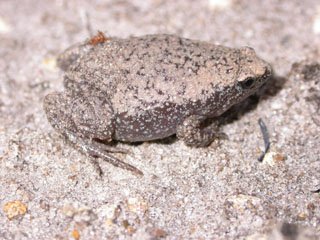 Eastern Narrow-mouthed ToadGastrophryne carolinensis
-
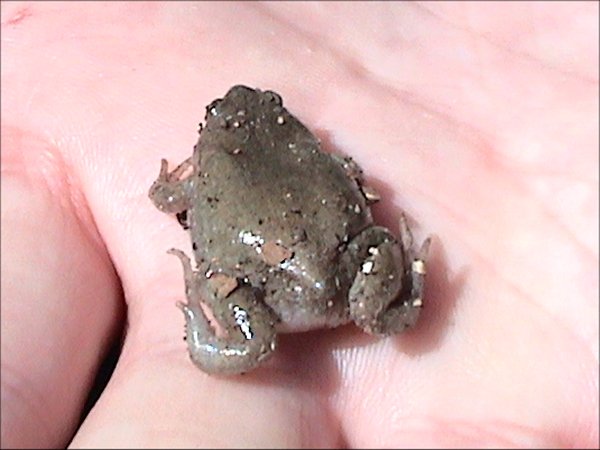 Great Plains Narrow-mouthed ToadGastrophryne olivacea
- Sinaloan Narrow-mouthed ToadGastrophryne mazatlanensis
-
 Galaxy FrogMelanobatrachus indicus
-
 New Guinea Amau FrogPaedophryne amauensis
- Banded BullfrogKaloula pulchra
-
 Dotted Humming FrogChiasmocleis ventrimaculata
-
 Mini mum
Compare
Questions and answers
What is the scientific name of the Elegant Narrow-mouthed Toad?
The scientific name of the Elegant Narrow-mouthed Toad is Gastrophryne elegans. Written with its author, the full name is Gastrophryne elegans (Boulenger, 1882).
Which family does the Elegant Narrow-mouthed Toad belong to?
Gastrophryne elegans belongs to the family Microhylidae, in the order Anura and the class Amphibia.
Where is the Elegant Narrow-mouthed Toad found?
Checklists and occurrence records place Gastrophryne elegans in 4 countries: Mexico, Guatemala, Belize and Honduras.
What is the conservation status of the Elegant Narrow-mouthed Toad?
The IUCN Red List category recorded for Gastrophryne elegans is Least Concern (LC).
What other names does the Elegant Narrow-mouthed Toad have?
Gastrophryne elegans is also known in English as Elegant Narrowmouth Toad.
Where do narrow-mouthed toads live?
The Elegant Narrow-mouthed Toad occurs from north-central coastal Honduras to central Veracruz, with an isolated population in the Sian Ka'an Biosphere Reserve on the Yucatán Peninsula. It inhabits subtropical or tropical dry forests, moist lowland forests, intermittent freshwater marshes, plantations, rural gardens, and heavily degraded former forests.[10][11][12][13][14][25][26]
Sources
Passages the profile rests on
- The species has a small triangular head and a body flattened from top to bottom. Source passage: “The elegant narrow-mouthed toad has a small triangular head and is flattened dorsoventrally.” — English Wikipedia
- Its dorsal surface features a broad, irregularly widening and narrowing dark-brown central stripe bordered by a narrow dark line. Source passage: “The dorsal surface has a broad, dark-brown, central stripe which widens and narrows irregularly and is delineated with a narrow, dark line.” — English Wikipedia
- The dorsal coloration includes reddish-brown areas and dark-brown lines extending from the snout past the eyes and shoulders to the groin. Source passage: “On either side is a reddish-brown area and then a dark-brown line that runs from the tip of the snout, past the eye, over the shoulder to the groin.” — English Wikipedia
- Its thighs have two dark bands, with additional lines on the lower legs that align when it crouches. Source passage: “The thighs have two dark bands and further lines occur on the lower leg which align when the animal is crouched.” — English Wikipedia
- Its underside is dark brown or black and is mostly covered by indistinct, merging whitish spots. Source passage: “The ventral surface is dark brown or black, mostly obscured by indistinct whitish spots which merge.” — English Wikipedia
- Each hind foot has a metatarsal tubercle and slight webbing on the fourth toe. Source passage: “The hind feet each have a tubercle on the metatarsal and slight webbing on the fourth toe.” — English Wikipedia
- The outer toes have flattened tips that spread outward. Source passage: “The outer toes have flattened, spreading tips.” — English Wikipedia
- Females reach approximately 27 mm in snout-to-vent length. Source passage: “The females have a snout-to-vent length of about 27 mm (1.06 in), while the males are slightly smaller.” — English Wikipedia
- Males are slightly smaller than females. Source passage: “The females have a snout-to-vent length of about 27 mm (1.06 in), while the males are slightly smaller.” — English Wikipedia
- The species inhabits subtropical or tropical dry forests. Source passage: “Its natural habitats are subtropical or tropical dry forests,” — English Wikipedia
- The species inhabits subtropical or tropical moist lowland forests. Source passage: “subtropical or tropical moist lowland forests,” — English Wikipedia
- The species occurs in intermittent freshwater marshes. Source passage: “intermittent freshwater marshes,” — English Wikipedia
- The species also occurs in plantations and rural gardens. Source passage: “plantations, rural gardens,” — English Wikipedia
- The species can inhabit heavily degraded former forests. Source passage: “and heavily degraded former forests.” — English Wikipedia
- The species lives on the ground among leaf litter in tropical forests. Source passage: “This species is found in tropical forests, where it lives on the ground among the leaf litter.” — English Wikipedia
- Its variable coloration helps camouflage it among leaf litter. Source passage: “The colouring is somewhat variable and helps to camouflage this frog among the leaf litter.” — English Wikipedia
- The species breeds during the rainy season in temporary pools. Source passage: “It breeds in the rainy season in temporary pools.” — English Wikipedia
- The species is classified as Least Concern by the IUCN. Source passage: “The IUCN rates Gastrophryne elegans as "Least Concern",” — English Wikipedia
- Its large population, broad distribution, and tolerance of habitat modification support its Least Concern classification. Source passage: “because of its large population, wide distribution, and tolerance of modifications to its habitat.” — English Wikipedia
- The species' population appears relatively stable. Source passage: “Its population seems relatively stable” — English Wikipedia
- Its population decline is considered unlikely to be sufficiently rapid to warrant a more threatened classification. Source passage: “any decline is unlikely to be fast enough to justify listing it in a more threatened category.” — English Wikipedia
- The IUCN assessment published in 2019 lists the species as Least Concern. Source passage: “Elegant Narrowmouth Toad Gastrophryne elegans has most recently been assessed for The IUCN 2019. Gastrophryne elegans is listed as Least Concern.” — iucnredlist.org
- The species is protected under Mexico's Special Protection category. Source passage: “It is protected by legislation in Mexico under the "Special Protection" category.” — English Wikipedia
- Habitat loss is identified as a threat to the species. Source passage: “It is threatened by habitat loss.” — English Wikipedia
- Its geographic range extends from north-central coastal Honduras to central Veracruz. Source passage: “Its range extends from north-central coastal areas of Honduras to central Veracruz.” — English Wikipedia
- An isolated population occurs in the Sian Ka'an Biosphere Reserve on the Yucatán Peninsula. Source passage: “An isolated population is found in the Sian Ka'an Biosphere Reserve on the Yucatán Peninsula.” — English Wikipedia
Data
- Catalogue of Life, 2026-10-16 XR cc by
- Global Biodiversity Information Facility CC BY 4.0
- Wikidata CC0
- GeoNames CC BY 4.0
- Wikimedia Commons per image; credit shown with each image
- Within the Catalogue of Life, this name comes from The Integrated Taxonomic Information System cc0
References
- Flores-Villela, Oscar / McCoy, C. J., ed. (1993). Herpetofauna Mexicana: Lista anotada de las especies de anfibios y reptiles de México, cambios taxonómicos recientes, y nuevas especies. Carnegie Museum of Natural History Special Publication, No. 17.
This species in other databases
Page built on 29 November 2026. See how the catalog is made and all sources and licences.
Cite this page
ScientificNames.org. (2026). Gastrophryne elegans (Elegant Narrow-mouthed Toad). Retrieved November 29, 2026, from https://scientificnames.org/species/gastrophryne-elegans
“Gastrophryne elegans (Elegant Narrow-mouthed Toad).” ScientificNames.org, 2026, scientificnames.org/species/gastrophryne-elegans. Accessed 29 Nov. 2026.
ScientificNames.org. “Gastrophryne elegans (Elegant Narrow-mouthed Toad).” Accessed November 29, 2026. https://scientificnames.org/species/gastrophryne-elegans.
@misc{scientificnames_gastrophryne_elegans_elegant_narrow_mouthed_toad,
  author = {{ScientificNames.org}},
  title = {Gastrophryne elegans (Elegant Narrow-mouthed Toad)},
  year = {2026},
  url = {https://scientificnames.org/species/gastrophryne-elegans},
  note = {Accessed 2026-11-29}
}