Species · Other invertebrates
Barrett's Horny Sponge Geodia barretti
The scientific name of the Barrett's Horny Sponge is Geodia barretti. It is a species of animal in the family Geodiidae, order Tetractinellida. The name dates from 1858.
- Scientific name
- Geodia barretti Bowerbank, 1858
- Common name
- Barrett's Horny Sponge
- Genus
- Geodia
- Family
- Geodiidae
- Order
- Tetractinellida
- Class
- Demospongiae
- Environment
- marine
- Recorded in
- 10 countries
- Name status
- accepted in the Catalogue of Life
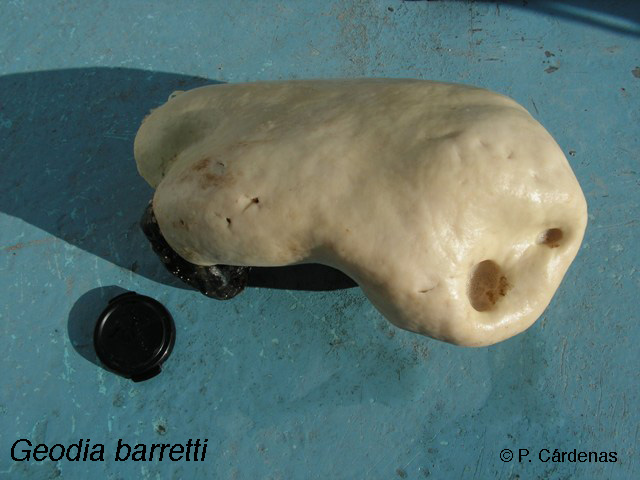
Overview
Barrett's horny sponge (Geodia barretti Bowerbank, 1858) is an invertebrate in the family Geodiidae, order Tetractinellida, and class Demospongiae. It occurs throughout the boreal waters of the North Atlantic, with a main geographical distribution along the Swedish west coast, the Norwegian coast, and Svalbard. It has a distinct cortex approximately 0.5 mm thick, composed of spherical sterraster spicules.
Written 26 November 2026 from the sources listed below. Each statement was checked against the passage it cites; statements that could not be supported were removed.
Appearance
Barrett's horny sponge has a massive body that is often irregularly lobed. Its color ranges from whitish to light yellow, while its internal tissue is light brown.[1][2]
Its oscules occur in groups within relatively shallow depressions, while its pores are distributed across the entire body. It has a distinct cortex approximately 0.5 mm thick, composed of spherical sterraster spicules.[3][4]
Habitat
Barrett's horny sponge is a dominant component of boreal sponge grounds. It occurs in sponge aggregations on the outer continental shelf and upper slope of the northeastern Atlantic.[5][6]
The species commonly occurs in shallow Norwegian coastal waters, particularly in fjords. It has been recorded at depths ranging from 30 to 2,000 m, with most northeastern Atlantic records occurring along continental margins at depths between 200 and 500 m.[7][8][9]
In the northwestern Atlantic, it has been recorded at depths between 410 and 1,852 m. It has also been recorded on the eastern slopes of the Faroe-Shetland Channel at approximately 500 m depth.[10][11]
In high-energy environments, the sponge attaches itself to stable substrates. In lower-energy environments, it incorporates small stones to maintain negative buoyancy rather than attaching itself to the substrate.[12][13]
The species occurs in waters where temperatures are usually between 3 and 9 °C.[14]
Behaviour
The sponge-feeding deep-sea chiton Hanleya nagelfar is frequently found on Barrett's horny sponge in the northeastern Atlantic. The parasitic foraminiferan Hyrrokkin sarcophaga is occasionally found living on the species.[15][16]
Reproduction and life cycle
Barrett's horny sponge reproduces by laying eggs and has separate male and female individuals. Its reproductive cycle is annual, with one or two gamete-release events each year.[17][18]
Its main reproductive season extends from late spring to early autumn. Individuals within the same local population are thought to reproduce simultaneously within a restricted period.[19][20]
In two Scandinavian fjords, the onset of reproduction coincides with phytoplankton blooms. Gamete release is considered likely during early summer and again in October following seasonal phytoplankton blooms.[21][22]
Uses
The compound barettin, isolated from Barrett's horny sponge, has antifouling activity.[23]
Classification of the Barrett's Horny Sponge
| Kingdom | Animalia |
|---|---|
| Phylum | Porifera |
| Class | Demospongiae (Demosponge) |
| Subclass | Heteroscleromorpha |
| Order | Tetractinellida |
| Suborder | Astrophorina |
| Family | Geodiidae |
| Subfamily | Geodiinae |
| Genus | Geodia |
| Species | Geodia barretti Bowerbank, 1858 |
Where the Barrett's Horny Sponge is found
Checklists and occurrence records place Geodia barretti in 10 countries. GBIF holds 4,345 georeferenced records of it.
Countries
- Faroe Islands 21
- France 8
- Iceland 21
- Ireland 8
- Norway 3,087
- Russia 6
- Spain 3
- Svalbard and Jan Mayen 105
- Sweden 1,065
- United Kingdom 21
Regions and cities with the most records
- Bodø, Norway 85
- Kristiansund, Norway 56
- Halden, Norway 15
- Haugesund, Norway 14
- Alta, Norway 11
- Nordland, Norway 9
- Levanger, Norway 6
- Tromsdalen, Norway 6
- Tromsø, Norway 6
- Molde, Norway 4
- Troms, Norway 3
5 more countries have a few records outside this range
These countries hold a few records of Geodia barretti but lie outside the range the checklists give for it. Such records are often zoo or garden specimens, museum material or vagrants, so the species is not counted as occurring there.
A number beside a place is its count of GBIF occurrence records. A place without a number comes from a checklist alone. Records show where a species has been observed or collected, which can include escapes and vagrants.
Common names
English
- Barrett's Horny Sponge
Names in 6 other languages
- Czech
- houba Barrettova
- French
- éponge de Barrett
- Norwegian
- kålrabisvamp
- Portuguese
- Esponja-batata
- Russian
- Геодия
- Swedish
- fotbollssvamp, fotbollssvampdjur, futbollssvampdjur
Synonyms
4 other scientific names have been used for this species and are now treated as synonyms of Geodia barretti.
- Cydonium barretti (Bowerbank, 1858)
- Cydonium barretti Gray, 1867
- Geodia simplicissima Burton, 1931
- Sidonops barretti von Lendenfeld, 1903
Related species
- White Encrusting SpongeGeodia gibberosa
-
 Geodia megastrella
- Geodia angulata
-
 Geodia macandrewii
- Geodia cooksoni
- Geodia hirsuta
- Geodia alba
- Geodia conchilega
Compare
Questions and answers
What is the scientific name of the Barrett's Horny Sponge?
The scientific name of the Barrett's Horny Sponge is Geodia barretti. Written with its author, the full name is Geodia barretti Bowerbank, 1858.
Which family does the Barrett's Horny Sponge belong to?
Geodia barretti belongs to the family Geodiidae, in the order Tetractinellida and the class Demospongiae.
Where is the Barrett's Horny Sponge found?
Checklists and occurrence records place Geodia barretti in 10 countries, including Norway, Sweden, Svalbard and Jan Mayen, Faroe Islands, Iceland and United Kingdom.
Sources
Passages the profile rests on
- The species has a massive body that is often irregularly lobed and ranges in color from whitish to light yellow. Source passage: “Massive sponge, often irregularly lobate, whitish to light yellow color.” — English Wikipedia
- The internal tissue of the sponge is light brown. Source passage: “The inside is light brown.” — English Wikipedia
- Its oscules occur in groups within relatively shallow depressions, while its pores are distributed across the entire body. Source passage: “Oscules are grouped in more or less shallow depressions (= preoscules) while pores are spread over the whole body.” — English Wikipedia
- The species has a distinct cortex approximately 0.5 mm thick, composed of spherical sterraster spicules. Source passage: “There is a distinct cortex about 0.5 mm thick, it is made of ball-shaped spicules called sterrasters.” — English Wikipedia
- The species is a dominant component of boreal sponge grounds. Source passage: “It is a dominant species in boreal sponge grounds.” — English Wikipedia
- The species occurs in sponge aggregations on the outer continental shelf and upper slope of the northeastern Atlantic. Source passage: “Geodia barretti, Geodia macandrewii, Geodia atlantica and Geodia phlegraei, of the class Demospongiae (sub-order Astrophorina) form aggregations on the outer shelf and upper slope over large areas of the NE Atlantic” — marlin.ac.uk
- The species commonly occurs in shallow Norwegian coastal waters, particularly in fjords. Source passage: “Shallow specimens are common along the Norwegian coast, especially in fjords.” — English Wikipedia
- The species has been recorded at depths ranging from 30 to 2,000 m. Source passage: “It is found from 30 to 2000 meter depths.” — English Wikipedia
- Most northeastern Atlantic records occur along continental margins at depths between 200 and 500 m. Source passage: “Most North-East Atlantic records are from the continental margins, between 200 and 500 m.” — English Wikipedia
- In the northwestern Atlantic, the species has been recorded at depths between 410 and 1,852 m. Source passage: “In the North-West Atlantic (Grand Banks, Flemish Cap, Nova Scotia, and Davis Strait), it has been recorded between 410 and 1852 meter depths.” — English Wikipedia
- The species has been recorded on the eastern slopes of the Faroe-Shetland Channel at approximately 500 m depth. Source passage: “This biotope has been found at approximately 500 m on the eastern slopes of the Faroe-Shetland Channel.” — marlin.ac.uk
- In high-energy environments, the sponge attaches itself to stable substrates. Source passage: “In high-energy environments, Geodia barretti is found attached to stable substrata” — marlin.ac.uk
- In lower-energy environments, the sponge incorporates small stones to maintain negative buoyancy rather than attaching itself to the substrate. Source passage: “while in areas with lower energy it is not attached, but incorporates small stones in order to maintain negative buoyancy (Tjensvoll et al., 2013).” — marlin.ac.uk
- The species occurs in waters where temperatures are usually between 3 and 9 °C. Source passage: “where water temperature is usually 3-9 degrees Celsius.” — English Wikipedia
- The sponge-feeding deep-sea chiton Hanleya nagelfar is frequently found on this sponge in the northeastern Atlantic. Source passage: “The sponge-feeding deep-sea chiton Hanleya nagelfar is often found on G. barretti in the North-East Atlantic.” — English Wikipedia
- The parasitic foraminiferan Hyrrokkin sarcophaga is occasionally found living on the species. Source passage: “The parasitic foraminiferan Hyrrokkin sarcophaga is more rarely found living on G. barretti.” — English Wikipedia
- The species reproduces by laying eggs and has separate male and female individuals. Source passage: “G. barretti is an oviparous species with separated males and females.” — English Wikipedia
- Its reproductive cycle is annual, with one or two gamete-release events each year. Source passage: “The reproductive cycle is annual with one or two events of gamete release per year” — English Wikipedia
- Its main reproductive season extends from late spring to early autumn. Source passage: “the major reproductive season being from late spring to early autumn.” — English Wikipedia
- Individuals within the same local population are thought to reproduce simultaneously within a restricted period. Source passage: “Individuals are thought to reproduce simultaneously within the same local population, within a restricted time period” — marlin.ac.uk
- In two Scandinavian fjords, the onset of reproduction coincides with phytoplankton blooms. Source passage: “In two Scandinavian fjords, the onset of reproduction coincides with the phytoplankton blooms” — marlin.ac.uk
- Gamete release is considered likely during early summer and again in October following seasonal phytoplankton blooms. Source passage: “i.e. in early summer, but also in October after the autumn phytoplankton blooms (Spetland et al., 2007).” — marlin.ac.uk
- The compound barettin, isolated from this species, has antifouling activity. Source passage: “barettin has antifouling activity.” — English Wikipedia
Data
- Catalogue of Life, 2026-10-16 XR cc by
- Global Biodiversity Information Facility CC BY 4.0
- Wikidata CC0
- GeoNames CC BY 4.0
- Wikimedia Commons per image; credit shown with each image
- Within the Catalogue of Life, this name comes from World Porifera Database cc by
References
- Bowerbank, J. S. (1858). On the Anatomy and Physiology of the Spongiadae. Part I. On the Spicula. Philosophical Transactions of the Royal Society, 148. where the name was published
This species in other databases
- Catalogue of Life 3FP96
- Wikidata Q946464
- iNaturalist 459743
- WoRMS urn:lsid:marinespecies.org:taxname:134023
Page built on 28 November 2026. See how the catalog is made and all sources and licences.
Cite this page
ScientificNames.org. (2026). Geodia barretti (Barrett's Horny Sponge). Retrieved November 28, 2026, from https://scientificnames.org/species/geodia-barretti
“Geodia barretti (Barrett's Horny Sponge).” ScientificNames.org, 2026, scientificnames.org/species/geodia-barretti. Accessed 28 Nov. 2026.
ScientificNames.org. “Geodia barretti (Barrett's Horny Sponge).” Accessed November 28, 2026. https://scientificnames.org/species/geodia-barretti.
@misc{scientificnames_geodia_barretti_barretts_horny_sponge,
  author = {{ScientificNames.org}},
  title = {Geodia barretti (Barrett's Horny Sponge)},
  year = {2026},
  url = {https://scientificnames.org/species/geodia-barretti},
  note = {Accessed 2026-11-28}
}