Species · Molluscs
Buffalo Pebblesnail Gillia altilis
The scientific name of the Buffalo Pebblesnail is Gillia altilis. It is a species of mollusc in the family Lithoglyphidae, order Littorinimorpha. The name dates from 1841.
- Scientific name
- Gillia altilis (I. Lea, 1841)
- Common name
- Buffalo Pebblesnail
- Genus
- Gillia
- Family
- Lithoglyphidae
- Order
- Littorinimorpha
- Class
- Gastropoda
- Red List category
- LC Least Concern
- Environment
- freshwater
- Recorded in
- 2 countries
- Name status
- accepted in the Catalogue of Life
Overview
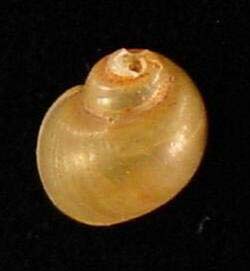
The buffalo pebblesnail (Gillia altilis) is a freshwater gastropod mollusc in the family Lithoglyphidae, order Littorinimorpha, and class Gastropoda. It inhabits freshwater streams, lakes, and rapidly flowing waters, with records from New York State and Vermont. It has an inflated, conical yellow-to-green shell with distinct shoulders on its whorls.
Written 27 November 2026 from the sources listed below. Each statement was checked against the passage it cites; statements that could not be supported were removed.
Appearance
The shell is inflated and conical, with yellow-to-green coloration and distinct shoulders on each whorl. It has approximately 4.5 whorls when intact and 2–4 whorls when eroded, and measures 6–8 mm in height.[1][2][3][4]
The umbilicus is absent or very small, and the columella is not thickened. The shell can be thin or thick, its aperture is oval to ear-shaped, and its outer lip curves forward when viewed from the side.[5][6][7][8]
The operculum is oval and chitinous, with yellow-to-green coloration, paucispiral markings, and a subcentral nucleus. The mantle is black or darkly pigmented, with dark pigmentation also present on the nape, front of the snout, tentacle tips, and edge of the peristome.[9][10][11]
The radula resembles a single serrated blade and has 51–55 rows of teeth. Each row has two central basocones, three to four central octocones, eight to nine lateral teeth, approximately 30 inner marginal teeth, and six to nine outer marginal teeth.[12][13]
Habitat
The species is usually found in freshwater streams and inhabits both stagnant lake and stream waters and rapidly flowing waters.[14][15]
In Vermont, it occurs in Hudson River shoals with macrophyte cover and muddy substrates. In New York State, it commonly inhabits warm, shallow lake habitats with muddy substrates.[16][17]
Diet
The buffalo pebblesnail grazes on coarser food particles than those consumed by related snails in the subfamily Lithoglyphinae.[18]
Reproduction and life cycle
The species has separate male and female sexes. Males transfer sperm to females using a penis extending from the nape.[19][20]
Eggs are deposited in hemispherical capsules, either singly or in clusters of up to six. The capsules measure approximately 1.25 mm in diameter and are attached to macrophyte leaves and stems, stones, or leaf litter.[21][22][23]
Conservation
Some native populations are declining or are not abundant. Vermont considers the species an invertebrate species of greatest conservation need.[24][25]
In New York State, the species is listed as a species of special concern and ranked S1. Habitat modification, pesticides, and competition with introduced species are identified as major threats to vulnerable or declining gastropod populations in New York State.[26][27]
No negative impacts have been recorded for the species in the Great Lakes system. No impacts are currently known in other water bodies.[28][29]
Classification of the Buffalo Pebblesnail
| Kingdom | Animalia |
|---|---|
| Phylum | Mollusca |
| Class | Gastropoda (Gastropod) |
| Subclass | Caenogastropoda |
| Order | Littorinimorpha |
| Superfamily | Truncatelloidea |
| Family | Lithoglyphidae |
| Subfamily | Lithoglyphinae |
| Genus | Gillia |
| Species | Gillia altilis (I. Lea, 1841) |
Where the Buffalo Pebblesnail is found
Checklists and occurrence records place Gillia altilis in 2 countries. GBIF holds 422 georeferenced records of it.
Countries
Regions and cities with the most records
- North Carolina, United States 51
- Vermont, United States 38
- Pennsylvania, United States 37
- New York, United States 28
- Cherry Hill, United States 20
- Maple Shade, United States 20
- New Jersey, United States 20
- Pennsauken, United States 20
- Baileys Crossroads, United States 19
- Camden, United States 19
- Philadelphia, United States 18
- Abington, United States 17
- Annandale, United States 17
- Arlington, United States 17
- Capitol Riverfront, United States 17
- Lincolnia, United States 17
- Southwest Waterfront, United States 17
- Alexandria, United States 16
- Camp Springs, United States 16
- Clinton, United States 16
- Fort Hunt, United States 16
- Franconia, United States 16
- Glassmanor, United States 16
- Hillcrest Heights, United States 16
- Hybla Valley, United States 16
- Oxon Hill, United States 16
- Oxon Hill-Glassmanor, United States 16
- Rose Hill, United States 16
- Suitland, United States 16
- Suitland-Silver Hill, United States 16
- West Falls Church, United States 16
- Adams Morgan, United States 15
- Brightwood, United States 15
- Idylwood, United States 15
- McLean, United States 15
- Merrifield, United States 15
A number beside a place is its count of GBIF occurrence records. A place without a number comes from a checklist alone. Records show where a species has been observed or collected, which can include escapes and vagrants.
Common names
English
- Buffalo Pebblesnail
Synonyms
2 other scientific names have been used for this species and are now treated as synonyms of Gillia altilis.
- Leptoxis crenata Haldeman, 1847
- Melania altilis I. Lea, 1841
Related species
-
 Gravel SnailLithoglyphus naticoides
-
 Cahaba PebblesnailClappia cahabensis
-
 Umbilicate PebblesnailClappia umbilicata
-
 Flat PebblesnailLepyrium showalterii
- Tennessee PebblesnailSomatogyrus currierianus
- Thick-lipped PebblesnailSomatogyrus crassilabris
- Channeled PebblesnailSomatogyrus wheeleri
- Ouachita PebblesnailSomatogyrus amnicoloides
Compare
Questions and answers
What is the scientific name of the Buffalo Pebblesnail?
The scientific name of the Buffalo Pebblesnail is Gillia altilis. Written with its author, the full name is Gillia altilis (I. Lea, 1841).
Which family does the Buffalo Pebblesnail belong to?
Gillia altilis belongs to the family Lithoglyphidae, in the order Littorinimorpha and the class Gastropoda.
Where is the Buffalo Pebblesnail found?
Checklists and occurrence records place Gillia altilis in 2 countries: United States and Canada.
What is the conservation status of the Buffalo Pebblesnail?
The IUCN Red List category recorded for Gillia altilis is Least Concern (LC).
Sources
Passages the profile rests on
- The shell is inflated and conical, with a yellow-to-green coloration. Source passage: “The shell of this species is inflated but still conical. The shell color is usually yellow to green.” — English Wikipedia
- The shell has approximately 4.5 whorls when intact and 2–4 whorls when eroded. Source passage: “The shell has 2–4 whorls when eroded, and ~4.5 when intact.” — English Wikipedia
- Each shell whorl has a distinct shoulder. Source passage: “Each whorl is distinctly shouldered.” — English Wikipedia
- The shell measures 6–8 mm in height. Source passage: “The height of the shell is 6–8 mm (1⁄4–5⁄16 in).” — English Wikipedia
- The shell's umbilicus is absent or very small. Source passage: “The umbilicus is either not apparent, or very small.” — English Wikipedia
- The columella is not thickened, and the shell can be either thin or thick. Source passage: “The columella is not thickened, and the shell itself can be thin or thick.” — English Wikipedia
- The shell aperture is oval to ear-shaped. Source passage: “The shell aperture is oval to ear-shaped.” — English Wikipedia
- The shell's outer lip curves forward when viewed from the side. Source passage: “When viewed laterally, the outer lip of the shell bends forward.” — English Wikipedia
- The operculum is oval, chitinous, and yellow to green, with paucispiral markings and a subcentral nucleus. Source passage: “The operculum is chitinous, oval, yellow to green in color and shows paucispiral markings, with a subcentral nucleus.” — English Wikipedia
- The mantle is black or darkly pigmented. Source passage: “The mantle is black, or shows dark pigmentation.” — English Wikipedia
- Dark pigmentation also occurs on the nape, front of the snout, tentacle tips, and edge of the peristome. Source passage: “This pigmentation is also seen in the nape, the anterior part of the snout, the top of the tentacles, and along the edge of the peristome” — English Wikipedia
- The radula resembles a single serrated blade and has 51–55 rows of teeth. Source passage: “The radula of Gillia altilis looks like a single serrated blade, with 51-55 rows of teeth.” — English Wikipedia
- Each radular row has two central basocones, three to four central octocones, eight to nine lateral teeth, approximately 30 inner marginal teeth, and six to nine outer marginal teeth. Source passage: “Each row has 2 central basocones, 3-4 central octocones, 8-9 lateral teeth, ca. 30 inner marginal teeth and 6-9 outer marginal teeth.” — English Wikipedia
- The species is usually found in freshwater streams. Source passage: “Gillia altilis is usually found in freshwater stream environments.” — English Wikipedia
- The species inhabits both stagnant lake and stream waters and rapidly flowing waters. Source passage: “In fact, it is not uncommon for Gillia altilis to inhabit both stagnant waters in lakes and streams and rapidly moving waters.” — English Wikipedia
- In Vermont, the species occurs in Hudson River shoals with macrophyte cover and muddy substrates. Source passage: “In Vermont, it is found in the Hudson River in shoals where there is macrophyte cover and mud substrate.” — English Wikipedia
- In New York State, the species commonly inhabits warm, shallow lake habitats with muddy substrates. Source passage: “In New York State, it also commonly inhabits warmwater, shallow lacustrine habitats with mud substrate.” — English Wikipedia
- The species grazes on coarser food particles than those consumed by related snails in the subfamily Lithoglyphinae. Source passage: “which are adapted for grazing on coarser food particles than are eaten by related snails in the subfamily Lithoglyphinae.” — English Wikipedia
- The species has separate male and female sexes. Source passage: “Gillia altilis exhibits separate sexes.” — English Wikipedia
- Males transfer sperm to females using a penis extending from the nape. Source passage: “Sperm is transmitted to the female through a penis that extends from the nape of the male.” — English Wikipedia
- Eggs are deposited in hemispherical capsules, either singly or in clusters of up to six. Source passage: “This species lays its eggs in hemisphere-shaped capsules, singly or in clumps up to six at a time” — English Wikipedia
- Egg capsules are attached to macrophyte leaves and stems, stones, or leaf litter. Source passage: “on leaves and stems of macrophytes (or stones and leaf litter).” — English Wikipedia
- The egg capsules measure approximately 1.25 mm in diameter. Source passage: “The egg capsules are ~1.25 mm in diameter.” — English Wikipedia
- Some native populations are declining or are not abundant. Source passage: “In some regions where Gillia altilis is native, populations are declining or not very abundant” — English Wikipedia
- Vermont considers the species an invertebrate species of greatest conservation need. Source passage: “in Vermont, this species is considered to be an invertebrate species in "greatest conservation need".” — English Wikipedia
- In New York State, the species is listed as a species of special concern and ranked S1. Source passage: “This snail is listed as a species of special concern in its native range in New York State, where the species is ranked as S1” — English Wikipedia
- Habitat modification, pesticides, and competition with introduced species are identified as major threats to vulnerable or declining gastropod populations in New York State. Source passage: “Loss of habitat due to anthropogenic modifications, pesticides and competition with introduced species are considered the major threats to declining or vulnerable gastropod populations in New York State.” — English Wikipedia
- No negative impacts have been recorded for the species in the Great Lakes system. Source passage: “At this time, there are no recorded negative impacts in the Great Lakes system.” — English Wikipedia
- No impacts are currently known in other water bodies. Source passage: “There are also no known impacts in other water bodies at present.” — English Wikipedia
Data
- Catalogue of Life, 2026-10-16 XR cc by
- Global Biodiversity Information Facility CC BY 4.0
- Wikidata CC0
- GeoNames CC BY 4.0
- Wikimedia Commons per image; credit shown with each image
- Within the Catalogue of Life, this name comes from World Register of Marine Species cc by
This species in other databases
Page built on 29 November 2026. See how the catalog is made and all sources and licences.
Cite this page
ScientificNames.org. (2026). Gillia altilis (Buffalo Pebblesnail). Retrieved November 29, 2026, from https://scientificnames.org/species/gillia-altilis
“Gillia altilis (Buffalo Pebblesnail).” ScientificNames.org, 2026, scientificnames.org/species/gillia-altilis. Accessed 29 Nov. 2026.
ScientificNames.org. “Gillia altilis (Buffalo Pebblesnail).” Accessed November 29, 2026. https://scientificnames.org/species/gillia-altilis.
@misc{scientificnames_gillia_altilis_buffalo_pebblesnail,
  author = {{ScientificNames.org}},
  title = {Gillia altilis (Buffalo Pebblesnail)},
  year = {2026},
  url = {https://scientificnames.org/species/gillia-altilis},
  note = {Accessed 2026-11-29}
}