Species · Flowering plants
Flame Lily Gloriosa superba
The scientific name of the Flame Lily is Gloriosa superba. It is a species of flowering plant in the family Colchicaceae (meadow saffron family), order Liliales.
- Scientific name
- Gloriosa superba L.
- Common name
- Flame Lily
- Genus
- Gloriosa
- Family
- Colchicaceae (Meadow Saffron Family)
- Order
- Liliales
- Class
- Liliopsida
- Red List category
- LC Least Concern
- Recorded in
- 69 countries
- Name status
- accepted in the Catalogue of Life
Overview
Gloriosa superba occurs in tropical forests, savannahs, grasslands, dunes, agricultural field edges, barren lands and roadsides.
Written 26 November 2026 from the sources listed below. Each statement was checked against the passage it cites; statements that could not be supported were removed.
Appearance
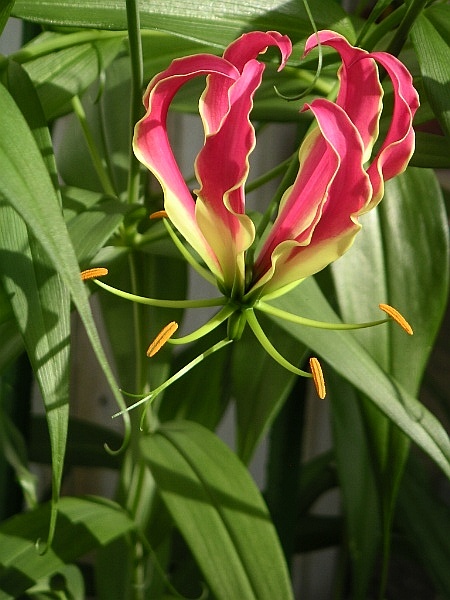
Mature flowers can be yellow, red, off-white, orange, maroon or purple-brown. Individual flowers measure approximately 7.6–12 centimetres long and 4.5–7 centimetres in diameter, with flower stalks reaching 20 centimetres in length.[1][2][3]
The leaves are lance-shaped or elongated oval-shaped, with coiled tips bearing green tendrils. These tendrils help the plant attach to supporting surfaces.[4][5]
The fruit is a fleshy capsule containing several red seeds.[6]
Habitat
The Flame Lily occurs in tropical forests, savannahs, grasslands, dunes, agricultural field edges, barren lands and roadsides. It also naturally grows in forests, thickets, grasslands and nutrient-poor sandy habitats.[7][8]
Wild populations are generally found at elevations between 900 and 1,300 metres, although occurrences up to 2,500 metres have been recorded.[9]
The species has been introduced to Alabama, Hawaii, parts of the Caribbean, Suriname, Australia and various Pacific Islands.[10]
Behaviour
The Flame Lily climbs by using tendrils at the tips of its leaves to attach itself to other plants or structures. Its stems die back in late summer or autumn.[11][12]
Reproduction and life cycle
The species can reproduce through seeds or by vegetative division of its rhizome. It is likely pollinated by butterflies and sunbirds in its natural habitats.[13][14]
Seed germination can take up to one year, even after cold stratification. Plants grown from seeds can take approximately three years to reach maturity and generally require three to four years to flower.[15][16][17]
Conservation
The species has become rarer in Southern Africa, Bangladesh, Sri Lanka and certain parts of India. Harvesting wild plants for traditional medicine has contributed to population declines.[18][19]
The species is classified as invasive in Australia and several Pacific Island territories. It is considered a noxious weed in Australia, some Pacific islands and parts of the United States.[20][21]
Uses
The Flame Lily is cultivated as an ornamental plant because of its varied flower colours. It is also used as a houseplant in bright, sunny windows.[22][23]
The plant contains colchicine, an alkaloid used in pharmaceutical production. Colchicine obtained from the plant is used to treat gout and other inflammatory disorders.[24][25][26]
The species has been used in traditional medicine, including Ayurvedic preparations. Its leaves are traditionally used to treat asthma in the Democratic Republic of Congo and rheumatism in Burundi.[27][28]
Plant derivatives are used in arrow poison in Africa and as snake repellent in India.[29]
Classification of the Flame Lily
| Kingdom | Plantae |
|---|---|
| Subkingdom | Pteridobiotina |
| Phylum | Tracheophyta |
| Class | Liliopsida |
| Order | Liliales |
| Family | Colchicaceae (Meadow Saffron Family) |
| Genus | Gloriosa (Flame Lilies) |
| Species | Gloriosa superba L. |
Where the Flame Lily is found
Checklists and occurrence records place Gloriosa superba in 69 countries across Africa, Asia, North America, Oceania and South America. GBIF holds 10,088 georeferenced records of it.
Countries where it is native or its origin is not stated
- Angola 127
- Bangladesh 5
- Benin 481
- Botswana 60
- Brunei 9
- Burkina Faso 19
- Burundi 43
- Cambodia 24
- Cameroon 194
- Central African Republic 23
- Chad 17
- China 41
- Democratic Republic of the Congo 603
- Equatorial Guinea 43
- Eswatini 19
- Ethiopia 43
- Gabon 147
- Gambia 11
- Ghana 46
- Guinea 103
- Guinea-Bissau 14
- India 1,772
- Indonesia 196
- Ivory Coast 135
- Kenya 196
- Laos 6
- Liberia 38
- Madagascar 279
- Malawi 88
- Malaysia 75
- Maldives 32
- Mali 5
- Mauritius 3
- Mozambique 103
- Myanmar 16
- Namibia 95
- Nepal 11
- Niger 17
- Nigeria 104
- Pakistan 11
- Republic of the Congo 35
- Rwanda 60
- Senegal 47
- Seychelles 37
- Sierra Leone 18
- Singapore 48
- Somalia 11
- South Africa 1,073
- Sri Lanka 262
- Sudan 7
- Tanzania 280
- Thailand 116
- Togo 34
- Uganda 53
- Vietnam 48
- Zambia 99
- Zimbabwe 262
Countries where it has been introduced
- Australia 1,833
- Cook Islands 25
- Fiji 7
- French Polynesia 38
- Kiribati 14
- Nauru
- Reunion 25
- Solomon Islands 5
- Suriname 8
- Trinidad and Tobago 8
- United States 365
- Vanuatu 16
Regions and cities with the most records
- New South Wales, Australia 1,157
- Queensland, Australia 495
- Karnataka, India 320
- KwaZulu-Natal, South Africa 319
- Maharashtra, India 319
- Eastern Cape, South Africa 296
- Florida, United States 255
- Tamil Nadu, India 244
- Port Macquarie, Australia 230
- Kerala, India 198
- Gonubie, South Africa 189
- East London, South Africa 174
- Limpopo, South Africa 154
- Zou, Benin 146
- Central Coast, Australia 138
- Sunshine Coast, Australia 127
- Mpumalanga, South Africa 122
- Mdantsane, South Africa 98
- Caloundra, Australia 97
- Bengaluru, India 93
- Telangana, India 81
- Jigani, India 79
- Andhra Pradesh, India 77
- Durban, South Africa 77
- Electronic City Phase I, India 76
- koppana Agrahara, India 76
- Hebbagodi, India 75
- Manicaland, Zimbabwe 75
- Bommasandra Industrial Area, India 73
- Haut-Katanga, Democratic Republic of the Congo 70
- Ntuzuma, South Africa 64
- Sydney, Australia 62
- Atlantique, Benin 61
- Atakora, Benin 56
- Gujarat, India 56
- Kumbalam, India 56
26 more countries have a few records outside this range
These countries hold a few records of Gloriosa superba but lie outside the range the checklists give for it. Such records are often zoo or garden specimens, museum material or vagrants, so the species is not counted as occurring there.
- American Samoa 3
- Bahamas 3
- Belgium 7
- Bermuda 3
- Bonaire, Saint Eustatius and Saba 4
- Brazil 15
- Canada 3
- Christmas Island 5
- Colombia 5
- Costa Rica 21
- El Salvador 7
- France 8
- French Guiana 4
- Germany 3
- Guadeloupe 3
- Martinique 18
- New Caledonia 6
- New Zealand 7
- Niue 4
- Panama 5
- Papua New Guinea 15
- Samoa 10
- The Netherlands 3
- Timor Leste 15
- Tuvalu 3
- United Kingdom 5
A number beside a place is its count of GBIF occurrence records. A place without a number comes from a checklist alone. Records show where a species has been observed or collected, which can include escapes and vagrants.
Common names
English
- Flame Lily
- Climbing Liliy
- Climing Lily
- Dragon Flower
- Gloriosa Lily
- Glory Lily
- Superb Lily
- Tiger's Claws
- Turk' S Cap
- Turk's Fez
- Wild Aconite
- Yellow Flame Lily
- Climbing-lily
- Creeping-lily
- Flame-lily
- Glory-lily
Names in 42 other languages
- Afrikaans
- Geelboslelie, Geelvlamlelie, Rooiboslelie, Vlamlelie
- Catalan
- Lliri de Foc
- Chinese
- 嘉蘭 鐵線雞爪, 嘉蘭百合
- Czech
- glorióza vznešená
- Danish
- klatrelilje
- Dutch
- Klimlelie
- Finnish
- keijunlilja
- German
- Ruhmeskrone
- Gujarati
- અગ્નિશિખા, વછનાગ
- Indonesian
- Kembang Sungsang
- Japanese
- ユリグルマ, 狐百合
- Kannada
- ಅಗ್ನಿಶಿಖೆ
- Malay
- Pokok Kembang Songsang
- Malayalam
- കാളിഹാരി
- Marathi
- अग्निशिखा, कलिहारी
- Polish
- glorioza wspaniała
- Portuguese
- Lírio-da-glória, Lírio-de-chama, Lírio-de-escalada, Lírio-rastejante, gloriosa, lírio-trepador
- Punjabi
- ਕਲਿਹਾਰੀ
- Russian
- Глориоза роскошная
- Sinhala
- නියඟලා
- Slovak
- glorióza pyšná
- Swahili
- Mkalamu, mwana funzi
- Swedish
- klänglilja
- Telugu
- అగ్నిశిఖ
- Thai
- ดองดึง
- Tongan
- Lile veʻemoa, Nyamahlokane, matalamanda
- Tswana
- Nachwa, seHokgwe
- Zulu
- Hlamvu comfananentombhazana, Uhlamvu Iwabafana, comfana, hlamvu, iHlamvu, ihlamvu lasolwandle, ihlamvu-labafana, ihlamvu-lamfana nentombazana
- asm
- কলিহাৰী
- cce
- chicomane, pembekushe
- ful
- djambel gak, jamabere jire
- gax
- add'aawa, gaal waaqa, hamo, homa, like, ooma
- hau
- baurere, gatarin kurege, gudumar zomo, gufumar zomo
- heh
- mugobogobo, vitisambili
- her
- otjinatjo
- ibo
- ugaele, uguele
- kik
- Gikwa-Kia-Nduru, mburiru, mburiu
- kua
- ompilu
- mas
- marau, molok, molong
- ori
- କଲିହାରି
- sna
- kajongwe
- suk
- tengaluangoko
Synonyms
18 other scientific names have been used for this species and are now treated as synonyms of Gloriosa superba.
- Eugone superba (L.) Salisb.
- Gloriosa angulata Schumach.
- Gloriosa cirrhifolia Stokes
- Gloriosa doniana Schult. & Schult.f.
- Gloriosa lutea Anon.
- Gloriosa lutea Mast.
- Gloriosa nepalensis G.Don
- Gloriosa rockefelleriana Stehlé & M.Stehlé
- Gloriosa rothschildiana O'Brien
- Gloriosa superba f. angustifolia Kuntze
- Gloriosa superba f. doniana (Schult. & Schult.f.) T.Durand & Schinz
- Gloriosa superba var. angustifolia Baker
- Gloriosa superba var. superba
- Gloriosa verschuurii Hoog
- Methonica doniana (Schult. & Schult.f.) Kunth
- Methonica gloriosa Salisb.
- Methonica senegalensis Poit.
- Methonica superba (L.) Crantz
Related species
-
 Yellow FlamelilyGloriosa modesta
-
 Mini FlamelilyGloriosa rigidifolia
- Gloriosa simplex
- Gloriosa carsonii
- Gloriosa lindenii
- Gloriosa baudii
- Gloriosa flavovirens
- Gloriosa littonioides
Compare
Questions and answers
What is the scientific name of the Flame Lily?
The scientific name of the Flame Lily is Gloriosa superba. Written with its author, the full name is Gloriosa superba L..
Which family does the Flame Lily belong to?
Gloriosa superba belongs to the family Colchicaceae, in the order Liliales and the class Liliopsida.
Where is the Flame Lily found?
Checklists and occurrence records place Gloriosa superba in 69 countries, including India, South Africa, Democratic Republic of the Congo, Benin, Tanzania and Madagascar.
What is the conservation status of the Flame Lily?
The IUCN Red List category recorded for Gloriosa superba is Least Concern (LC).
What other names does the Flame Lily have?
Gloriosa superba is also known in English as Climbing Liliy, Climing Lily, Dragon Flower, Gloriosa Lily, Glory Lily and Superb Lily.
How poisonous is Gloriosa superba?
The Flame Lily contains high levels of the alkaloid colchicine. Most parts of the plant are poisonous, particularly its seeds and tubers.[26][30]
Are flame lilies invasive?
The Flame Lily is classified as invasive in Australia and several Pacific Island territories. It is also considered a noxious weed in Australia, some Pacific islands and parts of the United States.[20][21]
Sources
Passages the profile rests on
- Mature flowers can display yellow, red, off-white, orange, maroon, or purple-brown coloration. Source passage: “Other variations with off white, yellow, orange, maroon, and purple-brown flowers have been reported.” — English Wikipedia
- Individual flowers measure approximately 7.6–12 centimetres long and 4.5–7 centimetres in diameter. Source passage: “The plant produces large solitary flowers measuring 7.6 to 12 cm (3.0 to 4.7 in) in length and 4.5 to 7 cm (1.8 to 2.8 in) in diameter.” — English Wikipedia
- Flower stalks can reach 20 centimetres in length. Source passage: “They are borne on slender and long pedicels measuring up to 20 cm (7.9 in) in length.” — English Wikipedia
- The leaves are lance-shaped or elongated oval-shaped and have coiled tips with tendrils. Source passage: “The leaves are lance-shaped or elongated oval shaped with coiled lip tips with tendrils.” — English Wikipedia
- The plant has green leaf-tip tendrils that help it attach to supporting surfaces. Source passage: “Unlike other plants from the lily family, the plant produces green colored leaf-tip tendrils which are 2 to 3 in (51 to 76 mm) long, which is used for holding on to surfaces.” — English Wikipedia
- The fruit is a fleshy capsule containing several red seeds. Source passage: “The fruit is a fleshy capsule up to 6 cm (2.4 in) long consisting of several red seeds.” — English Wikipedia
- The species occurs in tropical forests, savannahs, grasslands, dunes, agricultural field edges, barren lands, and roadsides. Source passage: “The plant is found across a variety of habitats including dense tropical forests, savannah, grasslands, dunes, edges of agricultural fields, barren lands, and on roadsides.” — English Wikipedia
- The species naturally grows in forests, thickets, grasslands, and nutrient-poor sandy habitats. Source passage: “it grows naturally in a wide variety of habitats from forests to thickets to grasslands and even in sand dunes and other nutrient-poor sites.” — hort.extension.wisc.edu
- Wild populations are generally found at elevations between 900 and 1,300 metres, although occurrences up to 2,500 metres have been recorded. Source passage: “It is generally found in the wild at altitudes ranging from 900 to 1,300 m (3,000 to 4,300 ft), though it has been found at altitudes up to 2,500 m (8,200 ft).” — English Wikipedia
- The species has been introduced to Alabama, Hawaii, parts of the Caribbean, Suriname, Australia, and various Pacific Islands. Source passage: “It has been introduced to Alabama and Hawaii in the United States, parts of the Caribbean, Suriname in South America, the Australian territories of New South Wales, Queensland, and Northern Territory, and various Pacific Islands.” — English Wikipedia
- The plant climbs by using tendrils at the tips of its leaves to attach itself to other plants or structures. Source passage: “tapers at the tip into a 1¼ to 2 inch inch long coiling, clinging tendril which allows this scrambling plant to ascend other plants or structures.” — hort.extension.wisc.edu
- The stems die back in late summer or autumn. Source passage: “The stems die back in late summer or fall.” — hort.extension.wisc.edu
- The species is likely pollinated by butterflies and sunbirds in its natural habitats. Source passage: “In natural habitats, the plant is likely pollinated by butterflies and sunbirds.” — English Wikipedia
- The plant can reproduce through seeds or by vegetative division of its rhizome. Source passage: “The plant can be propagated by seed or vegetatively by dividing the rhizome.” — English Wikipedia
- Plants grown from seeds can take approximately three years to reach maturity. Source passage: “plants grown from seeds can take long to germinate, and three years to mature” — English Wikipedia
- Seed germination can take up to one year, even after cold stratification. Source passage: “Seed germination is erratic and even after cold stratification may take up to a year to germinate.” — hort.extension.wisc.edu
- New plants grown from seeds generally require three to four years to flower. Source passage: “It will take 3 to 4 years for new plants to flower.” — hort.extension.wisc.edu
- The species has become rarer in Southern Africa, Bangladesh, Sri Lanka, and certain parts of India. Source passage: “the species has been rarer in Southern Africa, Bangladesh, Sri Lanka, and certain territories of India.” — English Wikipedia
- Harvesting wild plants for traditional medicine has contributed to population declines. Source passage: “The decline is attributed to the harvesting of wild plants for its parts for usage in traditional medicine.” — English Wikipedia
- The species is classified as invasive in Australia and several Pacific Island territories. Source passage: “outside its native range, it has been classified as an invasive species in Australia and the Pacific Islands such as Cook Islands, French Polynesia, Kiribati, and Singapore.” — English Wikipedia
- The species is considered a noxious weed in Australia, some Pacific islands, and parts of the United States. Source passage: “This plant is the national flower of Zimbabwe but is considered a noxious weed in some place such as Australia, some Pacific islands, and some parts of the US.” — hort.extension.wisc.edu
- The species is cultivated as an ornamental plant because of its varied flower colours. Source passage: “It is grown as an ornamental plant for its varied colored flowers.” — English Wikipedia
- The plant is used as a houseplant in bright, sunny windows. Source passage: “This plant can be used as a houseplant in a bright, sunny window” — hort.extension.wisc.edu
- The plant is used in pharmaceutical production because it contains colchicine. Source passage: “As it contains colchicine, it is widely used in pharmaceuticals.” — English Wikipedia
- The colchicine obtained from the plant is used to treat gout and other inflammatory disorders. Source passage: “Colchicine is used in the treatment of gout, and other inflammatory disorders.” — English Wikipedia
- The species contains high levels of the alkaloid colchicine. Source passage: “The plant contains high levels of colchicine, an alkaloid” — English Wikipedia
- The species has been used in traditional medicine, including Ayurvedic preparations. Source passage: “The plant is extensively used in traditional medicine such as ayurveda.” — English Wikipedia
- The leaves are used traditionally to treat asthma in the Democratic Republic of Congo and rheumatism in Burundi. Source passage: “The leaves are used for treating asthma in Democractic Republic of Congo, and rheumatism in Burundi.” — English Wikipedia
- Plant derivatives are used in arrow poison in Africa and as snake repellent in India. Source passage: “The plant derivatives are used in arrow poison in Africa, and snake repellent in India.” — English Wikipedia
- Most parts of the plant are poisonous, particularly its seeds and tubers. Source passage: “Due to the presence of colchicine, most parts of the plant are toxic, especially the seeds and the tubers.” — English Wikipedia
- The species is native to most of Africa except North Africa, South Asia, Southeast Asia, and south-central China. Source passage: “The plant is native to Africa, tropical regions of South Asia and Southeast Asia, and south-central China.” — English Wikipedia
Data
- Catalogue of Life, 2026-10-16 XR cc by
- Global Biodiversity Information Facility CC BY 4.0
- Wikidata CC0
- GeoNames CC BY 4.0
- Wikimedia Commons per image; credit shown with each image
- Within the Catalogue of Life, this name comes from The World Checklist of Vascular Plants (WCVP) cc by
References
- Sp. Pl.: 305 (1753) where the name was published
This species in other databases
- Catalogue of Life 3GD93
- Wikidata Q2175092
- iNaturalist 141177
- World Flora Online wfo-0000769245
- GRIN 17663
Page built on 26 November 2026. See how the catalog is made and all sources and licences.
Cite this page
ScientificNames.org. (2026). Gloriosa superba (Flame Lily). Retrieved November 26, 2026, from https://scientificnames.org/species/gloriosa-superba
“Gloriosa superba (Flame Lily).” ScientificNames.org, 2026, scientificnames.org/species/gloriosa-superba. Accessed 26 Nov. 2026.
ScientificNames.org. “Gloriosa superba (Flame Lily).” Accessed November 26, 2026. https://scientificnames.org/species/gloriosa-superba.
@misc{scientificnames_gloriosa_superba_flame_lily,
  author = {{ScientificNames.org}},
  title = {Gloriosa superba (Flame Lily)},
  year = {2026},
  url = {https://scientificnames.org/species/gloriosa-superba},
  note = {Accessed 2026-11-26}
}