Species · Fishes
Grime Rainbowfish Glossolepis dorityi
The scientific name of the Grime Rainbowfish is Glossolepis dorityi. It is a species of fish in the family Melanotaeniidae (rainbowfish), order Atheriniformes. The name dates from 2001.
- Scientific name
- Glossolepis dorityi Allen, 2001
- Common name
- Grime Rainbowfish
- Genus
- Glossolepis
- Family
- Melanotaeniidae (Rainbowfish)
- Order
- Atheriniformes
- Class
- Teleostei
- Red List category
- CR Critically Endangered
- Environment
- freshwater
- Recorded in
- 1 country
- Name status
- accepted in the Catalogue of Life

Overview
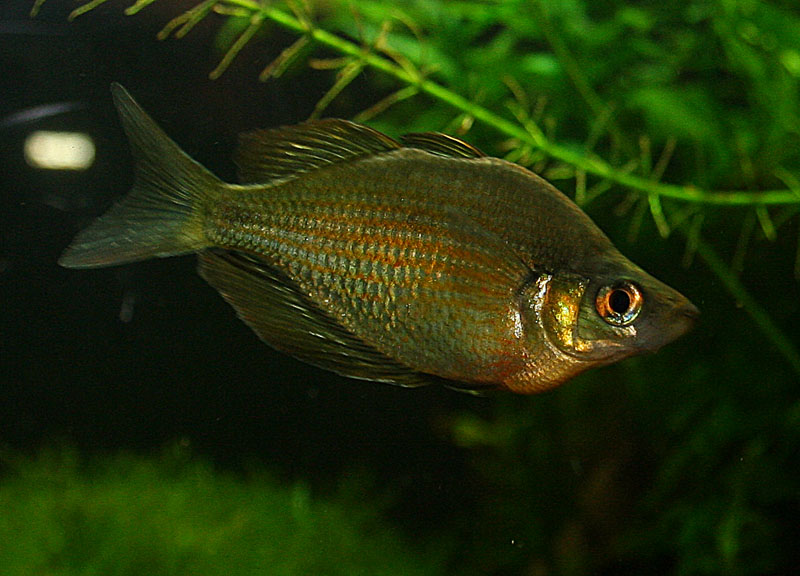
The species is known only from two lakes in the Grime River system in northern West Papua. It has a greenish body with orange stripes between regular rows of large scales.
Written 27 November 2026 from the sources listed below. Each statement was checked against the passage it cites; statements that could not be supported were removed.
Habitat
Grime Rainbowfish inhabits a floodplain containing small, round lakes. It is more abundant in areas with dense aquatic vegetation.[1][2]
Appearance
The species has a greenish body with orange stripes between regular rows of large scales. The orange stripes become especially prominent during courtship.[3][4]
Males have deeper bodies than females. Females lack the stripes between the scale rows.[5][6]
The maximum recorded length is 11.5 centimetres.[7]
Behaviour
Grime Rainbowfish forms schools.[8]
Diet
The species feeds on various plants and insects.[9]
Juveniles feed on microscopic invertebrates and plants until maturity.[10]
Reproduction and life cycle
Breeding pairs come together on the riverbed. Adults abandon their offspring after the young hatch.[11][12]
Newly hatched juvenile fish measure approximately 4 millimetres in length.[13]
Conservation
The species was last caught in 2008. It may now be extinct in the wild because of aquaculture threats and competition from non-native tilapia and carp.[14][15]
Its habitat has undergone extensive modification associated with human population expansion.[16]
The species was assessed as Critically Endangered in the 2019 IUCN Red List assessment.[17]
Uses
Captive-bred individuals of Grime Rainbowfish are available in the aquarium trade.[18]
Classification of the Grime Rainbowfish
| Kingdom | Animalia |
|---|---|
| Phylum | Chordata |
| Subphylum | Vertebrata |
| Infraphylum | Gnathostomata |
| Parvphylum | Osteichthyes |
| Gigaclass | Actinopterygii |
| Superclass | Actinopteri |
| Class | Teleostei (Teleost) |
| Order | Atheriniformes |
| Suborder | Atherinoidei |
| Family | Melanotaeniidae (Rainbowfish) |
| Genus | Glossolepis |
| Species | Glossolepis dorityi Allen, 2001 |
Where the Grime Rainbowfish is found
Checklists and occurrence records place Glossolepis dorityi in 1 country. GBIF holds 3 georeferenced records of it.
Countries
Regions and cities with the most records
A number beside a place is its count of GBIF occurrence records. A place without a number comes from a checklist alone. Records show where a species has been observed or collected, which can include escapes and vagrants.
Common names
English
- Grime Rainbowfish
Names in 1 other language
- Czech
- duhovka grimská
Related species
-
 Lake Wanam RainbowfishGlossolepis wanamensis
- Leggett’s RainbowfishGlossolepis leggetti
-
 Ramu RainbowfishGlossolepis ramuensis
-
 Rosy RainbowfishGlossolepis multisquamata
- Kabia RainbowfishGlossolepis kabia
- Red RainbowfishGlossolepis incisa
- Glossolepis maculosa
- Tami River RainbowfishGlossolepis pseudoincisa
Compare
Questions and answers
What is the scientific name of the Grime Rainbowfish?
The scientific name of the Grime Rainbowfish is Glossolepis dorityi. Written with its author, the full name is Glossolepis dorityi Allen, 2001.
Which family does the Grime Rainbowfish belong to?
Glossolepis dorityi belongs to the family Melanotaeniidae, in the order Atheriniformes and the class Teleostei.
Where is the Grime Rainbowfish found?
Checklists and occurrence records place Glossolepis dorityi in 1 country: Indonesia.
What is the conservation status of the Grime Rainbowfish?
The IUCN Red List category recorded for Glossolepis dorityi is Critically Endangered (CR).
How big do rainbowfish get?
Grime Rainbowfish can reach a maximum recorded length of 11.5 centimetres.[7]
Sources
Passages the profile rests on
- The species inhabits a floodplain containing small, round lakes. Source passage: “The locality in which the species is found is a floodplain, covered with small round lakes.” — English Wikipedia
- The species is more abundant in areas with dense aquatic vegetation. Source passage: “The fish are more abundant where the aquatic vegetation is dense.” — English Wikipedia
- The species has a greenish body with orange stripes between regular rows of large scales. Source passage: “Individuals of Glossolepis dorityi are greenish, with orange stripes between regular rows of large scales.” — English Wikipedia
- The orange stripes become especially prominent during courtship. Source passage: “The stripes are especially prominent during courtship.” — English Wikipedia
- Males have deeper bodies than females. Source passage: “Males have deeper bodies” — English Wikipedia
- Females lack the stripes between the scale rows. Source passage: “females lack the stripes between scale rows.” — English Wikipedia
- The species can reach a maximum recorded length of 11.5 centimetres. Source passage: “The species can grow up to 11.5 centimetres (4.5 in) in length.” — English Wikipedia
- The species forms schools. Source passage: “The species is schooling” — English Wikipedia
- The species feeds on various plants and insects. Source passage: “feeds on various plants and insects.” — English Wikipedia
- Juveniles feed on microscopic invertebrates and plants until maturity. Source passage: “feed on microscopic inveterbrates and plants until they mature.” — English Wikipedia
- Breeding pairs come together on the riverbed. Source passage: “During breeding, pairs of fish come together on the riverbed.” — English Wikipedia
- Adults abandon their offspring after the young hatch. Source passage: “After the young hatch, they are abandoned.” — English Wikipedia
- Newly hatched juvenile fish measure approximately 4 millimetres in length. Source passage: “The juvenile fish are 4mm long” — English Wikipedia
- The species was last caught in 2008. Source passage: “It was last caught in 2008” — English Wikipedia
- The species may now be extinct in the wild because of aquaculture threats and competition from non-native tilapia and carp. Source passage: “may now be extinct in the wild, due to the threat of aquaculture and competition with non-native species of tilapia and carp.” — English Wikipedia
- The species' habitat has undergone extensive modification associated with human population expansion. Source passage: “There has been extensive habitat modification due to an expanding human population.” — English Wikipedia
- The species was assessed as Critically Endangered in the 2019 IUCN Red List assessment. Source passage: “has most recently been assessed for The IUCN Red List of Threatened Species in 2019. as Critically Endangered” — iucnredlist.org
- Captive-bred individuals of the species are available in the aquarium trade. Source passage: “Captive bred individuals can be found in the aquarium trade, however.” — English Wikipedia
- The species is native to the Grime River region in northern West Papua. Source passage: “native to the Grime River region in northern West Papua.” — English Wikipedia
- The species is known only from two lakes in the Grime River system. Source passage: “The species is known only from two lakes in the Grime river system.” — English Wikipedia
Data
- Catalogue of Life, 2026-10-16 XR cc by
- Global Biodiversity Information Facility CC BY 4.0
- Wikidata CC0
- GeoNames CC BY 4.0
- Wikimedia Commons per image; credit shown with each image
- Within the Catalogue of Life, this name comes from World Register of Marine Species cc by
References
- Allen, G. R. (2001). A new species of rainbowfish (Glossolepis: Melanotaeniidae) from Irian Jaya, Indonesia. Fishes of Sahul. Journal of the Australia New Guinea Fishes Association, v. 15 (no. 3): 766–775. where the name was published
This species in other databases
- Catalogue of Life 3GDQ6
- Wikidata Q5539907
- iNaturalist 617291
- WoRMS urn:lsid:marinespecies.org:taxname:1009914
- ITIS 630731
Page built on 28 November 2026. See how the catalog is made and all sources and licences.
Cite this page
ScientificNames.org. (2026). Glossolepis dorityi (Grime Rainbowfish). Retrieved November 28, 2026, from https://scientificnames.org/species/glossolepis-dorityi
“Glossolepis dorityi (Grime Rainbowfish).” ScientificNames.org, 2026, scientificnames.org/species/glossolepis-dorityi. Accessed 28 Nov. 2026.
ScientificNames.org. “Glossolepis dorityi (Grime Rainbowfish).” Accessed November 28, 2026. https://scientificnames.org/species/glossolepis-dorityi.
@misc{scientificnames_glossolepis_dorityi_grime_rainbowfish,
  author = {{ScientificNames.org}},
  title = {Glossolepis dorityi (Grime Rainbowfish)},
  year = {2026},
  url = {https://scientificnames.org/species/glossolepis-dorityi},
  note = {Accessed 2026-11-28}
}