Species · Insects
Dancing Swordtail Graphium polistratus
The scientific name of the Dancing Swordtail is Graphium polistratus. It is a species of insect in the family Papilionidae (swallowtail butterfly), order Lepidoptera. The name dates from 1889.
- Scientific name
- Graphium polistratus (Grose-Smith, 1889)
- Common name
- Dancing Swordtail
- Genus
- Graphium
- Family
- Papilionidae (Swallowtail Butterfly)
- Order
- Lepidoptera
- Class
- Insecta
- Red List category
- LC Least Concern
- Recorded in
- 4 countries
- Name status
- accepted in the Catalogue of Life

Overview
The species occurs in Nigeria and the Democratic Republic of the Congo and inhabits warm and coastal forests. It has light green markings on its upper wing surfaces, no discal spots on the upper hindwing in cellules 2 to 5, and a narrow, streak-like discal spot in cellule 6.
Written 27 November 2026 from the sources listed below. Each statement was checked against the passage it cites; statements that could not be supported were removed.
Appearance
The forewing has three final transverse cell bars that are somewhat curved. The upper surface of the hindwing lacks red spots in cellule 1c and discal spots in cellules 2 to 5.[1][2][3]
The underside of the hindwing lacks a red spot at the apex of its cell. The discal spot in cellule 6 is narrow and streak-like, and the large light basal spot in cellule 2 is absent or only faintly indicated.[4][5][6]
The butterfly has light green markings on its upper wing surfaces.[7]
Habitat
The species inhabits warm and coastal forests.[8]
Diet
Both sexes feed on flowers as adults. The larvae feed on Annona senegalensis.[9][10]
Behaviour
Adult males engage in mud-puddling. Adults are probably active throughout the year.[11][12]
Similar species
Graphium richelmanni differs from Graphium polistratus by retaining discal spots in hindwing cellules 4 and 5.[13]
Classification of the Dancing Swordtail
| Kingdom | Animalia |
|---|---|
| Phylum | Arthropoda |
| Subphylum | Hexapoda |
| Class | Insecta (Insect) |
| Order | Lepidoptera |
| Superfamily | Papilionoidea |
| Family | Papilionidae (Swallowtail Butterfly) |
| Genus | Graphium (Swordtail Butterfly) |
| Species | Graphium polistratus (Grose-Smith, 1889) |
Where the Dancing Swordtail is found
Checklists and occurrence records place Graphium polistratus in 4 countries. GBIF holds 263 georeferenced records of it.
Countries
Regions and cities with the most records
- Kwale County, Kenya 89
- Ukunda, Kenya 63
- Kilifi County, Kenya 39
- Korogwe, Tanzania 39
- Maramba, Tanzania 39
- Tanga, Tanzania 39
- Watamu, Kenya 31
- Morogoro, Tanzania 24
- Malindi, Kenya 7
- Jomvu, Kenya 6
- Limpopo, South Africa 6
- Madizini, Tanzania 6
- Mazeras, Kenya 6
- Mombasa, Kenya 6
- Muheza, Tanzania 6
- KwaZulu-Natal, South Africa 5
- Mtwapa, Kenya 5
- Matuga, Kenya 4
- Kitui County, Kenya 3
- Maposeni, Tanzania 3
- Ruvuma, Tanzania 3
A number beside a place is its count of GBIF occurrence records. A place without a number comes from a checklist alone. Records show where a species has been observed or collected, which can include escapes and vagrants.
Common names
English
- Dancing Swordtail
- Dancing Swallowtail
Synonyms
2 other scientific names have been used for this species and are now treated as synonyms of Graphium polistratus.
- Papilio richelmanni Weymer, 1892
- Papilio sisenna Mabille, 1890
Related species
-
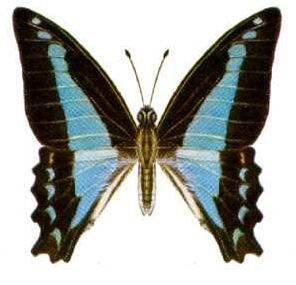 Common BluebottleGraphium sarpedon
-
 Tailed JayGraphium agamemnon
-
 Common JayGraphium doson
-
 Purple Spotted SwallowtailGraphium weiskei
-
 Five-bar SwordtailGraphium antiphates
-
 Macleay's SwallowtailGraphium macleayanus
- Large Striped SwordtailGraphium antheus
-
 Stresemanni SwallowtailGraphium stresemanni
Compare
Questions and answers
What is the scientific name of the Dancing Swordtail?
The scientific name of the Dancing Swordtail is Graphium polistratus. Written with its author, the full name is Graphium polistratus (Grose-Smith, 1889).
Which family does the Dancing Swordtail belong to?
Graphium polistratus belongs to the family Papilionidae, in the order Lepidoptera and the class Insecta.
Where is the Dancing Swordtail found?
Checklists and occurrence records place Graphium polistratus in 4 countries: Kenya, Tanzania, South Africa and Malawi.
What is the conservation status of the Dancing Swordtail?
The IUCN Red List category recorded for Graphium polistratus is Least Concern (LC).
What other names does the Dancing Swordtail have?
Graphium polistratus is also known in English as Dancing Swallowtail.
Sources
Passages the profile rests on
- The forewing has three final transverse cell bars that are somewhat curved. Source passage: “The last three transverse bars in the cell of the forewing somewhat curved.” — English Wikipedia
- The upper surface of the hindwing lacks red spots in cellule 1c. Source passage: “Hindwing above without red spot in cellule 1 c” — English Wikipedia
- The upper hindwing has no discal spots in cellules 2 to 5. Source passage: “the discal spots 2 to 5 of the hindwing above are entirely absent” — English Wikipedia
- The underside of the hindwing lacks a red spot at the apex of its cell. Source passage: “the apex of the cell of the hindwing beneath without red spot” — English Wikipedia
- The discal spot in hindwing cellule 6 is narrow and streak-like. Source passage: “the discal spot in cellule 6 of the hindwing narrow, streak-like” — English Wikipedia
- The large light basal spot in hindwing cellule 2 is absent or only faintly indicated on the underside. Source passage: “the large light basal spot in cellule 2 of the hindwing is entirely absent on the under surface or is only indicated” — English Wikipedia
- The butterfly has light green markings on its upper wing surfaces. Source passage: “the markings of the upper surface light green.” — English Wikipedia
- The species inhabits warm and coastal forests. Source passage: “Its habitat consists of warm and coastal forests.” — English Wikipedia
- Both sexes feed on flowers as adults. Source passage: “Both sexes feed from flowers.” — English Wikipedia
- The larvae feed on Annona senegalensis. Source passage: “The larvae feed on Annona senegalensis” — English Wikipedia
- Adult males engage in mud-puddling. Source passage: “Adult males mud-puddle.” — English Wikipedia
- Adults are probably active throughout the year. Source passage: “Adults are probably on wing year round.” — English Wikipedia
- Graphium richelmanni differs from Graphium polistratus by retaining discal spots in hindwing cellules 4 and 5. Source passage: “richelmanni Weym. only differs in having the discal spots in cellules 4 and 5 of the hindwing present.” — English Wikipedia
Data
- Catalogue of Life, 2026-10-16 XR cc by
- Global Biodiversity Information Facility CC BY 4.0
- Wikidata CC0
- GeoNames CC BY 4.0
- Wikimedia Commons per image; credit shown with each image
- Within the Catalogue of Life, this name comes from Global Butterfly Information System cc by
This species in other databases
Page built on 27 November 2026. See how the catalog is made and all sources and licences.
Cite this page
ScientificNames.org. (2026). Graphium polistratus (Dancing Swordtail). Retrieved November 27, 2026, from https://scientificnames.org/species/graphium-polistratus
“Graphium polistratus (Dancing Swordtail).” ScientificNames.org, 2026, scientificnames.org/species/graphium-polistratus. Accessed 27 Nov. 2026.
ScientificNames.org. “Graphium polistratus (Dancing Swordtail).” Accessed November 27, 2026. https://scientificnames.org/species/graphium-polistratus.
@misc{scientificnames_graphium_polistratus_dancing_swordtail,
  author = {{ScientificNames.org}},
  title = {Graphium polistratus (Dancing Swordtail)},
  year = {2026},
  url = {https://scientificnames.org/species/graphium-polistratus},
  note = {Accessed 2026-11-27}
}