Species · Fishes
Naked Sole Gymnachirus nudus
The scientific name of the Naked Sole is Gymnachirus nudus. It is a species of fish in the family Achiridae (american sole), order Pleuronectiformes. The name dates from 1858.
- Scientific name
- Gymnachirus nudus Kaup, 1858
- Common name
- Naked Sole
- Genus
- Gymnachirus
- Family
- Achiridae (American Sole)
- Order
- Pleuronectiformes
- Class
- Teleostei
- Red List category
- LC Least Concern
- Environment
- marine
- Recorded in
- 12 countries
- Name status
- accepted in the Catalogue of Life
Overview
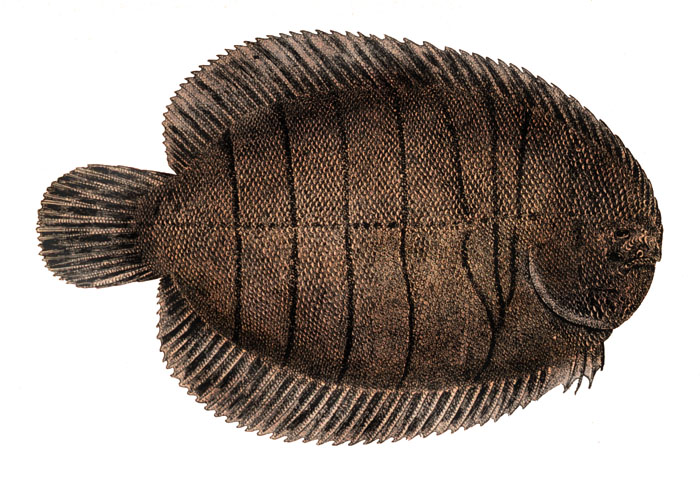
The Naked sole is a fish in the family Achiridae. It inhabits soft bottoms at depths of 2–100 m in the western Atlantic. It has no scales, loose skin, and typically 15–18 dark, narrow crossbars on its eye side as an adult.
Written 27 November 2026 from the sources listed below. Each statement was checked against the passage it cites; statements that could not be supported were removed.
Appearance
The Naked sole has an oval body, small eyes positioned on its right side, and a rounded snout. Its mouth is small, arched, and positioned slightly below the snout, with fleshy lips and wide gill openings that unite in front of the pelvic fins.[1][2][3]
Its lateral line extends from the head to the tail and has 7–10 accessory sensory lines at right angles on the right side. The species has no scales and its body is covered with loose skin; adult fish may have short cirri on their eye side.[4][5][6]
Adults typically have 15–18 dark, narrow crossbars on the eye side, with 13–21 reported overall. The crossbars extend across the body and the dorsal and anal fins, while the tail has three to four complete crossbars.[7][8][9]
Juveniles have very dark bodies and fins on both sides.[10]
The species reaches a maximum total length of 15 cm and more commonly reaches a total length of 12 cm.[11][12]
Habitat
The Naked sole inhabits soft bottoms at depths of 2–100 m. It occurs on muddy bottoms in the western Atlantic.[13][14]
Its recorded soft-bottom habitats include mud, sand, gravel, beaches, estuaries, mangroves, and seagrass areas.[15]
The species occurs throughout the western Atlantic, with a documented range extending from Florida to northern South America.[16][17]
Diet
Mobile benthic crustaceans, including shrimps and crabs, are listed as potential food organisms associated with the species. Mobile benthic gastropods, bivalves, and worms are also listed among its associated food categories.[18][19][20]
Conservation
The Naked sole is classified as Least Concern by the IUCN Red List. This classification is attributed to a lack of known threats to the species.[21][22]
The species is sometimes caught as bycatch in trawls targeting shrimp and other fish.[23]
Classification of the Naked Sole
| Kingdom | Animalia |
|---|---|
| Phylum | Chordata |
| Subphylum | Vertebrata |
| Infraphylum | Gnathostomata |
| Parvphylum | Osteichthyes |
| Gigaclass | Actinopterygii |
| Superclass | Actinopteri |
| Class | Teleostei (Teleost) |
| Order | Pleuronectiformes |
| Suborder | Pleuronectoidei |
| Family | Achiridae (American Sole) |
| Genus | Gymnachirus |
| Species | Gymnachirus nudus Kaup, 1858 |
Where the Naked Sole is found
Checklists and occurrence records place Gymnachirus nudus in 12 countries. GBIF holds 159 georeferenced records of it.
Countries
- Brazil 59
- Colombia 5
- French Guiana 17
- Guyana 4
- Honduras 8
- India 9
- Mexico 5
- Saint Barthelemy 5
- Suriname 7
- Trinidad and Tobago 5
- United States 32
- Venezuela 3
Regions and cities with the most records
- Espírito Santo, Brazil 6
- Gustavia, Saint Barthelemy 5
- Governador Celso Ramos, Brazil 3
- Ilhabela, Brazil 3
- São Sebastião, Brazil 3
1 more country has a few records outside this range
These countries hold a few records of Gymnachirus nudus but lie outside the range the checklists give for it. Such records are often zoo or garden specimens, museum material or vagrants, so the species is not counted as occurring there.
A number beside a place is its count of GBIF occurrence records. A place without a number comes from a checklist alone. Records show where a species has been observed or collected, which can include escapes and vagrants.
Common names
English
- Naked Sole
- Zebra Sole
- Flabby Sole
Names in 5 other languages
- French
- Sole nue
- Japanese
- オビウシノシタ
- Portuguese
- Linguado-zebra-costeiro
- Russian
- Бразильский бесчешуйный язык
- Spanish
- acedía nudosa, suela fofa
Synonyms
3 other scientific names have been used for this species and are now treated as synonyms of Gymnachirus nudus.
- Gymnachirus fasciatus Günther, 1862
- Gymnachirus zebrinus Miranda Ribeiro, 1903
- Gynmachirus nudus Kaup, 1858
Related species
-
 Gulf of Mexico Fringed SoleGymnachirus texae
- North American Naked SoleGymnachirus melas
-
 HogchokerTrinectes maculatus
-
 Lined SoleAchirus lineatus
-
 Drab SoleAchirus achirus
-
 Mazatlan SoleAchirus mazatlanus
-
 Peruvian FlounderHypoclinemus mentalis
- Freshwater TonguefishApionichthys nattereri
Compare
Questions and answers
What is the scientific name of the Naked Sole?
The scientific name of the Naked Sole is Gymnachirus nudus. Written with its author, the full name is Gymnachirus nudus Kaup, 1858.
Which family does the Naked Sole belong to?
Gymnachirus nudus belongs to the family Achiridae, in the order Pleuronectiformes and the class Teleostei.
Where is the Naked Sole found?
Checklists and occurrence records place Gymnachirus nudus in 12 countries, including Brazil, United States, French Guiana, India, Honduras and Suriname.
What is the conservation status of the Naked Sole?
The IUCN Red List category recorded for Gymnachirus nudus is Least Concern (LC).
What other names does the Naked Sole have?
Gymnachirus nudus is also known in English as Zebra Sole and Flabby Sole.
Sources
Passages the profile rests on
- The species has an oval body, small eyes positioned on its right side, and a rounded snout. Source passage: “Body oval; eyes small, on right side; snout rounded” — biogeodb.stri.si.edu
- Its mouth is small, arched, and positioned slightly below the snout. Source passage: “mouth small, arched, a little below snout” — biogeodb.stri.si.edu
- The species has fleshy lips and wide gill openings that unite in front of the pelvic fins. Source passage: “lips fleshy; rear edge of preopercle covered with skin; gill openings wide, united before pelvic fins” — biogeodb.stri.si.edu
- Its lateral line extends from the head to the tail and has 7–10 accessory sensory lines at right angles on the right side. Source passage: “lateral line from head to tail, straight, with 7-10 (usually > 7) accessory sensory lines at right angles to main line on right side” — biogeodb.stri.si.edu
- The species has no scales and its body is covered with loose skin. Source passage: “no scales, body covered with loose skin” — biogeodb.stri.si.edu
- Adult fish may have short cirri on their eye side. Source passage: “eye side with or without short cirri in adults.” — biogeodb.stri.si.edu
- Adults typically have 15–18 dark, narrow crossbars on the eye side, with 13–21 reported overall. Source passage: “Eye side of adults with 13-21 (usually 15-18) dark narrow” — biogeodb.stri.si.edu
- The adult crossbars extend across the body and the dorsal and anal fins. Source passage: “complete crossbars plus partial cross bars (often dotted) across body and dorsal and anal fins” — biogeodb.stri.si.edu
- The tail has three to four complete crossbars. Source passage: “tail with 3-4 complete crossbars” — biogeodb.stri.si.edu
- Juveniles have very dark bodies and fins on both sides. Source passage: “juveniles very dark body and fins on both sides.” — biogeodb.stri.si.edu
- The species reaches a maximum total length of 15 cm. Source passage: “It reaches a maximum total length of 15 cm (5.9 in)” — English Wikipedia
- The species more commonly reaches a total length of 12 cm. Source passage: “more commonly reaching a TL of 12 cm (4.7 in).” — English Wikipedia
- The species inhabits soft bottoms at depths of 2–100 m. Source passage: “It dwells on soft bottoms at a depth range of 2 to 100 m (6.6 to 328.1 ft).” — English Wikipedia
- The species occurs on muddy bottoms in the western Atlantic. Source passage: “Muddy bottoms of the Western Atlantic, from Florida to northern South America.” — English Wikipedia
- Its recorded soft-bottom habitats include mud, sand, gravel, beaches, estuaries, mangroves, and seagrass areas. Source passage: “Soft bottom (mud/sand/gravel/beach/estuary/mangrove/seagrass)” — biogeodb.stri.si.edu
- The species occurs throughout the western Atlantic. Source passage: “It is known from throughout the western Atlantic.” — English Wikipedia
- Its documented western Atlantic range extends from Florida to northern South America. Source passage: “Muddy bottoms of the Western Atlantic, from Florida to northern South America.” — English Wikipedia
- The species is associated with mobile benthic crustaceans, including shrimps and crabs, as potential food organisms. Source passage: “Mobile benthic crustacea (shrimps/crabs)” — biogeodb.stri.si.edu
- Mobile benthic gastropods and bivalves are listed among its associated food categories. Source passage: “Mobile benthic gastropods/bivalves” — biogeodb.stri.si.edu
- Mobile benthic worms are listed among its associated food categories. Source passage: “Mobile benthic worms” — biogeodb.stri.si.edu
- The species is classified as Least Concern by the IUCN Red List. Source passage: “The naked sole is currently ranked as Least Concern by the IUCN redlist” — English Wikipedia
- The reported Least Concern classification is attributed to a lack of known threats to the species. Source passage: “because of a lack of known threats to the species” — English Wikipedia
- The species is sometimes caught as bycatch in trawls targeting shrimp and other fish. Source passage: “it is sometimes harvested as bycatch in trawls for shrimp and other fish.” — English Wikipedia
Data
- Catalogue of Life, 2026-10-16 XR cc by
- Global Biodiversity Information Facility CC BY 4.0
- Wikidata CC0
- GeoNames CC BY 4.0
- Within the Catalogue of Life, this name comes from World Register of Marine Species cc by
References
- Kaup, J. J. (1858). Uebersicht der Soleinae, der vierten Subfamilie der Pleuronectidae. Archiv Für Naturgeschichte, v. 24 (pt. 1): 94–104. https://doi.org/10.5962/bhl.part.5286 Link where the name was published
This species in other databases
- Catalogue of Life 3HP27
- Wikidata Q2461557
- iNaturalist 317126
- WoRMS urn:lsid:marinespecies.org:taxname:275995
- ITIS 172992
Page built on 29 November 2026. See how the catalog is made and all sources and licences.
Cite this page
ScientificNames.org. (2026). Gymnachirus nudus (Naked Sole). Retrieved November 29, 2026, from https://scientificnames.org/species/gymnachirus-nudus
“Gymnachirus nudus (Naked Sole).” ScientificNames.org, 2026, scientificnames.org/species/gymnachirus-nudus. Accessed 29 Nov. 2026.
ScientificNames.org. “Gymnachirus nudus (Naked Sole).” Accessed November 29, 2026. https://scientificnames.org/species/gymnachirus-nudus.
@misc{scientificnames_gymnachirus_nudus_naked_sole,
  author = {{ScientificNames.org}},
  title = {Gymnachirus nudus (Naked Sole)},
  year = {2026},
  url = {https://scientificnames.org/species/gymnachirus-nudus},
  note = {Accessed 2026-11-29}
}