Species · Flowering plants
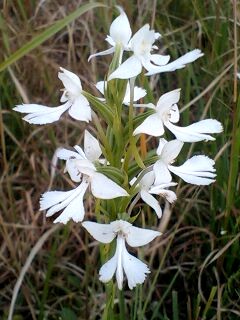
Water Orchid Habenaria repens
The scientific name of the Water Orchid is Habenaria repens. It is a species of flowering plant in the family Orchidaceae (orchid), order Asparagales.
- Scientific name
- Habenaria repens Nutt.
- Common name
- Water Orchid
- Genus
- Habenaria
- Family
- Orchidaceae (Orchid)
- Order
- Asparagales
- Class
- Liliopsida
- Recorded in
- 28 countries
- Name status
- accepted in the Catalogue of Life

Overview
Habenaria repens Nutt. is a perennial flowering orchid in the family Orchidaceae, order Asparagales, and class Liliopsida. The water orchid occurs across Latin America from Mexico and the West Indies south to Argentina, and in the southeastern United States from Texas and Oklahoma east to Florida and the Carolinas, with an isolated population in Virginia. It can grow fully submerged or form large floating masses of pale green flowers on the water.
Written 26 November 2026 from the sources listed below. Each statement was checked against the passage it cites; statements that could not be supported were removed.
Habitat
The water orchid grows in marshes, swamps, blackwater swamps, pools, and along slow-moving streams. It can thrive in acidic waters containing abundant tannins.[1][2][3]
Diet
The species produces a phenolic compound called habenariol, which acts as a feeding deterrent. Habenariol deters red crawfish from feeding.[4][5][6]
Behaviour
The flowers emit a strong fragrance during the evening. This fragrance evidently attracts night-flying moths that pollinate the species.[7][8]
Reproduction and life cycle
The water orchid reproduces by producing seeds and spreading through stolons. It flowers for much of the year.[9][10]
Its flowers are adapted to attract pollinators, particularly insects associated with water.[11]
Conservation
The species is listed as threatened by the Florida Department of Agriculture and Consumer Services.[12]
Appearance
The species produces stalks approximately one to two feet tall above the water surface. A single stalk can bear dozens of small, pale green flowers.[13][14]
The flowers have elongated, narrow perianth lobes and narrow yellow or green petals. They can form large floating masses on the water.[15][16][17]
The leaves are approximately ten inches long and one inch wide. The species can grow fully submerged while its roots remain in the ground beneath the water.[18][19]
The common name Water-Spider Orchid refers to the spindly appearance of its flowers.[20]
Classification of the Water Orchid
| Kingdom | Plantae |
|---|---|
| Subkingdom | Pteridobiotina |
| Phylum | Tracheophyta |
| Class | Liliopsida |
| Order | Asparagales |
| Family | Orchidaceae (Orchid) |
| Genus | Habenaria (Bog Orchids) |
| Species | Habenaria repens Nutt. |
Where the Water Orchid is found
Checklists and occurrence records place Habenaria repens in 28 countries across North America and South America. GBIF holds 3,936 georeferenced records of it.
Countries
- Argentina 38
- Belize 9
- Bolivia 26
- Brazil 599
- Chile 6
- Colombia 46
- Costa Rica 46
- Cuba 41
- Dominican Republic 18
- Ecuador 22
- El Salvador 15
- French Guiana 13
- Guatemala 64
- Guyana 12
- Haiti 11
- Honduras 26
- Jamaica 6
- Mexico 197
- Nicaragua 7
- Panama 12
- Paraguay 19
- Peru 13
- Puerto Rico 18
- Suriname 8
- Trinidad and Tobago 6
- United States 2,620
- Uruguay 19
- Venezuela 19
Regions and cities with the most records
- Florida, United States 624
- North Carolina, United States 108
- South Carolina, United States 104
- Texas, United States 101
- Alabama, United States 88
- Louisiana, United States 85
- Mississippi, United States 67
- Georgia, United States 61
- Bahia, Brazil 58
- Veracruz, Mexico 51
- Tabasco, Mexico 37
- Port Saint Lucie, United States 34
- Gainesville, United States 33
- Virginia, United States 33
- Stuart, United States 32
- Fort Pierce, United States 31
- Arkansas, United States 30
- Campeche, Mexico 30
- Alafaya, United States 28
- Mato Grosso do Sul, Brazil 26
- São Paulo, Brazil 25
- Minas Gerais, Brazil 24
- Oviedo, United States 24
- Paraná, Brazil 24
- Rio Grande do Sul, Brazil 24
- Wellington, United States 24
- Greater Northdale, United States 22
- Carrollwood Village, United States 21
- Citrus Park, United States 21
- Royal Palm Beach, United States 21
- Egypt Lake-Leto, United States 20
- Keystone, United States 20
- Land O' Lakes, United States 20
- Lutz, United States 20
- Town 'n' Country, United States 20
- Westchase, United States 20
A number beside a place is its count of GBIF occurrence records. A place without a number comes from a checklist alone. Records show where a species has been observed or collected, which can include escapes and vagrants.
Common names
English
- Water Orchid
- Waterspider Bog Orchid
- Floating Orchid
- Water-spider Orchid
Names in 1 other language
- Spanish
- Orquidea de los pantanos
Synonyms
4 other scientific names have been used for this species and are now treated as synonyms of Habenaria repens.
- Mesicera repens (Nutt.) Raf.
- Orchis repens (Nutt.) Raf.
- Platanthera repens (Nutt.) Alph.Wood
- Orchis repens (Nutt.) Alph.Wood ambiguous synonym
Subspecies and varieties
- Habenaria repens var. maxillaris variety
- Habenaria repens var. repens variety
Related species
-
 Phantom OrchidHabenaria dentata
-
 Longhorn Bog OrchidHabenaria quinqueseta
-
 Toothpetal False ReinorchidHabenaria floribunda
-
 Plantain OrchidHabenaria plantaginea
-
 Red-Lipped HabenariaHabenaria rhodocheila
-
 Canary Three-finger OrchidHabenaria tridactylites
-
 Sickle OrchidHabenaria ochroleuca
-
 Toothbrush OrchidHabenaria heyneana
Compare
Questions and answers
What is the scientific name of the Water Orchid?
The scientific name of the Water Orchid is Habenaria repens. Written with its author, the full name is Habenaria repens Nutt..
Which family does the Water Orchid belong to?
Habenaria repens belongs to the family Orchidaceae, in the order Asparagales and the class Liliopsida.
Where is the Water Orchid found?
Checklists and occurrence records place Habenaria repens in 28 countries, including United States, Brazil, Mexico, Guatemala, Colombia and Costa Rica.
What other names does the Water Orchid have?
Habenaria repens is also known in English as Waterspider Bog Orchid, Floating Orchid and Water-spider Orchid.
Sources
Passages the profile rests on
- The species can thrive in acidic waters containing abundant tannins. Source passage: “a plant that thrives in acidic waters with loads of tannins” — lucec.loyno.edu
- The species is found in wet areas, including blackwater swamps and pools. Source passage: “native perennial orchid found in wet areas, blackwater swamps, pools” — plants.ces.ncsu.edu
- The species grows in marshes, swamps, and along slow-moving streams. Source passage: “The Water-Spider Orchid grows in wetland areas, such as marshes, swamps, and along slow-moving streams.” — blogs.ifas.ufl.edu
- The species contains a phenolic compound called habenariol. Source passage: “A phenolic compound called habenariol can be found in H. repens.” — English Wikipedia
- Habenariol produced by the species acts as a feeding deterrent. Source passage: “It acts as a feeding deterrent.” — English Wikipedia
- Habenariol produced by the species deters red crawfish from feeding. Source passage: “Habenariol is a chemical produced by water-spider orchids that deters feeding activities by red crawfish, Procambarus clarkii.” — lucec.loyno.edu
- The flowers emit a strong fragrance during the evening. Source passage: “In the evenings, the flowers emit a strong fragrance” — lucec.loyno.edu
- The evening fragrance evidently attracts night-flying moths that pollinate the species. Source passage: “which evidently attracts its pollinators - night-flying moths.” — lucec.loyno.edu
- The species can reproduce by producing seeds and by spreading through stolons. Source passage: “the species may set seeds and/or propagate by runners (stolons) that spread in all directions.” — lucec.loyno.edu
- The species flowers for much of the year. Source passage: “For much of the year, these flowers bloom” — blogs.ifas.ufl.edu
- The flowers are adapted to attract pollinators, particularly insects associated with water. Source passage: “These delicate blossoms are specifically designed to attract certain pollinators, particularly water-loving insects.” — blogs.ifas.ufl.edu
- The species is listed as threatened by the Florida Department of Agriculture and Consumer Services. Source passage: “It is listed as a threatened plant by the Florida Department of Agriculture and Consumer Services.” — blogs.ifas.ufl.edu
- The species produces stalks approximately one to two feet tall above the water surface. Source passage: “Water-spider orchids appear as one- to two-foot high stalks protruding from the surface.” — lucec.loyno.edu
- A single stalk can bear dozens of small, pale green flowers. Source passage: “Dozens of these small, pale green flowers adorn the stalk of a single orchid.” — blogs.ifas.ufl.edu
- The stalks bear greenish-white flowers with elongated, narrow perianth lobes. Source passage: “the stalks are covered with greenish white orchid flowers that have the perianth (the sepals and petals together) divided into small elongated lobes” — lucec.loyno.edu
- The flowers can form large floating masses on the water. Source passage: “The flowers can float in large masses in the bodies of water they inhabit” — blogs.ifas.ufl.edu
- The flowers have narrow yellow or green petals. Source passage: “Their yellow or green, narrow petals evoke the image of spiders climbing up the stalk” — blogs.ifas.ufl.edu
- The leaves are approximately ten inches long and one inch wide. Source passage: “Their leaves are about ten inches long, and one inch wide.” — lucec.loyno.edu
- The species can grow fully submerged while its roots remain in the ground beneath the water. Source passage: “although the plant can grow fully submerged, its roots are growing in the ground below.” — blogs.ifas.ufl.edu
- The common name Water-Spider Orchid refers to the spindly appearance of its flowers. Source passage: “the name of this peculiar plant is derived from the shape of its flowers, which have a spindly quality that resembles a spider as they grow.” — blogs.ifas.ufl.edu
- The species grows in cypress swamps with relatively open tree canopies. Source passage: “find this orchid thriving in a small, yet very healthy, cypress swamp.” — lucec.loyno.edu
- The species can grow within dense floating mats of marsh vegetation. Source passage: “The plants form a floating mat with the green water-spider orchids laced into the dense growth.” — lucec.loyno.edu
Data
- Catalogue of Life, 2026-10-16 XR cc by
- Global Biodiversity Information Facility CC BY 4.0
- Wikidata CC0
- GeoNames CC BY 4.0
- Wikimedia Commons per image; credit shown with each image
- Within the Catalogue of Life, this name comes from The World Checklist of Vascular Plants (WCVP) cc by
References
- Gen. N. Amer. Pl. 2: 190 (1818) where the name was published
This species in other databases
- Catalogue of Life 3J49R
- Wikidata Q15482311
- iNaturalist 155102
- World Flora Online wfo-0000978533
- GRIN 465597
Page built on 29 November 2026. See how the catalog is made and all sources and licences.
Cite this page
ScientificNames.org. (2026). Habenaria repens (Water Orchid). Retrieved November 29, 2026, from https://scientificnames.org/species/habenaria-repens
“Habenaria repens (Water Orchid).” ScientificNames.org, 2026, scientificnames.org/species/habenaria-repens. Accessed 29 Nov. 2026.
ScientificNames.org. “Habenaria repens (Water Orchid).” Accessed November 29, 2026. https://scientificnames.org/species/habenaria-repens.
@misc{scientificnames_habenaria_repens_water_orchid,
  author = {{ScientificNames.org}},
  title = {Habenaria repens (Water Orchid)},
  year = {2026},
  url = {https://scientificnames.org/species/habenaria-repens},
  note = {Accessed 2026-11-29}
}