Species · Spiders and other arachnids
Relict Tick Haemaphysalis concinna
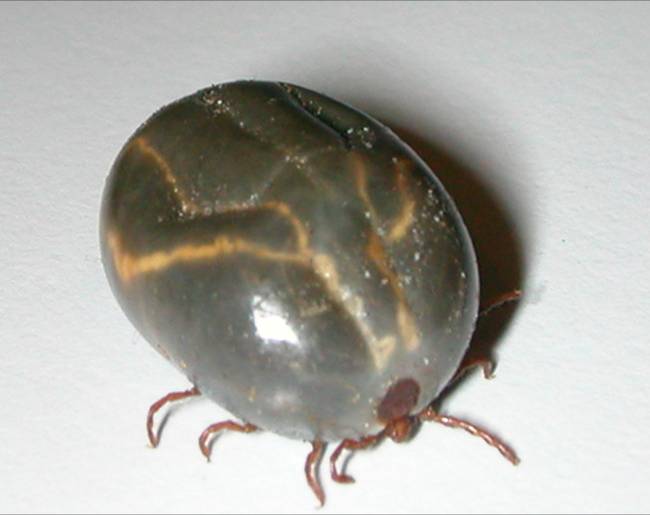
The scientific name of the Relict Tick is Haemaphysalis concinna. It is a species of arachnid in the family Ixodidae (hard ticks), order Ixodida. The name dates from 1844.
- Scientific name
- Haemaphysalis concinna Koch, 1844
- Common name
- Relict Tick
- Genus
- Haemaphysalis
- Family
- Ixodidae (Hard Ticks)
- Order
- Ixodida
- Class
- Arachnida
- Recorded in
- 9 countries
- Name status
- accepted in the Catalogue of Life

Overview
The Relict tick is an important ectoparasite of domestic animals, free-living animals and humans. It inhabits warm temperate deciduous and mixed forests across Europe and Asia, particularly moist areas near lake shores and river banks. It has a fragmented distribution across Europe and Asia and may contribute to the transmission of pathogens of medical and veterinary importance.
Written 26 November 2026 from the sources listed below. Each statement was checked against the passage it cites; statements that could not be supported were removed.
Appearance
Unfed adult females measure 3–4 mm in length, while engorged females can reach 10 mm. Adult males measure approximately 3 mm.[1][2][3]
Unfed nymphs measure less than 2 mm in length.[4]
Habitat
The Relict tick inhabits warm temperate deciduous and mixed forests across Europe and Asia. It prefers moist habitats, particularly lake shores and river banks.[5][6]
Diet
Larvae and nymphs feed on small mammals, including rodents and hedgehogs, as well as birds, reptiles and humans. Juvenile stages also feed on small rodents, birds and reptiles.[7][8][9]
Adult ticks prefer larger mammals, including cats, horses and humans. They also infest wildlife and farm animals, including cattle, goats and sheep.[10][11]
Behaviour
Males outnumber females in this species. All three developmental stages use different host groups, and rodents serve as important hosts for juvenile stages.[12][13][14]
Both nymphs and adult ticks can attack humans.[15]
Reproduction and life cycle
Individuals mate on their hosts around April. Females lay their eggs on the ground.[16][17]
Classification of the Relict Tick
| Kingdom | Animalia |
|---|---|
| Phylum | Arthropoda |
| Subphylum | Chelicerata |
| Class | Arachnida (Arachnid) |
| Superorder | Parasitiformes |
| Order | Ixodida (Tick) |
| Family | Ixodidae (Hard Ticks) |
| Genus | Haemaphysalis |
| Species | Haemaphysalis concinna Koch, 1844 |
Where the Relict Tick is found
Checklists and occurrence records place Haemaphysalis concinna in 9 countries across Europe. GBIF holds 432 georeferenced records of it.
Countries
Regions and cities with the most records
- Lower Austria, Austria 64
- Centre-Val de Loire, France 60
- Sopron, Hungary 24
- Malacky, Slovakia 22
- Csongrád, Hungary 20
- Szeged, Hungary 20
- Vienna, Austria 20
- Győr-Moson-Sopron, Hungary 19
- Nitra Region, Slovakia 18
- Dunakeszi, Hungary 16
- Klosterneuburg, Austria 16
- Pest County, Hungary 16
- Vierzon, France 16
- Fejér, Hungary 15
- Stockerau, Austria 14
- Székesfehérvár, Hungary 14
- Baden, Austria 13
- Dúbravka, Slovakia 13
- Szombathely, Hungary 13
- Vas County, Hungary 13
- Bratislava, Slovakia 12
- Bratislava Region, Slovakia 12
- Komárno, Slovakia 12
- Levice, Slovakia 12
- Pezinok, Slovakia 12
- Senec, Slovakia 12
- Zala County, Hungary 12
- Zalaegerszeg, Hungary 12
- Eger, Hungary 11
- Fót, Hungary 11
- Gödöllő, Hungary 11
- Heves County, Hungary 11
- Vecsés, Hungary 11
- Veresegyház, Hungary 11
- Vrakuňa, Slovakia 11
- Karlova Ves, Slovakia 10
3 more countries have a few records outside this range
These countries hold a few records of Haemaphysalis concinna but lie outside the range the checklists give for it. Such records are often zoo or garden specimens, museum material or vagrants, so the species is not counted as occurring there.
Range as the checklists state it
France
A number beside a place is its count of GBIF occurrence records. A place without a number comes from a checklist alone. Records show where a species has been observed or collected, which can include escapes and vagrants.
Common names
English
- Relict Tick
- Bush Tick
Names in 3 other languages
- Czech
- klíšť lužní
- German
- Reliktzecke
- Korean
- 매부리피참진드기
Synonyms
9 other scientific names have been used for this species and are now treated as synonyms of Haemaphysalis concinna.
- Haemaphysalis (Haemaphysalis) concinna Santos Dias, 1963
- Haemaphysalis (Haemaphysalis) filippovae Hoogstraal & Kim, 1985
- Haemaphysalis concinna concinna Neumann, 1911
- Haemaphysalis concinna hirudo Gedoelst, 1911
- Haemaphysalis concinna kochi Neumann, 1905
- Haemaphysalis kochi Santos Dias, 1958
- Ixodes chelifer Mégnin, 1880
- Haemaphysalis filippovae Bolotin, 1979 ambiguous synonym
- Haemaphysalis hirudo L.Koch, 1878 ambiguous synonym
Related species
-
 Asian Longhorned TickHaemaphysalis longicornis
-
 Rabbit TickHaemaphysalis leporispalustris
- Japanese Black-rabbit HaemaphysalidHaemaphysalis pentalagi
- Haemaphysalis spinigera
-
 African Dog TickHaemaphysalis leachi
- East Asian Mountain HaemaphysalidHaemaphysalis hystricis
- Luzon Mountain Glossy HaemaphysalidHaemaphysalis luzonensis
- Flat-inner-spurred HaemaphysalidHaemaphysalis intermedia
Compare
Questions and answers
What is the scientific name of the Relict Tick?
The scientific name of the Relict Tick is Haemaphysalis concinna. Written with its author, the full name is Haemaphysalis concinna Koch, 1844.
Which family does the Relict Tick belong to?
Haemaphysalis concinna belongs to the family Ixodidae, in the order Ixodida and the class Arachnida.
Where is the Relict Tick found?
Checklists and occurrence records place Haemaphysalis concinna in 9 countries, including Hungary, Austria, France, Russia, Slovakia and Spain.
What other names does the Relict Tick have?
Haemaphysalis concinna is also known in English as Bush Tick.
Sources
Passages the profile rests on
- Adult females measure 3–4 mm in length when unfed. Source passage: “Females reach a length of 3-4 mm” — English Wikipedia
- Engorged females can reach 10 mm in length. Source passage: “can grow up to 10 mm when engorged” — English Wikipedia
- Adult males measure approximately 3 mm in length. Source passage: “males are about 3 mm long.” — English Wikipedia
- Unfed nymphs measure less than 2 mm in length. Source passage: “An unfed nymph is under 2 mm long.” — English Wikipedia
- The species inhabits warm temperate deciduous and mixed forests across Europe and Asia. Source passage: “The tick can be found in the warm, temperate climate zone of deciduous and mixed forests across Europe and Asia.” — English Wikipedia
- The species prefers moist habitats, particularly lake shores and river banks. Source passage: “It prefers moist habitats lake shores or river banks.” — English Wikipedia
- Larvae and nymphs feed on small mammals, including rodents and hedgehogs. Source passage: “Nymphs and larvae feed on small mammals such as rodents or hedgehogs” — English Wikipedia
- Larvae and nymphs also feed on birds, reptiles and humans. Source passage: “or on birds, reptiles, and humans.” — English Wikipedia
- Juvenile stages feed on small rodents, birds and reptiles. Source passage: “larvae and nymphs feed on small rodents, birds or reptiles.” — pmc.ncbi.nlm.nih.gov
- Adult ticks prefer larger mammals, including cats, horses and humans. Source passage: “Adults prefer larger mammals, ranging from cats to horses, again including humans.” — English Wikipedia
- Adult ticks infest wildlife and farm animals, including cattle, goats and sheep. Source passage: “Adult ticks infest wildlife and farm animals (cattle, goats and sheep)” — pmc.ncbi.nlm.nih.gov
- Males outnumber females in this species. Source passage: “Males exceed females in number.” — English Wikipedia
- All three developmental stages use different host groups. Source passage: “All three stages target different hosts” — English Wikipedia
- Rodents serve as important hosts for the juvenile stages of this species. Source passage: “Rodents play a pivotal role as the hosts for juvenile ticks, larvae and nymphs, of at least three important tick species (H. concinna, D. reticulatus and I. ricinus)” — pmc.ncbi.nlm.nih.gov
- Both nymphs and adult ticks can attack humans. Source passage: “Humans can be attacked by both nymphs and adult ticks” — pmc.ncbi.nlm.nih.gov
- Females lay their eggs on the ground. Source passage: “the eggs are laid on the ground.” — English Wikipedia
- Individuals mate on their hosts around April. Source passage: “They mate on their host around April.” — English Wikipedia
Data
- Catalogue of Life, 2026-10-16 XR cc by
- Global Biodiversity Information Facility CC BY 4.0
- Wikidata CC0
- GeoNames CC BY 4.0
- Wikimedia Commons per image; credit shown with each image
- Within the Catalogue of Life, this name comes from TicksBase cc by
References
- Koch, C. L. (1844 a) Systematische Ubersicht uber die Ordnung der Zecken. Archiv fur Naturgeschichte, 10, 217 - 239. https: // doi. org / 10.5962 / bhl. part. 29560 where the name was published
This species in other databases
Page built on 27 November 2026. See how the catalog is made and all sources and licences.
Cite this page
ScientificNames.org. (2026). Haemaphysalis concinna (Relict Tick). Retrieved November 27, 2026, from https://scientificnames.org/species/haemaphysalis-concinna
“Haemaphysalis concinna (Relict Tick).” ScientificNames.org, 2026, scientificnames.org/species/haemaphysalis-concinna. Accessed 27 Nov. 2026.
ScientificNames.org. “Haemaphysalis concinna (Relict Tick).” Accessed November 27, 2026. https://scientificnames.org/species/haemaphysalis-concinna.
@misc{scientificnames_haemaphysalis_concinna_relict_tick,
  author = {{ScientificNames.org}},
  title = {Haemaphysalis concinna (Relict Tick)},
  year = {2026},
  url = {https://scientificnames.org/species/haemaphysalis-concinna},
  note = {Accessed 2026-11-27}
}