Species · Insects
Ceraunus Blue Hemiargus ceraunus
The scientific name of the Ceraunus Blue is Hemiargus ceraunus. It is a species of insect in the family Lycaenidae (blues), order Lepidoptera. The name dates from 1793.
- Scientific name
- Hemiargus ceraunus (Fabricius, 1793)
- Common name
- Ceraunus Blue
- Genus
- Hemiargus
- Family
- Lycaenidae (Blues)
- Order
- Lepidoptera
- Class
- Insecta
- Recorded in
- 19 countries
- Name status
- accepted in the Catalogue of Life

Overview
The Ceraunus Blue is a butterfly belonging to the family Lycaenidae. The species inhabits open woodland, desert scrub, dunes, pastures, road edges and vacant lots. The adult butterfly has a wingspan of 20–30 mm.
Written 26 November 2026 from the sources listed below. Each statement was checked against the passage it cites; statements that could not be supported were removed.
Appearance
The Ceraunus Blue is a butterfly in the family Lycaenidae. Adults have a wingspan of 20–30 mm.[1][2]
Habitat
The species inhabits open woodland, desert scrub and dunes. It also occurs in pastures and can inhabit road edges and vacant lots.[3][4][5][6][7][8]
Diet
Adult Ceraunus Blue butterflies feed on flower nectar.[9]
The larvae feed on the flowers and seedpods of woody legumes. Their food plants include Chamaecrista fasciculata, Abrus precatorius and plants belonging to the genus Prosopis.[10][11][12][13][14]
Behaviour
Adults are present on the wing throughout the year in Texas and southern Florida. In other parts of the species' range, adults occur on the wing in late summer.[15][16][17]
Classification of the Ceraunus Blue
| Kingdom | Animalia |
|---|---|
| Phylum | Arthropoda |
| Subphylum | Hexapoda |
| Class | Insecta (Insect) |
| Order | Lepidoptera |
| Superfamily | Papilionoidea |
| Family | Lycaenidae (Blues) |
| Subfamily | Polyommatinae |
| Tribe | Polyommatini |
| Genus | Hemiargus |
| Species | Hemiargus ceraunus (Fabricius, 1793) |
Where the Ceraunus Blue is found
Checklists and occurrence records place Hemiargus ceraunus in 19 countries. GBIF holds 22,454 georeferenced records of it.
Countries
- Bahamas 13
- Belize 68
- British Virgin Islands 3
- Cayman Islands 5
- Costa Rica 104
- Cuba 197
- Dominican Republic 103
- El Salvador 8
- Guatemala 28
- Haiti 27
- Honduras 92
- Jamaica 113
- Mexico 2,318
- Nicaragua 25
- Panama 46
- Puerto Rico 12
- Saint Kitts and Nevis 11
- U.S. Virgin Islands 7
- United States 19,274
Regions and cities with the most records
- Texas, United States 8,636
- Florida, United States 5,531
- Arizona, United States 2,893
- McAllen, United States 1,460
- Pharr, United States 1,436
- Alton, United States 1,370
- Reynosa, Mexico 1,324
- Mission, United States 1,304
- California, United States 1,163
- San Antonio, United States 880
- Tanque Verde, United States 810
- Catalina Foothills, United States 748
- Tucson, United States 704
- Casas Adobes, United States 675
- Flowing Wells, United States 661
- Live Oak, United States 589
- Oro Valley, United States 569
- Converse, United States 550
- Austin, United States 527
- Alamo, United States 505
- Universal City, United States 497
- Donna, United States 479
- New Braunfels, United States 464
- San Juan, United States 440
- Pflugerville, United States 417
- Missouri City, United States 408
- Stafford, United States 399
- Brushy Creek, United States 398
- Round Rock, United States 370
- Oaxaca, Mexico 369
- Sugar Land, United States 356
- Three Lakes, United States 341
- Country Walk, United States 338
- The Crossings, United States 334
- Gainesville, United States 328
- The Hammocks, United States 328
1 more country has a few records outside this range
These countries hold a few records of Hemiargus ceraunus but lie outside the range the checklists give for it. Such records are often zoo or garden specimens, museum material or vagrants, so the species is not counted as occurring there.
A number beside a place is its count of GBIF occurrence records. A place without a number comes from a checklist alone. Records show where a species has been observed or collected, which can include escapes and vagrants.
Common names
English
- Ceraunus Blue
- Antillean Blue
Names in 1 other language
- Spanish
- Mariposa átomo, Mariposa átomo azul
Synonyms
One other scientific name has been used for this species and is now treated as a synonym of Hemiargus ceraunus.
- Hesperia ceraunus Fabricius, 1793
Subspecies and varieties
- Hemiargus ceraunus ramon subspecies
Related species
-
 Hanno BlueHemiargus hanno
- Hemiargus astenida
- Hemiargus catilina
- Hemiargus teste
- Hemiargus bahamensis
-
 Common BluePolyommatus icarus
-
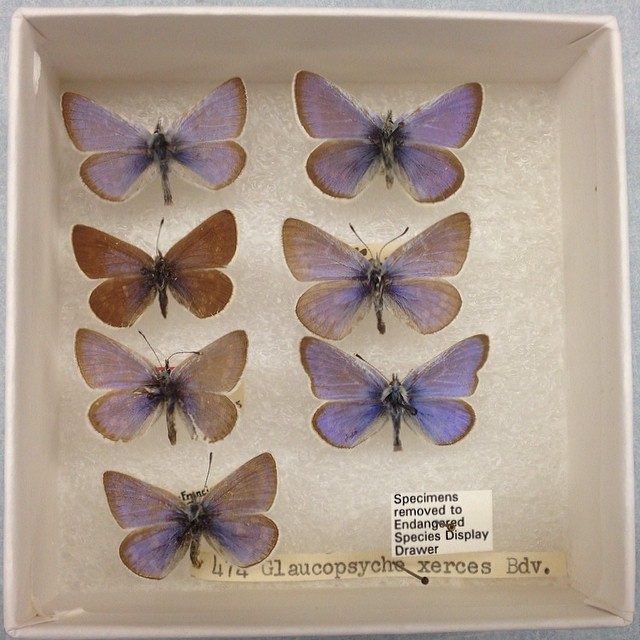 Xerces BlueGlaucopsyche xerces
-
 Adonis BlueLysandra bellargus
Compare
Questions and answers
What is the scientific name of the Ceraunus Blue?
The scientific name of the Ceraunus Blue is Hemiargus ceraunus. Written with its author, the full name is Hemiargus ceraunus (Fabricius, 1793).
Which family does the Ceraunus Blue belong to?
Hemiargus ceraunus belongs to the family Lycaenidae, in the order Lepidoptera and the class Insecta.
Where is the Ceraunus Blue found?
Checklists and occurrence records place Hemiargus ceraunus in 19 countries, including United States, Mexico, Cuba, Jamaica, Costa Rica and Dominican Republic.
What other names does the Ceraunus Blue have?
Hemiargus ceraunus is also known in English as Antillean Blue.
Sources
Passages the profile rests on
- The Ceraunus Blue is a butterfly belonging to the family Lycaenidae. Source passage: “Hemiargus ceraunus, the Ceraunus blue, is a species of butterfly in the family Lycaenidae.” — English Wikipedia
- The adult butterfly has a wingspan of 20–30 mm. Source passage: “The wingspan is 20–30 mm.” — English Wikipedia
- The species inhabits open woodland. Source passage: “The habitat consists of open woodland, desert scrub, dunes, pastures, road edges and vacant lots.” — English Wikipedia
- The species occurs in desert scrub habitats. Source passage: “The habitat consists of open woodland, desert scrub, dunes, pastures, road edges and vacant lots.” — English Wikipedia
- The species inhabits dunes. Source passage: “The habitat consists of open woodland, desert scrub, dunes, pastures, road edges and vacant lots.” — English Wikipedia
- The species occurs in pastures. Source passage: “The habitat consists of open woodland, desert scrub, dunes, pastures, road edges and vacant lots.” — English Wikipedia
- The species can inhabit road edges. Source passage: “The habitat consists of open woodland, desert scrub, dunes, pastures, road edges and vacant lots.” — English Wikipedia
- The species can inhabit vacant lots. Source passage: “The habitat consists of open woodland, desert scrub, dunes, pastures, road edges and vacant lots.” — English Wikipedia
- Adult Ceraunus Blue butterflies feed on flower nectar. Source passage: “Adults feed on flower nectar.” — English Wikipedia
- The larvae feed on the flowers of woody legumes. Source passage: “The larvae feed on the flowers and seedpods of various woody legumes, including Chamaecrista fasciculata, Abrus precatorius and Prosopis species.” — English Wikipedia
- The larvae consume seedpods of woody legumes. Source passage: “The larvae feed on the flowers and seedpods of various woody legumes, including Chamaecrista fasciculata, Abrus precatorius and Prosopis species.” — English Wikipedia
- The larvae feed on Chamaecrista fasciculata. Source passage: “including Chamaecrista fasciculata, Abrus precatorius and Prosopis species.” — English Wikipedia
- The larvae feed on Abrus precatorius. Source passage: “including Chamaecrista fasciculata, Abrus precatorius and Prosopis species.” — English Wikipedia
- The larvae feed on plants belonging to the genus Prosopis. Source passage: “including Chamaecrista fasciculata, Abrus precatorius and Prosopis species.” — English Wikipedia
- Adults are present on the wing throughout the year in Texas. Source passage: “Adults are on wing year round in Texas and southern Florida” — English Wikipedia
- Adults are present on the wing throughout the year in southern Florida. Source passage: “Adults are on wing year round in Texas and southern Florida” — English Wikipedia
- Adults occur on the wing in late summer in other parts of the species' range. Source passage: “and in late summer in other parts of the range.” — English Wikipedia
Data
- Catalogue of Life, 2026-10-16 XR cc by
- Global Biodiversity Information Facility CC BY 4.0
- Wikidata CC0
- GeoNames CC BY 4.0
- Wikimedia Commons per image; credit shown with each image
- Within the Catalogue of Life, this name comes from Global Lepidoptera Index cc by
This species in other databases
Page built on 28 November 2026. See how the catalog is made and all sources and licences.
Cite this page
ScientificNames.org. (2026). Hemiargus ceraunus (Ceraunus Blue). Retrieved November 28, 2026, from https://scientificnames.org/species/hemiargus-ceraunus
“Hemiargus ceraunus (Ceraunus Blue).” ScientificNames.org, 2026, scientificnames.org/species/hemiargus-ceraunus. Accessed 28 Nov. 2026.
ScientificNames.org. “Hemiargus ceraunus (Ceraunus Blue).” Accessed November 28, 2026. https://scientificnames.org/species/hemiargus-ceraunus.
@misc{scientificnames_hemiargus_ceraunus_ceraunus_blue,
  author = {{ScientificNames.org}},
  title = {Hemiargus ceraunus (Ceraunus Blue)},
  year = {2026},
  url = {https://scientificnames.org/species/hemiargus-ceraunus},
  note = {Accessed 2026-11-28}
}