Species · Birds
Heart-spotted Woodpecker Hemicircus canente
The scientific name of the Heart-spotted Woodpecker is Hemicircus canente. It is a species of bird in the family Picidae (woodpecker), order Piciformes. The name dates from 1832.
- Scientific name
- Hemicircus canente (R. Lesson, 1832)
- Common name
- Heart-spotted Woodpecker
- Genus
- Hemicircus
- Family
- Picidae (Woodpecker)
- Order
- Piciformes
- Class
- Aves
- Red List category
- LC Least Concern
- Recorded in
- 6 countries
- Name status
- accepted in the Catalogue of Life

Overview
The heart-spotted woodpecker (Hemicircus canente) is a species of bird in the woodpecker family. It has a contrasting black and white plumage, a distinctively stubby body and a large wedge-shaped head making it easy to identify while its frequent calling make it easy to detect as it forage for invertebrates under the bark of the slender outer branches of trees.
Classification of the Heart-spotted Woodpecker
| Kingdom | Animalia |
|---|---|
| Phylum | Chordata |
| Subphylum | Vertebrata |
| Infraphylum | Gnathostomata |
| Parvphylum | Osteichthyes |
| Megaclass | Tetrapoda |
| Class | Aves (Bird) |
| Order | Piciformes (Woodpeckers) |
| Family | Picidae (Woodpecker) |
| Subfamily | Picumninae |
| Genus | Hemicircus (Large-crested Woodpeckers) |
| Species | Hemicircus canente (R. Lesson, 1832) |
Where the Heart-spotted Woodpecker is found
Checklists and occurrence records place Hemicircus canente in 6 countries across Asia. GBIF holds 16,908 georeferenced records of it.
Countries
Regions and cities with the most records
- Kerala, India 6,962
- Karnataka, India 3,003
- Goa, India 2,064
- Dandeli, India 851
- Phetchaburi, Thailand 773
- Tamil Nadu, India 712
- Maharashtra, India 570
- Gudalur, India 561
- Dong Nai, Vietnam 532
- Nakhon Ratchasima, Thailand 527
- Valparai, India 324
- Nilambūr, India 265
- Cumbum, India 235
- Nakhon Nayok, Thailand 216
- Mannārakkāt, India 191
- Karwar, India 190
- Mondolkiri, Cambodia 190
- Chhattisgarh, India 187
- Odisha, India 181
- Thrissur, India 178
- Gudalur, India 176
- Preah Vihear, Cambodia 166
- Kharghar, India 165
- Panvel, India 165
- Munnar, India 149
- Mattanur, India 148
- Taliparamba, India 134
- Sirsi, India 121
- Tondalam, India 110
- Andhra Pradesh, India 106
- Kanhangad, India 100
- Kizhake Chālakudi, India 100
- Nedumangād, India 100
- Palakkad, India 99
- Ooty, India 93
- Perintalmanna, India 91
Range as the checklists state it
Southern Asia
A number beside a place is its count of GBIF occurrence records. A place without a number comes from a checklist alone. Records show where a species has been observed or collected, which can include escapes and vagrants.
Common names
English
- Heart-spotted Woodpecker
Names in 29 other languages
- Arabic
- نقار الخشب منقط القلب
- Bengali
- কলজেবুটি কাঠঠোকরা
- Catalan
- picot de Canens
- Chinese
- 心斑啄木, 黑冠啄木鳥, 黑冠啄木鸟
- Croatian
- kratkorepa žuna
- Czech
- datel kruhoocasý, datlovec srdíčkový
- Danish
- Hjerteplettet Spætte
- Dutch
- Hartvlekspecht
- Esperanto
- kormakula pego
- Estonian
- manisk-ladvarähn
- Finnish
- herttatöyhtöpoimija
- French
- Pic canente
- German
- Rundschwanzspecht
- Italian
- Picchio cordato
- Japanese
- クロカンムリコゲラ
- Lithuanian
- dėmėtakrūtis trumpauodegis genys
- Malayalam
- ചിത്രാംഗൻ മരംകൊത്തി
- Norwegian
- svarttopphjertespett
- Polish
- kusodrwal żałobny
- Portuguese
- pica-pau-canente, pica-pau-de-corações
- Russian
- Светлогорлый короткохвостый дятел, Чернохохлый дятлик
- Serbian
- Crni kratkorepi detlić
- Slovak
- ďatlík bielohrdlý
- Spanish
- Pito de corazones
- Swedish
- svarttofsad dvärgspett
- Thai
- นกหัวขวานแคระจุดรูปหัวใจ
- Turkish
- Kara Tepeli Alaca Ağaçkakan
- Ukrainian
- дятел-куцохвіст чорночубий
- Welsh
- cnocell fraith India
Synonyms
2 other scientific names have been used for this species and are now treated as synonyms of Hemicircus canente.
- Hemicircus canente canente Lesson, RP, 1832
- Picus canente Lesson, RP, 1832
Related species
-
 Grey-and-buff WoodpeckerHemicircus concretus
- Northern FlickerColaptes auratus
-
 Pileated WoodpeckerDryocopus pileatus
-
 Ivory-billed WoodpeckerCampephilus principalis
-
 Downy WoodpeckerDryobates pubescens
-
 Red-bellied WoodpeckerMelanerpes carolinus
-
 Great Spotted WoodpeckerDendrocopos major
-
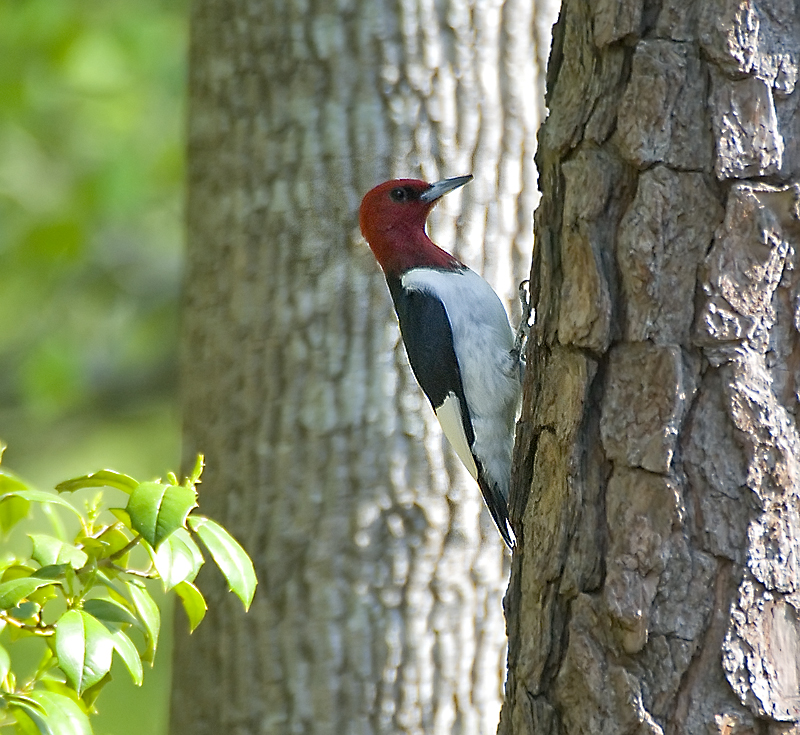 Red-headed WoodpeckerMelanerpes erythrocephalus
Compare
Questions and answers
What is the scientific name of the Heart-spotted Woodpecker?
The scientific name of the Heart-spotted Woodpecker is Hemicircus canente. Written with its author, the full name is Hemicircus canente (R. Lesson, 1832).
Which family does the Heart-spotted Woodpecker belong to?
Hemicircus canente belongs to the family Picidae, in the order Piciformes and the class Aves.
Where is the Heart-spotted Woodpecker found?
Checklists and occurrence records place Hemicircus canente in 6 countries: India, Thailand, Vietnam, Cambodia, Myanmar and Laos.
What is the conservation status of the Heart-spotted Woodpecker?
The IUCN Red List category recorded for Hemicircus canente is Least Concern (LC).
Sources
Data
- Catalogue of Life, 2026-10-16 XR cc by
- Global Biodiversity Information Facility CC BY 4.0
- Wikidata CC0
- English Wikipedia CC BY-SA 4.0
- GeoNames CC BY 4.0
- Wikimedia Commons per image; credit shown with each image
- Within the Catalogue of Life, this name comes from The Integrated Taxonomic Information System cc0
References
- Gill, Frank, & and Minturn Wright. (2006). Birds of the World: Recommended English Names.
This species in other databases
Page built on 26 November 2026. See how the catalog is made and all sources and licences.
Cite this page
ScientificNames.org. (2026). Hemicircus canente (Heart-spotted Woodpecker). Retrieved November 26, 2026, from https://scientificnames.org/species/hemicircus-canente
“Hemicircus canente (Heart-spotted Woodpecker).” ScientificNames.org, 2026, scientificnames.org/species/hemicircus-canente. Accessed 26 Nov. 2026.
ScientificNames.org. “Hemicircus canente (Heart-spotted Woodpecker).” Accessed November 26, 2026. https://scientificnames.org/species/hemicircus-canente.
@misc{scientificnames_hemicircus_canente_heart_spotted_woodpecker,
  author = {{ScientificNames.org}},
  title = {Hemicircus canente (Heart-spotted Woodpecker)},
  year = {2026},
  url = {https://scientificnames.org/species/hemicircus-canente},
  note = {Accessed 2026-11-26}
}