Species · Fishes
Australian Weasel Shark Hemigaleus australiensis
The scientific name of the Australian Weasel Shark is Hemigaleus australiensis. It is a species of fish in the family Hemigaleidae (weasel sharks), order Carcharhiniformes. The name dates from 2005.
- Scientific name
- Hemigaleus australiensis White, Last & Compagno, 2005
- Common name
- Australian Weasel Shark
- Genus
- Hemigaleus
- Family
- Hemigaleidae (Weasel Sharks)
- Order
- Carcharhiniformes
- Class
- Elasmobranchii
- Red List category
- LC Least Concern
- Environment
- marine
- Recorded in
- 2 countries
- Name status
- accepted in the Catalogue of Life

Overview
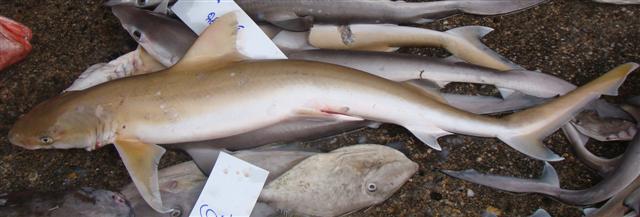
Hemigaleus australiensis inhabits continental and insular shelves off northern Australia, from inshore waters to depths of 170 m. It has a slender, spindle-shaped body, sickle-shaped fins and darkened tips on the second dorsal fin and upper caudal fin lobe.
Written 26 November 2026 from the sources listed below. Each statement was checked against the passage it cites; statements that could not be supported were removed.
Appearance
Its fins are sickle-shaped, with particularly narrow pectoral fins. The second dorsal fin and upper caudal fin lobe have darkened tips.[1][2]
It has 28–30 upper tooth rows and 46–52 lower tooth rows. Its upper teeth are broad, with large serrations along their trailing edges, while its lower teeth are thin, upright and smooth-edged.[3][4][5]
Its lateral line is prominent and curves downward below the second dorsal fin. Its skin is densely covered with small overlapping dermal denticles, each bearing five horizontal ridges.[6][7]
The species reaches a maximum reported length of 1.1 m.[8]
Habitat
The Australian Weasel Shark inhabits continental and insular shelves off northern Australia. It occurs from inshore waters to depths of 170 m and generally swims close to the sea floor.[9][10][11]
Juveniles and small adults generally inhabit sandy areas covered with seagrass. Large adults occur more frequently around coral reefs.[12][13]
Its Australian range extends from Geraldton in Western Australia to Brunswick Heads in New South Wales. Records from Papua New Guinea have been reported but remain unconfirmed.[14][15]
Diet
Octopuses are the predominant food of the Australian Weasel Shark. It consumes octopuses belonging to the genus Callistoctopus and commonly swallows them whole or removes their arms before consuming them.[16][17][18]
Sharks exceeding 90 cm in length eat almost exclusively octopuses. Bobtail squids are a minor secondary food source, particularly for smaller individuals.[19][20]
Other recorded foods include mud lobsters, crabs and echinoderms.[21]
Behaviour
The Australian Weasel Shark probably hunts mainly at dawn and dusk. Although it generally seeks prey near the bottom, it can also hunt in the water column.[22][23]
Reproduction and life cycle
The Australian Weasel Shark is viviparous, with embryos nourished through a placental connection to the mother. Its gestation period lasts approximately six months.[24][25]
Females typically produce two litters annually, around February and September. Litter sizes range from 1 to 19 pups, averaging eight.[26][27]
Newborn pups measure approximately 30 cm in length. Males reach sexual maturity at approximately 60 cm, while females reach sexual maturity at approximately 65 cm.[28][29][30]
Conservation
The Australian Weasel Shark is classified as Least Concern by the International Union for Conservation of Nature.[31]
Uses
The Australian Weasel Shark is commonly caught by prawn and fish trawlers operating off northern Australia. Gillnets and longlines also capture the species, but in smaller numbers than trawls.[32][33]
Similar species
The Australian Weasel Shark was originally regarded as the same species as the sicklefin weasel shark (Hemigaleus microstoma).[34]
Classification of the Australian Weasel Shark
| Kingdom | Animalia |
|---|---|
| Phylum | Chordata |
| Subphylum | Vertebrata |
| Infraphylum | Gnathostomata |
| Parvphylum | Chondrichthyes |
| Class | Elasmobranchii |
| Subclass | Neoselachii |
| Infraclass | Selachii |
| Superorder | Galeomorphi |
| Order | Carcharhiniformes |
| Family | Hemigaleidae (Weasel Sharks) |
| Genus | Hemigaleus (Sicklefin Weasel Sharks) |
| Species | Hemigaleus australiensis White, Last & Compagno, 2005 |
Where the Australian Weasel Shark is found
Checklists and occurrence records place Hemigaleus australiensis in 2 countries. GBIF holds 2,278 georeferenced records of it.
Countries
Regions and cities with the most records
1 more country has a few records outside this range
These countries hold a few records of Hemigaleus australiensis but lie outside the range the checklists give for it. Such records are often zoo or garden specimens, museum material or vagrants, so the species is not counted as occurring there.
A number beside a place is its count of GBIF occurrence records. A place without a number comes from a checklist alone. Records show where a species has been observed or collected, which can include escapes and vagrants.
Common names
English
- Australian Weasel Shark
- Sickelfin Weasel Shark
- Weasel Shark
Names in 4 other languages
- German
- Australischer Wieselhai
- Italian
- Squalo donnola australiano
- Japanese
- オーストラリアヒレトガリザメ
- Portuguese
- Tubarão-mangusto-australiano
Related species
-
 Sicklefin Weasel SharkHemigaleus microstoma
-
 Snaggletooth SharkHemipristis elongata
- Whitetip Weasel SharkParagaleus leucolomatus
-
 Atlantic Weasel SharkParagaleus pectoralis
-
 Hooktooth SharkChaenogaleus macrostoma
- Straight-tooth Weasel SharkParagaleus tengi
- Hemipristis tanakai
- Hemipristis curvatus
Compare
Questions and answers
What is the scientific name of the Australian Weasel Shark?
The scientific name of the Australian Weasel Shark is Hemigaleus australiensis. Written with its author, the full name is Hemigaleus australiensis White, Last & Compagno, 2005.
Which family does the Australian Weasel Shark belong to?
Hemigaleus australiensis belongs to the family Hemigaleidae, in the order Carcharhiniformes and the class Elasmobranchii.
Where is the Australian Weasel Shark found?
Checklists and occurrence records place Hemigaleus australiensis in 2 countries: Australia and Papua New Guinea.
What is the conservation status of the Australian Weasel Shark?
The IUCN Red List category recorded for Hemigaleus australiensis is Least Concern (LC).
What other names does the Australian Weasel Shark have?
Hemigaleus australiensis is also known in English as Sickelfin Weasel Shark and Weasel Shark.
Sources
Passages the profile rests on
- Its fins are sickle-shaped, with particularly narrow pectoral fins. Source passage: “All of the fins, particularly the narrow pectoral fins, are falcate (sickle-shaped) to some degree.” — English Wikipedia
- The second dorsal fin and upper caudal fin lobe have darkened tips. Source passage: “darkening at the tips of the second dorsal fin and upper caudal fin lobe” — English Wikipedia
- The species has 28–30 upper tooth rows and 46–52 lower tooth rows. Source passage: “There are 28–30 upper and 46–52 lower tooth rows” — English Wikipedia
- Its upper teeth are broad and have large serrations only along their trailing edges. Source passage: “the upper teeth are broad and angled with large serrations on the trailing edge only” — English Wikipedia
- Its lower teeth are thin, upright and smooth-edged. Source passage: “the lower teeth are thin and upright with smooth edges.” — English Wikipedia
- Its lateral line is prominent and curves downward below the second dorsal fin. Source passage: “The prominent lateral line curves downward below the second dorsal fin.” — English Wikipedia
- Its skin is densely covered with small overlapping dermal denticles, each bearing five horizontal ridges. Source passage: “The skin is densely covered by small, overlapping dermal denticles; each bears five horizontal ridges” — English Wikipedia
- The species reaches a maximum reported length of 1.1 m. Source passage: “Reaching 1.1 m (3.6 ft) in length” — English Wikipedia
- The species inhabits continental and insular shelves off northern Australia. Source passage: “The Australian weasel shark inhabits continental and insular shelves off northern Australia” — English Wikipedia
- It occurs from inshore waters to depths of 170 m. Source passage: “can be found from inshore waters down to 170 m (560 ft) deep.” — English Wikipedia
- The species generally swims close to the sea floor. Source passage: “This species tends to swim close to the sea floor” — English Wikipedia
- Juveniles and small adults generally inhabit sandy areas covered with seagrass. Source passage: “Juveniles and small adults are generally found in sandy areas with seagrass cover” — English Wikipedia
- Large adults occur more frequently around coral reefs. Source passage: “while large adults occur more around coral reefs.” — English Wikipedia
- Its Australian range extends from Geraldton in Western Australia to Brunswick Heads in New South Wales. Source passage: “from Geraldton in Western Australia to Brunswick Heads in New South Wales.” — English Wikipedia
- Records from Papua New Guinea have been reported but remain unconfirmed. Source passage: “Additional records from Papua New Guinea are as yet unconfirmed.” — English Wikipedia
- Octopuses are the predominant food of the species. Source passage: “The Australian weasel shark feeds predominantly on octopuses” — English Wikipedia
- It consumes octopuses belonging to the genus Callistoctopus. Source passage: “Octopuses such as Callistoctopus spp.” — English Wikipedia
- It commonly swallows octopuses whole or removes their arms before consuming them. Source passage: “either swallowing them whole or removing the arms first.” — English Wikipedia
- Sharks exceeding 90 cm in length eat almost exclusively octopuses. Source passage: “such that sharks over 90 cm (35 in) long eat almost nothing else” — English Wikipedia
- Bobtail squids are a minor secondary food source, particularly for smaller individuals. Source passage: “Bobtail squids represent a minor secondary food source, particularly for smaller sharks.” — English Wikipedia
- Other recorded foods include mud lobsters, crabs and echinoderms. Source passage: “mud lobsters, crabs, and echinoderms are rarely consumed.” — English Wikipedia
- The species probably hunts mainly at dawn and dusk. Source passage: “This species probably hunts mostly at dawn and dusk” — English Wikipedia
- Although it generally seeks prey near the bottom, it can also hunt in the water column. Source passage: “it typically seeks bottom-dwelling prey but will also rise into the water column if opportunity presents” — English Wikipedia
- The species is viviparous, with embryos nourished through a placental connection to the mother. Source passage: “the Australian weasel shark is viviparous with the developing embryos sustained through a placental connection with the mother.” — English Wikipedia
- Its gestation period lasts approximately six months. Source passage: “The gestation period is six months long” — English Wikipedia
- Females typically produce two litters annually, around February and September. Source passage: “typically two litters are produced annually, one around February and the other around September.” — English Wikipedia
- Litter sizes range from 1 to 19 pups, averaging eight. Source passage: “Litter size varies from 1 to 19 pups (average 8).” — English Wikipedia
- Newborn pups measure approximately 30 cm in length. Source passage: “are born at a length of 30 cm (12 in).” — English Wikipedia
- Males reach sexual maturity at approximately 60 cm in length. Source passage: “Males and females reach sexual maturity at approximately 60 cm (24 in) and 65 cm (26 in) long respectively.” — English Wikipedia
- Females reach sexual maturity at approximately 65 cm in length. Source passage: “Males and females reach sexual maturity at approximately 60 cm (24 in) and 65 cm (26 in) long respectively.” — English Wikipedia
- The species is classified as Least Concern by the International Union for Conservation of Nature. Source passage: “it has been listed as Least Concern by the International Union for Conservation of Nature (IUCN).” — English Wikipedia
- The species is commonly caught by prawn and fish trawlers operating off northern Australia. Source passage: “commonly caught by prawn and fish trawlers operating off northern Australia.” — English Wikipedia
- Gillnets and longlines also capture the species, but in smaller numbers than trawls. Source passage: “Smaller numbers are also captured in gillnets and on longlines.” — English Wikipedia
- The species was originally regarded as the same species as the sicklefin weasel shark (Hemigaleus microstoma). Source passage: “Originally regarded as conspecific with the sicklefin weasel shark (H. microstoma)” — English Wikipedia
Data
- Catalogue of Life, 2026-10-16 XR cc by
- Global Biodiversity Information Facility CC BY 4.0
- Wikidata CC0
- GeoNames CC BY 4.0
- Wikimedia Commons per image; credit shown with each image
- Within the Catalogue of Life, this name comes from World Register of Marine Species cc by
References
- White, W. T., Last, P. R., & Compagno, L. J. V. (2005). Description of a new species of weasel shark, Hemigaleus australiensis (Carcharhiniformes: Hemigaleidae) from Australian waters. Zootaxa, 1077: 37–49. https://doi.org/10.11646/zootaxa.1077.1.3 Link where the name was published
This species in other databases
- Catalogue of Life 3KNQX
- Wikidata Q40565
- iNaturalist 102559
- WoRMS urn:lsid:marinespecies.org:taxname:281023
Page built on 28 November 2026. See how the catalog is made and all sources and licences.
Cite this page
ScientificNames.org. (2026). Hemigaleus australiensis (Australian Weasel Shark). Retrieved November 28, 2026, from https://scientificnames.org/species/hemigaleus-australiensis
“Hemigaleus australiensis (Australian Weasel Shark).” ScientificNames.org, 2026, scientificnames.org/species/hemigaleus-australiensis. Accessed 28 Nov. 2026.
ScientificNames.org. “Hemigaleus australiensis (Australian Weasel Shark).” Accessed November 28, 2026. https://scientificnames.org/species/hemigaleus-australiensis.
@misc{scientificnames_hemigaleus_australiensis_australian_weasel_shark,
  author = {{ScientificNames.org}},
  title = {Hemigaleus australiensis (Australian Weasel Shark)},
  year = {2026},
  url = {https://scientificnames.org/species/hemigaleus-australiensis},
  note = {Accessed 2026-11-28}
}