Species · Insects
Yellow Pasha Herona marathus
The scientific name of the Yellow Pasha is Herona marathus. It is a species of insect in the family Nymphalidae (purples), order Lepidoptera. The name dates from 1848.
- Scientific name
- Herona marathus Doubleday, 1848
- Common name
- Yellow Pasha
- Genus
- Herona
- Family
- Nymphalidae (Purples)
- Order
- Lepidoptera
- Class
- Insecta
- Recorded in
- 7 countries
- Name status
- accepted in the Catalogue of Life

Overview
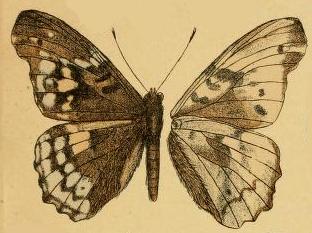
Yellow Pasha is a nymphalid butterfly of the genus Herona, with the accepted scientific name Herona marathus Doubleday, 1848. The species is found in India, occurring at elevations up to 4,000 ft (1,200 m) in the Sikkim-Darjeeling area. Adults have dark brown upper surfaces with two yellow or white discal bands on both pairs of wings.
Written 26 November 2026 from the sources listed below. Each statement was checked against the passage it cites; statements that could not be supported were removed.
Appearance
Adult butterflies have dark brown upper surfaces with two yellow or white discal bands on both the forewings and hindwings. They have a basal streak in vein 1b of the forewing, while the underside of the forewing has a white streak in vein 5 extending through the outer half to the termen.[1][2][3]
The nominate subspecies Herona marathus marathus has broad, confluent tawny bands on its upper surfaces and a wingspan of 70–90 mm.[4][5]
Herona marathus angustata has narrow tawny bands on its upper surfaces. Its hindwing discal bands and forewing outer bands are macular, with whitish bands in males and white bands in females.[6][7][8]
Habitat
The species occurs at elevations up to 4,000 ft (1,200 m) in the Sikkim-Darjeeling area. It is most frequently encountered between 2,000 and 3,000 ft (600–900 m) in this area.[9][10]
Diet
The butterfly is very fond of overripe fruits.[11]
Behaviour
The butterfly visits damp patches to obtain moisture through puddling.[12]
When disturbed, the butterfly rests with its head pointing downward and its wings held close to tree trunks. This resting posture makes it very difficult to locate or catch.[13][14]
Conservation
The nominate subspecies is not considered rare.[15]
Classification of the Yellow Pasha
| Kingdom | Animalia |
|---|---|
| Phylum | Arthropoda |
| Subphylum | Hexapoda |
| Class | Insecta (Insect) |
| Order | Lepidoptera |
| Superfamily | Papilionoidea |
| Family | Nymphalidae (Purples) |
| Subfamily | Apaturinae |
| Genus | Herona |
| Species | Herona marathus Doubleday, 1848 |
Where the Yellow Pasha is found
Checklists and occurrence records place Herona marathus in 7 countries. GBIF holds 268 georeferenced records of it.
Countries
Regions and cities with the most records
- Yunnan, China 42
- Assam, India 18
- Hainan, China 17
- Chiang Mai, Thailand 15
- Andaman and Nicobar, India 12
- Andhra Pradesh, India 12
- Sanya, China 12
- Chiang Rai, Thailand 10
- Hang Dong, Thailand 10
- Chiang Mai, Thailand 9
- Arunachal Pradesh, India 8
- Guangxi, China 8
- Mandalay Region, Myanmar 8
- Phetchaburi, Thailand 8
- Pyin Oo Lwin, Myanmar 8
- Meghalaya, India 7
- Port Blair, India 7
- Ban Khoan, Laos 6
- Tezpur, India 6
- Shella, India 5
- West Bengal, India 5
- Chiang Rai, Thailand 4
- Nakhon Ratchasima, Thailand 4
- Guwahati, India 3
- Ko Samui, Thailand 3
- Kālimpong, India 3
- North Guwāhāti, India 3
- Phetchabun, Thailand 3
- San Kamphaeng, Thailand 3
- Sikkim, India 3
- Surat Thani, Thailand 3
A number beside a place is its count of GBIF occurrence records. A place without a number comes from a checklist alone. Records show where a species has been observed or collected, which can include escapes and vagrants.
Common names
English
- Yellow Pasha
Names in 3 other languages
- Chinese
- 爻蛱蝶, 爻蛺蝶
- Japanese
- ウスコムラサキ
- Thai
- ผีเสื้อปาชาเหลือง
Subspecies and varieties
- Herona marathus andamana subspecies
- Herona marathus angustata subspecies
- Herona marathus marathon subspecies
- Herona marathus subsp. marathus (Assam Pasha) subspecies
Related species
-
 Herona sumatrana
- Herona djarang
-
 Monarch ButterflyDanaus (Danaus) plexippus
-
 Blue Morpho ButterflyMorpho menelaus
-
 Painted LadyVanessa cardui
-
 Gulf FritillaryDione (Agraulis) vanillae
-
 Red AdmiralVanessa atalanta
-
 ViceroyLimenitis archippus
Compare
Questions and answers
What is the scientific name of the Yellow Pasha?
The scientific name of the Yellow Pasha is Herona marathus. Written with its author, the full name is Herona marathus Doubleday, 1848.
Which family does the Yellow Pasha belong to?
Herona marathus belongs to the family Nymphalidae, in the order Lepidoptera and the class Insecta.
Where is the Yellow Pasha found?
Checklists and occurrence records place Herona marathus in 7 countries, including India, China, Thailand, Malaysia, Laos and Myanmar.
Sources
Passages the profile rests on
- Adult butterflies have dark brown upper surfaces with two yellow or white discal bands on both the forewings and hindwings. Source passage: “The adults are dark brown above with two yellow or white discal bands on forewing and hindwing.” — English Wikipedia
- Adults have a basal streak in vein 1b of the forewing. Source passage: “They have a basal streak in vein 1b of forewing.” — English Wikipedia
- The underside of the forewing has a white streak in vein 5 extending through the outer half to the termen. Source passage: “Underside of forewing, in vein 5 with white streak in outer half till the termen.” — English Wikipedia
- The nominate subspecies Herona marathus marathus has a wingspan of 70–90 mm. Source passage: “H. m. marathus Doubleday Wingspan 70–90 mm.” — English Wikipedia
- The nominate subspecies has broad, confluent tawny bands on its upper surfaces. Source passage: “Above bands tawny, very wide and confluent.” — English Wikipedia
- Herona marathus angustata has narrow tawny bands on its upper surfaces. Source passage: “Above bands tawny, narrow.” — English Wikipedia
- In Herona marathus angustata, the hindwing discal bands and forewing outer bands are macular. Source passage: “Discal bands on hindwing and outer band on forewing macular.” — English Wikipedia
- In Herona marathus angustata, males have whitish bands and females have white bands. Source passage: “Bands in males whitish while in female white.” — English Wikipedia
- The species occurs at elevations up to 4,000 ft (1,200 m) in the Sikkim-Darjeeling area. Source passage: “It is fairly common up to 4000 ft (1200 m) in the Sikkim-Darjeeling area.” — English Wikipedia
- The species is most frequently encountered between 2,000 and 3,000 ft (600–900 m) in the Sikkim-Darjeeling area. Source passage: “Most frequent between 2000 and 3000 ft (600–900 m).” — English Wikipedia
- The butterfly is very fond of overripe fruits. Source passage: “It is very fond of over-ripe fruits.” — English Wikipedia
- The butterfly visits damp patches to obtain moisture through puddling. Source passage: “Visits damp patches for puddling.” — English Wikipedia
- When disturbed, the butterfly rests with its head pointing downward and its wings held close to tree trunks. Source passage: “According to Haribal (1992), when disturbed it sits with head down and wings close to tree trunks and thus perfectly camouflaged.” — English Wikipedia
- Its resting posture against tree trunks makes it very difficult to locate or catch. Source passage: “Very difficult to catch/locate in this stage.” — English Wikipedia
- The nominate subspecies is not considered rare. Source passage: “The nominate subspecies is not rare (Evans, 1932).” — English Wikipedia
Data
- Catalogue of Life, 2026-10-16 XR cc by
- Global Biodiversity Information Facility CC BY 4.0
- Wikidata CC0
- GeoNames CC BY 4.0
- Wikimedia Commons per image; credit shown with each image
- Within the Catalogue of Life, this name comes from Global Lepidoptera Index cc by
References
- Doubleday. (1848). The genera of diurnal Lepidoptera, illustrated with plates by W.C. Hewitson. http://www.biodiversitylibrary.org/item/49324#page/290/mode/2up Link where the name was published
This species in other databases
Page built on 27 November 2026. See how the catalog is made and all sources and licences.
Cite this page
ScientificNames.org. (2026). Herona marathus (Yellow Pasha). Retrieved November 27, 2026, from https://scientificnames.org/species/herona-marathus
“Herona marathus (Yellow Pasha).” ScientificNames.org, 2026, scientificnames.org/species/herona-marathus. Accessed 27 Nov. 2026.
ScientificNames.org. “Herona marathus (Yellow Pasha).” Accessed November 27, 2026. https://scientificnames.org/species/herona-marathus.
@misc{scientificnames_herona_marathus_yellow_pasha,
  author = {{ScientificNames.org}},
  title = {Herona marathus (Yellow Pasha)},
  year = {2026},
  url = {https://scientificnames.org/species/herona-marathus},
  note = {Accessed 2026-11-27}
}