Species · Amphibians
Victoria Caecilian Herpele multiplicata
The scientific name of the Victoria Caecilian is Herpele multiplicata. It is a species of amphibian in the family Herpelidae (african caecilians), order Gymnophiona. The name dates from 1912.
- Scientific name
- Herpele multiplicata Nieden, 1912
- Common name
- Victoria Caecilian
- Genus
- Herpele
- Family
- Herpelidae (African Caecilians)
- Order
- Gymnophiona
- Class
- Amphibia
- Red List category
- DD Data Deficient
- Name status
- accepted in the Catalogue of Life
Overview
Herpele multiplicata is endemic to Cameroon and is known only from its type locality. It is distinguished by an unusually high number of body annuli, with a primary annulus count interpreted as 166.
Written 27 November 2026 from the sources listed below. Each statement was checked against the passage it cites; statements that could not be supported were removed.
Appearance
The holotype measured 239 mm in snout–vent length and had a body width of 4 mm. It was in a badly shrunken condition when measured.[1][2][3]
The species is distinguished by its unusually high number of body annuli. Its description can be interpreted as indicating 166 primary annuli and eight or possibly more secondary annuli, although the original description does not distinguish between primary and secondary annuli.[4][5][6][7]
Its primary annulus count is the highest recorded for an African caecilian. The body likely ended in a small terminal cap, and the eyes were probably concealed.[8][9][10]
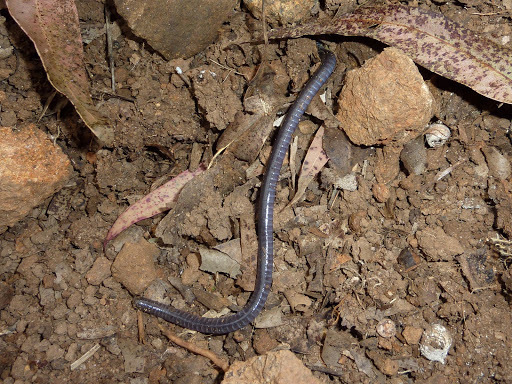
The species has a dark brown coloration with a lighter-colored head.[11]
Habitat
The original type locality was recorded as Mundame on the Mungo River in Cameroon. Victoria, now Limbé in Cameroon, was subsequently proposed as the type locality, but this assignment was considered erroneous.[12][13]
Classification of the Victoria Caecilian
| Kingdom | Animalia |
|---|---|
| Phylum | Chordata |
| Subphylum | Vertebrata |
| Infraphylum | Gnathostomata |
| Parvphylum | Osteichthyes |
| Megaclass | Tetrapoda |
| Class | Amphibia (Amphibians) |
| Order | Gymnophiona (Caecilian) |
| Family | Herpelidae (African Caecilians) |
| Genus | Herpele (Congo Caecilians) |
| Species | Herpele multiplicata Nieden, 1912 |
Common names
English
- Victoria Caecilian
Names in 2 other languages
- Czech
- cecílie prstenčitá
- Russian
- Многокольчатая червяга
Related species
-
 Congo CaecilianHerpele squalostoma
-
 Taita African CaecilianBoulengerula taitana
-
 Sagalla CaecilianBoulengerula niedeni
- Denhardt's African CaecilianBoulengerula denhardti
- Changamwe CaecilianBoulengerula changamwensis
- Boulenger's CaecilianBoulengerula boulengeri
- Fischer's African CaecilianBoulengerula fischeri
- Uluguru African CaecilianBoulengerula uluguruensis
Compare
Questions and answers
What is the scientific name of the Victoria Caecilian?
The scientific name of the Victoria Caecilian is Herpele multiplicata. Written with its author, the full name is Herpele multiplicata Nieden, 1912.
Which family does the Victoria Caecilian belong to?
Herpele multiplicata belongs to the family Herpelidae, in the order Gymnophiona and the class Amphibia.
What is the conservation status of the Victoria Caecilian?
The IUCN Red List category recorded for Herpele multiplicata is Data Deficient (DD).
Sources
Passages the profile rests on
- The holotype measured 239 mm in snout–vent length. Source passage: “The holotype measured 239 mm (9.4 in) in snout–vent length” — English Wikipedia
- The holotype had a body width of 4 mm. Source passage: “and was 4 mm (0.2 in) wide” — English Wikipedia
- The holotype was in a badly shrunken condition when measured. Source passage: “albeit in a badly shrunken state.” — English Wikipedia
- The species is distinguished by its unusually high number of body annuli. Source passage: “This species can be distinguished based on its high number of annuli.” — English Wikipedia
- The species description can be interpreted as indicating 166 primary annuli. Source passage: “the description can be interpreted as implying 166 primary annuli” — English Wikipedia
- The species description can be interpreted as indicating eight or possibly more secondary annuli. Source passage: “and eight (possibly more) secondary annuli.” — English Wikipedia
- The original species description does not distinguish between primary and secondary annuli. Source passage: “The original species description does not differentiate between primary and secondary annuli” — English Wikipedia
- Its primary annulus count is the highest recorded for an African caecilian. Source passage: “The first is the highest count for an African caecilian.” — English Wikipedia
- The body likely ended in a small terminal cap. Source passage: “The body likely ended in a small terminal cap.” — English Wikipedia
- The eyes were probably concealed. Source passage: “The eyes were likely hidden” — English Wikipedia
- The species has a dark brown coloration with a lighter-colored head. Source passage: “Coloration was dark brown, with head lighter.” — English Wikipedia
- The original type locality was recorded as Mundame on the Mungo River in Cameroon. Source passage: “Type locality: "Mundame am Mungo in Kamerun"” — amphibiansoftheworld.amnh.org
- Victoria, now Limbé in Cameroon, was subsequently proposed as the type locality, but this assignment was considered erroneous. Source passage: “given as "Victoria [now Limbé], Cameroon, West Africa", by Taylor, 1968, Caecilians of the World: 686; this considered in error by Wilkinson, Müller, and Gower, 2003, Afr. J. Herpetol., 52: 120.” — amphibiansoftheworld.amnh.org
Data
- Catalogue of Life, 2026-10-16 XR cc by
- Wikidata CC0
- Within the Catalogue of Life, this name comes from The Integrated Taxonomic Information System cc0
This species in other databases
Page built on 29 November 2026. See how the catalog is made and all sources and licences.
Cite this page
ScientificNames.org. (2026). Herpele multiplicata (Victoria Caecilian). Retrieved November 29, 2026, from https://scientificnames.org/species/herpele-multiplicata
“Herpele multiplicata (Victoria Caecilian).” ScientificNames.org, 2026, scientificnames.org/species/herpele-multiplicata. Accessed 29 Nov. 2026.
ScientificNames.org. “Herpele multiplicata (Victoria Caecilian).” Accessed November 29, 2026. https://scientificnames.org/species/herpele-multiplicata.
@misc{scientificnames_herpele_multiplicata_victoria_caecilian,
  author = {{ScientificNames.org}},
  title = {Herpele multiplicata (Victoria Caecilian)},
  year = {2026},
  url = {https://scientificnames.org/species/herpele-multiplicata},
  note = {Accessed 2026-11-29}
}