Species · Spiders and other arachnids
Giant Huntsman Spider Heteropoda maxima
The scientific name of the Giant Huntsman Spider is Heteropoda maxima. It is a species of arachnid in the family Sparassidae (huntsman spider), order Araneae. The name dates from 2001.
- Scientific name
- Heteropoda maxima Jäger, 2001
- Common name
- Giant Huntsman Spider
- Genus
- Heteropoda
- Family
- Sparassidae (Huntsman Spider)
- Order
- Araneae
- Class
- Arachnida
- Recorded in
- 3 countries
- Name status
- accepted in the Catalogue of Life
Overview
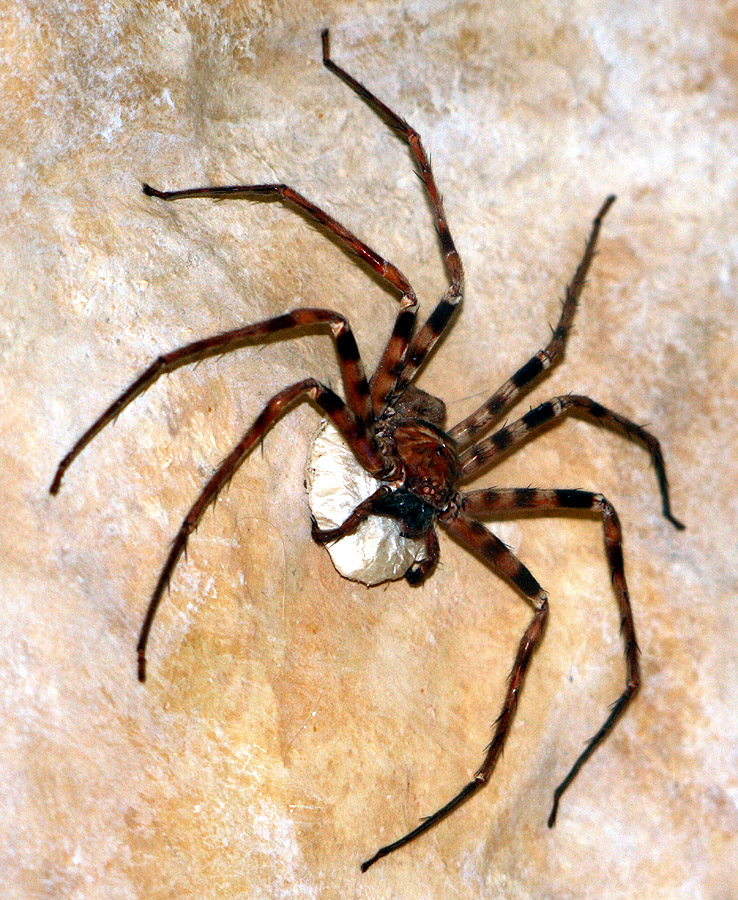
The species is found in Laos and has been documented in a cave near Vang Vieng. It can reach a maximum leg span of 30 cm (12 inches) and has long, forward-twisting legs arranged in a crab-like shape.
Written 24 November 2026 from the sources listed below. Each statement was checked against the passage it cites; statements that could not be supported were removed.
Appearance
The Giant Huntsman Spider has yellowish-brown coloration with irregularly distributed dark spots on the rear half of its body. Its legs have broad dark bands located before the first bend.[1][2]
Its legs are long relative to its body and twist forward in a crab-like arrangement. Its body length can reach 4.6 cm (1.8 inches).[3][4]
The species has pale coloration and does not exhibit an apparent reduction in eye size. Male specimens have special hairs on the second foot.[5][6][7]
Habitat
The Giant Huntsman Spider is described as a cave-dwelling species. It was discovered in a cave in Laos and has been documented in a cave near Vang Vieng in Laos.[8][9][10]
The species may inhabit areas close to cave entrances. Its pale coloration is cited as an indication of its cave-dwelling lifestyle, while its lack of apparent eye reduction suggests it may live near cave entrances.[5][7][11]
Behaviour
Cannibalism has been documented among individuals of the Giant Huntsman Spider. This behaviour is described as normal spider behaviour.[12][13]
Reproduction and life cycle
Female Giant Huntsman Spiders may consume males after mating.[14]
Classification of the Giant Huntsman Spider
| Kingdom | Animalia |
|---|---|
| Phylum | Arthropoda |
| Subphylum | Chelicerata |
| Class | Arachnida (Arachnid) |
| Order | Araneae (Spider) |
| Family | Sparassidae (Huntsman Spider) |
| Genus | Heteropoda (Giant Huntsman Spiders) |
| Species | Heteropoda maxima Jäger, 2001 |
Where the Giant Huntsman Spider is found
Checklists and occurrence records place Heteropoda maxima in 3 countries across Asia. GBIF holds 114 georeferenced records of it.
Countries
Regions and cities with the most records
Range as the checklists state it
Laos
A number beside a place is its count of GBIF occurrence records. A place without a number comes from a checklist alone. Records show where a species has been observed or collected, which can include escapes and vagrants.
Common names
English
- Giant Huntsman Spider
Names in 3 other languages
- Chinese
- 寮國高腳蛛
- Dutch
- Reuzenjachtkrabspin
- Thai
- แมงมุมพเนจรยักษ์
Related species
-
 LayaHeteropoda venatoria
-
 David Bowie SpiderHeteropoda davidbowie
-
 Jungle Huntsman SpiderHeteropoda jugulans
- Heteropoda lunula
- Heteropoda cervina
-
 Black-jaw HuntsmanHeteropoda tetrica
- Heteropoda amphora
- Heteropoda dagmarae
Compare
Questions and answers
What is the scientific name of the Giant Huntsman Spider?
The scientific name of the Giant Huntsman Spider is Heteropoda maxima. Written with its author, the full name is Heteropoda maxima Jäger, 2001.
Which family does the Giant Huntsman Spider belong to?
Heteropoda maxima belongs to the family Sparassidae, in the order Araneae and the class Arachnida.
Where is the Giant Huntsman Spider found?
Checklists and occurrence records place Heteropoda maxima in 3 countries: Laos, Pakistan and Vietnam.
Sources
Passages the profile rests on
- The species has yellowish-brown coloration with irregularly distributed dark spots on the rear half of its body. Source passage: “The coloration is yellowish-brown with several irregularly distributed dark spots on the rear half.” — English Wikipedia
- Its legs have broad dark bands located before the first bend. Source passage: “The legs have wide dark bands before the first bend.” — English Wikipedia
- The body length of Heteropoda maxima can reach 4.6 cm (1.8 inches). Source passage: “and 4.6 cm (1.8 in) body-length.” — English Wikipedia
- Its legs are long relative to its body and twist forward in a crab-like arrangement. Source passage: “the legs of the giant huntsman spider are long compared to the body, and twist forward in a crab-like fashion.” — English Wikipedia
- The species has pale coloration, which is cited as one indication of its cave-dwelling lifestyle. Source passage: “because of its pale colour, long legs and special hairs on the second foot of the male.” — English Wikipedia
- Male specimens have special hairs on the second foot. Source passage: “special hairs on the second foot of the male.” — English Wikipedia
- The species does not exhibit an apparent reduction in eye size. Source passage: “There is no apparent reduction of the eyes” — English Wikipedia
- The species was discovered in a cave in Laos. Source passage: “after being discovered in a cave in Laos.” — English Wikipedia
- The species has been documented in a cave near Vang Vieng in Laos. Source passage: “in a cave near Vang Vieng in Laos.” — English Wikipedia
- The giant huntsman spider is described as a cave-dwelling species. Source passage: “A cave-dwelling spider” — britannica.com
- The species may inhabit areas close to cave entrances, as suggested by the absence of apparent eye reduction. Source passage: “There is no apparent reduction of the eyes, possibly because the species lives near cave entrances.” — English Wikipedia
- Cannibalism has been documented among individuals of Heteropoda maxima. Source passage: “discovered cannibalism within the species of giant huntsman spiders” — English Wikipedia
- Cannibalism in this species is described as normal spider behaviour. Source passage: “although it is considered normal spider behavior.” — English Wikipedia
- Female Heteropoda maxima individuals may consume males after mating. Source passage: “Female individuals may eat male individuals after mating” — English Wikipedia
- The species can reach a maximum leg span of 30 cm (12 inches). Source passage: “The giant huntsman spider is the largest member of the family Sparassidae, boasting a 30 cm (12 in) leg-span” — English Wikipedia
Data
- Catalogue of Life, 2026-10-16 XR cc by
- Global Biodiversity Information Facility CC BY 4.0
- Wikidata CC0
- GeoNames CC BY 4.0
- Wikimedia Commons per image; credit shown with each image
- Within the Catalogue of Life, this name comes from The World Spider Catalog cc by
References
- Jäger, P. (2001a). A new species of Heteropoda (Araneae, Sparassidae, Heteropodinae) from Laos, the largest huntsman spider? Zoosystema 23: 461-465. where the name was published
This species in other databases
Page built on 24 November 2026. See how the catalog is made and all sources and licences.
Cite this page
ScientificNames.org. (2026). Heteropoda maxima (Giant Huntsman Spider). Retrieved November 24, 2026, from https://scientificnames.org/species/heteropoda-maxima
“Heteropoda maxima (Giant Huntsman Spider).” ScientificNames.org, 2026, scientificnames.org/species/heteropoda-maxima. Accessed 24 Nov. 2026.
ScientificNames.org. “Heteropoda maxima (Giant Huntsman Spider).” Accessed November 24, 2026. https://scientificnames.org/species/heteropoda-maxima.
@misc{scientificnames_heteropoda_maxima_giant_huntsman_spider,
  author = {{ScientificNames.org}},
  title = {Heteropoda maxima (Giant Huntsman Spider)},
  year = {2026},
  url = {https://scientificnames.org/species/heteropoda-maxima},
  note = {Accessed 2026-11-24}
}