Species · Spiders and other arachnids
Ornamental Baboon Spider Heteroscodra maculata
The scientific name of the Ornamental Baboon Spider is Heteroscodra maculata. It is a species of arachnid in the family Theraphosidae (tarantulas), order Araneae. The name dates from 1900.
- Scientific name
- Heteroscodra maculata Pocock, 1900
- Common name
- Ornamental Baboon Spider
- Genus
- Heteroscodra
- Family
- Theraphosidae (Tarantulas)
- Order
- Araneae
- Class
- Arachnida
- Recorded in
- 1 country
- Name status
- accepted in the Catalogue of Life

Overview
The Ornamental Baboon Spider is an arboreal spider species. It is native to West Africa, with its primary distribution in Togo and Ghana. Adults have a chalky-white or cream coloration, mottled abdominal patterns and a starburst pattern on the carapace.
Written 26 November 2026 from the sources listed below. Each statement was checked against the passage it cites; statements that could not be supported were removed.
Appearance
Juvenile specimens have olive-green or grey coloration. Adults have a chalky-white or cream base coloration with mottled black and brown abdominal patterns and a starburst pattern on the carapace.[1][2]
The rear legs are noticeably thickened, helping the spider grip tree bark. The species lacks urticating hairs and exhibits sexual dimorphism.[3][4][5]
Mature females have a body length of 5–6 centimetres and can reach a leg span of 13 centimetres. Males are smaller than females.[6][7][8]
Habitat
The Ornamental Baboon Spider is arboreal. Wild specimens inhabit tree hollows, logs and dense foliage.[9][10]
The species constructs retreats lined with thick silk sheets.[11]
Behaviour
The Ornamental Baboon Spider is fast-moving and defensive. Because it lacks urticating hairs, it primarily uses biting as a defensive response.[4][12][13]
Young specimens have been observed burrowing during their first few months of life.[14]
The species possesses venom considered medically significant. Its venom can cause intense pain and muscle spasms in humans.[15][16]
Reproduction and life cycle
The Ornamental Baboon Spider reaches maturity at approximately three years of age. Female specimens tend to reproduce readily.[17][18]
Following copulation, females construct a fixed silk hammock attached to the substrate or enclosure walls for depositing their eggs. Egg sacs are reported to contain between 75 and 130 spiderlings.[19][20]
Sexual cannibalism may occur during reproduction. Introducing breeding pairs in captivity carries a high risk of sexual cannibalism.[21][22]
Uses
The Ornamental Baboon Spider is kept as an exotic pet.[23]
Venom toxins from the species have been used in neurological research investigating how the human body processes chronic pain.[24]
Its venom contains δ-theraphotoxin-Hm1a, δ-theraphotoxin-Hm1b and Π-Theraphotoxin-Hm3a. These toxins activate NaV1.1 voltage-gated sodium channels located in mechanical pain receptors.[25][26][27]
Classification of the Ornamental Baboon Spider
| Kingdom | Animalia |
|---|---|
| Phylum | Arthropoda |
| Subphylum | Chelicerata |
| Class | Arachnida (Arachnid) |
| Order | Araneae (Spider) |
| Family | Theraphosidae (Tarantulas) |
| Genus | Heteroscodra |
| Species | Heteroscodra maculata Pocock, 1900 |
Where the Ornamental Baboon Spider is found
Checklists and occurrence records place Heteroscodra maculata in 1 country across Africa. GBIF holds 4 georeferenced records of it.
Countries
1 more country has a few records outside this range
These countries hold a few records of Heteroscodra maculata but lie outside the range the checklists give for it. Such records are often zoo or garden specimens, museum material or vagrants, so the species is not counted as occurring there.
Range as the checklists state it
West, Central Africa
A number beside a place is its count of GBIF occurrence records. A place without a number comes from a checklist alone. Records show where a species has been observed or collected, which can include escapes and vagrants.
Common names
English
- Ornamental Baboon Spider
- Togo Starburst Baboon Spider
- Togo Starburst Tarantula
Names in 3 other languages
- Chinese
- 多哥星团巴布
- Czech
- sklípkan skvrnitý
- German
- Afrikanische Baumvogelspinne, Marmorvogelspinne
Related species
- Cameron Brown TarantulaHeteroscodra crassipes
-
 Goliath BirdeaterTheraphosa blondi
-
 Gooty Sapphire Ornamental TarantulaPoecilotheria metallica
- Curly Hair TarantulaTliltocatl albopilosus
-
 Mexican Orange-knee TarantulaBrachypelma hamorii
-
 Chilean Rose TarantulaGrammostola rosea
-
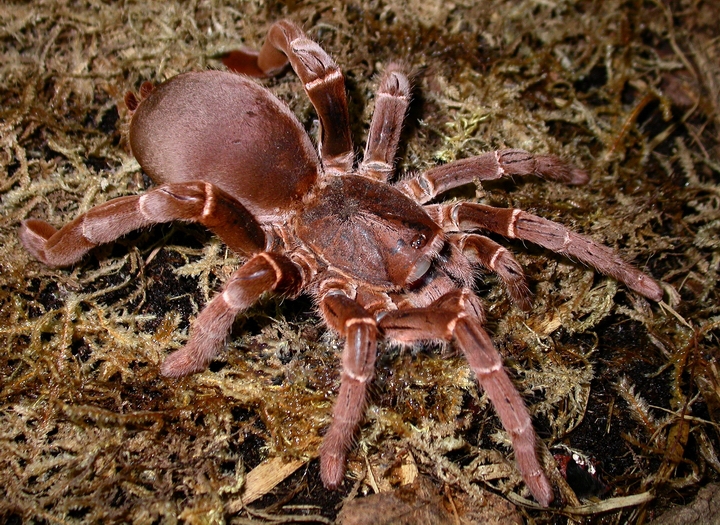 King Baboon SpiderPelinobius muticus
-
 Orange Baboon TarantulaPterinochilus murinus
Compare
Questions and answers
What is the scientific name of the Ornamental Baboon Spider?
The scientific name of the Ornamental Baboon Spider is Heteroscodra maculata. Written with its author, the full name is Heteroscodra maculata Pocock, 1900.
Which family does the Ornamental Baboon Spider belong to?
Heteroscodra maculata belongs to the family Theraphosidae, in the order Araneae and the class Arachnida.
Where is the Ornamental Baboon Spider found?
Checklists and occurrence records place Heteroscodra maculata in 1 country: Togo.
What other names does the Ornamental Baboon Spider have?
Heteroscodra maculata is also known in English as Togo Starburst Baboon Spider and Togo Starburst Tarantula.
Are Togo Starburst venomous?
Yes. The Ornamental Baboon Spider possesses venom considered medically significant, which can cause intense pain and muscle spasms in humans.[15][16]
Are baboon tarantulas aggressive?
The Ornamental Baboon Spider is fast-moving and defensive. It primarily uses biting as a defensive response because it lacks urticating hairs.[4][12][13]
How long do Togo Starburst tarantulas live?
Female specimens have a reported lifespan of 12–15 years, while males have a reported lifespan of 3–5 years.[28][29]
How do I care for a Togo Starburst Baboon tarantula?
Captive specimens require arboreal enclosures with substantial vertical clearance. Cork bark and hollow branches encourage the construction of silk retreats. Cross-ventilation is necessary to replicate the humidity of the species' native tropical environment.[30][31][32]
Sources
Passages the profile rests on
- Juvenile Heteroscodra maculata specimens have olive-green or grey coloration. Source passage: “Juveniles are olive-green or grey.” — English Wikipedia
- Adult specimens have a chalky-white or cream base coloration with mottled black and brown abdominal patterns and a starburst pattern on the carapace. Source passage: “Adults develop a chalky-white or cream base color, marked with mottled black and brown patterns on the abdomen and a starburst pattern on the carapace.” — English Wikipedia
- The rear legs of Heteroscodra maculata are noticeably thickened, helping the spider grip tree bark. Source passage: “The rear legs are noticeably thickened, which aids in gripping tree bark.” — English Wikipedia
- Heteroscodra maculata lacks urticating hairs. Source passage: “It lacks urticating hairs.” — English Wikipedia
- Heteroscodra maculata exhibits sexual dimorphism. Source passage: “The species exhibits sexual dimorphism” — English Wikipedia
- Mature female Heteroscodra maculata specimens have a body length of 5–6 centimetres. Source passage: “Mature females are stocky, with a body length of 5 to 6 centimeters (2.0 to 2.4 in)” — English Wikipedia
- Female Heteroscodra maculata specimens can reach a leg span of 13 centimetres. Source passage: “and a leg span up to 13 centimeters (5.1 in).” — English Wikipedia
- Male Heteroscodra maculata specimens are smaller than females. Source passage: “Males are smaller with shorter lifespans, only living 3-5 years.” — English Wikipedia
- Heteroscodra maculata is an arboreal spider species. Source passage: “They are an arboreal species” — English Wikipedia
- Wild Heteroscodra maculata specimens inhabit tree hollows, logs and dense foliage. Source passage: “In the wild, these spiders reside in tree hollows, logs, and dense foliage” — English Wikipedia
- Heteroscodra maculata constructs retreats lined with thick silk sheets. Source passage: “constructing retreats lined with thick silk sheets.” — English Wikipedia
- Heteroscodra maculata specimens are fast-moving and defensive. Source passage: “Heteroscodra maculata specimens are quite fast, defensive” — English Wikipedia
- Heteroscodra maculata primarily uses biting as a defensive response because it lacks urticating hairs. Source passage: “Due to their lack of urticating hairs, they tend to bite as a primary defense.” — English Wikipedia
- Young Heteroscodra maculata specimens have been observed burrowing during their first few months of life. Source passage: “though younger specimens have been noted to burrow during their first few months of life.” — English Wikipedia
- Heteroscodra maculata possesses venom considered medically significant. Source passage: “possess medically significant venom.” — English Wikipedia
- Heteroscodra maculata venom can cause intense pain and muscle spasms in humans. Source passage: “known to cause intense pain and muscle spasms in humans.” — English Wikipedia
- Heteroscodra maculata reaches maturity at approximately three years of age. Source passage: “matures in approximately three years.” — English Wikipedia
- Female Heteroscodra maculata specimens tend to reproduce readily. Source passage: “Females tend to reproduce readily” — English Wikipedia
- Heteroscodra maculata egg sacs are reported to contain between 75 and 130 spiderlings. Source passage: “Egg sacs are reported to contain between 75 and 130 spiderlings.” — English Wikipedia
- Following copulation, female Heteroscodra maculata construct a fixed silk hammock attached to the substrate or enclosure walls for depositing their eggs. Source passage: “Following copulation, the female constructs a fixed silk hammock attached to the substrate or enclosure walls to deposit her eggs” — English Wikipedia
- Sexual cannibalism may occur during reproduction in Heteroscodra maculata. Source passage: “though sexual cannibalism may occur.” — English Wikipedia
- Introducing breeding pairs of Heteroscodra maculata in captivity carries a high risk of sexual cannibalism. Source passage: “introduction of breeding pairs carries a high risk of sexual cannibalism” — English Wikipedia
- Heteroscodra maculata is kept as an exotic pet. Source passage: “Heteroscodra maculata is considered an exotic pet.” — English Wikipedia
- Venom toxins from Heteroscodra maculata have been used in neurological research investigating how the human body processes chronic pain. Source passage: “they have become a useful tool in neurological research for studying how the human body processes chronic pain.” — English Wikipedia
- Heteroscodra maculata venom contains the toxins δ-theraphotoxin-Hm1a and δ-theraphotoxin-Hm1b. Source passage: “The venom includes toxins like δ-theraphotoxin-Hm1a and δ-theraphotoxin-Hm1b.” — English Wikipedia
- Heteroscodra maculata venom also contains Π-Theraphotoxin-Hm3a. Source passage: “Along with these toxins, it also includes Π-Theraphotoxin-Hm3a.” — English Wikipedia
- The venom toxins activate NaV1.1 voltage-gated sodium channels located in mechanical pain receptors. Source passage: “these toxins activate the NaV1.1 voltage-gated sodium channels located in mechanical pain receptors (A-delta fibers).” — English Wikipedia
- Female Heteroscodra maculata specimens have a reported lifespan of 12–15 years. Source passage: “Females live 12-15 years.” — English Wikipedia
- Male Heteroscodra maculata specimens have a reported lifespan of 3–5 years. Source passage: “Males are smaller with shorter lifespans, only living 3-5 years.” — English Wikipedia
- Captive Heteroscodra maculata requires arboreal enclosures with substantial vertical clearance. Source passage: “Captive spiders require arboreal enclosures with high vertical clearance” — English Wikipedia
- Cork bark and hollow branches are used in captive enclosures to encourage Heteroscodra maculata to construct silk retreats. Source passage: “elements such as cork bark or hollow branches to encourage the construction of silk retreats.” — English Wikipedia
- Cross-ventilation is necessary in captive enclosures to replicate the humidity of the species' native tropical environment. Source passage: “Cross-ventilation is necessary to replicate the humidity of its native tropical environment.” — English Wikipedia
Data
- Catalogue of Life, 2026-10-16 XR cc by
- Global Biodiversity Information Facility CC BY 4.0
- Wikidata CC0
- GeoNames CC BY 4.0
- Wikimedia Commons per image; credit shown with each image
- Within the Catalogue of Life, this name comes from The World Spider Catalog cc by
References
- Pocock, R. I. (1900g). On the scorpions, pedipalps and spiders from tropical West-Africa, represented in the collection of the British Museum. Proceedings of the Zoological Society of London 67(4, 1899): 833-885, pl. 55-58. where the name was published
This species in other databases
Page built on 27 November 2026. See how the catalog is made and all sources and licences.
Cite this page
ScientificNames.org. (2026). Heteroscodra maculata (Ornamental Baboon Spider). Retrieved November 27, 2026, from https://scientificnames.org/species/heteroscodra-maculata
“Heteroscodra maculata (Ornamental Baboon Spider).” ScientificNames.org, 2026, scientificnames.org/species/heteroscodra-maculata. Accessed 27 Nov. 2026.
ScientificNames.org. “Heteroscodra maculata (Ornamental Baboon Spider).” Accessed November 27, 2026. https://scientificnames.org/species/heteroscodra-maculata.
@misc{scientificnames_heteroscodra_maculata_ornamental_baboon_spider,
  author = {{ScientificNames.org}},
  title = {Heteroscodra maculata (Ornamental Baboon Spider)},
  year = {2026},
  url = {https://scientificnames.org/species/heteroscodra-maculata},
  note = {Accessed 2026-11-27}
}