Species · Fishes
Reticulate Whipray Himantura uarnak
The scientific name of the Reticulate Whipray is Himantura uarnak. It is a species of fish in the family Dasyatidae (whiptail stingray), order Myliobatiformes. The name dates from 1789.
- Scientific name
- Himantura uarnak (Gmelin, 1789)
- Common name
- Reticulate Whipray
- Genus
- Himantura
- Family
- Dasyatidae (Whiptail Stingray)
- Order
- Myliobatiformes
- Class
- Elasmobranchii
- Red List category
- EN Endangered
- Environment
- brackish, marine
- Recorded in
- 30 countries
- Name status
- accepted in the Catalogue of Life
Overview
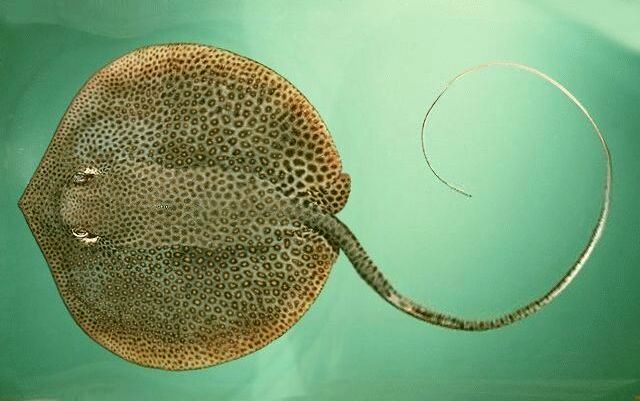
Adults generally have closely spaced dark brown spots or reticulations against a beige to yellow-brown dorsal background.
Written 26 November 2026 from the sources listed below. Each statement was checked against the passage it cites; statements that could not be supported were removed.
Appearance
The Reticulate Whipray has a diamond-shaped pectoral disc that is wider than it is long. Its underside is pale white and unmarked.[1][2]
Adults generally have closely spaced dark brown spots or reticulations against a beige to yellow-brown dorsal background. Juveniles have yellowish upper surfaces with densely packed tiny dark spots.[3][4]
Adults develop a broad band of flattened, heart-shaped dermal denticles extending from between the eyes to the tail spine. The species also has two large pearl thorns at the center of its back and small triangular pelvic fins.[5][6][7]
The tail is whip-like and extremely thin, without fin folds. It usually has one serrated stinging spine on its upper surface.[8][9]
The Reticulate Whipray can reach a disc width of 2 metres, a total length of 6 metres and a reported weight of 120 kilograms. An intact tail measures approximately 3–3.5 times the length of its disc.[10][11][12][13]
Newborn Reticulate Whiprays off South Africa measure approximately 28–30 centimetres across, while newborns off Australia measure approximately 21–28 centimetres across.[14][15]
Habitat
The Reticulate Whipray inhabits coral reefs, brackish waters and marine environments. It occurs over sandy flats near beaches, in lagoons and around coral reefs.[16][17]
It occurs from the intertidal zone to offshore waters at depths of 50 metres or more. It tolerates low salinities and can enter estuaries and mangrove swamps.[18][19]
Its preferred water temperature is 23–26 °C. In Shark Bay, Western Australia, it uses intertidal sand flats during warm periods and deeper seagrass patches during cold periods.[20][21]
The Reticulate Whipray occurs in the Red Sea, western Indian Ocean and Arabian Sea. It has expanded into the eastern Mediterranean through the Suez Canal and is now common in the southeastern Mediterranean.[22][23][24]
Diet
The Reticulate Whipray feeds on crabs, shrimps, mantis shrimps, bivalves, gastropods, worms, jellyfish and bony fishes.[25]
Fishes constitute approximately two-thirds of its diet in the western Indian Ocean. Ponyfish and anchovies are particularly important fish prey in this area.[26][27]
Reticulate Whiprays in Australian waters are known to consume penaeid prawns.[28]
Behaviour
The Reticulate Whipray is generally inactive during daytime and rests motionless on the seabed, sometimes buried in sand.[29]
In Shark Bay, Western Australia, Reticulate Whiprays rest individually or in small groups in very shallow water during high tide. They sometimes form mixed-species resting groups with cowtail stingrays.[30][31]
Mixed-species resting groups of Reticulate Whiprays and cowtail stingrays can form circular arrangements with their tails pointing outward.[32]
Reproduction and life cycle
Females produce litters of up to five pups. The gestation period is approximately one year, and females give birth during summer.[33][34][35]
Conservation
The Reticulate Whipray is classified as Endangered by the International Union for Conservation of Nature. Global populations are suspected to have declined by 50–75% over the last 75 years.[36][37]
The species is vulnerable to population depletion because of its large size, inshore habitat preferences and slow reproductive rate. Habitat degradation also threatens it.[38][39]
The minimum population doubling rate of the Reticulate Whipray is very low, requiring more than 14 years. FishBase reports a vulnerability score of 90 out of 100.[40][41]
Uses
Reticulate Whiprays are fished for their meat, skin and cartilage. They are sometimes processed into fishmeal for the poultry industry.[42][43]
Some wings are exported to Malaysia and Thailand. The tail may be sold as a curio.[44][45]
The Reticulate Whipray is occasionally sold in the home aquarium trade.[46]
Similar species
The Reticulate Whipray is closely related to Himantura undulata, Himantura leoparda, Himantura tutul and Himantura australis.[47]
Classification of the Reticulate Whipray
| Kingdom | Animalia |
|---|---|
| Phylum | Chordata |
| Subphylum | Vertebrata |
| Infraphylum | Gnathostomata |
| Parvphylum | Chondrichthyes |
| Class | Elasmobranchii |
| Subclass | Neoselachii |
| Infraclass | Batoidea |
| Order | Myliobatiformes |
| Family | Dasyatidae (Whiptail Stingray) |
| Genus | Himantura (Whip Rays) |
| Species | Himantura uarnak (Gmelin, 1789) |
Where the Reticulate Whipray is found
Checklists and occurrence records place Himantura uarnak in 30 countries. GBIF holds 1,396 georeferenced records of it.
Countries
- Australia 516
- Bangladesh 5
- Egypt 80
- French Polynesia 6
- India 41
- Indonesia 67
- Israel 132
- Japan 6
- Kenya 12
- Kuwait 3
- Madagascar 9
- Malaysia 38
- Maldives 3
- Mayotte 3
- Mozambique 182
- Myanmar 5
- Oman 11
- Papua New Guinea 3
- Philippines 23
- Saudi Arabia 18
- Seychelles 16
- Singapore 3
- South Africa 163
- Sri Lanka 8
- Taiwan 6
- Tanzania 7
- Thailand 15
- Turkey 3
- United Arab Emirates 7
- Yemen 5
Regions and cities with the most records
- Inhambane, Mozambique 80
- Maxixe, Mozambique 79
- Aqaba, Jordan 75
- Eilat, Israel 75
- KwaZulu-Natal, South Africa 36
- Western Australia, Australia 35
- Binyamina-Giv'at Ada, Israel 34
- Binyamina-Giv‘at ‘Ada, Israel 34
- Jisr ez Zarqā, Israel 34
- Or Akiva, Israel 34
- Pardés H̱anna Karkur, Israel 34
- Zikhron Ya‘aqov, Israel 32
- Hadera, Israel 29
- Kafr Qari‘, Israel 26
- Netanya, Israel 23
- Haifa, Israel 22
- Kfar Yona, Israel 21
- Zambezia Province, Mozambique 21
- Bāqa el Gharbīya, Israel 20
- Aqaba, Jordan 19
- Tirat Karmel, Israel 16
- Even Yehuda, Israel 15
- Kadima Zoran, Israel 15
- Qalansuwa, Israel 13
- Quelimane, Mozambique 13
- Ţūlkarm, Palestinian Territory 12
- Daliyat al Karmel, Israel 11
- Yoqne‘am ‘Illit, Israel 11
- Givatayim, Israel 10
- Herzliya, Israel 10
- Nesher, Israel 10
- Ramat HaSharon, Israel 10
- Sabah, Malaysia 10
- Tel Aviv, Israel 10
- Haifa, Israel 9
- Hod HaSharon, Israel 9
1 more country has a few records outside this range
These countries hold a few records of Himantura uarnak but lie outside the range the checklists give for it. Such records are often zoo or garden specimens, museum material or vagrants, so the species is not counted as occurring there.
A number beside a place is its count of GBIF occurrence records. A place without a number comes from a checklist alone. Records show where a species has been observed or collected, which can include escapes and vagrants.
Common names
English
- Reticulate Whipray
- Coach Whipray
- Darkspotted Stingray
- Fine-spotted Leopard Whipray
- Honeycomb Ray
- Leopard Stingray
- Long-tailed Ray
- Longtail Ray
- Longtail Stingray
- Marbled Stingray
- Reticulated Whipray
- Honeycomb Stingray
Names in 18 other languages
- Arabic
- Ruget, شفنين طويل الذيل
- Cebuano
- Dahunan
- Chinese
- 花魴, 花點窄尾魟, 花點魟, 豹紋窄尾魟, 豹紋魟, 魟仔, 魴仔
- Czech
- trnucha leopardí
- Dutch
- Luipaard pijlstaartrog
- Finnish
- leopardisiimarausku
- French
- Pastenague indienne, Pastenague léopard
- German
- Indo-Australischer Tüpfelrochen
- Hebrew
- טריגון נקוד
- Italian
- Pastinaca reticolata comune
- Japanese
- アミメオトメエイ, ヒョウモンオトメエイ
- Malay
- Pari Bunga, Pari Harimau, Pari rimau, Pari tanjung
- Portuguese
- Raia-psicodélica
- Russian
- Кольчатый хвостокол
- Thai
- ปลากระเบนลายเสือเล็ก
- Turkish
- Uzunkuyruklu Rina, dikenli vatoz, uzun kuyruklu rina baligi
- bik
- Pagi
- jav
- Pari macan
Synonyms
14 other scientific names have been used for this species and are now treated as synonyms of Himantura uarnak.
- Dasyatis uarnak (Gmelin, 1789)
- Dasyatis uarnak (Forsskål, 1775)
- Dasybatus uarnak (Gmelin, 1789)
- Dasybatus uarnak (Forsskål, 1775)
- Himantura punctata (Günther, 1870)
- Himantura variegatus (McClelland, 1841)
- Raja sephen uarnak Forsskål, 1775
- Raja sephen var. uarnak Forsskål, 1775
- Raja uarnak Gmelin, 1789
- Trygon punctata Günther, 1870
- Trygon uarnak (Gmelin, 1789)
- Trygon uarnak (Forsskål, 1775)
- Trygon uarnak : Bleeker, 1860
- Trygon variegatus McClelland, 1841
Related species
-
 Leopard WhiprayHimantura leoparda
-
 Honeycomb WhiprayHimantura undulata
-
 Australian WhiprayHimantura australis
-
 Pale-spot WhiprayHimantura alcockii
-
 Himantura krempfi
- Honeycomb WhiprayHimantura fava
-
 Blackedge WhiprayHimantura marginata
- Smalleye Whip RayHimantura microphthalma
Compare
Questions and answers
What is the scientific name of the Reticulate Whipray?
The scientific name of the Reticulate Whipray is Himantura uarnak. Written with its author, the full name is Himantura uarnak (Gmelin, 1789).
Which family does the Reticulate Whipray belong to?
Himantura uarnak belongs to the family Dasyatidae, in the order Myliobatiformes and the class Elasmobranchii.
Where is the Reticulate Whipray found?
Checklists and occurrence records place Himantura uarnak in 30 countries, including Australia, Mozambique, South Africa, Israel, Egypt and Indonesia.
What is the conservation status of the Reticulate Whipray?
The IUCN Red List category recorded for Himantura uarnak is Endangered (EN).
What other names does the Reticulate Whipray have?
Himantura uarnak is also known in English as Coach Whipray, Darkspotted Stingray, Fine-spotted Leopard Whipray, Honeycomb Ray, Leopard Stingray and Long-tailed Ray.
Is a stingray an herbivore, carnivore, or omnivore?
The Reticulate Whipray feeds on animals including crustaceans, molluscs, worms, jellyfish and bony fishes.[25]
Sources
Passages the profile rests on
- The reticulate whipray has a diamond-shaped pectoral disc that is wider than it is long. Source passage: “The pectoral fin disc of the reticulate whipray is diamond-shaped and wider than long” — English Wikipedia
- The underside of the reticulate whipray is pale white and unmarked. Source passage: “The ventral side a pale, white color without markings.” — English Wikipedia
- Adult reticulate whiprays generally have closely spaced dark brown spots or reticulations against a beige to yellow-brown dorsal background. Source passage: “Adults generally have a dorsal pattern of numerous closely spaced dark brown spots or reticulations on a beige to yellow-brown background” — English Wikipedia
- Juvenile reticulate whiprays have yellowish upper surfaces with densely packed tiny dark spots. Source passage: “Juveniles are yellowish above with tiny, densely packed dark spots” — English Wikipedia
- Adult reticulate whiprays develop a broad band of flattened, heart-shaped dermal denticles extending from between the eyes to the tail spine. Source passage: “Adult rays have a wide band of flattened, heart-shaped dermal denticles that extend from between the eyes to the tail spine” — English Wikipedia
- The reticulate whipray has two large pearl thorns at the center of its back. Source passage: “along with two large pearl thorns at the center of the back.” — English Wikipedia
- The reticulate whipray has small triangular pelvic fins. Source passage: “The pelvic fins are small and triangular.” — English Wikipedia
- The reticulate whipray has a whip-like, extremely thin tail that lacks fin folds. Source passage: “The tail is whip-like and extremely thin, measuring 3–3.5 times as long as the disc when intact, and lacks fin folds.” — English Wikipedia
- The reticulate whipray usually has one serrated stinging spine on the upper surface of its tail. Source passage: “Usually one serrated stinging spine is located on the upper surface on the tail, some distance from the base.” — English Wikipedia
- The reticulate whipray can reach a disc width of 2 metres. Source passage: “This large species has been reported to reach a disc width of 2 m (6.6 ft)” — English Wikipedia
- The reticulate whipray can reach a total length of 6 metres. Source passage: “a total length of 6 m (20 ft)” — English Wikipedia
- The reticulate whipray has been reported to weigh up to 120 kilograms. Source passage: “and a weight of 120 kg (260 lb).” — English Wikipedia
- An intact reticulate whipray tail measures approximately 3–3.5 times the length of its disc. Source passage: “measuring 3–3.5 times as long as the disc when intact” — English Wikipedia
- Newborn reticulate whiprays off South Africa measure approximately 28–30 centimetres across. Source passage: “Off South Africa, the newborns measure 28–30 cm (11–12 in) across” — English Wikipedia
- Newborn reticulate whiprays off Australia measure approximately 21–28 centimetres across. Source passage: “Off Australia, the newborns measure 21–28 cm (8.3–11.0 in) across” — English Wikipedia
- The reticulate whipray inhabits coral reefs, brackish waters and marine environments. Source passage: “Habitat of the reticulate whipray includes coral reefs, brackish water and marine environments.” — English Wikipedia
- The reticulate whipray occurs over sandy flats near beaches, in lagoons and around coral reefs. Source passage: “generally encountered over sandy flats near beaches, in lagoons, and around coral reefs” — English Wikipedia
- The reticulate whipray occurs from the intertidal zone to offshore waters at depths of 50 metres or more. Source passage: “from the intertidal zone to offshore waters 50 m (160 ft) deep or more.” — English Wikipedia
- The reticulate whipray tolerates low salinities and can enter estuaries and mangrove swamps. Source passage: “This species is tolerant of low salinities and has been known to enter estuaries and mangrove swamps” — English Wikipedia
- The preferred water temperature of the reticulate whipray is 23–26 °C. Source passage: “Its preferred water temperatures are 23–26 °C (73–79 °F).” — English Wikipedia
- In Shark Bay, Western Australia, the reticulate whipray uses intertidal sand flats during warm periods and deeper seagrass patches during cold periods. Source passage: “In Shark Bay, it frequents intertidal sand flats during the warm season, and shifts to slightly deeper seagrass patches in the cold season.” — English Wikipedia
- The reticulate whipray occurs in the Red Sea, western Indian Ocean and Arabian Sea. Source passage: “It inhabits coastal waters in the western Indian Ocean including the Red Sea, Natal and the Arabian Sea” — English Wikipedia
- The reticulate whipray has expanded into the eastern Mediterranean through the Suez Canal. Source passage: “It also entered 30 years ago the Mediterranean Sea through the Suez Canal” — English Wikipedia
- The reticulate whipray is now common in the southeastern Mediterranean. Source passage: “and it is now common in the south eastern Mediterranean.” — English Wikipedia
- The reticulate whipray feeds on crabs, shrimps, mantis shrimps, bivalves, gastropods, worms, jellyfish and bony fishes. Source passage: “including crabs, shrimps, mantis shrimps, bivalves, gastropods, worms, jellyfish, and bony fishes.” — English Wikipedia
- Fishes constitute approximately two-thirds of the reticulate whipray's diet in the western Indian Ocean. Source passage: “In the western Indian Ocean, about two-thirds of its diet consists of fishes” — English Wikipedia
- Ponyfish and anchovies are particularly important fish prey for reticulate whiprays in the western Indian Ocean. Source passage: “in particular ponyfish and anchovies” — English Wikipedia
- Reticulate whiprays in Australian waters are known to consume penaeid prawns. Source passage: “and are known to consume penaeid prawns.” — English Wikipedia
- The reticulate whipray is generally inactive during daytime and rests motionless on the seabed, sometimes buried in sand. Source passage: “During the day, the reticulate whipray is generally inactive and spends much time resting motionless on the sea floor, sometimes buried in sand.” — English Wikipedia
- In Shark Bay, Western Australia, reticulate whiprays rest individually or in small groups in very shallow water during high tide. Source passage: “this ray can be found resting singly or in small groups in very shallow water during high tide.” — English Wikipedia
- Reticulate whiprays sometimes form mixed-species resting groups with cowtail stingrays. Source passage: “The cowtail stingray (Pastinachus sephen) prefers to rest with the reticulate whipray over others of its own species” — English Wikipedia
- Mixed-species resting groups of reticulate whiprays and cowtail stingrays can form circular arrangements with their tails pointing outward. Source passage: “These mixed-species groups often settle into a "rosette" with their tails pointing radially outward for maximum predator awareness.” — English Wikipedia
- Female reticulate whiprays produce litters of up to five pups. Source passage: “Females give birth to up to five pups in the summer” — English Wikipedia
- The gestation period of the reticulate whipray is approximately one year. Source passage: “after a year-long gestation period.” — English Wikipedia
- Female reticulate whiprays give birth during summer. Source passage: “Females give birth to up to five pups in the summer” — English Wikipedia
- The reticulate whipray is classified as Endangered by the International Union for Conservation of Nature. Source passage: “The International Union for Conservation of Nature (IUCN) has listed the reticulate whipray as Endangered.” — English Wikipedia
- Global reticulate whipray populations are suspected to have declined by 50–75% over the last 75 years. Source passage: “Globally populations are suspected to have reduced by 50-75% in the last 75 years.” — English Wikipedia
- The reticulate whipray is vulnerable to population depletion because of its large size, inshore habitat preferences and slow reproductive rate. Source passage: “Its large size, inshore habitat preferences, and slow reproductive rate render it susceptible to overfishing.” — English Wikipedia
- Habitat degradation threatens the reticulate whipray. Source passage: “Habitat degradation also threatens this species” — English Wikipedia
- The reticulate whipray has a very low minimum population doubling rate, requiring more than 14 years. Source passage: “Very Low, minimum population doubling time more than 14 years (Fec=3-5).” — fishbase.se
- FishBase reports a vulnerability score of 90 out of 100 for the reticulate whipray. Source passage: “Very high vulnerability (90 of 100).” — fishbase.se
- Reticulate whiprays are fished for their meat, skin and cartilage. Source passage: “The meat, skin, and cartilage are utilized” — English Wikipedia
- Reticulate whiprays are sometimes processed into fishmeal for the poultry industry. Source passage: “Commercially caught whiprays are often used as raw materials to produce fishmeal for the poultry industry” — English Wikipedia
- Some reticulate whipray wings are exported to Malaysia and Thailand. Source passage: “with some of the "wings" being exported to Malaysia and Thailand.” — English Wikipedia
- The tail of the reticulate whipray may be sold as a curio. Source passage: “and its tail may be sold as a curio.” — English Wikipedia
- The reticulate whipray is occasionally sold in the home aquarium trade. Source passage: “The reticulate whipray is occasionally offered within the home aquarium trade.” — English Wikipedia
- The reticulate whipray is closely related to Himantura undulata, Himantura leoparda, Himantura tutul and Himantura australis. Source passage: “The reticulate whipray is closely related to H. undulata, H. leoparda as well as the recently described H. tutul (previously confused with H. leoparda) and H. australis.” — English Wikipedia
Data
- Catalogue of Life, 2026-10-16 XR cc by
- Global Biodiversity Information Facility CC BY 4.0
- Wikidata CC0
- GeoNames CC BY 4.0
- Wikimedia Commons per image; credit shown with each image
- Within the Catalogue of Life, this name comes from World Register of Marine Species cc by
References
- Gmelin, J. F. (1789) Caroli a Linne ... Systema Naturae per regna tria naturae, secundum classes, ordines, genera, species; cum characteribus, differentiis, synonymis, locis. Editio decimo tertia, aucta, reformata. 1788 - 93. 3 Vols. in 9 parts. Vol. 1. Pt. 3. s. n., Lipsiae, pp. 1033 - 1516. where the name was published
This species in other databases
- Catalogue of Life 3LY4N
- Wikidata Q1254948
- iNaturalist 102778
- WoRMS urn:lsid:marinespecies.org:taxname:105854
Page built on 28 November 2026. See how the catalog is made and all sources and licences.
Cite this page
ScientificNames.org. (2026). Himantura uarnak (Reticulate Whipray). Retrieved November 28, 2026, from https://scientificnames.org/species/himantura-uarnak
“Himantura uarnak (Reticulate Whipray).” ScientificNames.org, 2026, scientificnames.org/species/himantura-uarnak. Accessed 28 Nov. 2026.
ScientificNames.org. “Himantura uarnak (Reticulate Whipray).” Accessed November 28, 2026. https://scientificnames.org/species/himantura-uarnak.
@misc{scientificnames_himantura_uarnak_reticulate_whipray,
  author = {{ScientificNames.org}},
  title = {Himantura uarnak (Reticulate Whipray)},
  year = {2026},
  url = {https://scientificnames.org/species/himantura-uarnak},
  note = {Accessed 2026-11-28}
}