Species · Insects
Convergent Lady Beetle Hippodamia convergens
The scientific name of the Convergent Lady Beetle is Hippodamia convergens. It is a species of insect in the family Coccinellidae (ladybird beetles), order Coleoptera. The name dates from 1842.
- Scientific name
- Hippodamia convergens Guérin-Méneville, 1842
- Common name
- Convergent Lady Beetle
- Genus
- Hippodamia
- Family
- Coccinellidae (Ladybird Beetles)
- Order
- Coleoptera
- Class
- Insecta
- Recorded in
- 19 countries
- Name status
- accepted in the Catalogue of Life

Overview
The species is native to North America, where its documented range includes southern Canada and the United States. Adults have orange wing covers commonly bearing 13 black spots and a black thorax with two converging white markings.
Written 26 November 2026 from the sources listed below. Each statement was checked against the passage it cites; statements that could not be supported were removed.
Appearance
The thorax is black with a white margin and two converging white markings. Adults have short, clubbed antennae and downward-pointing chewing mouthparts.[1][2]
Eggs are elongated, yellow, and laid upright. Adults measure 4 to 7 mm in body length, while eggs measure approximately 1 mm, larvae can grow to approximately 6 mm, and pupae measure approximately 5 mm.[3][4][5][6][7]
Habitat
The species inhabits forests, grasslands, agricultural fields, and suburban gardens. Its typical agricultural host crops include wheat, sorghum, and alfalfa.[8][9]
During winter, individuals shelter under logs, ground-covering vegetation, and inside buildings. In California, overwintering aggregations commonly occur on low-growing vegetation in moist locations.[10][11]
Large portions of California populations overwinter in the foothills of the Coastal Range or Sierra Nevada.[12]
Diet
Aphids are the principal prey of both larvae and adults. The species also consumes scale insects and thrips.[13][14]
Reported aphid prey include cotton, pea, melon, cabbage, potato, green peach, and corn leaf aphids. Adults may consume approximately 20 aphids per day, while fourth-instar larvae may consume approximately 50 aphids daily.[15][16][17]
When aphids are scarce, adults may feed on honeydew, nectar, pollen, and soft plant tissues. Adults and larvae may also consume insect eggs and small insect larvae.[18][19]
Adults consume pollen during autumn to accumulate fat before hibernation. The species may become cannibalistic when food is scarce.[20][21]
Behaviour
The species is primarily solitary except during overwintering, when hundreds of individuals may aggregate. Adults are predominantly active during daylight and fly between plants while searching for prey.[22][23][24]
Larvae move between plants by walking across overlapping leaves. In California, adults may migrate between coastal and valley locations and higher-elevation overwintering sites.[25][26]
Reproduction and life cycle
Females can lay between 200 and more than 1,000 eggs over one to three months beginning in spring or early summer. Females can produce approximately 200 to 500 eggs during their lifetime, and egg laying generally increases when aphid populations reach their peaks.[27][28][29]
Eggs are commonly deposited in clusters near prey on leaves and stems. They generally hatch after approximately one week.[30][31]
The species generally produces two generations annually, one in spring and another in fall. Females can enter reproductive diapause during dry seasons or periods of extreme temperatures when food is insufficient.[32][33]
Larvae pass through four instars over approximately two to three weeks. Development from egg to adult takes approximately four to seven weeks.[34][35]
The growing-season lifespan of adults is approximately two months.[36]
Uses
The species is commercially distributed for biological control of aphids. Commercially available beetles are collected from natural overwintering aggregation sites.[37][38]
Each commercially released adult can consume approximately 100 aphids daily before dispersing. Released adults commonly disperse from release sites within one or two days.[39][40]
Similar species
Hippodamia quinquesignata quinquesignata and Hippodamia quinquesignata ambigua can resemble the convergent lady beetle in external appearance. Reliable differentiation requires expert examination of male genitalia.[41][42]
Classification of the Convergent Lady Beetle
| Kingdom | Animalia |
|---|---|
| Phylum | Arthropoda |
| Subphylum | Hexapoda |
| Class | Insecta (Insect) |
| Order | Coleoptera (Beetle) |
| Suborder | Polyphaga |
| Series | Cucujiformia |
| Superfamily | Coccinelloidea |
| Family | Coccinellidae (Ladybird Beetles) |
| Subfamily | Coccinellinae |
| Tribe | Coccinellini |
| Genus | Hippodamia (Oblong Ladybirds) |
| Species | Hippodamia convergens Guérin-Méneville, 1842 |
This name was added to the Catalogue of Life from a contributing dataset by automated merging and has not yet been reviewed by its editors.
Where the Convergent Lady Beetle is found
Checklists and occurrence records place Hippodamia convergens in 19 countries across North America, Oceania and South America. GBIF holds 60,760 georeferenced records of it.
Countries
- Argentina 891
- Bolivia 118
- Brazil 841
- Canada 1,625
- Chile 83
- Colombia 67
- Costa Rica 3
- Cuba 4
- Dominican Republic 32
- Ecuador 894
- Guatemala 17
- Haiti 6
- Honduras 53
- Jamaica 11
- Mexico 3,237
- Paraguay 4
- Peru 347
- Puerto Rico 7
- United States 52,520
Regions and cities with the most records
- California, United States 22,886
- Texas, United States 6,352
- Colorado, United States 3,999
- New Mexico, United States 2,505
- Arizona, United States 2,436
- Lafayette, United States 1,703
- Moraga, United States 1,662
- Orinda, United States 1,571
- Oakland, United States 1,555
- Berkeley, United States 1,538
- Albany, United States 1,533
- Alameda, United States 1,488
- Burbank, United States 1,488
- El Cerrito, United States 1,487
- Walnut Creek, United States 1,476
- Glendale, United States 1,465
- Santa Clara, United States 1,425
- Oregon, United States 1,399
- Los Angeles, United States 1,378
- San Jose, United States 1,284
- South Pasadena, United States 1,283
- Cupertino, United States 1,280
- Pleasant Hill, United States 1,278
- Campbell, United States 1,277
- Sunnyvale, United States 1,274
- Alhambra, United States 1,262
- Richmond, United States 1,254
- Pasadena, United States 1,244
- San Gabriel, United States 1,221
- Saratoga, United States 1,218
- La Cañada Flintridge, United States 1,192
- Monterey Park, United States 1,184
- Los Altos, United States 1,169
- Mountain View, United States 1,167
- San Leandro, United States 1,166
- Altadena, United States 1,161
1 more country has a few records outside this range
These countries hold a few records of Hippodamia convergens but lie outside the range the checklists give for it. Such records are often zoo or garden specimens, museum material or vagrants, so the species is not counted as occurring there.
Range as the checklists state it
Middle America
North America
South America
Caribbean
A number beside a place is its count of GBIF occurrence records. A place without a number comes from a checklist alone. Records show where a species has been observed or collected, which can include escapes and vagrants.
Common names
English
- Convergent Lady Beetle
- Convergent Ladybird
- Convergent Ladybug
Names in 6 other languages
- French
- coccinelle convergente
- Norwegian Bokmål
- nordamerikamarihøne
- Polish
- czerwonka gromadna
- Portuguese
- Joaninha convergente
- Spanish
- Catarina convergente, Catarinita, Mariquita Convergente, Vaquita convergente
- Swedish
- större växthuspiga
Synonyms
One other scientific name has been used for this species and is now treated as a synonym of Hippodamia convergens.
- Coccinella convergens Guérin-Méneville, 1844
Related species
-
 Adonis' LadybirdHippodamia variegata
-
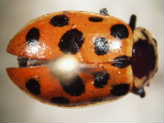 13-spotted LadybirdHippodamia tredecimpunctata
-
 Parenthesis Lady BeetleHippodamia parenthesis
-
 Five-spotted Lady BeetleHippodamia quinquesignata
-
 Sorrowful Lady BeetleHippodamia moesta
-
 Oregon Lady BeetleHippodamia oregonensis
-
 Sinuate Lady BeetleHippodamia sinuata
-
 Glacial Lady BeetleHippodamia glacialis
Compare
Questions and answers
What is the scientific name of the Convergent Lady Beetle?
The scientific name of the Convergent Lady Beetle is Hippodamia convergens. Written with its author, the full name is Hippodamia convergens Guérin-Méneville, 1842.
Which family does the Convergent Lady Beetle belong to?
Hippodamia convergens belongs to the family Coccinellidae, in the order Coleoptera and the class Insecta.
Where is the Convergent Lady Beetle found?
Checklists and occurrence records place Hippodamia convergens in 19 countries, including United States, Mexico, Canada, Ecuador, Argentina and Brazil.
What other names does the Convergent Lady Beetle have?
Hippodamia convergens is also known in English as Convergent Ladybird and Convergent Ladybug.
Are convergent lady beetles good or bad?
Convergent lady beetles are commercially distributed for biological control of aphids.[37]
What do convergent lady beetles eat?
They primarily eat aphids and also consume scale insects and thrips. When aphids are scarce, they may feed on honeydew, nectar, pollen, soft plant tissues, insect eggs, and small insect larvae.[13][14][18][19]
What type of habitat do ladybugs live in?
The convergent lady beetle inhabits forests, grasslands, agricultural fields, and suburban gardens. Its typical agricultural host crops include wheat, sorghum, and alfalfa.[8][9]
Sources
Passages the profile rests on
- The thorax is black with a white margin and two converging white markings. Source passage: “The thorax is black with a white margin. The species is named for the two distinct white markings on the thorax that are angled towards each other (convergent markings).” — ipm.ucanr.edu
- Adults have short, clubbed antennae and downward-pointing chewing mouthparts. Source passage: “The head has short, clubbed antennae and chewing mouthparts, which commonly are pointed downward and may not be apparent when viewed from above.” — ipm.ucanr.edu
- Eggs are elongated, yellow, and laid upright. Source passage: “Eggs are oblong, yellow, and about 1/25 inch (1 mm) long. They are laid on end in clusters of about 10 to 30 on leaves and green stems near aphids or other prey.” — ipm.ucanr.edu
- Adult body length ranges from 4 to 7 mm. Source passage: “The hard, shiny body is 1/6 to 1/4 inch (4–7 mm) long.” — ipm.ucanr.edu
- Eggs measure approximately 1 mm in length. Source passage: “Eggs are typically 1 to 1.5 mm, elongated, and pointed at one end.” — animaldiversity.org
- Larvae can grow to approximately 6 mm long. Source passage: “They grow up to 1/4 inch (6 mm) long and are blackish with orange blotches that become more prominent on older instars.” — ipm.ucanr.edu
- Pupae measure approximately 5 mm in length. Source passage: “Pupae are 1/5 inch (5 mm) long and glued to plant parts near where they fed as larvae.” — ipm.ucanr.edu
- The species inhabits forests, grasslands, agricultural fields, and suburban gardens. Source passage: “Hippodamia convergens , the convergent lady beetle, is found in a diverse array of habitats including forests, grasslands, agricultural fields, and suburban gardens.” — animaldiversity.org
- Its typical agricultural host crops include wheat, sorghum, and alfalfa. Source passage: “Typical crops on which they live are wheat, sorghum, and alfalfa.” — animaldiversity.org
- During winter, individuals shelter under logs, ground-covering vegetation, and inside buildings. Source passage: “During the winter, H. convergens can be found under logs, ground-covering vegetation, and even in buildings.” — animaldiversity.org
- In California, overwintering aggregations commonly occur on low-growing vegetation in moist locations. Source passage: “Overwintering is in aggregations, commonly on low-growing vegetation at moist locations.” — ipm.ucanr.edu
- Large portions of California populations overwinter in the foothills of the Coastal Range or Sierra Nevada. Source passage: “A large portion of the California populations overwinter in foothills of the Coastal Range or Sierra Nevada.” — ipm.ucanr.edu
- Aphids are the principal prey of both larvae and adults. Source passage: “Both larvae and adult H. convergens primarily consume aphids.” — English Wikipedia
- The species also consumes scale insects and thrips. Source passage: “H. convergens feed on other soft-bodied insects such as scales and thrips.” — English Wikipedia
- Adults may consume approximately 20 aphids per day. Source passage: “Fourth-instar larvae may consume about fifty aphids per day and adults may eat about twenty.” — English Wikipedia
- Fourth-instar larvae may consume approximately 50 aphids daily. Source passage: “Fourth-instar larvae may consume about fifty aphids per day” — English Wikipedia
- Reported aphid prey include cotton, pea, melon, cabbage, potato, green peach, and corn leaf aphids. Source passage: “Reported prey include cotton, pea, melon, cabbage, potato, green peach, and corn leaf aphids.” — biocontrol.entomology.cornell.edu
- When aphids are scarce, adults may feed on honeydew, nectar, pollen, and soft plant tissues. Source passage: “When aphids are scarce, the adults can eat honeydew, nectar and pollen or even petals and other soft parts of plants.” — English Wikipedia
- Adults and larvae may consume insect eggs and small insect larvae when aphids are scarce. Source passage: “If aphids are scarce, beetles and larvae may feed on small insect larvae, insect eggs, mites and, occasionally, nectar, and honeydew secreted by aphids and other sucking insects.” — biocontrol.entomology.cornell.edu
- Adults consume pollen during autumn to accumulate fat before hibernation. Source passage: “Although both immature beetles and adults eat mostly aphids, during the fall when they are getting ready for hibernation, adults will feed on pollen to gain extra fat for hibernation.” — animaldiversity.org
- The species may become cannibalistic when food is scarce. Source passage: “They are also known to exhibit cannibalistic behaviors when food is especially scarce.” — English Wikipedia
- The species is primarily solitary except during overwintering, when hundreds of individuals may aggregate. Source passage: “Hippodamia convergens is mainly a solitary species, except when overwintering, when hundreds of H. convergens may collect.” — animaldiversity.org
- Adults are predominantly active during daylight. Source passage: “It is mostly active during the day.” — animaldiversity.org
- Adults fly between plants while searching for prey. Source passage: “Adults can fly from plant to plant to find prey” — animaldiversity.org
- Larvae move between plants by walking across overlapping leaves. Source passage: “larvae move from plant to plant by walking across overlapping leaves, often following leaf veins.” — animaldiversity.org
- Adults may migrate between coastal and valley locations and higher-elevation overwintering sites in California. Source passage: “These adults migrate to the Coastal Range or Sierra in summer from coastal and valley locations, then in late winter migrate back to lower elevations.” — ipm.ucanr.edu
- Females can lay between 200 and more than 1,000 eggs over one to three months beginning in spring or early summer. Source passage: “Females may lay from 200 to more than 1,000 eggs over a one to three month period commencing in spring or early summer.” — biocontrol.entomology.cornell.edu
- Females can produce approximately 200 to 500 eggs during their lifetime. Source passage: “A female can produce 200 to 500 eggs in her lifetime.” — animaldiversity.org
- Egg laying generally increases when aphid populations reach their peaks. Source passage: “Egg laying generally coincides with aphid population cycles, with the most egg laying taking place when aphid populations are at their peak.” — animaldiversity.org
- Eggs are commonly deposited in clusters near prey on leaves and stems. Source passage: “Eggs are usually deposited near prey such as aphids, often in small clusters in protected sites on leaves and stems.” — biocontrol.entomology.cornell.edu
- Eggs generally hatch after approximately one week. Source passage: “Eggs hatch after approximately a week” — animaldiversity.org
- The species generally produces two generations annually, one in spring and another in fall. Source passage: “H. convergens generally has two generations a year, one in the spring and the other in the fall.” — animaldiversity.org
- Females can enter reproductive diapause during dry seasons or periods of extreme temperatures when food is insufficient. Source passage: “Females of H. convergens are able to enter into reproductive diapause during dry seasons or times of extreme temperature, when food resources are not plentiful enough for it to reproduce successfully.” — animaldiversity.org
- Larvae pass through four instars over approximately two to three weeks. Source passage: “larvae develop through four instars over the course of two to three weeks.” — animaldiversity.org
- Development from egg to adult takes approximately four to seven weeks. Source passage: “It takes about 4 to 7 weeks for H. convergens to develop from egg to an adult.” — animaldiversity.org
- The growing-season lifespan of adults is approximately two months. Source passage: “Adult females can lay several hundred eggs during their growing-season lifespan of about two months.” — ipm.ucanr.edu
- The species is commercially distributed for biological control of aphids. Source passage: “This is the species sold by insectaries for aphid control.” — biocontrol.entomology.cornell.edu
- Commercially available beetles are collected from natural overwintering aggregation sites. Source passage: “Commercially available Hippodamia are field collected from their overwintering sites using portable vacuum devices.” — ipm.ucanr.edu
- Commercially released adults commonly disperse from release sites within one or two days. Source passage: “Most will fly away from the release site within 1 or 2 days after they are released even if aphids are plentiful.” — ipm.ucanr.edu
- Each released adult can consume approximately 100 aphids daily before dispersing. Source passage: “However, each adult can consume about 100 aphids per day before it disperses.” — ipm.ucanr.edu
- Hippodamia quinquesignata quinquesignata and Hippodamia quinquesignata ambigua can resemble this species in external appearance. Source passage: “Hippodamia quinquesignata quinquesignata and Hippodamia quinquesignata ambigua have forms with black spots on orange wing covers and converging white marks on the thorax and cannot be reliably distinguished from convergent lady beetle based on external appearance.” — ipm.ucanr.edu
- Reliable differentiation from the two similar Hippodamia quinquesignata forms requires expert examination of male genitalia. Source passage: “The species are reliably distinguished only by expert dissection and examination of male genitalia.” — ipm.ucanr.edu
- The species is native to North America and has also been introduced into South America. Source passage: “Convergent lady beetles are native to North America, but have also been found in South America after they were imported from California.” — English Wikipedia
- Its documented North American range includes southern Canada and the United States. Source passage: “This is one of the best known and most common American lady beetles and is found from southern Canada to South America.” — biocontrol.entomology.cornell.edu
Data
- Catalogue of Life, 2026-10-16 XR cc by
- Global Biodiversity Information Facility CC BY 4.0
- Wikidata CC0
- GeoNames CC BY 4.0
- Wikimedia Commons per image; credit shown with each image
- Within the Catalogue of Life, this name comes from The Integrated Taxonomic Information System cc0
References
- Korschefsky, R. / Schenkling, S., ed. (1932). Coccinellidae II. Coleopterorum Catalogus, Pars 120.
- Gordon, Robert D. (1985). The Coccinellidae (Coleoptera) of America North of Mexico. Journal of the New York Entomological Society, Vol. 93, No. 1.
This species in other databases
Page built on 28 November 2026. See how the catalog is made and all sources and licences.
Cite this page
ScientificNames.org. (2026). Hippodamia convergens (Convergent Lady Beetle). Retrieved November 28, 2026, from https://scientificnames.org/species/hippodamia-convergens
“Hippodamia convergens (Convergent Lady Beetle).” ScientificNames.org, 2026, scientificnames.org/species/hippodamia-convergens. Accessed 28 Nov. 2026.
ScientificNames.org. “Hippodamia convergens (Convergent Lady Beetle).” Accessed November 28, 2026. https://scientificnames.org/species/hippodamia-convergens.
@misc{scientificnames_hippodamia_convergens_convergent_lady_beetle,
  author = {{ScientificNames.org}},
  title = {Hippodamia convergens (Convergent Lady Beetle)},
  year = {2026},
  url = {https://scientificnames.org/species/hippodamia-convergens},
  note = {Accessed 2026-11-28}
}