Species · Fishes
Bigeye Flounder Hippoglossina macrops
The scientific name of the Bigeye Flounder is Hippoglossina macrops. It is a species of fish in the family Paralichthyidae (sand flounders), order Pleuronectiformes. The name dates from 1876.
- Scientific name
- Hippoglossina macrops Steindachner, 1876
- Common name
- Bigeye Flounder
- Genus
- Hippoglossina
- Family
- Paralichthyidae (Sand Flounders)
- Order
- Pleuronectiformes
- Class
- Teleostei
- Red List category
- LC Least Concern
- Environment
- marine
- Recorded in
- 2 countries
- Name status
- accepted in the Catalogue of Life
Overview
Hippoglossina macrops occurs in the Eastern Pacific, primarily associated with the Peruvian province, with a recorded range extending from Costa Rica to Ecuador and several islands. It has large, closely positioned eyes normally located on the left side of the body and a strongly developed crest between them.
Written 27 November 2026 from the sources listed below. Each statement was checked against the passage it cites; statements that could not be supported were removed.
Appearance
The body is elongate, with a body height measuring 42–45% of standard length. The head measures 35–38% of standard length.[1][2]
The eyes are normally positioned on the left side of the body, although they occasionally occur on the right side. They are large, parallel and positioned close together, with a strongly developed, high crest between them that extends behind the eyes.[3][4][5]
The mouth is long, measuring approximately 33% of head length, and terminates beneath the middle of the lower eye. The teeth are small and approximately equal in size, with both jaws equally developed dentally.[6][7][8]
The gill rakers are long and slender, with five on one branch and seven on the other. The dorsal fin has 66–69 rays and originates above the upper eye.[9][10]
The pectoral fin on the eyed side is short and measures approximately half the head length. The pelvic-fin bases are symmetrical on the two sides of the body, and the pelvic fins measure 21–21.5% of head length.[11][12][13]
The urinary papilla is located on the eyed side immediately behind the level of the anus. The lateral line extends onto the head, with branches leading to the upper and lower eyes, and is strongly arched above the pectoral fin.[14][15][16]
The scales are large and lack small accessory scales. Those on the eyed side are mainly smooth, while those on the blind side are rough over the rear third of the body. The lateral line has 75–80 scales.[17][18][19][20]
Habitat
The species is recorded in the Eastern Pacific and is primarily associated with the Peruvian province. Its biogeographic distribution includes the South Temperate region associated with the Peruvian Province.[21][22][23]
Its recorded biogeographic range also includes the equatorial region from Costa Rica to Ecuador and the Galapagos, Clipperton, Cocos and Malpelo islands.[24]
Diet
Recorded food categories include mobile benthic worms and mobile benthic crustaceans, including shrimps and crabs.[25][26]
Octopuses, squids and cuttlefish are also included among its recorded food categories.[27]
Conservation
The species has a reported moderate vulnerability score of 39 out of 100.[28]
Classification of the Bigeye Flounder
| Kingdom | Animalia |
|---|---|
| Phylum | Chordata |
| Subphylum | Vertebrata |
| Infraphylum | Gnathostomata |
| Parvphylum | Osteichthyes |
| Gigaclass | Actinopterygii |
| Superclass | Actinopteri |
| Class | Teleostei (Teleost) |
| Order | Pleuronectiformes |
| Suborder | Pleuronectoidei |
| Family | Paralichthyidae (Sand Flounders) |
| Genus | Hippoglossina |
| Species | Hippoglossina macrops Steindachner, 1876 |
Where the Bigeye Flounder is found
Checklists and occurrence records place Hippoglossina macrops in 2 countries. GBIF holds 56,744 georeferenced records of it.
Countries
Regions and cities with the most records
- El Quisco, Chile 2,012
- Los Vilos, Chile 1,441
- Coquimbo, Chile 1,436
- Valparaíso, Chile 1,402
- Quintero, Chile 847
- La Serena, Chile 768
- San Antonio, Chile 676
- Cartagena, Chile 612
- Lebu, Chile 454
- Concón, Chile 409
- Constitución, Chile 167
- Viña del Mar, Chile 143
- Talcahuano, Chile 99
- Coquimbo Region, Chile 81
- Valparaiso, Chile 71
- San Pedro de la Paz, Chile 70
- Caldera, Chile 65
- Hualpén, Chile 53
- Biobio, Chile 44
- Araucania, Chile 37
- Maule Region, Chile 37
- Atacama, Chile 23
- Los Lagos Region, Chile 21
- Coronel, Chile 18
- Ñuble, Chile 18
- Concepción, Chile 17
- Santiago Metropolitan, Chile 17
- Quilpué, Chile 16
- Limache, Chile 15
- Quillota, Chile 14
- Villa Alemana, Chile 13
- Carahue, Chile 12
- Los Ríos Region, Chile 12
- Lota, Chile 12
- Cabildo, Chile 11
- Ovalle, Chile 11
2 more countries have a few records outside this range
These countries hold a few records of Hippoglossina macrops but lie outside the range the checklists give for it. Such records are often zoo or garden specimens, museum material or vagrants, so the species is not counted as occurring there.
A number beside a place is its count of GBIF occurrence records. A place without a number comes from a checklist alone. Records show where a species has been observed or collected, which can include escapes and vagrants.
Common names
English
- Bigeye Flounder
Names in 6 other languages
- Chinese
- 大眼小庸鰈
- French
- Perpeire Gros Yeux
- Japanese
- Oome-birame, オオメビラメ
- Portuguese
- Linguado-de-Valparaíso
- Russian
- Большая гипоглоссина
- Spanish
- Lenguado, Lenguado Ojo Grande, Lenguado de Ojo Grande, Lenguado de Ojos Grandes
Related species
-
 Four-spotted FlounderHippoglossina oblonga
- Bigmouth FlounderHippoglossina stomata
- Spotted FlounderHippoglossina bollmani
- Foureye FlounderHippoglossina tetrophthalma
- Montemar FlounderHippoglossina montemaris
- Hippoglossina mystacium
-
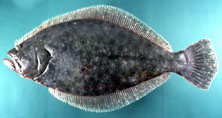 Summer FlounderParalichthys dentatus
-
 Pacific SanddabCitharichthys sordidus
Compare
Questions and answers
What is the scientific name of the Bigeye Flounder?
The scientific name of the Bigeye Flounder is Hippoglossina macrops. Written with its author, the full name is Hippoglossina macrops Steindachner, 1876.
Which family does the Bigeye Flounder belong to?
Hippoglossina macrops belongs to the family Paralichthyidae, in the order Pleuronectiformes and the class Teleostei.
Where is the Bigeye Flounder found?
Checklists and occurrence records place Hippoglossina macrops in 2 countries: Chile and Peru.
What is the conservation status of the Bigeye Flounder?
The IUCN Red List category recorded for Hippoglossina macrops is Least Concern (LC).
Sources
Passages the profile rests on
- The body is elongate, with a body height measuring 42–45% of standard length. Source passage: “Body elongate, height 42-45% of SL” — biogeodb.stri.si.edu
- The head measures 35–38% of standard length. Source passage: “head length 35-38% of SL” — biogeodb.stri.si.edu
- The eyes are normally positioned on the left side of the body, although they occasionally occur on the right side. Source passage: “eyes on left side (uncommonly on right side)” — biogeodb.stri.si.edu
- The eyes are large, parallel and positioned close together. Source passage: “parallel, large, close together” — biogeodb.stri.si.edu
- The crest between the eyes is strongly developed, high and extends behind the eyes. Source passage: “crest between eyes strong and high, extends behind eyes” — biogeodb.stri.si.edu
- The mouth is long and measures approximately 33% of head length. Source passage: “mouth long, 33% head length” — biogeodb.stri.si.edu
- The mouth terminates beneath the middle of the lower eye. Source passage: “ends under middle of lower eye” — biogeodb.stri.si.edu
- The teeth are small and approximately equal in size, with both jaws equally developed dentally. Source passage: “teeth small, ~ equal sized, equally developed on both jaws” — biogeodb.stri.si.edu
- The gill rakers are long and slender, with five on one branch and seven on the other. Source passage: “gill rakers long and slender, 5 +7” — biogeodb.stri.si.edu
- The dorsal fin has 66–69 rays and originates above the upper eye. Source passage: “66-69 dorsal rays, origin of dorsal over top eye” — biogeodb.stri.si.edu
- The pectoral fin on the eyed side is short and measures approximately half the head length. Source passage: “pectoral short, eye-side fin ~ 50% length of head” — biogeodb.stri.si.edu
- The pelvic-fin bases are symmetrical on the two sides of the body. Source passage: “bases of pelvics symmetric on sides” — biogeodb.stri.si.edu
- The pelvic fins measure 21–21.5% of head length. Source passage: “pelvic fins 21-21.5% of head length” — biogeodb.stri.si.edu
- The urinary papilla is located on the eyed side immediately behind the level of the anus. Source passage: “urinary papilla on eye side, immediately behind level of anus” — biogeodb.stri.si.edu
- The lateral line extends onto the head and has branches leading to the upper and lower eyes. Source passage: “lateral line extending onto head, with branches to upper eye and below lower eye” — biogeodb.stri.si.edu
- The lateral line is strongly arched above the pectoral fin. Source passage: “strongly arched over pectoral fin” — biogeodb.stri.si.edu
- The scales are large and lack small accessory scales. Source passage: “scales large, without small accessory scales” — biogeodb.stri.si.edu
- Scales on the eyed side are mainly smooth. Source passage: “eye side scales mainly smooth” — biogeodb.stri.si.edu
- Scales on the blind side are rough over the rear third of the body. Source passage: “blind side scales rough on rear 1/3 of body” — biogeodb.stri.si.edu
- The lateral line has 75–80 scales. Source passage: “75-80 lateral line scales” — biogeodb.stri.si.edu
- The species is recorded in the Eastern Pacific. Source passage: “East Pacific endemic” — biogeodb.stri.si.edu
- Its distribution is primarily associated with the Peruvian province. Source passage: “Peruvian province, primarily” — biogeodb.stri.si.edu
- Its recorded biogeographic distribution includes the South Temperate region associated with the Peruvian Province. Source passage: “South Temperate (Peruvian Province )” — biogeodb.stri.si.edu
- Its recorded biogeographic range also includes the equatorial region from Costa Rica to Ecuador and the Galapagos, Clipperton, Cocos and Malpelo islands. Source passage: “Equatorial (Costa Rica to Ecuador + Galapagos, Clipperton, Cocos, Malpelo)” — biogeodb.stri.si.edu
- Mobile benthic worms are included among its recorded food categories. Source passage: “Mobile benthic worms” — biogeodb.stri.si.edu
- Mobile benthic crustaceans, including shrimps and crabs, are included among its recorded food categories. Source passage: “Mobile benthic crustacea (shrimps/crabs)” — biogeodb.stri.si.edu
- Octopuses, squids and cuttlefish are included among its recorded food categories. Source passage: “Octopus/squid/cuttlefish” — biogeodb.stri.si.edu
- The species has a reported moderate vulnerability score of 39 out of 100. Source passage: “Moderate vulnerability (39 of 100).” — fishbase.se
Data
- Catalogue of Life, 2026-10-16 XR cc by
- Global Biodiversity Information Facility CC BY 4.0
- Wikidata CC0
- GeoNames CC BY 4.0
- Within the Catalogue of Life, this name comes from World Register of Marine Species cc by
References
- Steindachner, F. (1876). Ichthyologische Beiträge (V). [Subtitles i-v.]. Sitzungsberichte Der Kaiserlichen Akademie Der Wissenschaften. Mathematisch-Naturwissenschaftliche Classe, v. 74 (1. Abth.): 49–240, Pls. 1–15. [Also as a separate, pp. 1–192, Pls. 1–15. According to 1974 reprint of Ichthyologische Beiträge the date is 1877. Date of separate may be 1876, the date we use.]. where the name was published
This species in other databases
- Catalogue of Life 3M24Z
- Wikidata Q2567262
- iNaturalist 102842
- WoRMS urn:lsid:marinespecies.org:taxname:275824
- ITIS 616380
Page built on 29 November 2026. See how the catalog is made and all sources and licences.
Cite this page
ScientificNames.org. (2026). Hippoglossina macrops (Bigeye Flounder). Retrieved November 29, 2026, from https://scientificnames.org/species/hippoglossina-macrops
“Hippoglossina macrops (Bigeye Flounder).” ScientificNames.org, 2026, scientificnames.org/species/hippoglossina-macrops. Accessed 29 Nov. 2026.
ScientificNames.org. “Hippoglossina macrops (Bigeye Flounder).” Accessed November 29, 2026. https://scientificnames.org/species/hippoglossina-macrops.
@misc{scientificnames_hippoglossina_macrops_bigeye_flounder,
  author = {{ScientificNames.org}},
  title = {Hippoglossina macrops (Bigeye Flounder)},
  year = {2026},
  url = {https://scientificnames.org/species/hippoglossina-macrops},
  note = {Accessed 2026-11-29}
}