Species · Fishes
Flathead Sole Hippoglossoides elassodon
The scientific name of the Flathead Sole is Hippoglossoides elassodon. It is a species of fish in the family Pleuronectidae (dabs), order Pleuronectiformes. The name dates from 1880.
- Scientific name
- Hippoglossoides elassodon Jordan & Gilbert, 1880
- Common name
- Flathead Sole
- Genus
- Hippoglossoides
- Family
- Pleuronectidae (Dabs)
- Order
- Pleuronectiformes
- Class
- Teleostei
- Red List category
- LC Least Concern
- Environment
- marine
- Recorded in
- 2 countries
- Name status
- accepted in the Catalogue of Life
Overview
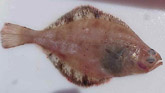
Flathead Sole (Hippoglossoides elassodon Jordan & Gilbert, 1880) is a right-eyed flounder in the family Pleuronectidae, order Pleuronectiformes and class Teleostei. Its native range extends across the northern Pacific, including the seas of Japan and Okhotsk, the Bering Sea and the North American coast as far south as Point Reyes in the United States. It has an oval-shaped body, an olive brown to reddish grey-brown upper surface and a white underside, and can reach 52 centimetres in length.
Written 26 November 2026 from the sources listed below. Each statement was checked against the passage it cites; statements that could not be supported were removed.
Appearance
Flathead Sole has an oval-shaped body and both eyes on the right side. Its upper surface is olive brown to reddish grey-brown and may display dusky blotches, while its underside is white with translucent areas.[1][2][3]
The dorsal and anal fins have dusky blotches. The lateral line curves slightly around the pectoral fin, and the upper jaw is narrow in the middle and bears a single row of teeth.[4][5][6]
The species can reach 52 centimetres in length and weigh up to 1.56 kilograms. Females are typically larger than males.[7][8][9]
Habitat
Flathead Sole inhabits soft, silty or muddy seafloors and is demersal. It occurs at depths of up to 1,050 metres.[10][11][12]
Its native range extends across the northern Pacific. It occurs in the seas of Japan and Okhotsk, the Bering Sea and along the North American coast as far south as Point Reyes in the United States.[13][14][15][16]
Diet
Flathead Sole feeds on benthic invertebrates, including clams, worms and brittle stars. It also consumes fish and squid.[17][18]
Behaviour
Flathead Sole occupies an intermediate trophic level in the food chain. Its main predators include Pacific cod, Alaska pollock, arrowtooth flounder, Greenland turbot and Pacific halibut.[19][20]
Conservation
Flathead Sole is not currently classified as overfished in the cited document. Its biomass is estimated to be above the level needed to support maximum sustainable yield.[21][22]
Uses
Flathead Sole is commercially harvested in fisheries managed by the United States. Commercial fishing is conducted using trawlers.[23][24]
Annual catches average approximately 17,000 tons in the Bering Sea and Aleutian Islands area.[25]
Classification of the Flathead Sole
| Kingdom | Animalia |
|---|---|
| Phylum | Chordata |
| Subphylum | Vertebrata |
| Infraphylum | Gnathostomata |
| Parvphylum | Osteichthyes |
| Gigaclass | Actinopterygii |
| Superclass | Actinopteri |
| Class | Teleostei (Teleost) |
| Order | Pleuronectiformes |
| Suborder | Pleuronectoidei |
| Family | Pleuronectidae (Dabs) |
| Subfamily | Pleuronectinae |
| Genus | Hippoglossoides |
| Species | Hippoglossoides elassodon Jordan & Gilbert, 1880 |
Where the Flathead Sole is found
Checklists and occurrence records place Hippoglossoides elassodon in 2 countries. GBIF holds 73,875 georeferenced records of it.
Countries
Regions and cities with the most records
- Richmond, Canada 300
- Vancouver, Canada 243
- Courtenay, Canada 233
- Riley Park, Canada 224
- Alaska, United States 191
- Victoria-Fraserview, Canada 189
- Campbell River, Canada 162
- West Vancouver, Canada 153
- North Vancouver, Canada 147
- Harewood, Canada 128
- Nanaimo, Canada 126
- Delta, Canada 123
- North Cowichan, Canada 65
- Central Saanich, Canada 58
- Burnaby, Canada 57
- Duncan, Canada 57
- Saanich, Canada 43
- British Columbia, Canada 30
- New Westminster, Canada 27
- Port Moody, Canada 25
- Coquitlam, Canada 24
- Port Coquitlam, Canada 22
- Shoreline, United States 16
- Bainbridge Island, United States 15
- Esquimalt, Canada 13
- Oak Bay, Canada 13
- Seattle, United States 13
- Victoria, Canada 13
- Lynnwood, United States 12
- Mountlake Terrace, United States 12
- Edmonds, United States 11
- Inglewood-Finn Hill, United States 11
- Langford, Canada 11
- Sooke, Canada 11
- Kenmore, United States 10
- Bremerton, United States 9
1 more country has a few records outside this range
These countries hold a few records of Hippoglossoides elassodon but lie outside the range the checklists give for it. Such records are often zoo or garden specimens, museum material or vagrants, so the species is not counted as occurring there.
A number beside a place is its count of GBIF occurrence records. A place without a number comes from a checklist alone. Records show where a species has been observed or collected, which can include escapes and vagrants.
Common names
English
- Flathead Sole
Names in 6 other languages
- Chinese
- 太平洋擬庸鰈
- Danish
- Nordpacifisk håising
- French
- plie à tête plate
- Japanese
- Uma-garei, ウマガレイ
- Portuguese
- Solha-japonesa
- Russian
- Камбала узкозубая (охотоморская, северная) палтусовидная, Узкозубая палтусовидная камбала
Related species
-
 American PlaiceHippoglossoides platessoides
-
 Bering FlounderHippoglossoides robustus
- Flathead FlounderHippoglossoides dubius
-
 European PlaicePleuronectes platessa
-
 Atlantic HalibutHippoglossus hippoglossus
-
 Pacific HalibutHippoglossus stenolepis
-
 Greenland HalibutReinhardtius hippoglossoides
-
 Lemon SoleMicrostomus kitt
Compare
Questions and answers
What is the scientific name of the Flathead Sole?
The scientific name of the Flathead Sole is Hippoglossoides elassodon. Written with its author, the full name is Hippoglossoides elassodon Jordan & Gilbert, 1880.
Which family does the Flathead Sole belong to?
Hippoglossoides elassodon belongs to the family Pleuronectidae, in the order Pleuronectiformes and the class Teleostei.
Where is the Flathead Sole found?
Checklists and occurrence records place Hippoglossoides elassodon in 2 countries: Canada and United States.
What is the conservation status of the Flathead Sole?
The IUCN Red List category recorded for Hippoglossoides elassodon is Least Concern (LC).
Are flathead and flounder the same?
Flathead Sole is a right-eyed flounder.[1]
Sources
Passages the profile rests on
- The flathead sole is a right-eyed flounder with an oval-shaped body. Source passage: “The flathead sole is a right-eyed flounder with an oval-shaped body.” — English Wikipedia
- The upper surface is olive brown to reddish grey-brown and may display dusky blotches. Source passage: “Its upper surface is dark in colour, olive brown to reddish grey-brown, and may have dusky blotches” — English Wikipedia
- The underside is white with translucent areas. Source passage: “its underside is white with translucent areas.” — English Wikipedia
- The dorsal and anal fins have dusky blotches. Source passage: “The dorsal and anal fins also have dusky blotches.” — English Wikipedia
- The lateral line curves slightly around the pectoral fin. Source passage: “The lateral line curves slightly around the pectoral fin.” — English Wikipedia
- The upper jaw is narrow in the middle and bears a single row of teeth. Source passage: “The upper jaw is narrow in the middle and has one row of teeth.” — English Wikipedia
- The species can reach 52 centimetres in length. Source passage: “It grows to 52 centimetres (20 in) in length” — English Wikipedia
- The species can weigh up to 1.56 kilograms. Source passage: “can weigh up to 1.56 kilograms (3.4 lb)” — English Wikipedia
- Females are typically larger than males. Source passage: “females are typically larger than males.” — English Wikipedia
- The flathead sole inhabits soft, silty or muddy seafloors. Source passage: “lives on soft, silty or muddy bottoms” — English Wikipedia
- The species is demersal. Source passage: “It is a demersal fish” — English Wikipedia
- The species occurs at depths of up to 1,050 metres. Source passage: “at depths of up to 1,050 metres (3,440 ft).” — English Wikipedia
- The native range of the flathead sole extends across the northern Pacific. Source passage: “Its native habitat is the northern Pacific” — English Wikipedia
- The species occurs in the seas of Japan and Okhotsk. Source passage: “from the seas of Japan and Okhotsk” — English Wikipedia
- The species occurs in the Bering Sea. Source passage: “across the Bering Sea” — English Wikipedia
- The species occurs along the North American coast as far south as Point Reyes in the United States. Source passage: “to the coast of North America, as far south as Point Reyes, United States.” — English Wikipedia
- The flathead sole feeds on benthic invertebrates, including clams, worms and brittle stars. Source passage: “zoobenthos invertebrates such as clams, worms and brittle stars” — English Wikipedia
- The flathead sole also consumes fish and squid. Source passage: “as well as fish and squid.” — English Wikipedia
- The flathead sole occupies an intermediate trophic level in the food chain. Source passage: “The flathead sole occupies an intermediate trophic level in the food chain.” — English Wikipedia
- The main predators of the flathead sole include Pacific cod, Alaska pollock, arrowtooth flounder, Greenland turbot and Pacific halibut. Source passage: “The main predators of the flathead sole are the Pacific cod, Alaska pollock, arrowtooth flounder, Greenland turbot and Pacific halibut.” — English Wikipedia
- The flathead sole is not currently classified as overfished in the cited document. Source passage: “Flathead sole is not currently overfished” — English Wikipedia
- The species' biomass is estimated to be above the level needed to support maximum sustainable yield. Source passage: “biomass is estimated to be above the level required to support the maximum sustainable yield.” — English Wikipedia
- The flathead sole is commercially harvested in fisheries managed by the United States. Source passage: “The U.S. lands the majority of the world's catch of flathead sole and manages three fisheries” — English Wikipedia
- Commercial fishing for flathead sole is conducted using trawlers. Source passage: “Commercial fishing is conducted by trawler.” — English Wikipedia
- Annual flathead sole catches average approximately 17,000 tons in the Bering Sea and Aleutian Islands area. Source passage: “Annual catches average around 17,000 tons in the Bering Sea and Aleutian Islands area” — English Wikipedia
Data
- Catalogue of Life, 2026-10-16 XR cc by
- Global Biodiversity Information Facility CC BY 4.0
- Wikidata CC0
- GeoNames CC BY 4.0
- Wikimedia Commons per image; credit shown with each image
- Within the Catalogue of Life, this name comes from World Register of Marine Species cc by
References
- Jordan, D. S., & Gilbert, C. H. (1880). Description of two new species of flounders (Parophrys ischyrus and Hippoglossoides elassodon) from Puget’s Sound. Proceedings of the United States National Museum, v. 3 (no. 147): 276–280. https://doi.org/10.5479/si.00963801.3-147.276 Link where the name was published
This species in other databases
- Catalogue of Life 6LWHZ
- Wikidata Q3135992
- iNaturalist 180032
- WoRMS urn:lsid:marinespecies.org:taxname:274289
- ITIS 172875
Page built on 28 November 2026. See how the catalog is made and all sources and licences.
Cite this page
ScientificNames.org. (2026). Hippoglossoides elassodon (Flathead Sole). Retrieved November 28, 2026, from https://scientificnames.org/species/hippoglossoides-elassodon
“Hippoglossoides elassodon (Flathead Sole).” ScientificNames.org, 2026, scientificnames.org/species/hippoglossoides-elassodon. Accessed 28 Nov. 2026.
ScientificNames.org. “Hippoglossoides elassodon (Flathead Sole).” Accessed November 28, 2026. https://scientificnames.org/species/hippoglossoides-elassodon.
@misc{scientificnames_hippoglossoides_elassodon_flathead_sole,
  author = {{ScientificNames.org}},
  title = {Hippoglossoides elassodon (Flathead Sole)},
  year = {2026},
  url = {https://scientificnames.org/species/hippoglossoides-elassodon},
  note = {Accessed 2026-11-28}
}