Species · Flowering plants
Chinese Raisintree Hovenia dulcis
The scientific name of the Chinese Raisintree is Hovenia dulcis. It is a species of flowering plant in the family Rhamnaceae (buckthorn family), order Rosales.
- Scientific name
- Hovenia dulcis Thunb.
- Common name
- Chinese Raisintree
- Genus
- Hovenia
- Family
- Rhamnaceae (Buckthorn Family)
- Order
- Rosales
- Class
- Magnoliopsida
- Red List category
- LC Least Concern
- Recorded in
- 17 countries
- Name status
- accepted in the Catalogue of Life
Overview
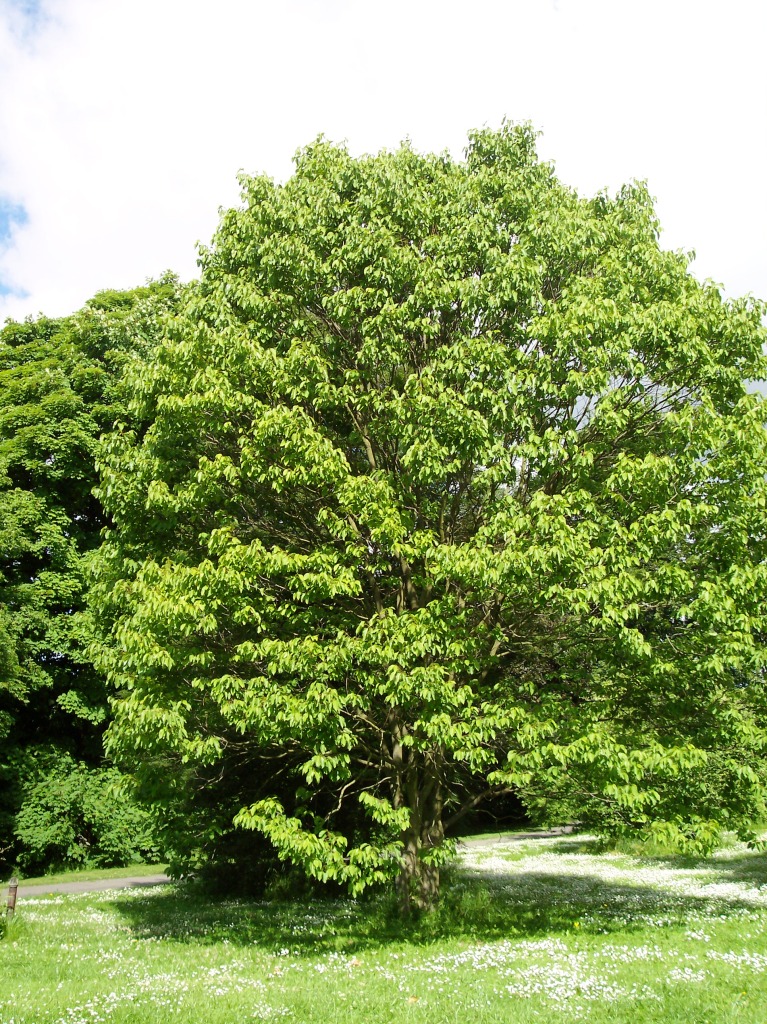
Chinese raisintree (Hovenia dulcis Thunb.) is a deciduous flowering tree in the family Rhamnaceae, order Rosales and class Magnoliopsida. The species is indigenous to and widespread in East Asia, with a native distribution that includes Eastern China and Korea. Its fleshy fruit stalks are edible raw or cooked, and dried stalks resemble raisins in appearance and taste.
Written 26 November 2026 from the sources listed below. Each statement was checked against the passage it cites; statements that could not be supported were removed.
Appearance
Chinese raisintree is a deciduous tree that only rarely grows as a shrub. It reaches a height of 10–30 metres.[1][2]
Its branchlets are brown or black-purple, hairless and have inconspicuous lenticels. Its leaves are large, glossy and pointed.[3][4]
Its drupes develop at the ends of fleshy fruit stalks called rachises.[5]
Habitat
Chinese raisintree grows preferably in sunny locations on moist sandy or loamy soils.[6]
In Thailand, it occurs in stream-irrigated valleys of primary lower mountain evergreen forests. It has been recorded there at elevations between 1,075 and 1,250 metres.[7][8]
The species occurs in the Himalayas at elevations of up to 2,000 metres.[9]
Reproduction and life cycle
Chinese raisintree produces clusters of small, cream-coloured hermaphroditic flowers in July.[10]
Diet
Birds and mammals feed on the seeds and fruit of Chinese raisintree.[11]
Uses
The fleshy fruit stalks are edible either raw or cooked. When dried, they resemble raisins in appearance and taste.[12][13]
Extracts from the seeds, branches and young leaves can substitute for honey and are used to make wine and candy. Leaf extracts contain hodulcine, a glycoside with anti-sweet activity.[14][15]
Chinese raisintree produces hard, fine timber used in building construction and fine furniture. The species is also a natural source of the flavonoid dihydromyricetin.[16][17]
The species has been used in traditional Chinese, Korean and Japanese medicine to treat fever, parasitic infections and liver diseases. It has also been used as a traditional hangover treatment, and extracts of the whole plant are used in Chinese traditional medicine for hangover syndrome.[18][19][20]
The fruits and peduncles have reported antimicrobial, antioxidant and antidiabetic activities. The seeds have been used in treating alcohol intoxication because of their diuretic properties.[21][22]
The fruits are used as ingredients in food supplements and nutraceuticals in Japan, China and Korea. The peduncles are used as food supplements because they contain abundant polysaccharides.[23][24]
Chinese raisintree has been identified as a potential alternative to Eucalyptus species for reforestation in Thailand.[25]
Conservation
Chinese raisintree is considered one of the most pervasive invasive plants in Brazilian subtropical forests.[26]
Classification of the Chinese Raisintree
| Kingdom | Plantae |
|---|---|
| Subkingdom | Pteridobiotina |
| Phylum | Tracheophyta |
| Class | Magnoliopsida |
| Order | Rosales |
| Family | Rhamnaceae (Buckthorn Family) |
| Tribe | Gouanieae |
| Genus | Hovenia |
| Species | Hovenia dulcis Thunb. |
Where the Chinese Raisintree is found
Checklists and occurrence records place Hovenia dulcis in 17 countries across Asia, North America, Oceania and South America. GBIF holds 3,907 georeferenced records of it.
Countries where it is native or its origin is not stated
- Bangladesh
- China 696
- Hong Kong 3
- India 14
- Iran 3
- Japan 1,049
- North Korea 6
- South Korea 594
- Thailand 9
- Vietnam
Countries where it has been introduced
Regions and cities with the most records
- Paraná, Brazil 171
- Kanagawa, Japan 132
- São Paulo, Brazil 121
- Minawa, Japan 105
- Aihara, Japan 97
- Sagamihara, Japan 91
- Nagano, Japan 86
- Zama, Japan 82
- Santa Catarina, Brazil 81
- Minamirinkan, Japan 79
- Yamato, Japan 79
- Atsugi, Japan 77
- Machida, Japan 77
- Ayase, Japan 74
- Hachiōji, Japan 72
- Henan, China 70
- Ebina, Japan 69
- Nihammatsu, Japan 69
- Jiangxi, China 64
- Gyeongsangbuk-do, South Korea 63
- Hino, Japan 63
- Isehara, Japan 61
- Uenohara, Japan 61
- Inagi, Japan 60
- Gangwon-do, South Korea 59
- Rio Grande do Sul, Brazil 59
- Azamino, Japan 58
- Chungcheongnam-do, South Korea 58
- Beijing, China 54
- Fujisawa, Japan 53
- Kunitachi, Japan 53
- Chigasaki, Japan 52
- Fussa, Japan 51
- Tama, Japan 51
- Hadano, Japan 50
- São Paulo, Brazil 50
15 more countries have a few records outside this range
These countries hold a few records of Hovenia dulcis but lie outside the range the checklists give for it. Such records are often zoo or garden specimens, museum material or vagrants, so the species is not counted as occurring there.
Range as the checklists state it
China (Anhui, Gansu, Hebei, Henan, NW-Hubei, Jiangsu, Jiangxi, Shaanxi, Shandong, Shanxi, N-Sichuan); North Korea; South Korea; Japan (Hokkaido); Taiwan [I]; Bangladesh; Thailand; Vietnam; Australia [I] (Queensland [I]); USA [I] (North Carolina [I], Texas [I]); Honduras [I]; Brazil [I]; Paraguay [I]; Argentina [I]
A number beside a place is its count of GBIF occurrence records. A place without a number comes from a checklist alone. Records show where a species has been observed or collected, which can include escapes and vagrants.
Common names
English
- Chinese Raisintree
Names in 13 other languages
- Afrikaans
- Japanse rosyntjieboom
- Chinese
- 北枳椇
- Czech
- dužistopka sladká
- German
- Quaffbirne, japanisches Mahagoni
- Hebrew
- הובניה מתוקה, עץ הצימוק היפני
- Italian
- Albero dell'uva passa
- Japanese
- kenponashi, ケンポナシ
- Korean
- 헛개나무
- Portuguese
- uva-do-japão, uva-japonesa
- Russian
- Говения сладкая, Конфетное дерево
- Slovak
- hovénia sladká
- Spanish
- Palo dulce, sarmiento japonés
- Turkish
- Japon Kuru Üzüm Ağacı, Şeker ağacı
Synonyms
7 other scientific names have been used for this species and are now treated as synonyms of Hovenia dulcis.
- Hovenia dulcis f. deviata Honda
- Hovenia dulcis f. latifolia (Nakai ex Y.Kimura) H.Hara
- Hovenia dulcis var. dulcis
- Hovenia dulcis var. glabra Makino
- Hovenia dulcis var. koreana Nakai ex Y.Kimura
- Hovenia dulcis var. latifolia Nakai ex Kimura
- Ziziphus dulcis Thunb.
Related species
- Hovenia acerba
- Hovenia tomentella
- Hovenia celtidifolia
- Hovenia pubescens
-
 JujubeZiziphus jujuba
-
 Indian JujubeZiziphus mauritiana
-
 Common BuckthornRhamnus cathartica
-
 Christ's-thornZiziphus spina-christi
Compare
Questions and answers
What is the scientific name of the Chinese Raisintree?
The scientific name of the Chinese Raisintree is Hovenia dulcis. Written with its author, the full name is Hovenia dulcis Thunb..
Which family does the Chinese Raisintree belong to?
Hovenia dulcis belongs to the family Rhamnaceae, in the order Rosales and the class Magnoliopsida.
Where is the Chinese Raisintree found?
Checklists and occurrence records place Hovenia dulcis in 17 countries, including Japan, China, South Korea, India, Thailand and North Korea.
What is the conservation status of the Chinese Raisintree?
The IUCN Red List category recorded for Hovenia dulcis is Least Concern (LC).
What are the benefits of oriental raisin tree tea?
The species has been used in traditional Chinese, Korean and Japanese medicine to treat fever, parasitic infections and liver diseases. It has also been used as a traditional hangover treatment, and extracts of the whole plant are used in Chinese traditional medicine for hangover syndrome.[18][19][20]
What is a raisin tree?
Chinese raisintree (Hovenia dulcis Thunb.) is a deciduous tree in the family Rhamnaceae. Its fleshy fruit stalks are edible, and dried stalks resemble raisins in appearance and taste.[1][12][13]
What is Korean raisin tea?
Chinese raisintree has been used in traditional Korean medicine to treat fever, parasitic infections and liver diseases. Its fruits are also used as ingredients in food supplements and nutraceuticals in Korea.[18][23]
What is Hovenia dulcis used for?
Its fleshy fruit stalks are eaten raw or cooked, and extracts from its seeds, branches and young leaves are used to make wine and candy. Its timber is used in building construction and fine furniture. The species has also been used in traditional medicine and in food supplements and nutraceuticals.[12][14][16][18][23][24]
Is Hovenia tea good for you?
The species has been used in traditional medicine to treat fever, parasitic infections, liver diseases and hangover syndrome. The fruits and peduncles have reported antimicrobial, antioxidant and antidiabetic activities.[18][20][21]
What does Hovenia taste like?
Dried fleshy fruit stalks resemble raisins in appearance and taste.[13]
What fruit looks like a big raisin?
The dried fleshy fruit stalks of Chinese raisintree resemble raisins in appearance and taste.[13]
Sources
Passages the profile rests on
- Hovenia dulcis is a deciduous tree that only rarely grows as a shrub. Source passage: “Tree, rarely a shrub, deciduous, to 10–30 m tall.” — English Wikipedia
- The tree reaches a height of 10–30 metres. Source passage: “Tree, rarely a shrub, deciduous, to 10–30 m tall.” — English Wikipedia
- Its branchlets are brown or black-purple, hairless and have inconspicuous lenticels. Source passage: “Branchlets brown or black-purple, glabrous, with inconspicuous lenticels.” — English Wikipedia
- Its leaves are large, glossy and pointed. Source passage: “The glossy leaves are large and pointed.” — English Wikipedia
- Its drupes develop at the ends of fleshy fruit stalks called rachises. Source passage: “The drupes appear at the ends of an edible rachis (fleshy fruit stalk), which is a type of accessory fruit.” — English Wikipedia
- The species grows preferably in sunny locations on moist sandy or loamy soils. Source passage: “growing preferably in a sunny position on moist sandy or loamy soils.” — English Wikipedia
- In Thailand, the species occurs in stream-irrigated valleys of primary lower mountain evergreen forests. Source passage: “typically found in the stream-irrigated valleys of primary lower mountain evergreen forest” — English Wikipedia
- In Thailand, the species has been recorded at elevations between 1,075 and 1,250 metres. Source passage: “located between 1,075 and 1,250 metres above sea level.” — English Wikipedia
- The species occurs in the Himalayas at elevations of up to 2,000 metres. Source passage: “to the Himalayas (up to altitudes of 2,000 m)” — English Wikipedia
- The species produces clusters of small, cream-coloured hermaphroditic flowers in July. Source passage: “The trees bear clusters of small cream-coloured hermaphroditic flowers in July.” — English Wikipedia
- Birds and mammals feed on the species' seeds and fruit. Source passage: “the tree is known to attract several varieties both of birds and of mammals which feed on the seeds and fruit.” — English Wikipedia
- The fleshy fruit stalks are edible either raw or cooked. Source passage: “The fleshy rachis of the infructescence is sweet, fragrant and is edible raw or cooked.” — English Wikipedia
- Dried fleshy fruit stalks resemble raisins in appearance and taste. Source passage: “Dried, they look and taste like raisins.” — English Wikipedia
- Extracts from the seeds, branches and young leaves can substitute for honey and are used to make wine and candy. Source passage: “An extract of the seeds, bough, and young leaves can be used as a substitute for honey and is used for making wine and candy.” — English Wikipedia
- Leaf extracts contain hodulcine, a glycoside with anti-sweet activity. Source passage: “An extract of the leaves contains hodulcine, a glycoside which exhibits an anti-sweet activity.” — English Wikipedia
- The species produces hard, fine timber used in building construction and fine furniture. Source passage: “The timber is fine and hard and is used for building construction and fine furniture.” — English Wikipedia
- The species is a natural source of the flavonoid dihydromyricetin. Source passage: “Hovenia dulcis is a natural source for dihydromyricetin, a flavonoid with antioxidant properties” — English Wikipedia
- The species has been used in traditional Chinese, Korean and Japanese medicine to treat fever, parasitic infections and liver diseases. Source passage: “It has been used in traditional Chinese, Korean, and Japanese medicines to treat fever, parasitic infection, as a laxative, and a treatment of liver diseases” — English Wikipedia
- The species has been used as a traditional hangover treatment. Source passage: “and as a hangover treatment.” — English Wikipedia
- Extracts of the whole plant are used in Chinese traditional medicine for hangover syndrome. Source passage: “The whole plant extract is helpful in the hangover syndrome” — pmc.ncbi.nlm.nih.gov
- The fruits and peduncles have reported antimicrobial, antioxidant and antidiabetic activities. Source passage: “Fruits and peduncles possess antimicrobial, antioxidant and antidiabetic activities” — pmc.ncbi.nlm.nih.gov
- The seeds have been used in treating alcohol intoxication because of their diuretic properties. Source passage: “seeds can be used in the treatment of alcohol intoxication for their diuretic properties.” — pmc.ncbi.nlm.nih.gov
- The fruits are used as ingredients in food supplements and nutraceuticals in Japan, China and Korea. Source passage: “In Japan, China and Korea, fruits are also used as ingredients for food supplements and nutraceuticals [3,4].” — pmc.ncbi.nlm.nih.gov
- The peduncles are used as food supplements because they contain abundant polysaccharides. Source passage: “Finally, peduncles have plenty of polysaccharides which justify the use as a food supplement.” — pmc.ncbi.nlm.nih.gov
- The species has been identified as a potential alternative to Eucalyptus species for reforestation in Thailand. Source passage: “it is one of 30 potential species identified as a substitute for Eucalyptus spp.” — English Wikipedia
- The species is considered one of the most pervasive invasive plants in Brazilian subtropical forests. Source passage: “It is considered to be one of the most pervasive invaders in Brazilian subtropical forests.” — English Wikipedia
Data
- Catalogue of Life, 2026-10-16 XR cc by
- Global Biodiversity Information Facility CC BY 4.0
- Wikidata CC0
- GeoNames CC BY 4.0
- Wikimedia Commons per image; credit shown with each image
- Within the Catalogue of Life, this name comes from Synonymic Checklists of the Vascular Plants of the World cc by
References
- Thunb. Fl. Jap. [Thunberg] 101 (1784). where the name was published
This species in other databases
- Catalogue of Life 3MRB8
- Wikidata Q1478203
- iNaturalist 163847
- World Flora Online wfo-0000725083
- GRIN 19387
Page built on 28 November 2026. See how the catalog is made and all sources and licences.
Cite this page
ScientificNames.org. (2026). Hovenia dulcis (Chinese Raisintree). Retrieved November 28, 2026, from https://scientificnames.org/species/hovenia-dulcis
“Hovenia dulcis (Chinese Raisintree).” ScientificNames.org, 2026, scientificnames.org/species/hovenia-dulcis. Accessed 28 Nov. 2026.
ScientificNames.org. “Hovenia dulcis (Chinese Raisintree).” Accessed November 28, 2026. https://scientificnames.org/species/hovenia-dulcis.
@misc{scientificnames_hovenia_dulcis_chinese_raisintree,
  author = {{ScientificNames.org}},
  title = {Hovenia dulcis (Chinese Raisintree)},
  year = {2026},
  url = {https://scientificnames.org/species/hovenia-dulcis},
  note = {Accessed 2026-11-28}
}