Species · Insects
Hydrillodes lentalis
Hydrillodes lentalis has no English name on record in the checklists used here. It is a species of insect in the family Erebidae (erebid moths), order Lepidoptera. The name dates from 1854.
- Scientific name
- Hydrillodes lentalis Guenée, 1854
- Genus
- Hydrillodes
- Family
- Erebidae (Erebid Moths)
- Order
- Lepidoptera
- Class
- Insecta
- Recorded in
- 12 countries
- Name status
- accepted in the Catalogue of Life

Overview
Hydrillodes lentalis Guenée, 1854 is an insect in the family Erebidae, described by Achille Guenée in 1854. The species occurs in south-east Asia, India, Sri Lanka, Japan, Taiwan and Queensland, Australia. It has dark forewings with a pale or reddish-brown antemedial area and pale hindwings.
Written 27 November 2026 from the sources listed below. Each statement was checked against the passage it cites; statements that could not be supported were removed.
Appearance
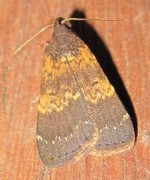
The forewings have a dark base and a pale or reddish-brown antemedial area crossed by an indistinct dark medial band. A black speck or spot may occur at the end of the forewing cell.[1][2][3]
The outer half of the forewing is dark and has an indistinct pale, wavy submarginal line. The forewings have rounded apices.[4][5]
The hindwings are pale, with indistinct cell spots and postmedial lines that are prominent on the underside.[6]
The male has a long, curved third palpal joint and a slight tuft of hair on the palpi. The second palpal joint is smoothly scaled on its front surface.[7][8][9]
The fore tibia is fringed with hair, and the male antennae are minutely ciliated. The forewings lack a costal fold, tuft and distortion of the nervules.[10][11][12]
The forewings measure 24–30 mm in length.[13]
Habitat
The species occurs in south-east Asia, India, Sri Lanka, Japan, Taiwan and Queensland, Australia.[14][15][16][17][18][19]
Diet
Classification of Hydrillodes lentalis
| Kingdom | Animalia |
|---|---|
| Phylum | Arthropoda |
| Subphylum | Hexapoda |
| Class | Insecta (Insect) |
| Order | Lepidoptera |
| Superfamily | Noctuoidea |
| Family | Erebidae (Erebid Moths) |
| Subfamily | Herminiinae |
| Genus | Hydrillodes |
| Species | Hydrillodes lentalis Guenée, 1854 |
Where Hydrillodes lentalis is found
Checklists and occurrence records place Hydrillodes lentalis in 12 countries. GBIF holds 1,687 georeferenced records of it.
Countries
- China 36
- Hong Kong 88
- India 35
- Japan 1,151
- Macao 7
- Malaysia 9
- Pakistan 14
- Philippines 3
- Singapore 12
- South Korea 34
- Taiwan 293
- Thailand 5
Regions and cities with the most records
- Taiwan, Taiwan 122
- Taipei, Taiwan 98
- Xizhi, Taiwan 97
- Neihu, Taiwan 95
- Banqiao, Taiwan 93
- New Taipei City, Taiwan 92
- Tsing Yi Town, Hong Kong 84
- Kwai Chung, Hong Kong 83
- Mei Foo, Hong Kong 83
- Shek Lei, Hong Kong 83
- Discovery Park, Hong Kong 82
- Gifu, Japan 82
- Mei Foo Sun Chuen, Hong Kong 82
- Tai Wo Hau, Hong Kong 82
- Tsuen Wan, Hong Kong 82
- Fu Cheong Estate, Hong Kong 81
- Hoi Lai Estate, Hong Kong 81
- Sham Shui Po, Hong Kong 81
- Nam Cheong, Hong Kong 80
- Olympic, Hong Kong 80
- Un Chau Estate, Hong Kong 80
- Fo Tan, Hong Kong 79
- Pak Tin Estate, Hong Kong 79
- Shek Kip Mei, Hong Kong 79
- Shek Kip Mei Estate, Hong Kong 79
- So Uk, Hong Kong 79
- So Uk Estate, Hong Kong 79
- Tai Kok Tsui, Hong Kong 79
- Keng Hau, Hong Kong 78
- San Tin, Hong Kong 78
- Sha Tin, Hong Kong 78
- Sun Tin Wai, Hong Kong 78
- Tai Wai, Hong Kong 78
- Wo Che, Hong Kong 78
- City One, Hong Kong 77
- Kadoorie, Hong Kong 77
1 more country has a few records outside this range
These countries hold a few records of Hydrillodes lentalis but lie outside the range the checklists give for it. Such records are often zoo or garden specimens, museum material or vagrants, so the species is not counted as occurring there.
A number beside a place is its count of GBIF occurrence records. A place without a number comes from a checklist alone. Records show where a species has been observed or collected, which can include escapes and vagrants.
Common names
Names in 3 other languages
- Chinese
- 普亥鬚裳蛾, 暜亥鬚裳蛾
- Japanese
- ソトウスグロアツバ, ソトウスモンアツバ
- Korean
- 남방담흑수염나방
Synonyms
8 other scientific names have been used for this species and are now treated as synonyms of Hydrillodes lentalis.
- Bocana basalis Moore, 1867
- Bocana metisalis Walker, 1859
- Hydrillodes basalis Moore, 1867
- Hydrillodes metisalis (Walker, 1859)
- Hydrillodes repugnalis (Walker, 1863)
- Hydrillodes submorosa Strand, 1920
- Hydrillodes turbidalis Walker
- Hypochalcia repugnalis Walker, 1863
Related species
-
 Hydrillodes gravatalis
- Hydrillodes aviculalis
-
 Hydrillodes abavalis
-
 Hydrillodes morosa
- Hydrillodes surata
-
 Hydrillodes uliginosalis
-
 Hydrillodes truncata
-
 Hydrillodes funestalis
Compare
Sources
Passages the profile rests on
- The forewings have a dark base. Source passage: “Forewings with dark base.” — English Wikipedia
- The forewings have a pale or reddish-brown antemedial area crossed by an indistinct dark medial band. Source passage: “Antemedial area pale or reddish brown, crossed by a more or less developed, ill-defined, dark medial band.” — English Wikipedia
- A black speck or spot may occur at the end of the forewing cell. Source passage: “There is a black speck found or spot sometimes present at end of cell.” — English Wikipedia
- The outer half of the forewing is dark and has an indistinct pale, wavy submarginal line. Source passage: “The outer half of wing dark with an indistinct pale waved submarginal line.” — English Wikipedia
- The forewings have rounded apices. Source passage: “Forewings with round apex.” — English Wikipedia
- The hindwings are pale and have indistinct cell spots and postmedial lines that are prominent on the underside. Source passage: “Hindwings pale with indistinct cell-spot and postmedial line, which are prominent on ventral surface.” — English Wikipedia
- The male has a long, curved third palpal joint. Source passage: “Palpi of male with long curved third joint and with slight tuft of hair.” — English Wikipedia
- The male has a slight tuft of hair on the palpi. Source passage: “Palpi of male with long curved third joint and with slight tuft of hair.” — English Wikipedia
- The second palpal joint is smoothly scaled on its front surface. Source passage: “Palpi with second joint smoothly scaled in front.” — English Wikipedia
- The fore tibia is fringed with hair. Source passage: “Fore tibia fringed with hair.” — English Wikipedia
- The male antennae are minutely ciliated. Source passage: “Antennae of male minutely ciliated.” — English Wikipedia
- The forewings lack a costal fold, tuft, and distortion of the nervules. Source passage: “There is no costal fold and tuft nor distortion of nervules.” — English Wikipedia
- The forewings measure 24–30 mm in length. Source passage: “The length of the forewings is 24–30 mm.” — English Wikipedia
- The species occurs in south-east Asia. Source passage: “It is found in south-east Asia (including India, Sri Lanka, Japan and Taiwan) and Australia (Queensland).” — English Wikipedia
- The species occurs in India. Source passage: “It is found in south-east Asia (including India, Sri Lanka, Japan and Taiwan) and Australia (Queensland).” — English Wikipedia
- The species occurs in Sri Lanka. Source passage: “It is found in south-east Asia (including India, Sri Lanka, Japan and Taiwan) and Australia (Queensland).” — English Wikipedia
- The species occurs in Japan. Source passage: “It is found in south-east Asia (including India, Sri Lanka, Japan and Taiwan) and Australia (Queensland).” — English Wikipedia
- The species occurs in Taiwan. Source passage: “It is found in south-east Asia (including India, Sri Lanka, Japan and Taiwan) and Australia (Queensland).” — English Wikipedia
- The species occurs in Queensland, Australia. Source passage: “It is found in south-east Asia (including India, Sri Lanka, Japan and Taiwan) and Australia (Queensland).” — English Wikipedia
- The larvae feed on dead leaves. Source passage: “The larvae feed on dead leaves and many grasses.” — English Wikipedia
- The larvae feed on many grasses. Source passage: “The larvae feed on dead leaves and many grasses.” — English Wikipedia
Data
- Catalogue of Life, 2026-10-16 XR cc by
- Global Biodiversity Information Facility CC BY 4.0
- Wikidata CC0
- GeoNames CC BY 4.0
- Wikimedia Commons per image; credit shown with each image
- Within the Catalogue of Life, this name comes from Global Lepidoptera Index cc by
References
- Guenée. (1854). Histoire naturelle des insectes. 8. http://www.biodiversitylibrary.org/item/37754#page/134/mode/2up Link where the name was published
This species in other databases
Page built on 28 November 2026. See how the catalog is made and all sources and licences.
Cite this page
ScientificNames.org. (2026). Hydrillodes lentalis. Retrieved November 28, 2026, from https://scientificnames.org/species/hydrillodes-lentalis
“Hydrillodes lentalis.” ScientificNames.org, 2026, scientificnames.org/species/hydrillodes-lentalis. Accessed 28 Nov. 2026.
ScientificNames.org. “Hydrillodes lentalis.” Accessed November 28, 2026. https://scientificnames.org/species/hydrillodes-lentalis.
@misc{scientificnames_hydrillodes_lentalis,
  author = {{ScientificNames.org}},
  title = {Hydrillodes lentalis},
  year = {2026},
  url = {https://scientificnames.org/species/hydrillodes-lentalis},
  note = {Accessed 2026-11-28}
}