Species · Fishes
Giant Tigerfish Hydrocynus goliath
The scientific name of the Giant Tigerfish is Hydrocynus goliath. It is a species of fish in the family Alestidae (african tetras), order Characiformes. The name dates from 1898.
- Scientific name
- Hydrocynus goliath Boulenger, 1898
- Common name
- Giant Tigerfish
- Genus
- Hydrocynus
- Family
- Alestidae (African Tetras)
- Order
- Characiformes
- Class
- Teleostei
- Red List category
- LC Least Concern
- Environment
- freshwater
- Recorded in
- 3 countries
- Name status
- accepted in the Catalogue of Life

Overview
The Giant Tigerfish is the largest tigerfish in the genus Hydrocynus. It occurs in the Congo River Basin and Lake Tanganyika. It has large, dagger-shaped conical teeth spaced along its jaws, with individual teeth growing to approximately 2.5 cm long.
Written 24 November 2026 from the sources listed below. Each statement was checked against the passage it cites; statements that could not be supported were removed.
Appearance
The Giant Tigerfish has a silvery-gray back and flanks, black adipose fins, and a body shape resembling that of tuna.[1]
Its large conical teeth are shaped like daggers and spaced along its jaws. The upper jaw has 12–20 teeth, while the lower jaw has 8–14 teeth.[2][3]
Individual teeth can grow to approximately 2.5 cm long. The teeth in each jaw quadrant are replaced simultaneously over approximately five days.[4][5]
Habitat
The Giant Tigerfish inhabits highly oxygenated, fast-flowing waters, including deep river channels and open lakes.[6]
It breeds near riverbanks and lakeshores.[7]
Diet
The Giant Tigerfish feeds on fish that it can overpower, including smaller individuals of its own species. Larval individuals feed on animal plankton before switching to small fish and eventually larger fish.[8][9]
The species has been reported to take chunks from large fish, crocodiles, and humans.[10]
Behaviour
The Giant Tigerfish generally hunts alone. It ambushes prey from calmer eddies in rapids, using keen eyesight to detect prey before accelerating to pursue it.[11][12][13]
The species is capable of swimming strongly in turbulent water.[14]
Reproduction and life cycle
Females migrate together and breed near one another along riverbanks or lakeshores. They lay thousands of eggs among thick vegetation.[15][16]
The species does not provide parental care to its eggs or young. Juveniles grow approximately four to six inches in length per year and can take up to ten years to reach adult size.[17][18][19]
Conservation
The Giant Tigerfish was assessed as Least Concern in the 2010 IUCN Red List assessment. Its current conservation status is described as unknown.[20][21]
Uses
A tank capacity of approximately 15,000 litres is recommended for keeping the species in an aquarium. It strongly prefers live prey when fed in captivity.[22][23]
Classification of the Giant Tigerfish
| Kingdom | Animalia |
|---|---|
| Phylum | Chordata |
| Subphylum | Vertebrata |
| Infraphylum | Gnathostomata |
| Parvphylum | Osteichthyes |
| Gigaclass | Actinopterygii |
| Superclass | Actinopteri |
| Class | Teleostei (Teleost) |
| Order | Characiformes |
| Suborder | Characoidei |
| Family | Alestidae (African Tetras) |
| Genus | Hydrocynus (Tigerfish) |
| Species | Hydrocynus goliath Boulenger, 1898 |
Where the Giant Tigerfish is found
Checklists and occurrence records place Hydrocynus goliath in 3 countries. GBIF holds 139 georeferenced records of it.
Countries
Regions and cities with the most records
- Tshopo, Democratic Republic of the Congo 26
- Kinshasa, Democratic Republic of the Congo 19
- Brazzaville, Republic of the Congo 17
- Kinshasa, Democratic Republic of the Congo 17
- Masina, Democratic Republic of the Congo 16
- Yangambi, Democratic Republic of the Congo 11
- Mai-Ndombe, Democratic Republic of the Congo 10
- Kisangani, Democratic Republic of the Congo 9
- Ituri, Democratic Republic of the Congo 6
- Maniema, Democratic Republic of the Congo 6
- Matadi, Democratic Republic of the Congo 6
- Boma, Democratic Republic of the Congo 5
- Kindu, Democratic Republic of the Congo 4
- Lisala, Democratic Republic of the Congo 4
- Mongala, Democratic Republic of the Congo 4
- Mushie, Democratic Republic of the Congo 4
- Tanganyika, Democratic Republic of the Congo 4
- Haut-Lomami, Democratic Republic of the Congo 3
- Pool, Republic of the Congo 3
- Équateur, Democratic Republic of the Congo 3
A number beside a place is its count of GBIF occurrence records. A place without a number comes from a checklist alone. Records show where a species has been observed or collected, which can include escapes and vagrants.
Common names
English
- Giant Tigerfish
- Goliath Tigerfish
- Mbenga
Names in 25 other languages
- Arabic
- رشال عملاق
- Chinese
- 巨狗脂鯉
- Czech
- afrotetra tygří, binga tygří
- Danish
- Stor Tigerfisk
- Esperanto
- Goljata tigrofiŝo
- Estonian
- Suur vesihunt
- French
- Poisson tigre goliath
- German
- Riesen-Tigersalmler, Wasserhund, Wolfsalmler
- Hebrew
- דג טיגריס גולייתי
- Italian
- pesce tigre golia
- Japanese
- ムベンガ
- Korean
- 골리앗타이거피시
- Lithuanian
- Afrikinės tigrinės tetros
- Mandarin Chinese
- 条纹狗脂鲤, 條紋狗脂鯉
- Polish
- Goliat tygrysi
- Portuguese
- Peixe-tigre-golias
- Russian
- Большая тигровая рыба, Большая тигровая рыба[, Гигантский гидроцин
- Spanish
- Pez tigre
- Swahili
- Mbiribi
- Swedish
- Jättetigerfisk
- Thai
- ปลาไทเกอร์โกไลแอต
- Ukrainian
- Риба голіаф
- keb
- Ifwe, Ilembu, Imemenga, Isenekwa, Menga, Soowa
- mis
- Imibanse
- run
- Imbiribi
Synonyms
3 other scientific names have been used for this species and are now treated as synonyms of Hydrocynus goliath.
- Hydrocynus vittiger Boulenger, 1907
- Hydrocyon goliath Boulenger, 1898
- Hydrocyon vittiger Boulenger, 1907
Related species
-
 Striped TigerfishHydrocynus vittatus
-
 CharacinHydrocynus forskahlii
-
 Tiger FishHydrocynus brevis
-
 Blue TigerfishHydrocynus tanzaniae
-
 Congo TetraPhenacogrammus interruptus
-
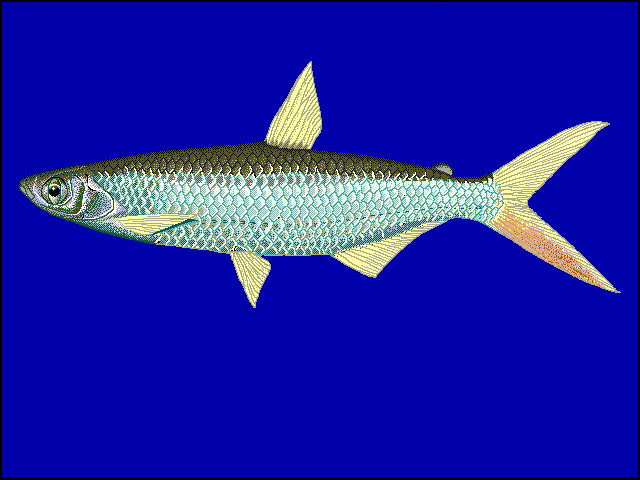 NyeleAlestes baremoze
-
 Nangnang FishBrycinus nurse
-
 Torpedo RobberAlestes macrophthalmus
Compare
Questions and answers
What is the scientific name of the Giant Tigerfish?
The scientific name of the Giant Tigerfish is Hydrocynus goliath. Written with its author, the full name is Hydrocynus goliath Boulenger, 1898.
Which family does the Giant Tigerfish belong to?
Hydrocynus goliath belongs to the family Alestidae, in the order Characiformes and the class Teleostei.
Where is the Giant Tigerfish found?
Checklists and occurrence records place Hydrocynus goliath in 3 countries: Democratic Republic of the Congo, Republic of the Congo and Central African Republic.
What is the conservation status of the Giant Tigerfish?
The IUCN Red List category recorded for Hydrocynus goliath is Least Concern (LC).
What other names does the Giant Tigerfish have?
Hydrocynus goliath is also known in English as Goliath Tigerfish and Mbenga.
What is the maximum size a goliath tigerfish can reach?
The Giant Tigerfish can reach a recorded maximum length of approximately 2 metres. The largest recorded specimen weighed 70 kilograms.[24][25]
Can you have a goliath tigerfish as a pet?
The Giant Tigerfish is sometimes kept as a display fish in home aquariums. A tank capacity of approximately 15,000 litres is recommended, and the species strongly prefers live prey when fed in captivity.[26][22][23]
How aggressive are Goliath Tigerfish?
The Giant Tigerfish generally hunts alone and feeds on fish it can overpower, including smaller individuals of its own species. It has also been reported to take chunks from large fish, crocodiles, and humans.[8][10][11]
What do goliath tigerfish eat?
The Giant Tigerfish feeds on fish it can overpower, including smaller individuals of its own species. Larvae initially feed on animal plankton, then switch to small fish and eventually larger fish.[8][9]
How many people have been killed by goliath tigerfish?
The species has been reported to take chunks from humans, but no number of human deaths is given.[10]
Sources
Passages the profile rests on
- The species has a silvery-gray back and flanks, black adipose fins, and a body shape resembling that of tuna. Source passage: “The goliath tigerfish has a characteristic silvery gray dorsum and flanks, with a thunniform body plan similar to that of tuna, featuring black adipose fins.” — English Wikipedia
- The species has large conical teeth shaped like daggers and spaced along its jaws. Source passage: “they also have incredibly large conical teeth. Due to their predatory nature, they possess well-developed pharyngeal teeth similar to those of sharks and piranhas. Their teeth are spaced out along the jaw and shaped like daggers” — English Wikipedia
- Its upper jaw has 12–20 teeth, while its lower jaw has 8–14 teeth. Source passage: “The premaxilla holds six to seven teeth while the dentary or lower jaw holds five, for a total of 12 to 20 upper teeth plus 8 to 14 lower teeth.” — English Wikipedia
- The teeth in each jaw quadrant are replaced simultaneously over approximately five days. Source passage: “In each jaw quadrant, all teeth are replaced at the same time over the course of about five days.” — English Wikipedia
- Individual teeth can grow to approximately 2.5 cm long. Source passage: “On average each of its teeth can grow up to 2.5 cm (1 in)” — English Wikipedia
- The species inhabits highly oxygenated, fast-flowing waters, including deep river channels and open lakes. Source passage: “They are typically found in highly oxygenated fast-flowing waters such as those found in deep river channels and open lakes” — English Wikipedia
- The species breeds near riverbanks and lakeshores. Source passage: “female goliath tigerfish migrate together and breed near each other on riverbanks or lakeshores.” — English Wikipedia
- The species feeds on fish that it can overpower, including smaller individuals of its own species. Source passage: “Hydrocynus goliath is a piscivore, feeding on any fish it can overpower, including smaller members of the same species.” — English Wikipedia
- Larval individuals feed on animal plankton before switching to small fish and eventually larger fish. Source passage: “Infant fish feed on animal plankton during their larval stage before transitioning to small fish and eventually an adult diet of larger fish.” — English Wikipedia
- The species has been reported to take chunks from large fish, crocodiles, and humans. Source passage: “They have been known to attack larger animals, taking "chunks" out of large fish, crocodiles, and even humans.” — English Wikipedia
- The species generally hunts alone. Source passage: “Despite being mostly solitary hunters” — English Wikipedia
- When hunting, the species ambushes prey from calmer eddies in rapids. Source passage: “When hunting, this fish uses the calmer eddies of the rapids to ambush its prey” — English Wikipedia
- The species uses keen eyesight to detect prey before accelerating to pursue it. Source passage: “using its keen sight to detect prey. When a target is noticed, the fish accelerates to chase it down.” — English Wikipedia
- The species is capable of swimming strongly in turbulent water. Source passage: “making them strong swimmers able to capture prey even in turbulent waters.” — English Wikipedia
- Females migrate together and breed near one another along riverbanks or lakeshores. Source passage: “female goliath tigerfish migrate together and breed near each other on riverbanks or lakeshores.” — English Wikipedia
- Females lay thousands of eggs among thick vegetation. Source passage: “Thousands of eggs are laid among thick vegetation” — English Wikipedia
- The species does not provide parental care to its eggs or young. Source passage: “given that goliath tigerfish are not attentive parents.” — English Wikipedia
- Juveniles grow approximately four to six inches in length per year. Source passage: “Juvenile fish grow quite slowly, averaging four to six inches of growth per year.” — English Wikipedia
- Juveniles can take up to ten years to reach adult size. Source passage: “It can take up to ten years for a juvenile tigerfish to reach its full adult size.” — English Wikipedia
- The species was assessed as Least Concern in the 2010 IUCN Red List assessment. Source passage: “it is listed as "least concern" according to the IUCN Red List's 2010 assessment.” — English Wikipedia
- The document describes the species' current conservation status as unknown. Source passage: “The current conservation status of the goliath tigerfish is unknown” — English Wikipedia
- A tank capacity of approximately 15,000 litres is recommended for keeping the species in an aquarium. Source passage: “The recommended size of such a tank setup would be around 15,000 l.” — English Wikipedia
- The species strongly prefers live prey when fed in captivity. Source passage: “When feeding, this massive fish will strongly prefer live prey, making feeding them difficult.” — English Wikipedia
- The largest recorded specimen weighed 70 kilograms. Source passage: “The largest recorded specimen weighed 70 kg (154 lb)” — English Wikipedia
- The species can reach a recorded maximum length of approximately 2 metres. Source passage: “they can reach a maximum recorded length of about 2 m (6.6 ft)” — English Wikipedia
- The species is sometimes kept as a display fish in home aquariums. Source passage: “The goliath tigerfish is sometimes kept as a display fish in home aquarium setups.” — English Wikipedia
- The Nile crocodile is identified as the only known natural predator of mature individuals. Source passage: “The Nile crocodile is the only known natural predator of mature goliath tigerfish.” — English Wikipedia
- The species occurs in the Congo River Basin and Lake Tanganyika. Source passage: “is found in the Congo River Basin (including Lualaba River and Lake Upemba), and Lake Tanganyika.” — English Wikipedia
- Its documented Congo River Basin distribution includes the Lualaba River and Lake Upemba. Source passage: “including Lualaba River and Lake Upemba” — English Wikipedia
Data
- Catalogue of Life, 2026-10-16 XR cc by
- Global Biodiversity Information Facility CC BY 4.0
- Wikidata CC0
- GeoNames CC BY 4.0
- Wikimedia Commons per image; credit shown with each image
- Within the Catalogue of Life, this name comes from World Register of Marine Species cc by
References
- Boulenger, G. A. (1898). Matériaux pour la faune du Congo. Poissons nouveaux du Congo. Deuxième Partie. Elopes, Characins, Cyprins. Annales Du Musee Du Congo (Ser. Zoology), v. 1 (fasc. 2): 21–38, Pls. 10–19. https://doi.org/10.5962/bhl.title.5766 Link where the name was published
This species in other databases
- Catalogue of Life 6MJM7
- Wikidata Q1460026
- iNaturalist 103023
- WoRMS urn:lsid:marinespecies.org:taxname:1440610
- ITIS 641102
Page built on 24 November 2026. See how the catalog is made and all sources and licences.
Cite this page
ScientificNames.org. (2026). Hydrocynus goliath (Giant Tigerfish). Retrieved November 24, 2026, from https://scientificnames.org/species/hydrocynus-goliath
“Hydrocynus goliath (Giant Tigerfish).” ScientificNames.org, 2026, scientificnames.org/species/hydrocynus-goliath. Accessed 24 Nov. 2026.
ScientificNames.org. “Hydrocynus goliath (Giant Tigerfish).” Accessed November 24, 2026. https://scientificnames.org/species/hydrocynus-goliath.
@misc{scientificnames_hydrocynus_goliath_giant_tigerfish,
  author = {{ScientificNames.org}},
  title = {Hydrocynus goliath (Giant Tigerfish)},
  year = {2026},
  url = {https://scientificnames.org/species/hydrocynus-goliath},
  note = {Accessed 2026-11-24}
}