Species · Insects
Boisduval's Blue Icaricia icarioides
The scientific name of the Boisduval's Blue is Icaricia icarioides. It is a species of insect in the family Lycaenidae (blues), order Lepidoptera. The name dates from 1852.
- Scientific name
- Icaricia icarioides (Boisduval, 1852)
- Common name
- Boisduval's Blue
- Genus
- Icaricia
- Family
- Lycaenidae (Blues)
- Order
- Lepidoptera
- Class
- Insecta
- Recorded in
- 3 countries
- Name status
- accepted in the Catalogue of Life

Overview
Boisduval's Blue is a butterfly belonging to the family Lycaenidae. It occurs across western Canada and the western United States, with its Canadian range extending from southern Saskatchewan to British Columbia. Adults have a wingspan ranging from 21 to 32 mm.
Written 26 November 2026 from the sources listed below. Each statement was checked against the passage it cites; statements that could not be supported were removed.
Appearance
Adults have a wingspan ranging from 21 to 32 mm.[1]
Habitat
Boisduval's Blue inhabits dunes, mountains, meadows, streams, and sage-lands. It also occurs in open areas and woodland openings near its larval host plants.[2][3]
Diet
The larvae feed on lupine plants belonging to the genus Lupinus. Adults obtain nectar from Eriogonum flowers and other composite plants.[4][5]
Similar species
The Greenish blue (Icaricia saepiolus) and the Silvery blue (Glaucopsyche lygdamus) are identified as similar species.[6][7]
Conservation
The Mission blue subspecies faces threats from vehicles running over larvae and host plants on dirt roads, as well as trampling of larvae and host plants by hikers using trails.[8][9]
Classification of the Boisduval's Blue
| Kingdom | Animalia |
|---|---|
| Phylum | Arthropoda |
| Subphylum | Hexapoda |
| Class | Insecta (Insect) |
| Order | Lepidoptera |
| Superfamily | Papilionoidea |
| Family | Lycaenidae (Blues) |
| Genus | Icaricia |
| Species | Icaricia icarioides (Boisduval, 1852) |
Where the Boisduval's Blue is found
Checklists and occurrence records place Icaricia icarioides in 3 countries across North America. GBIF holds 16,097 georeferenced records of it.
Countries
Regions and cities with the most records
- British Columbia, Canada 3,985
- California, United States 3,394
- Washington, United States 1,789
- Oregon, United States 933
- Colorado, United States 911
- Idaho, United States 739
- Alberta, Canada 666
- Utah, United States 482
- Montana, United States 414
- Wyoming, United States 400
- San Francisco, United States 325
- Bayview-Hunters Point, United States 309
- Daly City, United States 307
- South San Francisco, United States 280
- Nevada, United States 277
- Pacifica, United States 267
- San Bruno, United States 265
- Oakland, United States 243
- Penticton, Canada 241
- Millbrae, United States 229
- Albany, United States 207
- Burlingame, United States 200
- Alameda, United States 186
- El Cerrito, United States 176
- Richmond, United States 172
- Berkeley, United States 169
- Agua Caliente, United States 153
- San Pablo, United States 152
- Santa Rosa, United States 148
- Golden, United States 137
- Columbine, United States 136
- Ken Caryl, United States 134
- Wenatchee, United States 133
- Orinda, United States 129
- Boulder, United States 126
- Pinole, United States 123
Range as the checklists state it
North America
A number beside a place is its count of GBIF occurrence records. A place without a number comes from a checklist alone. Records show where a species has been observed or collected, which can include escapes and vagrants.
Common names
English
- Boisduval's Blue
Names in 1 other language
- French
- bleu de Boisduval
Synonyms
5 other scientific names have been used for this species and are now treated as synonyms of Icaricia icarioides.
- Icaricia icarioides icarioides (Boisduval, 1852)
- Lycaena icarioides Boisduval, 1852
- Lycaena mintha Edwards, 1871
- Plebeius spinimaculata Gunder, 1926
- Plebejus icarioides (Boisduval, 1852)
Subspecies and varieties
- Icaricia icarioides blackmorei (Puget Blue) subspecies
- Icaricia icarioides buchholzi subspecies
- Icaricia icarioides missionensis ('Mission' Boisduval's Blue) subspecies
- Icaricia icarioides montis subspecies
- Icaricia icarioides moroensis (Morro Bay Blue) subspecies
- Plebejus icarioides albihalos subspecies
- Plebejus icarioides argusmontana subspecies
- Plebejus icarioides atascadero subspecies
- Plebejus icarioides austinorum subspecies
- Plebejus icarioides eosierra subspecies
- Plebejus icarioides icarioides subspecies
- Plebejus icarioides inyo subspecies
- Plebejus icarioides panamintina subspecies
- Plebejus icarioides parapheres subspecies
- Plebejus icarioides santana subspecies
Related species
-
 Common BluePolyommatus icarus
-
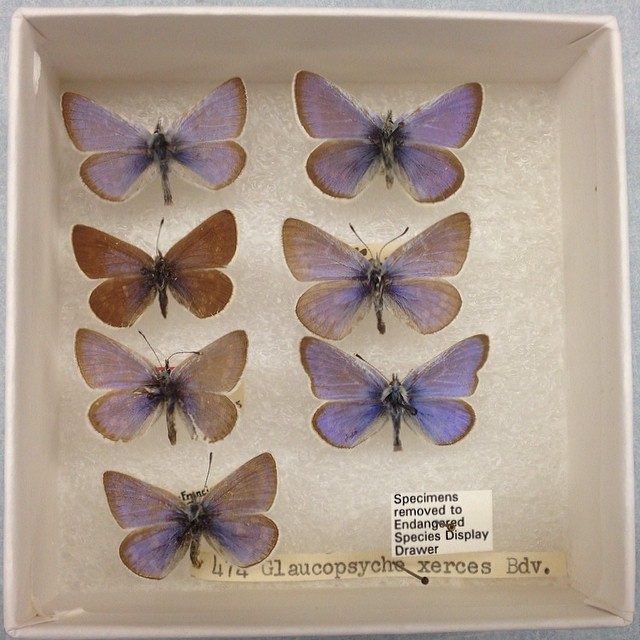 Xerces BlueGlaucopsyche xerces
-
 Adonis BlueLysandra bellargus
-
 Western Pygmy BlueBrephidium exilis
-
 AtalaEumaeus atala
-
 Holly BlueCelastrina argiolus
-
 Long-tailed BlueLampides boeticus
-
 HarvesterFeniseca tarquinius
Compare
Questions and answers
What is the scientific name of the Boisduval's Blue?
The scientific name of the Boisduval's Blue is Icaricia icarioides. Written with its author, the full name is Icaricia icarioides (Boisduval, 1852).
Which family does the Boisduval's Blue belong to?
Icaricia icarioides belongs to the family Lycaenidae, in the order Lepidoptera and the class Insecta.
Where is the Boisduval's Blue found?
Checklists and occurrence records place Icaricia icarioides in 3 countries: United States, Canada and Mexico.
Sources
Passages the profile rests on
- Adults have a wingspan ranging from 21 to 32 mm. Source passage: “Wingspan: 21 to 32 mm.” — English Wikipedia
- The species inhabits dunes, mountains, meadows, streams, and sage-lands. Source passage: “Its habitats include dunes, mountains, meadows, streams, and sage-lands.” — English Wikipedia
- The species also occurs in open areas and woodland openings near its larval host plants. Source passage: “It is also found in open areas or openings in woods near its larval host.” — English Wikipedia
- The larvae feed on lupine plants belonging to the genus Lupinus. Source passage: “Larvae feed on species of lupines (Lupinus).” — English Wikipedia
- Adults obtain nectar from Eriogonum flowers and other composite plants. Source passage: “Adults feed on nectar from flowers of Eriogonum species and other composites.” — English Wikipedia
- The Greenish blue (Icaricia saepiolus) is identified as a similar species. Source passage: “Greenish blue (Icaricia saepiolus)” — English Wikipedia
- The Silvery blue (Glaucopsyche lygdamus) is identified as a similar species. Source passage: “Silvery blue (Glaucopsyche lygdamus)” — English Wikipedia
- The Mission blue subspecies faces threats from vehicles running over larvae and host plants on dirt roads. Source passage: “Larvae and host plants being runover on dirt roads;” — fws.gov
- The Mission blue subspecies faces trampling of larvae and host plants by hikers using trails. Source passage: “Trampling of larvae and host plants by hikers along trails.” — fws.gov
Data
- Catalogue of Life, 2026-10-16 XR cc by
- Global Biodiversity Information Facility CC BY 4.0
- Wikidata CC0
- GeoNames CC BY 4.0
- Wikimedia Commons per image; credit shown with each image
- Within the Catalogue of Life, this name comes from Global Lepidoptera Index cc by
References
- Boisduval. (1852). Annales de la Société Entomologique de France. 10. http://www.biodiversitylibrary.org/item/34969#page/294/mode/2up Link where the name was published
This species in other databases
Page built on 27 November 2026. See how the catalog is made and all sources and licences.
Cite this page
ScientificNames.org. (2026). Icaricia icarioides (Boisduval's Blue). Retrieved November 27, 2026, from https://scientificnames.org/species/icaricia-icarioides
“Icaricia icarioides (Boisduval's Blue).” ScientificNames.org, 2026, scientificnames.org/species/icaricia-icarioides. Accessed 27 Nov. 2026.
ScientificNames.org. “Icaricia icarioides (Boisduval's Blue).” Accessed November 27, 2026. https://scientificnames.org/species/icaricia-icarioides.
@misc{scientificnames_icaricia_icarioides_boisduvals_blue,
  author = {{ScientificNames.org}},
  title = {Icaricia icarioides (Boisduval's Blue)},
  year = {2026},
  url = {https://scientificnames.org/species/icaricia-icarioides},
  note = {Accessed 2026-11-27}
}