Species · Flowering plants
Yerba Mate Ilex paraguariensis
The scientific name of the Yerba Mate is Ilex paraguariensis. It is a species of flowering plant in the family Aquifoliaceae (holly), order Aquifoliales.
- Scientific name
- Ilex paraguariensis A.St.-Hil.
- Common name
- Yerba Mate
- Genus
- Ilex
- Family
- Aquifoliaceae (Holly)
- Order
- Aquifoliales
- Class
- Magnoliopsida
- Red List category
- NT Near Threatened
- Recorded in
- 7 countries
- Name status
- accepted in the Catalogue of Life
Overview
Ilex paraguariensis grows naturally in the Paraná and Paraguay river basins at elevations between 500 and 1,000 meters. Its leaves contain caffeine and related xanthine alkaloids and are used to prepare hot and cold beverages.
Written 24 November 2026 from the sources listed below. Each statement was checked against the passage it cites; statements that could not be supported were removed.
Appearance
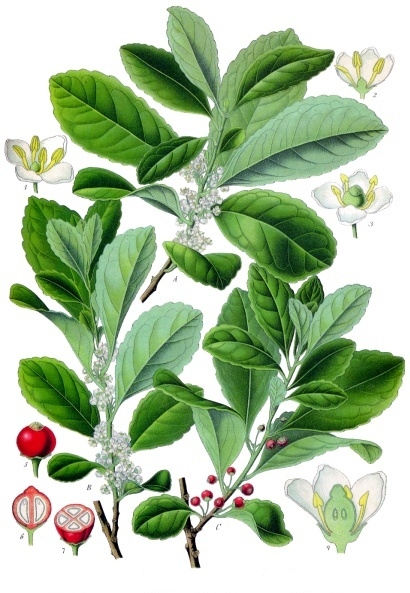
Yerba mate is an evergreen tree with hard, olive-green, egg-shaped leaves with crenate edges and blunt tips. Its leaves are approximately 8 centimeters long.[1][2][3]
The species produces small, greenish-white flowers with four petals and red or reddish-brown berries containing yellow seeds. Its fruits measure between 5 and 8 millimeters in diameter.[4][5][6]
The tree typically grows between 8 and 15 meters tall. It begins development as a shrub before maturing into a tree.[7][8][9]
Habitat
Yerba mate is native to South America and occurs in northern Argentina, southern Brazil, Uruguay, and Paraguay. It grows naturally in the Paraná and Paraguay river basins at elevations between 500 and 1,000 meters.[10][11][12]
The species grows in subtropical environments and is associated with mild climates without a dry season. It requires high humidity throughout the year and annual rainfall of at least 1,200 millimeters.[13][14][15]
Yerba mate can withstand temperatures as low as minus 6 degrees Celsius.[16]
Uses
The dried and roasted leaves of Yerba mate are used to prepare yerba mate tea. The leaves can also be steeped in hot water to produce mate or used to prepare a cold beverage called tereré.[17][18][19]
The species is used in commercial herbal preparations as a central nervous system stimulant, diuretic, and antirheumatic.[20]
The leaves contain caffeine at concentrations ranging from 0.7% to 1.7% of dry weight. They also contain tannins at concentrations of approximately 7% to 11%.[21][22]
The species contains polyphenols including quercetin and rutin, as well as caffeine, theobromine, and theophylline.[23][24]
Behaviour
Yerba mate retains its leaves throughout the year. Wild specimens can take approximately 25 years to reach full development.[3][25]
Reproduction and life cycle
Yerba mate is a dioecious species. It flowers between October and November and produces fruit between March and June.[26][27][28]
Birds disperse the species' seeds. Seeds used for propagation are harvested after turning dark purple, typically between January and April.[29][30]
New plants are generally started between March and May. Seed germination can take a long time because many apparently ripe seeds contain residual embryos.[31][32]
Classification of the Yerba Mate
| Kingdom | Plantae |
|---|---|
| Subkingdom | Pteridobiotina |
| Phylum | Tracheophyta |
| Class | Magnoliopsida |
| Order | Aquifoliales |
| Family | Aquifoliaceae (Holly) |
| Genus | Ilex (Holly) |
| Species | Ilex paraguariensis A.St.-Hil. |
Where the Yerba Mate is found
Checklists and occurrence records place Ilex paraguariensis in 7 countries across Africa, North America and South America. GBIF holds 9,354 georeferenced records of it.
Countries where it is native or its origin is not stated
Countries where it has been introduced
Regions and cities with the most records
- Paraná, Brazil 401
- Santa Catarina, Brazil 370
- Rio Grande do Sul, Brazil 250
- São Paulo, Brazil 195
- Bahia, Brazil 120
- Minas Gerais, Brazil 97
- Misiones, Argentina 87
- Pinhais, Brazil 84
- Piraquara, Brazil 84
- Mato Grosso, Brazil 80
- Alto Paraná Department, Paraguay 58
- Colombo, Brazil 51
- Mato Grosso do Sul, Brazil 47
- Curitiba, Brazil 45
- Almirante Tamandaré, Brazil 39
- Ciudad del Este, Paraguay 35
- Presidente Franco, Paraguay 35
- San Pedro Department, Paraguay 35
- Foz do Iguaçu, Brazil 31
- Rio de Janeiro, Brazil 31
- East Honolulu, United States 30
- Hawaii, United States 30
- Honolulu, United States 30
- Marau, Brazil 29
- Pedro Juan Caballero, Paraguay 29
- Ponta Porã, Brazil 29
- São José dos Pinhais, Brazil 28
- Pearl City, United States 26
- Poços de Caldas, Brazil 23
- Farroupilha, Brazil 22
- Taboão da Serra, Brazil 22
- Vargem Grande Paulista, Brazil 22
- Caxias do Sul, Brazil 21
- La Paz Department, Bolivia 21
- São Bento do Sul, Brazil 21
- São Caetano do Sul, Brazil 21
5 more countries have a few records outside this range
These countries hold a few records of Ilex paraguariensis but lie outside the range the checklists give for it. Such records are often zoo or garden specimens, museum material or vagrants, so the species is not counted as occurring there.
Range as the checklists state it
Seychelles [I]; Hawaii [I] (Oahu [I]); NE-Brazil (Bahia); WC-Brazil (Mato Grosso, Brazília Distrito Federal, Mato Grosso do Sul); SE-Brazil (Minas Gerais, São Paulo); S-Brazil (Paraná, Rio Grande do Sul, Santa Catarina); Paraguay (Alto Paraná, Amambay, Caaguazu, Canindeyu, Central, Guaira, Itapua, Misiones, San Pedro); Uruguay (Maldonado, Tacuarembó, Treinta y Tres); Argentina (Corrientes, Misiones)
A number beside a place is its count of GBIF occurrence records. A place without a number comes from a checklist alone. Records show where a species has been observed or collected, which can include escapes and vagrants.
Common names
English
- Yerba Maté
- Brazilian-tea
- Paraguayan-tea
Names in 16 other languages
- Chinese
- 巴拉圭冬青, 瑪黛茶
- Czech
- cesmína paraguayská
- Dutch
- Matéplant
- Esperanto
- Paragvaja ilekso
- Estonian
- matepuu
- Finnish
- matee
- French
- thé du Paraguay
- German
- Mate-Strauch, Mateteestrauch, Yerba, Yerba-Mate
- Italian
- Matè
- Japanese
- マテチャ
- Polish
- Ostrokrzew paragwajski
- Portuguese
- Caá, Chá-Mate, Congonha, Erva, Erva-Mate, Erva-congonha, Erva-verdadeira, Erveira
- Russian
- Падуб парагвайский
- Slovak
- cezmína paraguajská
- Spanish
- maté, yerba mate
- grn
- Ka'a
Synonyms
26 other scientific names have been used for this species and are now treated as synonyms of Ilex paraguariensis.
- Ilex bonplandiana Münter
- Ilex congonhas Liais
- Ilex curitibensis Miers
- Ilex domestica Reiss
- Ilex domestica var. glabra Reissek
- Ilex mate A.St.-Hil.
- Ilex paraguariensis f. confusa Loes.
- Ilex paraguariensis f. dasyprionata Loes.
- Ilex paraguariensis f. domestica (Reissek) Loes.
- Ilex paraguariensis f. latifolia (Reissek) Chodat
- Ilex paraguariensis f. microphylla Reissek
- Ilex paraguariensis f. parvifolia Chodat
- Ilex paraguariensis f. sorbilis (Reissek) Loes.
- Ilex paraguariensis var. acutifolia Mart.
- Ilex paraguariensis var. angustifolia Reissek
- Ilex paraguariensis var. dentata Miers
- Ilex paraguariensis var. euneura Loes.
- Ilex paraguariensis var. guaranina Loes.
- Ilex paraguariensis var. latifolia Reissek
- Ilex paraguariensis var. paraguariensis
- Ilex paraguariensis var. ulei Loes.
- Ilex paraguariensis var. usitata Miers
- Ilex paraguayensis Hook.
- Ilex sorbilis Reissek
- Ilex sorbitis Reissek
- Ilex theaezans Bonpl. ex Miers
Subspecies and varieties
Related species
-
 Yaupon HollyIlex vomitoria
-
 Black HollyIlex verticillata
-
 HollyIlex aquifolium
-
 Box-leaf HollyIlex crenata
- GuayusaIlex guayusa
-
 Christmas HollyIlex opaca
- Possum-hawIlex decidua
-
 GallberryIlex glabra
Compare
Questions and answers
What is the scientific name of the Yerba Mate?
The scientific name of the Yerba Mate is Ilex paraguariensis. Written with its author, the full name is Ilex paraguariensis A.St.-Hil..
Which family does the Yerba Mate belong to?
Ilex paraguariensis belongs to the family Aquifoliaceae, in the order Aquifoliales and the class Magnoliopsida.
Where is the Yerba Mate found?
Checklists and occurrence records place Ilex paraguariensis in 7 countries, including Brazil, Paraguay, Argentina, Uruguay and Bolivia.
What is the conservation status of the Yerba Mate?
The IUCN Red List category recorded for Ilex paraguariensis is Near Threatened (NT).
What other names does the Yerba Mate have?
Ilex paraguariensis is also known in English as Yerba Maté, Brazilian-tea and Paraguayan-tea.
What is yerba mate called now?
The name used here is Yerba mate. Other English names on record include Brazilian-tea, Paraguayan-tea, yerba mate, and Yerba Maté.[1]
What does drinking yerba mate do to your body?
Yerba mate is used in commercial herbal preparations as a central nervous system stimulant, diuretic, and antirheumatic. Its leaves contain caffeine and related xanthine alkaloids.[20][33]
How would you describe yerba mate?
Yerba mate is an evergreen tree with hard, olive-green, egg-shaped leaves, small greenish-white flowers, and red or reddish-brown berries. It typically grows between 8 and 15 meters tall.[1][4][5][8][3]
What is Ilex paraguariensis used for?
Its dried and roasted leaves are used to prepare yerba mate tea. The leaves are also used to make mate and the cold beverage tereré, and the species is used in commercial herbal preparations as a central nervous system stimulant, diuretic, and antirheumatic.[17][18][19][20]
Sources
Passages the profile rests on
- Ilex paraguariensis is an evergreen tree with hard, olive-green, egg-shaped leaves that have crenate edges and blunt tips. Source passage: “The hard perennial leaves are 8 cm long, olive green in color, darker on top. They are egg-shaped with a wedge-shaped base, crenate edge, and blunt tip.” — pmc.ncbi.nlm.nih.gov
- Its leaves are approximately 8 centimeters long. Source passage: “The hard perennial leaves are 8 cm long” — pmc.ncbi.nlm.nih.gov
- The species retains its leaves throughout the year. Source passage: “I. paraguariensis is a subtropical, dioecious, evergreen tree” — pmc.ncbi.nlm.nih.gov
- The species produces small, greenish-white flowers with four petals. Source passage: “The flowers are small and greenish-white with four petals.” — English Wikipedia
- The species produces red or reddish-brown berries containing yellow seeds. Source passage: “The fruit are red or reddish-brown berries 5–8 mm in diameter, containing 4–5 yellow seeds with a hard shell” — pmc.ncbi.nlm.nih.gov
- Its fruits measure between 5 and 8 millimeters in diameter. Source passage: “The fruit are red or reddish-brown berries 5–8 mm in diameter” — pmc.ncbi.nlm.nih.gov
- Ilex paraguariensis can grow to a height of 15 meters. Source passage: “growing up to 15 meters (50 ft) tall.” — English Wikipedia
- The tree typically grows between 8 and 15 meters tall. Source passage: “I. paraguariensis is a subtropical, dioecious, evergreen tree that grows from 8 to 15 m.” — pmc.ncbi.nlm.nih.gov
- The species begins its development as a shrub before maturing into a tree. Source passage: “begins as a shrub and then matures to a tree” — English Wikipedia
- The species grows naturally in the Paraná and Paraguay river basins at elevations between 500 and 1,000 meters. Source passage: “Grows between the parallels 10° and 30° (South) in the Paraná and Paraguay rivers basins at altitudes varying from 500 to 1,000 meters” — psfaculty.plantsciences.ucdavis.edu
- The species is native to South America. Source passage: “is a plant species of the holly genus native to South America.” — English Wikipedia
- The species occurs in northern Argentina, southern Brazil, Uruguay, and Paraguay. Source passage: “Ilex trees are located exclusively in South America: in northern Argentina, southern Brazil, Uruguay, and Paraguay” — pmc.ncbi.nlm.nih.gov
- The species grows in subtropical environments. Source passage: “I. paraguariensis is a subtropical, dioecious, evergreen tree” — pmc.ncbi.nlm.nih.gov
- The species requires high humidity throughout the year and annual rainfall of at least 1,200 millimeters. Source passage: “The tree requires high humidity throughout the year the rain-fall must not be less than 1200 mm” — pmc.ncbi.nlm.nih.gov
- The species is associated with mild climates without a dry season. Source passage: “Tropical or subtropical plant, needing mild climate, with no dry season” — psfaculty.plantsciences.ucdavis.edu
- The species can withstand temperatures as low as minus 6 degrees Celsius. Source passage: “can withstand even −6 °C” — pmc.ncbi.nlm.nih.gov
- The dried and roasted leaves of the species are used to prepare yerba mate tea. Source passage: “whose leaves (Mate folium), after being dried and roasted, are used to prepare the Paraguayan tea known as “Yerba Mate”.” — pmc.ncbi.nlm.nih.gov
- The leaves can be steeped in hot water to produce mate. Source passage: “The leaves of the plant can be steeped in hot water to make a beverage known as mate.” — English Wikipedia
- The leaves are used to prepare a cold beverage called tereré. Source passage: “Brewed cold, it is used to make tereré.” — English Wikipedia
- The species is used in commercial herbal preparations as a central nervous system stimulant, diuretic, and antirheumatic. Source passage: “It is used in popular medicine and employed in commercial herbal preparations as a stimulant to the central nervous system, a diuretic, and an antirheumatic.” — psfaculty.plantsciences.ucdavis.edu
- The leaves contain caffeine at concentrations ranging from 0.7% to 1.7% of dry weight. Source passage: “with caffeine content varying between 0.7% and 1.7% of dry weight” — English Wikipedia
- The leaves contain tannins at concentrations of approximately 7% to 11%. Source passage: “Caffeine: 1-1.5 % ; Tannins: 7-11 %” — psfaculty.plantsciences.ucdavis.edu
- The species contains polyphenols including quercetin and rutin. Source passage: “Yerba mate contains a variety of polyphenols, such as the flavonoids, quercetin and rutin.” — English Wikipedia
- The species contains caffeine, theobromine, and theophylline. Source passage: “Yerba mate contains three xanthines: caffeine, theobromine, and theophylline” — English Wikipedia
- Wild specimens can take approximately 25 years to reach full development. Source passage: “In the wild, the plant needs about 25 years to develop completely” — psfaculty.plantsciences.ucdavis.edu
- Ilex paraguariensis is a dioecious species. Source passage: “I. paraguariensis is a subtropical, dioecious, evergreen tree” — pmc.ncbi.nlm.nih.gov
- The species flowers between October and November. Source passage: “Paraguayan holly blooms from October to November.” — pmc.ncbi.nlm.nih.gov
- The species produces fruit between March and June. Source passage: “It fruits from March to June.” — pmc.ncbi.nlm.nih.gov
- Birds disperse the species' seeds. Source passage: “containing 4–5 yellow seeds with a hard shell, which are dispersed by birds.” — pmc.ncbi.nlm.nih.gov
- Seeds used for propagation are harvested after turning dark purple, typically between January and April. Source passage: “Seeds used to germinate new plants are harvested after they have turned dark purple, typically from January to April.” — English Wikipedia
- New plants are generally started between March and May. Source passage: “New plants are started between March and May.” — English Wikipedia
- Seed germination can take a long time because many apparently ripe seeds contain residual embryos. Source passage: “There is a residual embryo in many apparently ripe seeds, so that the period from sowing to germination can be long.” — pmc.ncbi.nlm.nih.gov
- The leaves contain caffeine and related xanthine alkaloids. Source passage: “They contain caffeine (known in some parts of the world as mateine) and related xanthine alkaloids” — English Wikipedia
Data
- Catalogue of Life, 2026-10-16 XR cc by
- Global Biodiversity Information Facility CC BY 4.0
- Wikidata CC0
- GeoNames CC BY 4.0
- Wikimedia Commons per image; credit shown with each image
- Within the Catalogue of Life, this name comes from Synonymic Checklists of the Vascular Plants of the World cc by
References
- A.St.-Hil. (1822). Mém. Mus. Hist. Nat. 9: 351 (1822). where the name was published
This species in other databases
- Catalogue of Life 6N77Y
- Wikidata Q117068
- iNaturalist 193722
- World Flora Online wfo-0000729719
- GRIN 19756
Page built on 24 November 2026. See how the catalog is made and all sources and licences.
Cite this page
ScientificNames.org. (2026). Ilex paraguariensis (Yerba Mate). Retrieved November 24, 2026, from https://scientificnames.org/species/ilex-paraguariensis
“Ilex paraguariensis (Yerba Mate).” ScientificNames.org, 2026, scientificnames.org/species/ilex-paraguariensis. Accessed 24 Nov. 2026.
ScientificNames.org. “Ilex paraguariensis (Yerba Mate).” Accessed November 24, 2026. https://scientificnames.org/species/ilex-paraguariensis.
@misc{scientificnames_ilex_paraguariensis_yerba_mate,
  author = {{ScientificNames.org}},
  title = {Ilex paraguariensis (Yerba Mate)},
  year = {2026},
  url = {https://scientificnames.org/species/ilex-paraguariensis},
  note = {Accessed 2026-11-24}
}