Species · Insects
Ilybius fenestratus
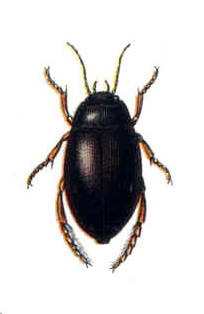
Ilybius fenestratus has no English name on record in the checklists used here. It is a species of insect in the family Dytiscidae (diving beetles), order Coleoptera. The name dates from 1781.
- Scientific name
- Ilybius fenestratus (Fabricius, 1781)
- Genus
- Ilybius
- Family
- Dytiscidae (Diving Beetles)
- Order
- Coleoptera
- Class
- Insecta
- Recorded in
- 23 countries
- Name status
- accepted in the Catalogue of Life
Overview
Ilybius fenestratus occurs throughout Europe and Northern Asia. Its scent gland is a natural source of the anabolic steroid boldenone.
Written 27 November 2026 from the sources listed below. Each statement was checked against the passage it cites; statements that could not be supported were removed.
Habitat
Ilybius fenestratus occurs throughout Europe and Northern Asia.[1]
Behaviour
Ilybius fenestratus has a semivoltine life cycle. Adults emerge in midsummer and hibernate over winter, possibly in water, until mid-June.[2][3][4]
Larvae hibernate in water until April or May. They then emerge from the water to pupate.[5][6]
The last adult individuals die in autumn.[7]
Reproduction and life cycle
Breeding takes place from mid- to late summer. Larvae hatch in late summer.[8][9]
Uses
The scent gland of Ilybius fenestratus is a natural source of the anabolic steroid boldenone.[10]
Classification of Ilybius fenestratus
| Kingdom | Animalia |
|---|---|
| Phylum | Arthropoda |
| Subphylum | Hexapoda |
| Class | Insecta (Insect) |
| Order | Coleoptera (Beetle) |
| Suborder | Adephaga |
| Family | Dytiscidae (Diving Beetles) |
| Subfamily | Agabinae |
| Tribe | Agabini |
| Genus | Ilybius |
| Species | Ilybius fenestratus (Fabricius, 1781) |
Where Ilybius fenestratus is found
Checklists and occurrence records place Ilybius fenestratus in 23 countries. GBIF holds 5,930 georeferenced records of it.
Countries
- Aland Islands 4
- Austria 45
- Belarus 5
- Belgium 75
- Denmark 551
- Estonia 43
- Finland 194
- France 82
- Germany 203
- Hungary 70
- Latvia 40
- Lithuania 48
- Luxembourg 8
- Norway 381
- Poland 220
- Russia 42
- Serbia 3
- Slovakia 4
- Sweden 379
- Switzerland 580
- The Netherlands 1,808
- Ukraine 21
- United Kingdom 1,124
Regions and cities with the most records
- England, United Kingdom 994
- Overijssel, The Netherlands 365
- Gelderland, The Netherlands 266
- Capital Region, Denmark 251
- Mijdrecht, The Netherlands 248
- Amstelveen, The Netherlands 242
- Maarssen, The Netherlands 234
- Diemen, The Netherlands 229
- Uithoorn, The Netherlands 219
- Hilversum, The Netherlands 216
- Weesp, The Netherlands 215
- Naarden, The Netherlands 214
- Baarn, The Netherlands 212
- Bussum, The Netherlands 210
- Bilthoven, The Netherlands 209
- Soest, The Netherlands 208
- Huizen, The Netherlands 194
- Vaud, Switzerland 178
- Almere Stad, The Netherlands 173
- Utrecht, The Netherlands 173
- Amsterdam, The Netherlands 169
- Zwolle, The Netherlands 160
- Karlebo, Denmark 157
- De Meern, The Netherlands 154
- Hørsholm, Denmark 153
- Allerød, Denmark 150
- Leiderdorp, The Netherlands 150
- Drenthe, The Netherlands 149
- Hillerød, Denmark 149
- Raalte, The Netherlands 148
- Birkerød, Denmark 147
- Dalfsen, The Netherlands 147
- Lillerød, Denmark 147
- Epe, The Netherlands 139
- Elburg, The Netherlands 136
- Woerden, The Netherlands 131
1 more country has a few records outside this range
These countries hold a few records of Ilybius fenestratus but lie outside the range the checklists give for it. Such records are often zoo or garden specimens, museum material or vagrants, so the species is not counted as occurring there.
Range as the checklists state it
Europe & Northern Asia (excluding China)
A number beside a place is its count of GBIF occurrence records. A place without a number comes from a checklist alone. Records show where a species has been observed or collected, which can include escapes and vagrants.
Common names
Names in 4 other languages
- Dutch
- Vensterwaterroofkever
- Estonian
- tähnik-mudaujur
- Finnish
- lampiliejusukeltaja
- Polish
- Grążak mułowy
Synonyms
One other scientific name has been used for this species and is now treated as a synonym of Ilybius fenestratus.
- Dytiscus fenestratus Fabricius, 1781
Related species
-
 Ilybius quadriguttatus
-
 Mud DwellerIlybius ater
-
 Sooty Mud DwellerIlybius fuliginosus
-
 Ilybius angustior
- Ilybius hozgargantae
-
 Ilybius montanus
-
 Ilybius subaeneus
- Ilybius discedens
Compare
Sources
Passages the profile rests on
- Ilybius fenestratus occurs throughout Europe and Northern Asia. Source passage: “Ilybius fenestratus is a species of beetle found throughout Europe and Northern Asia.” — English Wikipedia
- Ilybius fenestratus has a semivoltine life cycle. Source passage: “A study conducted in Målsjøen found the life cycle of the species to be semivoltine, with adults emerging in midsummer.” — English Wikipedia
- Adult Ilybius fenestratus emerge in midsummer. Source passage: “with adults emerging in midsummer.” — English Wikipedia
- Adults of Ilybius fenestratus hibernate over winter, possibly in water, until mid-June. Source passage: “They hibernate over the winter, possibly in the water, the hibernation lasting until mid-June.” — English Wikipedia
- Larvae of Ilybius fenestratus hibernate in water until April or May. Source passage: “The larvae hatch in late summer and hibernate, in the water, until April to May,” — English Wikipedia
- Ilybius fenestratus larvae emerge from water to pupate in April or May. Source passage: “when they emerge from the water to pupate.” — English Wikipedia
- The last adult Ilybius fenestratus individuals die in autumn. Source passage: “the last adults dying in autumn.” — English Wikipedia
- Breeding in Ilybius fenestratus takes place from mid- to late summer. Source passage: “Breeding takes place from mid- to late summer, the last adults dying in autumn.” — English Wikipedia
- Ilybius fenestratus larvae hatch in late summer. Source passage: “The larvae hatch in late summer and hibernate, in the water, until April to May, when they emerge from the water to pupate.” — English Wikipedia
- The scent gland of Ilybius fenestratus is a natural source of the anabolic steroid boldenone. Source passage: “The scent gland of this species of beetle is natural source for the anabolic steroid boldenone (Δ1-testosterone).” — English Wikipedia
Data
- Catalogue of Life, 2026-10-16 XR cc by
- Global Biodiversity Information Facility CC BY 4.0
- Wikidata CC0
- GeoNames CC BY 4.0
- Wikimedia Commons per image; credit shown with each image
- Within the Catalogue of Life, this name comes from The Integrated Taxonomic Information System cc0
References
- Nilsson, Anders N. (2001). World Catalogue of Insects, Volume 3: Dytiscidae (Coleoptera).
This species in other databases
Page built on 29 November 2026. See how the catalog is made and all sources and licences.
Cite this page
ScientificNames.org. (2026). Ilybius fenestratus. Retrieved November 29, 2026, from https://scientificnames.org/species/ilybius-fenestratus
“Ilybius fenestratus.” ScientificNames.org, 2026, scientificnames.org/species/ilybius-fenestratus. Accessed 29 Nov. 2026.
ScientificNames.org. “Ilybius fenestratus.” Accessed November 29, 2026. https://scientificnames.org/species/ilybius-fenestratus.
@misc{scientificnames_ilybius_fenestratus,
  author = {{ScientificNames.org}},
  title = {Ilybius fenestratus},
  year = {2026},
  url = {https://scientificnames.org/species/ilybius-fenestratus},
  note = {Accessed 2026-11-29}
}