Species · Insects
Iolas Blue Iolana iolas
The scientific name of the Iolas Blue is Iolana iolas. It is a species of insect in the family Lycaenidae (blues), order Lepidoptera. The name dates from 1816.
- Scientific name
- Iolana iolas (Ochsenheimer, 1816)
- Common name
- Iolas Blue
- Genus
- Iolana
- Family
- Lycaenidae (Blues)
- Order
- Lepidoptera
- Class
- Insecta
- Recorded in
- 18 countries
- Name status
- accepted in the Catalogue of Life

Overview
Iolana iolas occurs in northern Africa, southern Spain, southern France, southern Europe, Asia Minor and Iran. The male has violet-blue upper wings with a narrow black border and white fringes.
Written 27 November 2026 from the sources listed below. Each statement was checked against the passage it cites; statements that could not be supported were removed.
Appearance
The male has a wingspan of 18–21 mm. Its upper wings are violet-blue with a narrow black border and white fringes.[1][2]
The female has a broad black margin on the forewing and prominent black distal marginal spots on the hindwing.[3]
The underside is dust-grey with slight blue dusting at the base of the hindwing. It has a discal row of ocelli, a discocellular bar and two basal hindwing ocelli.[4][5]
The larva can be green, reddish or coffee-brown depending on the colour of the pod it inhabits. It has a dark dorsal line accompanied by pale-bordered blackish oblique markings.[6][7]
Habitat
Adults fly in rocky habitats at approximately 2,000 metres.[8]
The larva lives inside the pods of Colutea arborescens.[9]
Diet
The larva feeds on Colutea arborescens.[10]
Behaviour
Adults generally fly singly in localities where their food plant occurs. Adult butterflies are recorded flying in May and again in July and August.[11][12]
Larvae may occur in the pods alongside earwigs and ants.[13]
Reproduction and life cycle
The species has two irregular broods. The pupa is grey-brown with dark spots on its sides and develops in a sparse web on the ground.[14][15][16]
The pupal stage can sometimes extend into the following year.[17]
Classification of the Iolas Blue
| Kingdom | Animalia |
|---|---|
| Phylum | Arthropoda |
| Subphylum | Hexapoda |
| Class | Insecta (Insect) |
| Order | Lepidoptera |
| Superfamily | Papilionoidea |
| Family | Lycaenidae (Blues) |
| Subfamily | Polyommatinae |
| Tribe | Polyommatini |
| Genus | Iolana |
| Species | Iolana iolas (Ochsenheimer, 1816) |
Where the Iolas Blue is found
Checklists and occurrence records place Iolana iolas in 18 countries. GBIF holds 3,668 georeferenced records of it.
Countries
- Albania 29
- Austria 5
- Belarus 6
- Bulgaria 33
- Croatia 38
- France 810
- Germany 15
- Greece 41
- Hungary 54
- Italy 208
- Kosovo 5
- Montenegro 14
- North Macedonia 56
- Poland 5
- Romania 3
- Serbia 45
- Spain 634
- Switzerland 1,667
Regions and cities with the most records
- Valais, Switzerland 1,646
- Sierre, Switzerland 1,004
- Sitten, Switzerland 858
- Provence-Alpes-Côte d'Azur, France 742
- Martigny-Ville, Switzerland 642
- Monthey, Switzerland 610
- Catalonia, Spain 221
- Digne-les-Bains, France 178
- Madrid, Spain 139
- Aubagne, France 118
- Saint-Maximin-la-Sainte-Baume, France 118
- Arganda, Spain 117
- Rivas-Vaciamadrid, Spain 112
- Mejorada del Campo, Spain 94
- San Martín de la Vega, Spain 86
- Allauch, France 85
- San Fernando de Henares, Spain 82
- Torrejón de Ardoz, Spain 79
- Alcalá de Henares, Spain 78
- Coslada, Spain 74
- Aosta, Italy 73
- Aosta Valley, Italy 73
- La Ciotat, France 61
- Trentino-Alto Adige, Italy 61
- Terrassa, Spain 60
- Manresa, Spain 56
- Valdemoro, Spain 54
- Ciempozuelos, Spain 52
- Olesa de Montserrat, Spain 50
- Marseille 11, France 49
- Aranjuez, Spain 48
- Draguignan, France 48
- Valencia, Spain 48
- Aragon, Spain 46
- Brignoles, France 45
- Sanary-sur-Mer, France 44
5 more countries have a few records outside this range
These countries hold a few records of Iolana iolas but lie outside the range the checklists give for it. Such records are often zoo or garden specimens, museum material or vagrants, so the species is not counted as occurring there.
A number beside a place is its count of GBIF occurrence records. A place without a number comes from a checklist alone. Records show where a species has been observed or collected, which can include escapes and vagrants.
Common names
English
- Iolas Blue
Names in 11 other languages
- Czech
- modrásek měchýřníkový
- Dutch
- Blazenstruikblauwtje
- French
- Argus du Baguenaudier, Argus géant, Azuré du Baguenaudier (L'), Argus du Baguenaudier (L'), Argus géant (L'), Azuré du baguenaudier
- German
- Blasenstrauch-Bläuling
- Hungarian
- magyar boglárka
- Japanese
- イオラスシジミ
- Polish
- modraszek węgierski
- Slovak
- modráčik mechúrnikový
- Slovenian
- veliki mehurkar
- Spanish
- Espantalobos
- Turkish
- Anadolu Devmavisi
Synonyms
5 other scientific names have been used for this species and are now treated as synonyms of Iolana iolas.
- Glaucopsyche iolas (Ochsenheimer, 1816)
- Lycaena iolas Ochsenheimer, 1816
- Lycaena jolas Ochsenheimer, 1816
- Lycaena opulenta Schultz, 1905
- Polyommatus iolas (Ochsenheimer, 1816)
Subspecies and varieties
- Iolana iolas andreasi subspecies
- Iolana iolas arjanica subspecies
- Iolana iolas bureschi subspecies
- Iolana iolas cappadocia subspecies
- Iolana iolas christinae subspecies
- Iolana iolas debilitata (Oranian Blue) subspecies
- Iolana iolas eurysthenes subspecies
- Iolana iolas farriolsi subspecies
- Iolana iolas fidelis subspecies
- Iolana iolas khayyami subspecies
- Iolana iolas lessei subspecies
- Iolana iolas magnaiolas subspecies
- Iolana iolas obscuriolas subspecies
- Iolana iolas protogenes subspecies
- Iolana iolas saritae subspecies
- Iolana iolas thomasi subspecies
- Iolana iolas vareai subspecies
- Iolana iolas wullschlegeli subspecies
Related species
-
 Burning Bush BlueIolana alfierii
- Iolana coeli
- Iolana coelestis
-
 Common BluePolyommatus icarus
-
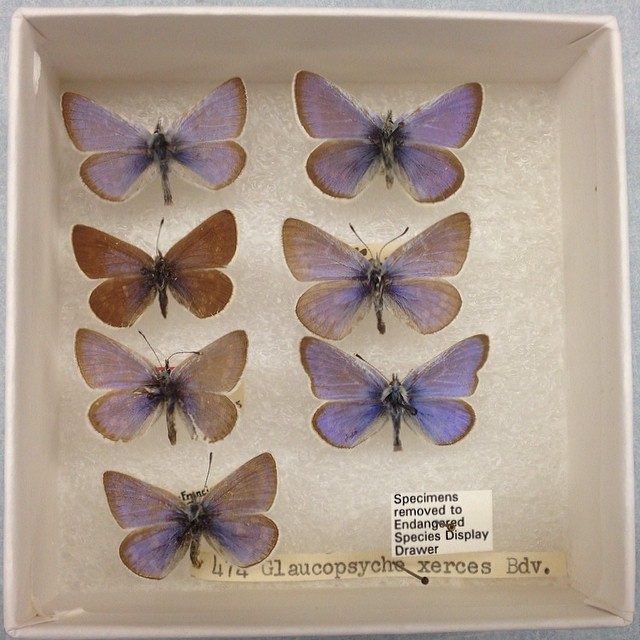 Xerces BlueGlaucopsyche xerces
-
 Adonis BlueLysandra bellargus
-
 Western Pygmy BlueBrephidium exilis
-
 AtalaEumaeus atala
Compare
Questions and answers
What is the scientific name of the Iolas Blue?
The scientific name of the Iolas Blue is Iolana iolas. Written with its author, the full name is Iolana iolas (Ochsenheimer, 1816).
Which family does the Iolas Blue belong to?
Iolana iolas belongs to the family Lycaenidae, in the order Lepidoptera and the class Insecta.
Where is the Iolas Blue found?
Checklists and occurrence records place Iolana iolas in 18 countries, including Switzerland, France, Spain, Italy, North Macedonia and Hungary.
Sources
Passages the profile rests on
- The male has a wingspan of 18–21 mm. Source passage: “The wingspan of the male is 18–21 mm (0.71–0.83 in).” — English Wikipedia
- The male has violet-blue upper wings with a narrow black border and white fringes. Source passage: “Male above a magnificent violet- blue, with narrow black border and white fringes.” — English Wikipedia
- The female has a broad black margin on the forewing and prominent black distal marginal spots on the hindwing. Source passage: “Female with broad black margin to the forewing and large black distal marginal dots to the hindwing.” — English Wikipedia
- The underside is dust-grey with slight blue dusting at the base of the hindwing. Source passage: “Under- side dust-grey, with feeble blue dusting at the base of the hindwing;” — English Wikipedia
- The underside has a discal row of ocelli, a discocellular bar and two basal hindwing ocelli. Source passage: “besides the discal row of ocelli only the discocellular bar and two basal ocelli to the hindwing are distinct.” — English Wikipedia
- The larva can be green, reddish or coffee-brown depending on the colour of the pod it inhabits. Source passage: “according to the colour of the pod green, reddish or coffee-brown” — English Wikipedia
- The larva has a dark dorsal line accompanied by pale-bordered blackish oblique markings. Source passage: “with dark dorsal line accompanied on each side by pale-bordered blackish oblique smears;” — English Wikipedia
- Adults fly in rocky habitats at approximately 2,000 metres. Source passage: “The flight period is May to June in rocky places at around 2,000 m (6,600 ft).” — English Wikipedia
- The larva lives inside the pods of Colutea arborescens. Source passage: “Larva in the pods of Colutea arborescens,” — English Wikipedia
- The larva feeds on Colutea arborescens. Source passage: “The larva feeds on Colutea arborescens.” — English Wikipedia
- Adults generally fly singly in localities where their food plant occurs. Source passage: “they fly, usually singly, in localities where the food-plant occurs.” — English Wikipedia
- Adult butterflies are recorded flying in May and again in July and August. Source passage: “The butterflies in May and again in July and August,” — English Wikipedia
- Larvae may occur in the pods alongside earwigs and ants. Source passage: “often in the pods together with earwigs and ants (Aigner).” — English Wikipedia
- The pupa is grey-brown with dark spots on its sides. Source passage: “Pupa grey-brown, with dark dots on the sides,” — English Wikipedia
- The pupa develops in a sparse web on the ground. Source passage: “in a sparse web on the ground,” — English Wikipedia
- The species has two irregular broods according to the source description. Source passage: “in two (irregular?) broods;” — English Wikipedia
- The pupal stage can sometimes extend into the following year. Source passage: “sometimes lying over into the next year.” — English Wikipedia
Data
- Catalogue of Life, 2026-10-16 XR cc by
- Global Biodiversity Information Facility CC BY 4.0
- Wikidata CC0
- GeoNames CC BY 4.0
- Wikimedia Commons per image; credit shown with each image
- Within the Catalogue of Life, this name comes from Global Lepidoptera Index cc by
References
- Ochsenheimer. (1816). Die Schmetterlinge von Europas. 4. https://www.biodiversitylibrary.org/page/34451139 Link where the name was published
This species in other databases
Page built on 27 November 2026. See how the catalog is made and all sources and licences.
Cite this page
ScientificNames.org. (2026). Iolana iolas (Iolas Blue). Retrieved November 27, 2026, from https://scientificnames.org/species/iolana-iolas
“Iolana iolas (Iolas Blue).” ScientificNames.org, 2026, scientificnames.org/species/iolana-iolas. Accessed 27 Nov. 2026.
ScientificNames.org. “Iolana iolas (Iolas Blue).” Accessed November 27, 2026. https://scientificnames.org/species/iolana-iolas.
@misc{scientificnames_iolana_iolas_iolas_blue,
  author = {{ScientificNames.org}},
  title = {Iolana iolas (Iolas Blue)},
  year = {2026},
  url = {https://scientificnames.org/species/iolana-iolas},
  note = {Accessed 2026-11-27}
}