Species · Molluscs
Hooked Mussel Ischadium recurvum
The scientific name of the Hooked Mussel is Ischadium recurvum. It is a species of mollusc in the family Mytilidae (mussels), order Mytilida. The name dates from 1820.
- Scientific name
- Ischadium recurvum (Rafinesque, 1820)
- Common name
- Hooked Mussel
- Genus
- Ischadium
- Family
- Mytilidae (Mussels)
- Order
- Mytilida
- Class
- Bivalvia
- Environment
- marine
- Recorded in
- 12 countries
- Name status
- accepted in the Catalogue of Life

Overview
Ischadium recurvum is characteristic of estuarine environments and commonly attaches to oysters, logs, pilings, and rocks, often in brackish water. It has a roughly triangular, strongly curved shell with prominent radiating ribs and a polished purplish interior.
Written 27 November 2026 from the sources listed below. Each statement was checked against the passage it cites; statements that could not be supported were removed.
Appearance
The shell is roughly triangular and strongly curved toward the beak, with prominent radiating ribs. It has a terminal beak and a hinge bearing three or four small teeth.[1][2]
The shell exterior ranges from gray or brown to dull bluish-black. The interior is polished and purplish, with a whitish margin.[3][4]
Adult individuals measure 25–50 mm in length.[5]
Habitat
The hooked mussel is characteristic of estuarine environments. Individuals commonly attach to oysters, logs, pilings, and rocks, often in brackish water.[6][7]
Individuals frequently grow on eastern oysters in intertidal or subtidal environments. They can also attach to artificial reefs and dead shells of the brackish-water clam Rangia cuneata.[8][9]
Larvae settle on hard surfaces, including oysters, wood, and rocks. Individuals tolerate water temperatures ranging from 0 to 35 °C and salinities ranging from 4.5 to 36 PSU.[10][11][12]
The species appears most successful in areas with mild winters and low salinities. Increasing salinity reduces its clearance, filtration, organic ingestion, and absorption rates.[13][14]
Diet
The hooked mussel feeds more effectively in environments with lower salinity.[15]
Behaviour
Individuals anchor themselves to their substrate using byssal threads. Larger individuals produce more byssal threads than smaller individuals.[16][17]
Individuals have higher survival in clumps than when living individually. The species primarily detects predators through chemical cues from predators or nearby dead bivalves.[18][19]
Shell strength increases with mussel length. The species develops a harder shell as a defense against predators.[20][21]
The blue crab is a principal predator of the hooked mussel.[22]
Reproduction and life cycle
The hooked mussel has separate sexes. Individuals reach sexual maturity at approximately one year of age.[23][24]
Females brood eggs while males release sperm into the water column. Fertilized eggs develop into planktotrophic shelled veligers while being brooded.[25][26]
Conservation
Declines in eastern oyster populations in Chesapeake Bay have been accompanied by declines in hooked mussel populations. Increased sedimentation following oyster population declines can bury substrates available to the mussels.[27][28]
Classification of the Hooked Mussel
| Kingdom | Animalia |
|---|---|
| Phylum | Mollusca |
| Class | Bivalvia |
| Subclass | Autobranchia |
| Infraclass | Pteriomorphia |
| Order | Mytilida |
| Superfamily | Mytiloidea |
| Family | Mytilidae (Mussels) |
| Subfamily | Brachidontinae |
| Genus | Ischadium |
| Species | Ischadium recurvum (Rafinesque, 1820) |
Where the Hooked Mussel is found
Checklists and occurrence records place Ischadium recurvum in 12 countries. GBIF holds 2,017 georeferenced records of it.
Countries
- Bahamas 4
- Belgium 18
- Belize 4
- Cuba 4
- Dominican Republic 8
- Guadeloupe 7
- Guatemala 3
- Jamaica 4
- Mexico 60
- Puerto Rico 4
- The Netherlands 92
- United States 1,809
Regions and cities with the most records
- Maryland, United States 211
- Louisiana, United States 163
- Florida, United States 148
- Texas, United States 85
- Assendelft, The Netherlands 81
- Haarlem, The Netherlands 81
- Hoofddorp, The Netherlands 81
- Krommenie, The Netherlands 81
- Velserbroek, The Netherlands 81
- Zaandam, The Netherlands 81
- Zaanstad, The Netherlands 81
- Beverwijk, The Netherlands 80
- Velsen-Noord, The Netherlands 80
- Annapolis, United States 79
- Heemstede, The Netherlands 79
- Badhoevedorp, The Netherlands 76
- Heemskerk, The Netherlands 76
- Arnold, United States 73
- IJmuiden, The Netherlands 73
- Parole, United States 72
- Castricum, The Netherlands 69
- Virginia, United States 60
- Amsterdam, The Netherlands 58
- Zandvoort, The Netherlands 49
- Amstelveen, The Netherlands 48
- Diemen, The Netherlands 47
- Heiloo, The Netherlands 43
- Lake Shore, United States 37
- Purmerend, The Netherlands 37
- Severna Park, United States 37
- Pasadena, United States 35
- Green Haven, United States 34
- La Marque, United States 32
- Volendam, The Netherlands 32
- Texas City, United States 29
- Cutler Bay, United States 27
3 more countries have a few records outside this range
These countries hold a few records of Ischadium recurvum but lie outside the range the checklists give for it. Such records are often zoo or garden specimens, museum material or vagrants, so the species is not counted as occurring there.
A number beside a place is its count of GBIF occurrence records. A place without a number comes from a checklist alone. Records show where a species has been observed or collected, which can include escapes and vagrants.
Common names
English
- Hooked Mussel
Names in 1 other language
- Dutch
- Gebogen traliemossel
Synonyms
6 other scientific names have been used for this species and are now treated as synonyms of Ischadium recurvum.
- Brachidontes recurvus (Rafinesque, 1820)
- Brachydontes recurvus (Rafinesque, 1820)
- Mytilus carolinensis Conrad, 1837
- Mytilus hamatus Say, 1822
- Mytilus recurvus Rafinesque, 1820
- Mytilus striatus Barnes, 1823 ambiguous synonym
Related species
-
 Blue MusselMytilus edulis
-
 New Zealand Green-lipped MusselPerna canaliculus
-
 Asian Green MusselPerna viridis
-
 Mediterranean MusselMytilus galloprovincialis
-
 California MusselMytilus californianus
-
 Date MusselLithophaga lithophaga
-
 Northern Blue MusselMytilus trossulus
-
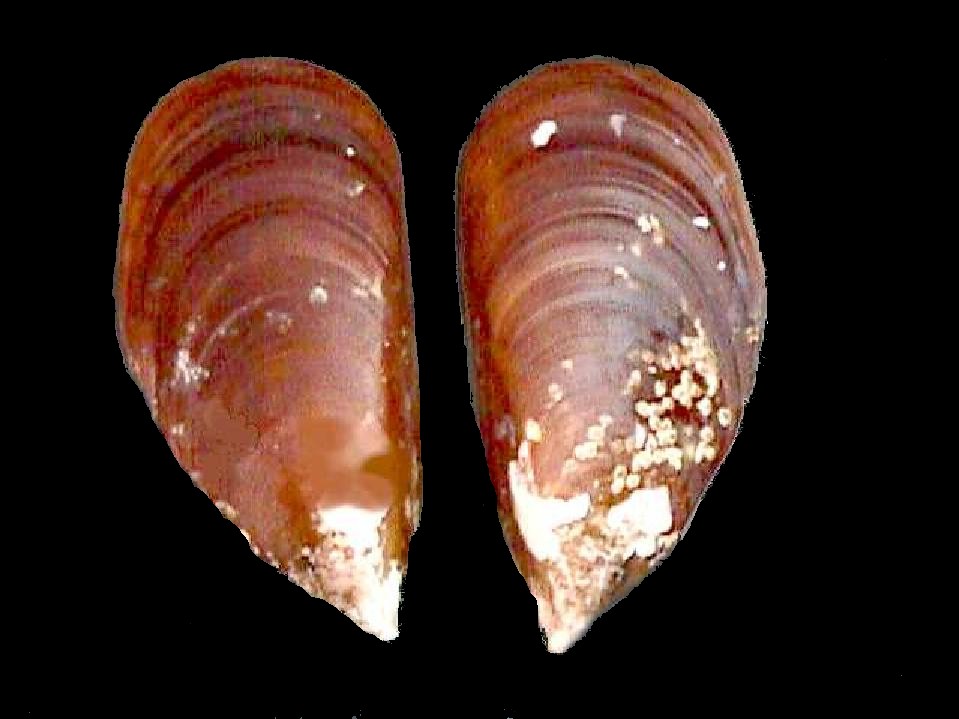 Brown MusselPerna perna
Compare
Questions and answers
What is the scientific name of the Hooked Mussel?
The scientific name of the Hooked Mussel is Ischadium recurvum. Written with its author, the full name is Ischadium recurvum (Rafinesque, 1820).
Which family does the Hooked Mussel belong to?
Ischadium recurvum belongs to the family Mytilidae, in the order Mytilida and the class Bivalvia.
Where is the Hooked Mussel found?
Checklists and occurrence records place Ischadium recurvum in 12 countries, including United States, The Netherlands, Mexico, Belgium, Dominican Republic and Guadeloupe.
Sources
Passages the profile rests on
- The shell is roughly triangular and strongly curved toward the beak, with prominent radiating ribs. Source passage: “Ischadium recurvum is roughly triangular in shape, and strongly curved toward the beak, with strong radiating ribs.” — invasions.si.edu
- The shell has a terminal beak and a hinge bearing three or four small teeth. Source passage: “The beak is terminal, and the hinge has 3 or 4 small teeth.” — invasions.si.edu
- The shell exterior ranges from gray or brown to dull bluish-black. Source passage: “The exterior color of the shell is gray or brown, to dull bluish-black.” — invasions.si.edu
- The shell interior is polished and purplish, with a whitish margin. Source passage: “The interior is polished and purplish, with a whitish margin.” — invasions.si.edu
- Adult individuals measure 25–50 mm in length. Source passage: “Adult mussels are 25-50 mm in length.” — invasions.si.edu
- The species is characteristic of estuarine environments. Source passage: “This species is characteristic of estuaries” — invasions.si.edu
- Individuals commonly attach to oysters, logs, pilings, and rocks, often in brackish water. Source passage: “usually found attached to oysters, logs, pilings, or rocks, often in brackish water” — invasions.si.edu
- Individuals frequently grow on eastern oysters in intertidal or subtidal environments. Source passage: “They are often found growing on eastern oysters, either intertidally (south of the Chesapeake Bay, where exposed oysters can survive the winter) or subtidally.” — English Wikipedia
- The species can attach to artificial reefs and dead shells of the brackish-water clam Rangia cuneata. Source passage: “They also attach to other hard substrates, including artificial reefs and dead shells of the brackish water clam Rangia cuneata.” — English Wikipedia
- Larvae settle on hard surfaces including oysters, wood, and rocks. Source passage: “Larvae settle on a variety of hard substrates, including oysters, wood, and rocks” — invasions.si.edu
- The species tolerates water temperatures ranging from 0 to 35 °C. Source passage: “with water temperatures of 0 to 35?C” — invasions.si.edu
- The species tolerates salinities ranging from 4.5 to 36 PSU. Source passage: “salinities of 4.5-36 PSU” — invasions.si.edu
- The species appears most successful in areas with mild winters and low salinities. Source passage: “they appear to be most successful in regions with mild winters and low salinities” — invasions.si.edu
- Increasing salinity reduces the species' clearance, filtration, organic ingestion, and absorption rates. Source passage: “As salinity increases, the mussel's rates of clearance, filtration, organic ingestion, and absorption decrease.” — English Wikipedia
- The species feeds more effectively in environments with lower salinity. Source passage: “Ischadium recurvum prefers to feed in environments with lower salinity.” — English Wikipedia
- Individuals anchor themselves to their substrate using byssal threads. Source passage: “Mussels also defend themselves by producing byssal threads, which anchor them to their substrate.” — English Wikipedia
- Larger individuals produce more byssal threads than smaller individuals. Source passage: “Because larger mussels produce a greater number of byssal threads” — English Wikipedia
- The species primarily detects predators through chemical cues from predators or nearby dead bivalves. Source passage: “Ischadium detects predators primarily through scent—either that of the predator itself or of nearby dead bivalves.” — English Wikipedia
- Individuals have higher survival in clumps than when living individually. Source passage: “These mussels tend to survive better in clumps rather than as individuals” — English Wikipedia
- Shell strength increases with the length of the mussel. Source passage: “Shell strength—the amount of force required to crack the shell—increases with the mussel's length.” — English Wikipedia
- The species develops a harder shell as a defense against predators. Source passage: “To protect itself, Ischadium builds its defenses by creating a harder shell.” — English Wikipedia
- The blue crab is a principal predator of the hooked mussel. Source passage: “The primary predators of hooked mussels include the blue crab (Callinectes sapidus).” — English Wikipedia
- The species has separate sexes. Source passage: “Ischadium recurvum has separate sexes.” — invasions.si.edu
- Individuals reach sexual maturity at approximately one year of age. Source passage: “Animals mature at about one year of age.” — invasions.si.edu
- Females brood eggs while males release sperm into the water column. Source passage: “Eggs are brooded, but sperm are released into the water column.” — invasions.si.edu
- Fertilized eggs develop into planktotrophic shelled veligers while being brooded. Source passage: “Fertilized eggs are brooded and develop into planktotrophic shelled veligers” — invasions.si.edu
- Declines in eastern oyster populations in Chesapeake Bay have been accompanied by declines in hooked mussel populations. Source passage: “there has been a corresponding loss in the hooked mussel population.” — English Wikipedia
- Increased sedimentation following oyster population declines can bury substrates available to the mussels. Source passage: “the decline in oyster populations leads to increased sedimentation rates, which bury available substrates.” — English Wikipedia
Data
- Catalogue of Life, 2026-10-16 XR cc by
- Global Biodiversity Information Facility CC BY 4.0
- Wikidata CC0
- GeoNames CC BY 4.0
- Wikimedia Commons per image; credit shown with each image
- Within the Catalogue of Life, this name comes from World Register of Marine Species cc by
This species in other databases
Page built on 28 November 2026. See how the catalog is made and all sources and licences.
Cite this page
ScientificNames.org. (2026). Ischadium recurvum (Hooked Mussel). Retrieved November 28, 2026, from https://scientificnames.org/species/ischadium-recurvum
“Ischadium recurvum (Hooked Mussel).” ScientificNames.org, 2026, scientificnames.org/species/ischadium-recurvum. Accessed 28 Nov. 2026.
ScientificNames.org. “Ischadium recurvum (Hooked Mussel).” Accessed November 28, 2026. https://scientificnames.org/species/ischadium-recurvum.
@misc{scientificnames_ischadium_recurvum_hooked_mussel,
  author = {{ScientificNames.org}},
  title = {Ischadium recurvum (Hooked Mussel)},
  year = {2026},
  url = {https://scientificnames.org/species/ischadium-recurvum},
  note = {Accessed 2026-11-28}
}