Species · Fishes
Cookiecutter Shark Isistius brasiliensis
The scientific name of the Cookiecutter Shark is Isistius brasiliensis. It is a species of fish in the family Dalatiidae (kitefin sharks), order Squaliformes. The name dates from 1824.
- Scientific name
- Isistius brasiliensis (Quoy & Gaimard, 1824)
- Common name
- Cookiecutter Shark
- Genus
- Isistius
- Family
- Dalatiidae (Kitefin Sharks)
- Order
- Squaliformes
- Class
- Elasmobranchii
- Red List category
- LC Least Concern
- Environment
- marine
- Recorded in
- 35 countries
- Name status
- accepted in the Catalogue of Life
Overview
Isistius brasiliensis inhabits tropical and warm-temperate oceanic waters across the world's major ocean basins. It has photophores on its underside that produce a vivid green glow.
Written 24 November 2026 from the sources listed below. Each statement was checked against the passage it cites; statements that could not be supported were removed.
Appearance
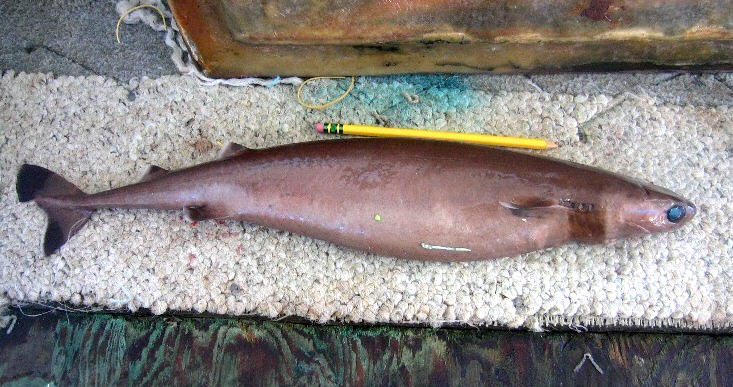
The Cookie cutter shark has an elongated, cylindrical body resembling a cigar, with a short, rounded snout. Its dorsal surface is chocolate brown, its underside is lighter, and a dark collar surrounds its gill region.[1][2]
Photophores on its underside produce a vivid green glow, except within the dark collar. The glow can persist for three hours after the shark is removed from water.[3][4]
Its eyes are large, oval, green, and positioned toward the front of its head. It has two dorsal fins without spines, both positioned toward the rear of its body, and lacks an anal fin.[5][6][7]
Its upper jaw contains 30–37 teeth, while its lower jaw contains 25–31 teeth. The lower teeth are broad, knife-like, and interconnected at their bases to form a continuous cutting edge.[8][9]
Its dermal denticles are flattened and approximately square, with a central depression and raised corners.[10]
Males reach a maximum recorded total length of 42 cm, while females reach 56 cm. Newborn individuals measure approximately 14–15 cm in length.[11][12]
Habitat
The Cookie cutter shark inhabits tropical and warm-temperate oceanic waters across the world's major ocean basins. It is most common in surface waters with temperatures between 18 and 26 °C and is frequently encountered near islands.[13][14][15]
During daylight hours, it generally occupies depths between 1 and 3.7 km. At night, it generally rises into the upper water column but usually remains below 85 m.[16][17]
Diet
The Cookie cutter shark feeds on tissue removed from larger marine animals, including fishes, sharks, cephalopods, and marine mammals. Commonly recorded large prey include marlin, wahoo, tuna, sharks, and stingrays.[18][19]
Other documented prey include whole squid measuring 15–30 cm in mantle length, bristlemouths, and copepods. Small micronektonic and forage species are the most important prey group across the studied body-size range of 17–43 cm.[20][21][22]
Large epipelagic prey constitute a relatively minor component of its overall diet. Larger mesopelagic species and species undertaking daily vertical migrations are also important prey.[23][24]
Behaviour
The Cookie cutter shark undertakes daily vertical migrations of up to 3 km, approaching the surface at dusk and descending around dawn. It spends much of its time hovering in the water column as an ambush predator.[25][26]
Individuals have been observed travelling in schools.[27]
Its lower teeth are shed in complete rows rather than individually. The shark swallows its discarded teeth, allowing it to recycle their calcium.[28][29]
Reproduction and life cycle
The Cookie cutter shark is aplacental viviparous, with embryos receiving nourishment from yolk before birth. Females have two functional uteri and give birth to litters containing 6–12 pups.[30][31][32]
Males reach sexual maturity at approximately 36 cm in length, while females reach sexual maturity at approximately 39 cm.[33][34]
Conservation
The Cookie cutter shark is classified as Least Concern by the International Union for Conservation of Nature. Its wide distribution is identified as one reason for this conservation assessment.[35][36]
Uses
The Cookie cutter shark has no commercial importance because of its small size and deep-water habitat.[37]
Similar species
Isistius plutodus is a similar species but has fewer and larger teeth and lacks the dark collar and dark caudal-fin tips.[38]
Classification of the Cookiecutter Shark
| Kingdom | Animalia |
|---|---|
| Phylum | Chordata |
| Subphylum | Vertebrata |
| Infraphylum | Gnathostomata |
| Parvphylum | Chondrichthyes |
| Class | Elasmobranchii |
| Subclass | Neoselachii |
| Infraclass | Selachii |
| Superorder | Squalomorphi |
| Order | Squaliformes |
| Family | Dalatiidae (Kitefin Sharks) |
| Genus | Isistius (Cookie-cuter Sharks) |
| Species | Isistius brasiliensis (Quoy & Gaimard, 1824) |
Where the Cookiecutter Shark is found
Checklists and occurrence records place Isistius brasiliensis in 35 countries. GBIF holds 481 georeferenced records of it.
Countries
- Angola 7
- Australia 66
- Bahamas 6
- Benin 4
- Cabo Verde 18
- Cameroon 16
- China 4
- Cook Islands 3
- Cuba 4
- Democratic Republic of the Congo 3
- Equatorial Guinea 7
- French Polynesia 12
- Gabon 22
- Ghana 26
- Guinea 11
- Guinea-Bissau 7
- Indonesia 3
- Ivory Coast 25
- Japan 21
- Kiribati 4
- Liberia 16
- Mexico 16
- New Caledonia 9
- Nigeria 41
- Norfolk Island 3
- Palau 3
- Papua New Guinea 12
- Philippines 5
- Republic of the Congo 3
- Reunion 3
- Saint Helena 3
- Sierra Leone 15
- Taiwan 5
- Togo 4
- United States 74
Regions and cities with the most records
- California, United States 29
- Oregon, United States 9
- Salinas, United States 6
- Watsonville, United States 6
- Daly City, United States 5
- South San Francisco, United States 5
- Amanfrom, Ghana 4
- Buchanan, Liberia 4
- Buduburam, Ghana 4
- Cape Coast, Ghana 4
- Godomè, Benin 4
- Hubei, China 4
- Kasoa, Ghana 4
- Lekki, Nigeria 4
- Monrovia, Liberia 4
- Ogooué-Maritime, Gabon 4
- Ouidah, Benin 4
- Santa Cruz, United States 4
- Sekondi, Ghana 4
- Sekondi-Takoradi, Ghana 4
- Taiwan, Taiwan 4
- Takoradi, Ghana 4
- Abidjan, Ivory Coast 3
- Bata, Equatorial Guinea 3
- Bellevue, United States 3
- Kirkland, United States 3
- Koumassi, Ivory Coast 3
- Marcory, Ivory Coast 3
- Port-Gentil, Gabon 3
- San-Pédro, Ivory Coast 3
- Seattle, United States 3
- Shoreline, United States 3
3 more countries have a few records outside this range
These countries hold a few records of Isistius brasiliensis but lie outside the range the checklists give for it. Such records are often zoo or garden specimens, museum material or vagrants, so the species is not counted as occurring there.
A number beside a place is its count of GBIF occurrence records. A place without a number comes from a checklist alone. Records show where a species has been observed or collected, which can include escapes and vagrants.
Common names
English
- Cookiecutter Shark
- Cigar Shark
- Cookie Cutter Shark
- Luminous Shark
- Pigmy Shark
- Smalltooth Cookiecutter Shark
- Smooth Cookiecutter Shark
- South China Cookiecutter Shark
- Cookie-cutter Shark
Names in 16 other languages
- Catalan
- Tauró cigar
- Chinese
- 巴西達摩鯊, 沙魚, 雪茄達摩鯊, 雪茄鮫
- Czech
- žraloček brazilský
- Dutch
- Koekjessnijder
- Finnish
- Brasilianvalohai, leikkurihai
- French
- squalelet féroce
- German
- Zigarrenhai
- Hungarian
- világítócápa
- Indonesian
- Hiu pemotong
- Italian
- Squalo tagliatore
- Japanese
- ダルマザメ
- Polish
- Rekin foremkowy
- Portuguese
- Cação-charuto, Tubarão-charuto
- Russian
- Бразильская светящаяся акула
- Spanish
- Tiburón cortador de galletas, tiburón cigarro, tollo cigarro
- Swedish
- Cigarrhaj
Synonyms
15 other scientific names have been used for this species and are now treated as synonyms of Isistius brasiliensis.
- Inistius brasiliensis (Quoy & Gaimard, 1824)
- Isistius labialis Meng, Zhu & Li, 1985
- Leius ferox Kner, 1864
- Scymnus brasiliensis Quoy & Gaimard, 1824
- Scymnus brasiliensis (Quoy & Gaimard, 1824) Cuvier, in Quoy & Gaimard, 1824
- Scymnus brasiliensis torquatus Müller & Henle, 1839
- Scymnus brasiliensis unicolor Müller & Henle, 1839
- Scymnus brasiliensis var. torquatus Müller & Henle, 1839
- Scymnus brasiliensis var. torquatus Valenciennes, 1839
- Scymnus brasiliensis var. unicolor Müller & Henle, 1839
- Scymnus torquatus Müller & Henle, 1839
- Scymnus unicolor Müller & Henle, 1839
- Scymnus unicolor var. brasiliensis Valenciennes, 1839
- Squalus fulgens Bennett, 1840
- Tristius brasiliensis (Quoy & Gaimard, 1824)
Related species
- Largetooth Cookiecutter SharkIsistius plutodus
-
 American Pocket SharkMollisquama mississippiensis
-
 Kitefin SharkDalatias licha
- Pocket SharkMollisquama parini
-
 Taillight SharkEuprotomicroides zantedeschia
-
 Pygmy SharkEuprotomicrus bispinatus
-
 Spined Pygmy SharkSqualiolus laticaudus
- Smalleye Pygmy SharkSqualiolus aliae
Compare
Questions and answers
What is the scientific name of the Cookiecutter Shark?
The scientific name of the Cookiecutter Shark is Isistius brasiliensis. Written with its author, the full name is Isistius brasiliensis (Quoy & Gaimard, 1824).
Which family does the Cookiecutter Shark belong to?
Isistius brasiliensis belongs to the family Dalatiidae, in the order Squaliformes and the class Elasmobranchii.
Where is the Cookiecutter Shark found?
Checklists and occurrence records place Isistius brasiliensis in 35 countries, including United States, Australia, Nigeria, Ghana, Ivory Coast and Gabon.
What is the conservation status of the Cookiecutter Shark?
The IUCN Red List category recorded for Isistius brasiliensis is Least Concern (LC).
What other names does the Cookiecutter Shark have?
Isistius brasiliensis is also known in English as Cigar Shark, Cookie Cutter Shark, Luminous Shark, Pigmy Shark, Smalltooth Cookiecutter Shark and Smooth Cookiecutter Shark.
Do cookie cutter sharks still exist?
The Cookie cutter shark is classified as Least Concern by the International Union for Conservation of Nature.[35]
What do cookiecutter sharks eat?
They feed on tissue removed from larger marine animals, including fishes, sharks, cephalopods, and marine mammals. Their prey also include bristlemouths, copepods, squid, and small micronektonic and forage species.[18][20][21][22]
What is shark's main diet?
Small micronektonic and forage species are the most important prey group across the studied body-size range of 17–43 cm.[22]
Sources
Passages the profile rests on
- The species has an elongated, cylindrical body resembling a cigar, with a short, rounded snout. Source passage: “The cookiecutter shark has an elongated, cigar-shaped body with a short, bulbously rounded snout.” — English Wikipedia
- Its dorsal surface is chocolate brown, its underside is lighter, and a dark collar surrounds its gill region. Source passage: “The cookiecutter shark is chocolate brown in color, becoming subtly lighter below, and a dark "collar" wraps around the gill region.” — English Wikipedia
- Its underside contains photophores that produce a vivid green glow, except within the dark collar. Source passage: “Complex, light-producing organs called photophores densely cover the entire underside, except for the collar, and produce a vivid green glow.” — English Wikipedia
- Its photophores produce green light that can persist for three hours after the shark is removed from water. Source passage: “The intrinsic green luminescence of the cookiecutter shark is the strongest known of any shark, and has been reported to persist for three hours after it has been taken out of water.” — English Wikipedia
- Its eyes are large, oval, green, and positioned toward the front of its head. Source passage: “The large, oval, green eyes are placed forward on the head, though not so that binocular vision is extensive.” — English Wikipedia
- The species has two dorsal fins without spines, with both positioned toward the rear of its body. Source passage: “Two spineless dorsal fins are placed far back on the body” — English Wikipedia
- The species lacks an anal fin. Source passage: “The anal fin is absent.” — English Wikipedia
- Its upper jaw contains 30–37 teeth, while its lower jaw contains 25–31 teeth. Source passage: “The upper jaw has 30–37 teeth, and the lower jaw has 25–31, increasing with body size.” — English Wikipedia
- Its lower teeth are broad, knife-like, and interconnected at their bases to form a continuous cutting edge. Source passage: “The lower teeth are also smooth-edged, but much larger, broader, and knife-like, with their bases interlocking to form a single saw-like cutting edge.” — English Wikipedia
- Its dermal denticles are flattened and approximately square, with a central depression and raised corners. Source passage: “The denticles are roughly square-shaped with a depression in the middle and raised points at the corners” — floridamuseum.ufl.edu
- Males reach a maximum recorded total length of 42 cm, while females reach 56 cm. Source passage: “The maximum recorded length for this species is 42 cm (17 in) for males and 56 cm (22 in) for females.” — English Wikipedia
- Newborn individuals measure approximately 14–15 cm in length. Source passage: “Newborn cookiecutter sharks are 14–15 cm (5.5–5.9 in) long.” — English Wikipedia
- The species inhabits tropical and warm-temperate oceanic waters across the world's major ocean basins. Source passage: “Inhabiting all of the world's major tropical and warm-temperate oceanic basins” — English Wikipedia
- It is most common in surface waters with temperatures between 18 and 26 °C. Source passage: “where the surface water temperature is 18–26 °C (64–79 °F).” — English Wikipedia
- The species is frequently encountered near islands. Source passage: “It is frequently found near islands” — English Wikipedia
- During daylight hours, the species generally occupies depths between 1 and 3.7 km. Source passage: “It spends the day at a depth of 1–3.7 km (0.62–2.30 mi)” — English Wikipedia
- At night, it generally rises into the upper water column but usually remains below 85 m. Source passage: “and at night it rises into the upper water column, usually remaining below 85 m (279 ft)” — English Wikipedia
- The species feeds on tissue removed from larger marine animals, including fishes, sharks, cephalopods, and marine mammals. Source passage: “known for removing plugs of tissue from larger prey, including teleosts, chondrichthyans, cephalopods, and marine mammals.” — pmc.ncbi.nlm.nih.gov
- Commonly recorded large prey include marlin, wahoo, tuna, sharks, and stingrays. Source passage: “Common prey items include large fishes such as marlin, wahoo, dolphin, tuna, sharks, and stingrays” — floridamuseum.ufl.edu
- Whole squid measuring 15–30 cm in mantle length are among its prey. Source passage: “The cookiecutter shark also regularly hunts and eats entire squid with a mantle length of 15–30 cm (5.9–11.8 in)” — English Wikipedia
- Other documented prey include bristlemouths and copepods. Source passage: “as well as bristlemouths, copepods, and other smaller prey.” — English Wikipedia
- Small micronektonic and forage species are the most important prey group across the studied body-size range of 17–43 cm. Source passage: “small micronektonic and forage species (meso- and epipelagic) are the most important prey group for Cookiecutter sharks across the studied size range (17–43 cm total length)” — pmc.ncbi.nlm.nih.gov
- Large epipelagic prey constitute a relatively minor component of the species' overall diet. Source passage: “large epipelagic prey constituted a relatively minor part of the overall diet.” — pmc.ncbi.nlm.nih.gov
- Larger mesopelagic species and species undertaking daily vertical migrations are also important prey. Source passage: “with larger mesopelagic species or species that exhibit diel vertical migration also being important prey.” — pmc.ncbi.nlm.nih.gov
- The species undertakes daily vertical migrations of up to 3 km, approaching the surface at dusk and descending around dawn. Source passage: “It migrates vertically up to 3 km (1.9 mi) every day, approaching the surface at dusk and descending with the dawn.” — English Wikipedia
- The species spends much of its time hovering in the water column as an ambush predator. Source passage: “With small fins and weak muscles, this ambush predator spends much of its time hovering in the water column.” — English Wikipedia
- Individuals have been observed travelling in schools. Source passage: “This species has been known to travel in schools.” — English Wikipedia
- Its lower teeth are shed in complete rows rather than individually. Source passage: “The cookiecutter shark regularly replaces its teeth like other sharks, but sheds its lower teeth in entire rows rather than one at a time.” — English Wikipedia
- The species swallows its discarded teeth, allowing it to recycle their calcium. Source passage: “The shark swallows its old sets of teeth, enabling it to recycle the calcium content.” — English Wikipedia
- The species is aplacental viviparous, with embryos receiving nourishment from yolk before birth. Source passage: “Like other dogfish sharks, the cookiecutter shark is aplacental viviparous, with the developing embryos being sustained by yolk until birth.” — English Wikipedia
- Females have two functional uteri. Source passage: “Females have two functional uteri” — English Wikipedia
- Females give birth to litters containing 6–12 pups. Source passage: “and give birth to litters of 6 to 12 pups.” — English Wikipedia
- Males reach sexual maturity at approximately 36 cm in length. Source passage: “Males attain sexual maturity at a length of 36 cm (14 in)” — English Wikipedia
- Females reach sexual maturity at approximately 39 cm in length. Source passage: “and females at a length of 39 cm (15 in).” — English Wikipedia
- The species is classified as Least Concern by the International Union for Conservation of Nature. Source passage: “The International Union for Conservation of Nature has listed the cookiecutter shark under least concern” — English Wikipedia
- Its wide distribution is identified as one reason for its Least Concern conservation assessment. Source passage: “as it is widely distributed, has no commercial value, and is not particularly susceptible to fisheries.” — English Wikipedia
- The species has no commercial importance because of its small size and deep-water habitat. Source passage: “Due to their small size and deepwater habitat, they are of no commercial importance (Stevens. 2003).” — floridamuseum.ufl.edu
- Isistius plutodus is a similar species but has fewer and larger teeth and lacks the dark collar and dark caudal-fin tips. Source passage: “I. plutodus has fewer and larger teeth and lacks the dark-colored collar as well as the dark tips on the caudal fin.” — floridamuseum.ufl.edu
Data
- Catalogue of Life, 2026-10-16 XR cc by
- Global Biodiversity Information Facility CC BY 4.0
- Wikidata CC0
- GeoNames CC BY 4.0
- Wikimedia Commons per image; credit shown with each image
- iNaturalist per image; credit shown with each image
- Within the Catalogue of Life, this name comes from World Register of Marine Species cc by
References
- Quoy, J. R. C. & Gaimard, J. P. (1824) Description des Poissons. Chapter IX. In: de Freycinet, L., Voyage autour du Monde ... execute sur les corvettes de L. M. " L'Uranie " et " La Physicienne, " pendant les annees 1817, 1818, 1819 et 1820. Paris. Description des Poissons. Chapter IX, 1824, pp. 1 - 328. where the name was published
This species in other databases
- Catalogue of Life 3Q78H
- Wikidata Q199372
- iNaturalist 103503
- WoRMS urn:lsid:marinespecies.org:taxname:215612
- ITIS 160683
Page built on 24 November 2026. See how the catalog is made and all sources and licences.
Cite this page
ScientificNames.org. (2026). Isistius brasiliensis (Cookiecutter Shark). Retrieved November 24, 2026, from https://scientificnames.org/species/isistius-brasiliensis
“Isistius brasiliensis (Cookiecutter Shark).” ScientificNames.org, 2026, scientificnames.org/species/isistius-brasiliensis. Accessed 24 Nov. 2026.
ScientificNames.org. “Isistius brasiliensis (Cookiecutter Shark).” Accessed November 24, 2026. https://scientificnames.org/species/isistius-brasiliensis.
@misc{scientificnames_isistius_brasiliensis_cookiecutter_shark,
  author = {{ScientificNames.org}},
  title = {Isistius brasiliensis (Cookiecutter Shark)},
  year = {2026},
  url = {https://scientificnames.org/species/isistius-brasiliensis},
  note = {Accessed 2026-11-24}
}