Species · Fishes
Black Marlin Istiompax indica
The scientific name of the Black Marlin is Istiompax indica. It is a species of fish in the family Istiophoridae (marlin), order Carangiformes. The name dates from 1832.
- Scientific name
- Istiompax indica (Cuvier, 1832)
- Common name
- Black Marlin
- Genus
- Istiompax
- Family
- Istiophoridae (Marlin)
- Order
- Carangiformes
- Class
- Teleostei
- Red List category
- DD Data Deficient
- Environment
- marine
- Recorded in
- 39 countries
- Name status
- accepted in the Catalogue of Life

Overview
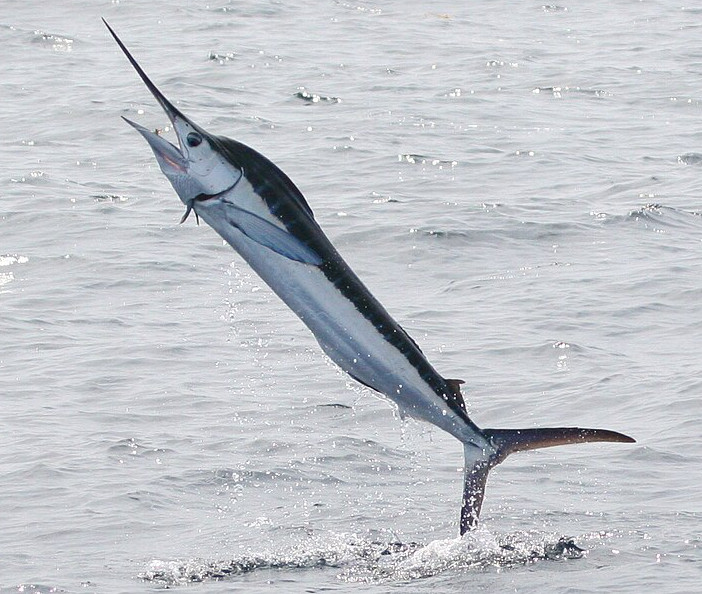
Istiompax indica occurs in tropical and subtropical regions of the Indian and Pacific Oceans, approximately between 40°N and 45°S. It has a dark blue-black dorsal surface, an extremely chrome-colored underside and rigid pectoral fins that cannot be pressed flat against its sides.
Written 26 November 2026 from the sources listed below. Each statement was checked against the passage it cites; statements that could not be supported were removed.
Habitat
Black Marlins occur in water temperatures ranging from 15°C to 30°C and from the sea surface to depths of approximately 500 m. They occasionally move into more temperate waters.[1][2][3]
Juvenile Black Marlins around Australia use the Great Barrier Reef lagoon as a development and growth habitat. Young fish form seasonal aggregations within the lagoon.[4][5]
Diet
Black Marlins feed primarily on fish and cephalopods. Recorded prey includes tuna, mackerel, snake mackerel, flying fish, squid, crustaceans and octopus.[6][7]
Mackerel scad has been identified as their preferred prey. Young sharks have also been found in the stomachs of some Black Marlins.[8][9]
Behaviour
Black Marlins swallow their prey head first. They are believed to use their bills to slash prey while hunting within schools of fish.[10][11]
Black Marlins spend more time near the sea surface than most other billfish, except sailfish. In one studied population, they spent up to 87% of nighttime at depths shallower than 30 m and less than 60% of daytime in the upper 30 m.[12][13][14]
Black Marlins can drag fishing boats over long distances after being hooked.[15]
Reproduction and life cycle
Black Marlins spawn around southern Asia during May and June. Around Taiwan, spawning occurs during March and April and again from August through October.[16][17]
Around Australia, spawning occurs between October and December. Spawning has also been recorded around northern Australia from August to November.[18][19]
Black Marlins are believed to prefer water temperatures of approximately 27–28°C for spawning. A ripe female can produce approximately 40 million eggs.[20][21]
Conservation
The conservation status of the Black Marlin is described as unknown. Its population size and health cannot be accurately determined because of its migratory behaviour and limited research.[22][23]
Uses
Black Marlins are commercially fished and are highly prized as game fish. They are commonly targeted by fisheries along the coasts of South America, Southern Asia and Australia.[24][25]
Black Marlins are popular targets for recreational big-game fishing.[26]
Similar species
Black Marlins resemble blue marlins but have more ventrally oriented pectoral fins and lack the faint light-blue vertical stripes found on blue marlins. They can be distinguished from striped marlins by the absence of prominent vertical white stripes.[27][28]
White Marlins have defined white stripes that distinguish them from Black Marlins.[29]
Appearance
Its pectoral fins are rigid and cannot be pressed flat against its sides, particularly in specimens weighing around 68 kg or more. Its dorsal surface is dark blue-black and its underside is extremely chrome-colored, often separated by a yellowish chrome stripe.[30][31]
The second dorsal fin is positioned anterior to the second anal fin at every body size. Juveniles have lighter coloration and shorter bills than adults.[32][33]
The maximum published length is 4.65 m. Females can exceed 700 kg, and the maximum reported weight is 750 kg, with possible estimates reaching 900 kg.[34][35][36]
Females generally become larger than males after approximately five years of age.[37]
Classification of the Black Marlin
| Kingdom | Animalia |
|---|---|
| Phylum | Chordata |
| Subphylum | Vertebrata |
| Infraphylum | Gnathostomata |
| Parvphylum | Osteichthyes |
| Gigaclass | Actinopterygii |
| Superclass | Actinopteri |
| Class | Teleostei (Teleost) |
| Order | Carangiformes |
| Family | Istiophoridae (Marlin) |
| Genus | Istiompax (Black Marlin) |
| Species | Istiompax indica (Cuvier, 1832) |
Where the Black Marlin is found
Checklists and occurrence records place Istiompax indica in 39 countries. GBIF holds 1,246 georeferenced records of it.
Countries
- Australia 518
- British Indian Ocean Territory 5
- Chile 360
- China 21
- Colombia 7
- Denmark 4
- Ecuador 4
- Faroe Islands 21
- France 3
- French Polynesia 3
- Germany 10
- Iceland 5
- India 5
- Indonesia 23
- Italy 4
- Ivory Coast 7
- Japan 7
- Liberia 3
- Mauritania 4
- Mauritius 13
- Mayotte 7
- Mozambique 17
- Myanmar 3
- New Caledonia 4
- New Zealand 22
- Norway 11
- Oman 5
- Philippines 9
- Reunion 4
- Seychelles 25
- South Africa 21
- Spain 3
- Svalbard and Jan Mayen 18
- Sweden 4
- Taiwan 8
- Tanzania 4
- The Netherlands 4
- United Kingdom 45
- Vanuatu 5
Regions and cities with the most records
- New South Wales, Australia 21
- Denguélé District, Ivory Coast 7
- Scottburgh, South Africa 7
- eMkhomazi, South Africa 7
- eMuziwezinto, South Africa 7
- Bavaria, Germany 6
- Queensland, Australia 6
- Zambezia Province, Mozambique 6
- England, United Kingdom 5
- Inhambane, Mozambique 5
- Western Cape, South Africa 5
- Scotland, United Kingdom 4
- Tiris Zemmour, Mauritania 4
- Dzaoudzi, Mayotte 3
- Kaouéni, Mayotte 3
- Koungou, Mayotte 3
- Labattoir, Mayotte 3
- Mamoudzou, Mayotte 3
- New Plymouth, New Zealand 3
- Ouangani, Mayotte 3
- Selong, Indonesia 3
- Taranaki Region, New Zealand 3
4 more countries have a few records outside this range
These countries hold a few records of Istiompax indica but lie outside the range the checklists give for it. Such records are often zoo or garden specimens, museum material or vagrants, so the species is not counted as occurring there.
A number beside a place is its count of GBIF occurrence records. A place without a number comes from a checklist alone. Records show where a species has been observed or collected, which can include escapes and vagrants.
Common names
English
- Black Marlin
- D'ombrain's Marlin [sic]
- Pacific Black Marlin
- Silver Marlin
- Southern Marlin
Names in 13 other languages
- Afrikaans
- Swartmarlyn
- Arabic
- مرلين أسود
- Danish
- Sort marlin
- Dutch
- Marlijn
- French
- Makaire noir, Marlin Noir
- Italian
- Marlin indopacifico, Marlin nero
- Japanese
- Kurokawa, Shirokajiki, シロカジキ
- Korean
- 흑새치
- Portuguese
- Espadim-negro
- Russian
- Чёрный марлин
- Spanish
- Aguja Negra, Picudo Negro, marlin negro
- Thai
- ปลากระโทงดำ
- Turkish
- Siyah Marlin
Synonyms
29 other scientific names have been used for this species and are now treated as synonyms of Istiompax indica.
- Histiophorus brevirostris Playfair, 1867
- Istiomax indicus (Cuvier, 1832)
- Istiompax australis Whitley, 1931
- Istiompax brevirostris (Playfair, 1867)
- Istiompax dombraini Whitley, 1954
- Istiompax indicus (Cuvier, 1832)
- Istiompax marlina (Jordan & Hill, 1926)
- Maikaira indica (Cuvier, 1832)
- Makaira ampla marlina Jordan & Hill, 1926
- Makaira ampla tahitiensis Nichols & LaMonte, 1935
- Makaira australis (MacLeay, 1854)
- Makaira brevirostris (Playfair, 1867)
- Makaira indica (Cuvier, 1832)
- Makaira indicus (Cuvier, 1832)
- Makaira malina Jordan & Hill, 1926
- Makaira marhina Jordan & Hill, 1926
- Makaira marlina Jordan & Hill, 1926
- Makaira marlina marlina Jordan & Hill, 1926
- Makaira marlina tahitiensis Nichols & LaMonte, 1935
- Makaira mazara tahitiensis Nichols & LaMonte, 1935
- Makaira nigricans marlina Jordan & Hill, 1926
- Makaira nigricans tahitiensis Nichols & La Monte, 1935
- Makaira xantholineata Deraniyagala, 1956
- Malina malina (Jordan & Hill, 1926)
- Marlina marlina (Jordan & Hill, 1926)
- Tetrapterus australis MacLeay, 1854
- Tetrapturus australis MacLeay, 1854
- Tetrapturus brevirostris (Playfair, 1867)
- Tetrapturus indicus Cuvier, 1832
Subspecies and varieties
- Istiompax indica glauca subspecies
Related species
-
 Atlantic Blue MarlinMakaira nigricans
-
 Indo-Pacific SailfishIstiophorus platypterus
-
 Striped MarlinKajikia audax
-
 Atlantic SailfishIstiophorus albicans
-
 White MarlinKajikia albida
-
 Indo-Pacific Blue MarlinMakaira mazara
-
 Shortbill SpearfishTetrapturus angustirostris
-
 Mediterranean SpearfishTetrapturus belone
Compare
Questions and answers
What is the scientific name of the Black Marlin?
The scientific name of the Black Marlin is Istiompax indica. Written with its author, the full name is Istiompax indica (Cuvier, 1832).
Which family does the Black Marlin belong to?
Istiompax indica belongs to the family Istiophoridae, in the order Carangiformes and the class Teleostei.
Where is the Black Marlin found?
Checklists and occurrence records place Istiompax indica in 39 countries, including Australia, Chile, United Kingdom, Seychelles, Indonesia and New Zealand.
What is the conservation status of the Black Marlin?
The IUCN Red List category recorded for Istiompax indica is Data Deficient (DD).
What other names does the Black Marlin have?
Istiompax indica is also known in English as D'ombrain's Marlin [sic], Pacific Black Marlin, Silver Marlin and Southern Marlin.
What is the world's biggest black marlin?
The maximum reported weight is 750 kg, with possible estimates reaching 900 kg. The maximum published length is 4.65 m.[34][36]
What does black marlin eat?
Black Marlins feed primarily on fish and cephalopods. Recorded prey includes tuna, mackerel, snake mackerel, flying fish, squid, crustaceans and octopus.[6][7]
What is a marlins habitat?
Black Marlins occur in tropical and subtropical regions of the Indian and Pacific Oceans, approximately between 40°N and 45°S. They inhabit waters from the sea surface to depths of approximately 500 m and have been recorded in temperatures ranging from 15°C to 30°C.[38][2][3]
Sources
Passages the profile rests on
- The species occasionally moves into more temperate waters. Source passage: “while in some instances venturing into more temperate waters.” — English Wikipedia
- Black marlins have been recorded in water temperatures ranging from 15°C to 30°C. Source passage: “Black Marlin live in temperatures from 15 degrees Celsius to 30 degrees Celsius.” — English Wikipedia
- Black marlins occur from the sea surface to depths of approximately 500 m. Source passage: “They are found anywhere from surface level down to depths of approximately 500 meters.” — English Wikipedia
- Juvenile black marlins around Australia use the Great Barrier Reef lagoon as a development and growth habitat. Source passage: “Juvenile black marlin around Australia utilize the great barrier reef lagoon as an area to grow and develop due to an abundance of resources.” — English Wikipedia
- Young black marlins form seasonal aggregations within the Great Barrier Reef lagoon. Source passage: “During the younger life stages, black marlin will form seasonal aggregations (aggregation: temporary assemblage of individuals) throughout the great barrier reef lagoon.” — English Wikipedia
- The black marlin feeds primarily on fish and cephalopods. Source passage: “Diet mostly consists of various fish and cephalopods.” — English Wikipedia
- Recorded prey of the black marlin includes tuna, mackerel, snake mackerel, flying fish, squid, crustaceans and octopus. Source passage: “They may eat tuna, mackerel, snake mackerel, flying fish, squid, crustaceans, octopus, etc” — English Wikipedia
- Mackerel scad has been identified as the preferred prey of black marlins. Source passage: “but mackerel scad have been found to be the preferred prey of black marlin.” — English Wikipedia
- Young sharks have been found in the stomachs of some black marlins. Source passage: “Scientists have even found young sharks in the stomachs of some black marlin.” — English Wikipedia
- Black marlins swallow their prey head first. Source passage: “When black marlin hunt prey they swallow the prey head first.” — English Wikipedia
- Black marlins are believed to use their bills to slash prey while hunting within schools of fish. Source passage: “Because of this, it is believed that these fish utilize their bills when hunting within a school of fish.” — English Wikipedia
- Black marlins spend more time near the sea surface than most other billfish, except sailfish. Source passage: “Black marlins spend more time closer to the surface than most other billfish, except for sailfish.” — English Wikipedia
- In one studied population, black marlins spent up to 87% of nighttime at depths shallower than 30 m. Source passage: “at night the fish would spend up to 87% of their time at depths above 30 meters deep” — English Wikipedia
- In one studied population, black marlins spent less than 60% of daytime in the upper 30 m of the sea. Source passage: “but during the day less than 60% of their time was spent in the upper 30 meter depths of the sea.” — English Wikipedia
- Black marlins can drag fishing boats over long distances after being hooked. Source passage: “Black marlins were known to drag ancient Maldivian fishing boats for very long distances after being hooked” — English Wikipedia
- Black marlins spawn around southern Asia during May and June. Source passage: “Spawning around southern Asia has been observed in May and June” — English Wikipedia
- Black marlins spawn around Taiwan during March and April and again from August through October. Source passage: “around Taiwan from March through April as well as from August to October” — English Wikipedia
- Black marlins spawn around Australia between October and December. Source passage: “and around Australia between October and December.” — English Wikipedia
- Spawning has also been recorded around northern Australia from August to November. Source passage: “Spawning has also been noted from August to November around northern Australia.” — English Wikipedia
- Black marlins are believed to prefer water temperatures of approximately 27–28°C for spawning. Source passage: “Black marlin are believed to prefer water temperatures around 27° to 28°C during spawning.” — English Wikipedia
- A ripe female black marlin can produce approximately 40 million eggs. Source passage: “Egg counts of ripe roe totaled about 40 million per female.” — English Wikipedia
- The conservation status of the black marlin is described as unknown in the document. Source passage: “The conservation status of the black marlin is unknown.” — English Wikipedia
- The population size and health of black marlins cannot be accurately determined because of their migratory behaviour and limited research. Source passage: “Due to the migratory nature of these fish and a lack of research, the population size and health cannot be accurately stated.” — English Wikipedia
- Black marlins are commercially fished and are highly prized as game fish. Source passage: “Black marlin are fished commercially and are also a highly prized game fish.” — English Wikipedia
- Black marlins are commonly targeted by fisheries along the coasts of South America, Southern Asia and Australia. Source passage: “They are commonly fished along the coasts of South America, Southern Asia, and Australia.” — English Wikipedia
- Black marlins are popular targets for recreational big-game fishing. Source passage: “Black marlin are a very popular big game fish.” — English Wikipedia
- Black marlins resemble blue marlins, but have more ventrally oriented pectoral fins and lack the faint light-blue vertical stripes found on blue marlins. Source passage: “The blue marlin looks very similar to the black marlin, but its pectoral fins are angled more laterally, whereas the black marlin's fins face more ventrally; black marlins are also larger and do not have the faint light blue vertical stripes that are visible on blue marlins.” — English Wikipedia
- Black marlins can be distinguished from striped marlins by the absence of prominent vertical white stripes. Source passage: “a distinct difference between the two is the highly prominent vertical white lines on the striped marlin, which the black marlin lacks.” — English Wikipedia
- White marlins have defined white stripes that distinguish them from black marlins. Source passage: “White marlins also have defined white stripes that distinguish them from black marlins.” — English Wikipedia
- The black marlin has rigid pectoral fins that cannot be pressed flat against its sides, particularly in specimens weighing around 68 kg or more. Source passage: “their rigid pectoral fins, which, especially from a weight of around 68 kg (150 lb), are unable to be pressed flat against their sides” — English Wikipedia
- The black marlin has a dark blue-black dorsal surface and an extremely chrome-colored underside, often separated by a yellowish chrome stripe. Source passage: “The black marlin showcases an extremely chrome underside and a dark blue-black dorsal side, the two colored layers are often separated by a yellow-ish chrome stripe.” — English Wikipedia
- The second dorsal fin of the black marlin is positioned anterior to its second anal fin at every body size. Source passage: “The black marlin is the only istiophorid in which the second dorsal fin is anterior to the second anal fin, this feature holds for all sizes.” — English Wikipedia
- Juvenile black marlins have lighter coloration and shorter bills than adults. Source passage: “Juveniles are similar in most features except their coloration is lighter, bills are shorter and they are physically smaller.” — English Wikipedia
- The maximum published length of the black marlin is 4.65 m. Source passage: “The maximum published length is 4.65 m (15 ft 3 in)” — English Wikipedia
- Female black marlins can exceed 700 kg in weight. Source passage: “females capable of exceeding 700 kg (1,500 lb).” — English Wikipedia
- The maximum reported weight of the black marlin is 750 kg, with possible estimates reaching 900 kg. Source passage: “The maximum weight is 750 kg (1,650 lb), possibly up to 900 kg (2,000 lb).” — English Wikipedia
- Females generally become larger than males after approximately five years of age. Source passage: “Females tend to be larger than males after about age 5” — English Wikipedia
- The black marlin occurs in tropical and subtropical regions of the Indian and Pacific Oceans, approximately between 40°N and 45°S. Source passage: “The black marlin (Istiompax indica) is a species of marlin found in tropical and subtropical areas of the Indian and Pacific Oceans approximately between 40 degrees North and 45 degrees South” — English Wikipedia
Data
- Catalogue of Life, 2026-10-16 XR cc by
- Global Biodiversity Information Facility CC BY 4.0
- Wikidata CC0
- GeoNames CC BY 4.0
- Wikimedia Commons per image; credit shown with each image
- Within the Catalogue of Life, this name comes from World Register of Marine Species cc by
References
- Cuvier, Georges in Cuvier, Georges & A. Valenciennes. 1832. [Original taxonomic description(s)]. . where the name was published
This species in other databases
- Catalogue of Life 3QDBS
- Wikidata Q998315
- iNaturalist 187569
- WoRMS urn:lsid:marinespecies.org:taxname:712905
- ITIS 768125
Page built on 28 November 2026. See how the catalog is made and all sources and licences.
Cite this page
ScientificNames.org. (2026). Istiompax indica (Black Marlin). Retrieved November 28, 2026, from https://scientificnames.org/species/istiompax-indica
“Istiompax indica (Black Marlin).” ScientificNames.org, 2026, scientificnames.org/species/istiompax-indica. Accessed 28 Nov. 2026.
ScientificNames.org. “Istiompax indica (Black Marlin).” Accessed November 28, 2026. https://scientificnames.org/species/istiompax-indica.
@misc{scientificnames_istiompax_indica_black_marlin,
  author = {{ScientificNames.org}},
  title = {Istiompax indica (Black Marlin)},
  year = {2026},
  url = {https://scientificnames.org/species/istiompax-indica},
  note = {Accessed 2026-11-28}
}