Species · Fishes
Skipjack Tuna Katsuwonus pelamis
The scientific name of the Skipjack Tuna is Katsuwonus pelamis. It is a species of fish in the family Scombridae (albacores), order Scombriformes. The name dates from 1758.
- Scientific name
- Katsuwonus pelamis (Linnaeus, 1758)
- Common name
- Skipjack Tuna
- Genus
- Katsuwonus
- Family
- Scombridae (Albacores)
- Order
- Scombriformes
- Class
- Teleostei
- Red List category
- LC Least Concern
- Environment
- marine
- Recorded in
- 71 countries
- Name status
- accepted in the Catalogue of Life
Overview
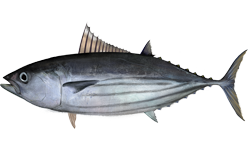
Katsuwonus pelamis inhabits tropical and warm-temperate marine waters and occurs throughout tropical and subtropical waters. It has a streamlined body, a dark purplish-blue back, silvery sides and no swim bladder.
Written 26 November 2026 from the sources listed below. Each statement was checked against the passage it cites; statements that could not be supported were removed.
Appearance
The Skipjack Tuna has a streamlined body adapted for fast swimming. It lacks scales except along its lateral line and has a thick band of scales around its body behind the head, called a corselet.[1][2][3]
Its back is dark purplish-blue and its sides are silvery. The species lacks a swim bladder.[4][5]
The species commonly reaches fork lengths of up to 80 cm and weighs between 8 and 10 kg. Its maximum recorded fork length is 108 cm, and its maximum recorded mass is 34.5 kg.[6][7][8][9]
The species can grow to approximately 1.1 m in total length.[10]
Habitat
The Skipjack Tuna inhabits tropical and warm-temperate marine waters and occupies surface waters. It occurs throughout tropical and subtropical waters.[11][12][13]
Adult individuals generally migrate alongside sea-surface isotherms of approximately 15 °C. The reported thermal range associated with adult migration extends from 14.7 to 30 °C.[14][15]
During daylight, the species generally occupies depths from the surface to 260 m. At night, it is predominantly restricted to the surface mixed layer.[16][17]
The species has seasonal abundance in waters surrounding Taiwan. The western and central Pacific Ocean is a major fishing ground for Skipjack Tuna.[18][19]
Diet
The Skipjack Tuna feeds on fish, crustaceans, cephalopods and mollusks. Juveniles in the tropical western Pacific consume fish larvae, cephalopods and pelagic crustaceans.[20][21]
Cephalopods and crustaceans were important prey in the study's time-integrated dietary estimates. Larger individuals are more piscivorous in the Central Pacific.[22][23]
Behaviour
The Skipjack Tuna forms large shoals that can contain up to 50,000 individuals. It sometimes forms shoals together with other members of the Scombridae family.[24][25]
The species must continue swimming to maintain buoyancy. Vertical movements in immature individuals off eastern Taiwan are considered likely to be associated with foraging.[26][27]
Reproduction and life cycle
The Skipjack Tuna reproduces through batch spawning. Spawning occurs throughout the year in equatorial waters and becomes more seasonal farther from the equator.[28][29][30]
The fork length at first spawning is approximately 45 cm.[31]
Conservation
The species is considered sustainable under its current level of consumption. Some authorities consider purse-seine fishing unsustainable because of excessive bycatch.[32][33]
Uses
The Skipjack Tuna is commercially harvested and used as a game fish. It is sold fresh, frozen, canned, dried, salted and smoked.[34][35]
The species is commonly used as live bait when fishing for marlin. It is also eaten raw in Japanese sushi and sashimi.[36][37]
The species is smoked and dried to produce katsuobushi. It is also an ingredient in the Hawaiian dishes sashimi and poke.[38][39]
Classification of the Skipjack Tuna
| Kingdom | Animalia |
|---|---|
| Phylum | Chordata |
| Subphylum | Vertebrata |
| Infraphylum | Gnathostomata |
| Parvphylum | Osteichthyes |
| Gigaclass | Actinopterygii |
| Superclass | Actinopteri |
| Class | Teleostei (Teleost) |
| Order | Scombriformes |
| Suborder | Scombroidei |
| Family | Scombridae (Albacores) |
| Subfamily | Scombrinae |
| Genus | Katsuwonus (Skipjack Tunas) |
| Species | Katsuwonus pelamis (Linnaeus, 1758) |
Where the Skipjack Tuna is found
Checklists and occurrence records place Katsuwonus pelamis in 71 countries. GBIF holds 25,687 georeferenced records of it.
Countries
- Algeria 4
- Angola 50
- Australia 568
- Bahamas 19
- Barbados 4
- Belize 16
- Benin 5
- British Virgin Islands 4
- Cabo Verde 18
- Cameroon 16
- Canada 10
- Cayman Islands 12
- Chile 468
- Comoros 92
- Costa Rica 9
- Cuba 37
- Democratic Republic of the Congo 3
- Denmark 5
- Dominican Republic 7
- Egypt 3
- Equatorial Guinea 75
- Faroe Islands 159
- Finland 5
- France 70
- Gabon 209
- Gambia 3
- Germany 63
- Ghana 141
- Greenland 16
- Guadeloupe 7
- Guinea 62
- Guinea-Bissau 37
- Haiti 4
- Honduras 11
- Iceland 20
- Ireland 36
- Italy 4
- Ivory Coast 131
- Kenya 16
- Liberia 181
- Madagascar 64
- Martinique 5
- Mauritania 240
- Mauritius 21
- Mayotte 150
- Mexico 383
- Mozambique 66
- Nigeria 54
- Norway 65
- Portugal 15,746
- Puerto Rico 9
- Republic of the Congo 23
- Reunion 6
- Saint Barthelemy 3
- Sao Tome and Principe 70
- Senegal 123
- Seychelles 1,329
- Sierra Leone 110
- Solomon Islands 362
- Somalia 48
- South Africa 50
- Spain 1,229
- Svalbard and Jan Mayen 24
- Sweden 8
- Tanzania 57
- The Netherlands 71
- Togo 5
- U.S. Virgin Islands 11
- United Kingdom 240
- United States 2,496
- Western Sahara 19
Regions and cities with the most records
- Temotu Province, Solomon Islands 360
- Ponta Delgada, Portugal 242
- Azores, Portugal 101
- Bono East, Ghana 60
- England, United Kingdom 51
- New South Wales, Australia 46
- Lower Saxony, Germany 32
- Wexford, Ireland 22
- Lingen, Germany 15
- Meppen, Germany 15
- Overijssel, The Netherlands 14
- Delfzijl, The Netherlands 13
- Emden, Germany 13
- Groningen, The Netherlands 13
- Scottburgh, South Africa 13
- Winschoten, The Netherlands 13
- Miami Beach, United States 12
- Aurich, Germany 11
- Denia, Spain 11
- Drenthe, The Netherlands 11
- Bavaria, Germany 10
- Carlsbad, United States 9
- Javea, Spain 9
- Miami, United States 9
- Port Shepstone, South Africa 9
- eMkhomazi, South Africa 9
- eMuziwezinto, South Africa 9
- Barrow in Furness, United Kingdom 8
- Bishops Stortford, United Kingdom 8
- Blackpool, United Kingdom 8
- California, United States 8
- Chake Chake, Tanzania 8
- East Dereham, United Kingdom 8
- Encinitas, United States 8
- Fleetwood, United Kingdom 8
- Florida, United States 8
35 more countries have a few records outside this range
These countries hold a few records of Katsuwonus pelamis but lie outside the range the checklists give for it. Such records are often zoo or garden specimens, museum material or vagrants, so the species is not counted as occurring there.
- Brazil 58
- British Indian Ocean Territory 238
- China 12
- Colombia 17
- Ecuador 48
- Fiji 5
- French Guiana 5
- French Polynesia 79
- French Southern Territories 61
- Guam 3
- Guyana 5
- India 29
- Indonesia 251
- Japan 123
- Kiribati 4
- Malaysia 9
- Maldives 9
- New Caledonia 7
- New Zealand 16
- Papua New Guinea 5
- Peru 7
- Philippines 72
- Saudi Arabia 4
- Singapore 4
- South Korea 8
- Sri Lanka 24
- Taiwan 29
- Tonga 3
- Turkey 5
- United Arab Emirates 3
- United States Minor Outlying Islands 5
- Venezuela 5
- Vietnam 5
- Wallis and Futuna 4
- Yemen 16
A number beside a place is its count of GBIF occurrence records. A place without a number comes from a checklist alone. Records show where a species has been observed or collected, which can include escapes and vagrants.
Common names
English
- Skipjack Tuna
- Aku
- Arctic Bonito
- Oceanic Skipjack
- Skipper
- Stripe-bellied Tunny
- Stripebellied Bonito
- Striped Bonito
- Stripey
- Stripy
- Watermelon Tuna
- Mushmouth
- Oceanic Bonito
- Skipjack
- Striped Tuna
- Victor Fish
Names in 47 other languages
- Arabic
- Af Muss, Boussenna, Dabub, Ghzel, Hargheiba, L'bakoura, Sacheto, Sheikh
- Asturian
- futbolista
- Basque
- lanpo sabelmarradun
- Catalan
- Bonítol de ventre ratllat, bonítol ratllat
- Chinese
- 小串, 柴魚, 正鰹, 煙仔, 煙仔虎, 肥煙, 鰹, 鲣
- Czech
- tuňák pruhovaný
- Danish
- Bugstribet bonit, bugstribet bonnit
- Dutch
- Echte bonito, gestreepte tonijn, tonijn
- Esperanto
- Vera bonito
- Fijian
- Yatu
- Finnish
- boniitti
- French
- Bonite a ventre raye, Bonite folle, Bonite ventre rayé, Bonitou, Bounicou, Ton Rayé, bonite à ventre rayé, listao
- Galician
- atún listado
- German
- Gestreifter thunfisch, Thunfisch, Thunfischwurst, Thunfish, bauchstreifiger Bonito, echter Bonito
- Greek
- Pelamide, Pelamit, Rigina, Tonina, Tónnos Macrypteros, Ρίκι
- Hebrew
- אטונס שחור קווים
- Hungarian
- Csíkoshasú tonhal
- Indonesian
- cakalang
- Italian
- Culurita, Impiriali, Nzimburu, Paamia, Paamie, Palaja steddara, Palametiedde, Palamida
- Japanese
- Katsuo, Nagakoban, Namaribushi, Tsuna Hamu, カツオ
- Korean
- 가다랑어
- Malayalam
- Choora
- Maltese
- Palamidu, Pelamis, Pizzutu, Plamtu bla rigi
- Mandarin Chinese
- 柴鱼
- Norwegian
- Bukstripet bonitt, stripet pelamide
- Papiamento
- Buní karèt, Buní porko
- Persian
- هوور مسقطی
- Polish
- Bonite
- Portuguese
- Atum-bonito, Barriga-listada, Bonito de barriga listada, Bonito de ventre rayado, Bonito rajado, Bonito-barriga-listada, Bonito-de-barriga listada, Bonito-de-barriga-listada
- Russian
- Malayj Tunets-bonito, Okamasu, Policanto, Polosatyi Tunets, Skios, Полосатый тунец, скипджек
- Sinhala
- බලයා
- Slovenian
- Črtasti tun
- Spanish
- Atun Listado, Atún, Atún de Altura, Barrilete, Bonita, Bonito Oceánico, Bonito de Altura, Bonito de Veintre Rayado
- Swahili
- Jodari
- Swedish
- bonit
- Tagalog
- Tambakol, Tulingan
- Thai
- ปลาทูน่าท้องแถบ, ปลาโอแถบ
- Turkish
- Yazılı orkinos, cizgili tonito, Çizgili Orkinos, Çizgiliorkinoz baliği, Çizgiliton baliği
- Ukrainian
- Тунець смугастий
- Vietnamese
- Cá ngừ vằn
- Welsh
- Marlin, Marlinod
- ban
- Cekalan
- bug
- Cikaleng
- div
- ކަޅުބިލަ މަސް
- nau
- Eae
- sus
- Makréni
- tah
- Auhopu
Synonyms
22 other scientific names have been used for this species and are now treated as synonyms of Katsuwonus pelamis.
- Euthynnus pelamis (Linnaeus, 1758)
- Euthynnus pelamys (Linnaeus, 1758)
- Gymnosarda pelamis (Linnaeus, 1758)
- Gymnosarda pelamys (Linnaeus, 1758)
- Katsowonus pelamis (Linnaeus, 1758)
- Katsuwinus pelamis (Linnaeus, 1758)
- Katsuwonis pelamis (Linnaeus, 1758)
- Katsuwonnus pelamis (Linnaeus, 1758)
- Katsuwonus pelamsi (Linnaeus, 1758)
- Katsuwonus pelamys (Linnaeus, 1758)
- Katsuwonus vagans (Lesson, 1829)
- Katuswonis pelamis (Linnaeus, 1758)
- Orcynus pelamis (Linnaeus, 1758)
- Orcynus pelamys (Linnaeus, 1758)
- Scomber pelamides Lacepède, 1801
- Scomber pelamis Linnaeus, 1758
- Scomber pelamys Linnaeus, 1758
- Thinnus pelamis (Linnaeus, 1758)
- Thunnus pelamys (Linnaeus, 1758)
- Thynnus pelamis (Linnaeus, 1758)
- Thynnus pelamys (Linnaeus, 1758)
- Thynnus vagans Lesson, 1829
Related species
-
 Atlantic Bluefin TunaThunnus thynnus
-
 WahooAcanthocybium solandri
-
 Yellowfin TunaThunnus albacares
-
 AlbacoreThunnus alalunga
-
 King MackerelScomberomorus cavalla
-
 Atlantic MackerelScomber scombrus
-
 Pacific Bluefin TunaThunnus orientalis
-
 Indian MackerelRastrelliger kanagurta
Compare
Questions and answers
What is the scientific name of the Skipjack Tuna?
The scientific name of the Skipjack Tuna is Katsuwonus pelamis. Written with its author, the full name is Katsuwonus pelamis (Linnaeus, 1758).
Which family does the Skipjack Tuna belong to?
Katsuwonus pelamis belongs to the family Scombridae, in the order Scombriformes and the class Teleostei.
Where is the Skipjack Tuna found?
Checklists and occurrence records place Katsuwonus pelamis in 71 countries, including Portugal, United States, Seychelles, Spain, Australia and Chile.
What is the conservation status of the Skipjack Tuna?
The IUCN Red List category recorded for Katsuwonus pelamis is Least Concern (LC).
What other names does the Skipjack Tuna have?
Katsuwonus pelamis is also known in English as Aku, Arctic Bonito, Oceanic Skipjack, Skipper, Stripe-bellied Tunny and Stripebellied Bonito.
Sources
Passages the profile rests on
- The skipjack tuna has a streamlined body adapted for fast swimming. Source passage: “It is a streamlined, fast-swimming pelagic fish” — English Wikipedia
- The species lacks scales except along its lateral line. Source passage: “It has no scales, except on the lateral line” — English Wikipedia
- The species has a thick band of scales around its body behind the head called a corselet. Source passage: “forming a large, thick band called a "corselet".” — English Wikipedia
- The species lacks a swim bladder. Source passage: “Like other tuna, it lacks a swim bladder” — English Wikipedia
- The species has a dark purplish-blue back and silvery sides. Source passage: “dark purplish-blue back, silvery.” — fisheries.noaa.gov
- The species commonly reaches fork lengths of up to 80 cm. Source passage: “It commonly reaches fork lengths up to 80 cm (2 ft 7 in)” — English Wikipedia
- The species commonly weighs between 8 and 10 kg. Source passage: “a mass of 8–10 kg (18–22 lb).” — English Wikipedia
- The maximum recorded fork length given for the species is 108 cm. Source passage: “Its maximum fork length is 108 cm (3 ft 7 in)” — English Wikipedia
- The maximum recorded mass given for the species is 34.5 kg. Source passage: “its maximum mass is 34.5 kg (76 lb).” — English Wikipedia
- The species can grow to approximately 1.1 m in total length. Source passage: “Skipjack tuna can grow up to 1.1 m (3 ft 7 in) in length” — English Wikipedia
- The species inhabits tropical and warm-temperate marine waters. Source passage: “found in tropical and warm-temperate waters.” — English Wikipedia
- The species occupies surface waters. Source passage: “where it inhabits surface waters in large shoals” — English Wikipedia
- The species occurs throughout tropical and subtropical waters. Source passage: “distributed throughout tropical and subtropical waters” — pmc.ncbi.nlm.nih.gov
- Adult individuals generally migrate alongside sea-surface isotherms of approximately 15 °C. Source passage: “Adult skipjack generally migrate with the sea surface isotherm of ~15 °C” — pmc.ncbi.nlm.nih.gov
- The reported thermal range associated with adult migration extends from 14.7 to 30 °C. Source passage: “though this ranges from 14.7 to 30 °C.” — pmc.ncbi.nlm.nih.gov
- The species generally occupies depths from the surface to 260 m during daylight. Source passage: “Skipjack depth use generally ranges from the sea surface to 260 m during the day” — pmc.ncbi.nlm.nih.gov
- The species is predominantly restricted to the surface mixed layer at night. Source passage: “and is predominantly constrained to the surface mixed layer at night.” — pmc.ncbi.nlm.nih.gov
- The species has seasonal abundance in waters surrounding Taiwan. Source passage: “with seasonal abundance in waters off Taiwan.” — pmc.ncbi.nlm.nih.gov
- The western and central Pacific Ocean is a major fishing ground for skipjack tuna. Source passage: “The western and central Pacific Ocean (WCPO) is the main fishing ground for tuna purse-seine fisheries” — pmc.ncbi.nlm.nih.gov
- The species feeds on fish, crustaceans, cephalopods and mollusks. Source passage: “feeding on fish, crustaceans, cephalopods, and mollusks.” — English Wikipedia
- Juvenile skipjack tuna in the tropical western Pacific consume fish larvae, cephalopods and pelagic crustaceans. Source passage: “dietary importance of fish larvae, cephalopods, and pelagic crustaceans” — pmc.ncbi.nlm.nih.gov
- Cephalopods and crustaceans were important prey in the study's time-integrated dietary estimates. Source passage: “indicated the importance of cephalopods and crustaceans as prey” — pmc.ncbi.nlm.nih.gov
- Larger individuals are more piscivorous in the Central Pacific. Source passage: “Larger skipjack are more piscivorous in the Central Pacific” — pmc.ncbi.nlm.nih.gov
- The species forms large shoals that can contain up to 50,000 individuals. Source passage: “in large shoals (up to 50,000 fish” — English Wikipedia
- The species sometimes forms shoals together with other members of the Scombridae family. Source passage: “often in combination with other scombridaes” — English Wikipedia
- The species must continue swimming to maintain buoyancy. Source passage: “must keep swimming to stay buoyant.” — English Wikipedia
- Vertical movements in immature individuals off eastern Taiwan are considered likely to be associated with foraging. Source passage: “with vertical use of the water column most likely linked to foraging” — pmc.ncbi.nlm.nih.gov
- The species reproduces through batch spawning. Source passage: “Skipjack tuna are batch spawners.” — English Wikipedia
- Spawning occurs throughout the year in equatorial waters. Source passage: “Spawning occurs year-round in equatorial waters” — English Wikipedia
- Spawning becomes more seasonal farther from the equator. Source passage: “but it gets more seasonal further away from the equator.” — English Wikipedia
- The fork length at first spawning is approximately 45 cm. Source passage: “Fork length at first spawning is about 45 cm (18 in).” — English Wikipedia
- The species is considered sustainable under its current level of consumption. Source passage: “its population is considered sustainable against its current consumption.” — English Wikipedia
- Some authorities consider purse-seine fishing unsustainable because of excessive bycatch. Source passage: “Purse seine methods are considered unsustainable by some authorities due to excess bycatch” — English Wikipedia
- The species is commercially harvested and used as a game fish. Source passage: “It is an important commercial and game fish” — English Wikipedia
- The species is sold fresh, frozen, canned, dried, salted and smoked. Source passage: “and is sold fresh, frozen, canned, dried, salted, and smoked.” — English Wikipedia
- The species is commonly used as live bait when fishing for marlin. Source passage: “is often used as live bait when fishing for marlin.” — English Wikipedia
- The species is eaten raw in Japanese sushi and sashimi. Source passage: “It is eaten raw in sushi and sashimi” — English Wikipedia
- The species is smoked and dried to produce katsuobushi. Source passage: “It is also smoked and dried to make katsuobushi” — English Wikipedia
- The species is an ingredient in the Hawaiian dishes sashimi and poke. Source passage: “Hawaiians prefer to eat aku either raw as a sashimi or poke” — English Wikipedia
Data
- Catalogue of Life, 2026-10-16 XR cc by
- Global Biodiversity Information Facility CC BY 4.0
- Wikidata CC0
- GeoNames CC BY 4.0
- Wikimedia Commons per image; credit shown with each image
- Within the Catalogue of Life, this name comes from World Register of Marine Species cc by
This species in other databases
- Catalogue of Life 3R3XY
- Wikidata Q633957
- iNaturalist 56943
- WoRMS urn:lsid:marinespecies.org:taxname:127018
- ITIS 172401
Page built on 27 November 2026. See how the catalog is made and all sources and licences.
Cite this page
ScientificNames.org. (2026). Katsuwonus pelamis (Skipjack Tuna). Retrieved November 27, 2026, from https://scientificnames.org/species/katsuwonus-pelamis
“Katsuwonus pelamis (Skipjack Tuna).” ScientificNames.org, 2026, scientificnames.org/species/katsuwonus-pelamis. Accessed 27 Nov. 2026.
ScientificNames.org. “Katsuwonus pelamis (Skipjack Tuna).” Accessed November 27, 2026. https://scientificnames.org/species/katsuwonus-pelamis.
@misc{scientificnames_katsuwonus_pelamis_skipjack_tuna,
  author = {{ScientificNames.org}},
  title = {Katsuwonus pelamis (Skipjack Tuna)},
  year = {2026},
  url = {https://scientificnames.org/species/katsuwonus-pelamis},
  note = {Accessed 2026-11-27}
}