Species · Fishes
Mangrove Rivulus Kryptolebias marmoratus
The scientific name of the Mangrove Rivulus is Kryptolebias marmoratus. It is a species of fish in the family Rivulidae (rivulines), order Cyprinodontiformes. The name dates from 1880.
- Scientific name
- Kryptolebias marmoratus (Poey, 1880)
- Common name
- Mangrove Rivulus
- Genus
- Kryptolebias
- Family
- Rivulidae (Rivulines)
- Order
- Cyprinodontiformes
- Class
- Teleostei
- Red List category
- LC Least Concern
- Environment
- brackish, freshwater
- Recorded in
- 16 countries
- Name status
- accepted in the Catalogue of Life
Overview
Kryptolebias marmoratus inhabits brackish and marine waters, particularly red mangroves (Rhizophora mangle), and occurs less frequently in freshwater. It consists predominantly of hermaphrodites that reproduce through self-fertilization, and can survive out of water for up to 66 consecutive days.
Written 26 November 2026 from the sources listed below. Each statement was checked against the passage it cites; statements that could not be supported were removed.
Uses
Mangrove Rivulus has potential applications as a bioindicator of estuary habitats. It has been used in laboratory research on epigenetic effects in genetically identical individuals, including investigations of DNA methylation patterns at CpG sites in adults and during development.[1][2][3][4]
Appearance
Mangrove Rivulus has an elongated, cylindrical body and a flattened head. Its sensory system is located on the upper surface of the head and consists of grooves and exposed pads rather than pores.[5][6]
Its body is light to dark brown, with irregular dark spots forming a checkerboard pattern along the upper side and tail base. A dark spot occurs on the body above the base of the pectoral fin.[7][8]
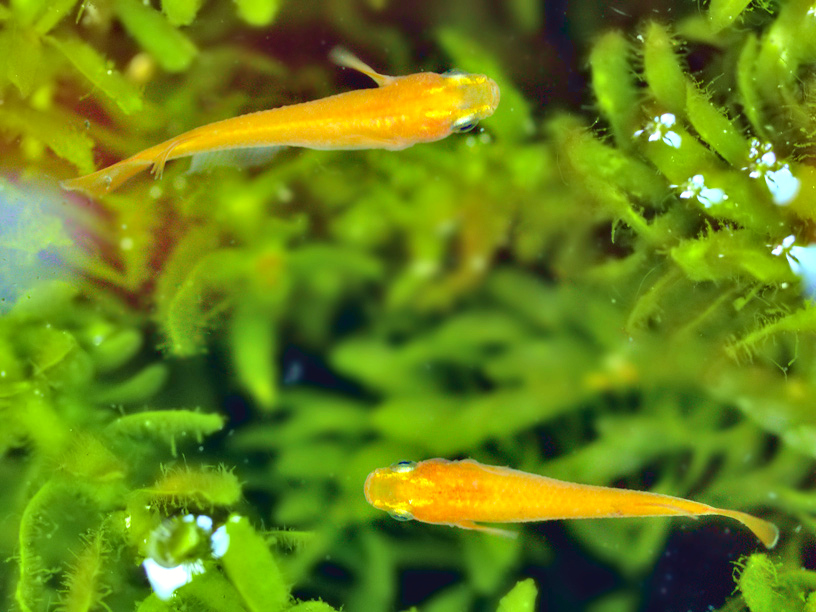
Hermaphroditic individuals have a row of silver to gold spots along their flanks and a large, dark, cream-ringed eyespot below the upper part of the tail-fin base. Males have an orangish coloration on their body sides and fins.[9][10][11]
The species has a rounded dorsal fin with 8–11 rays, a rounded anal fin with 10–13 rays, and a rounded tail fin containing 30–31 rays. Its body has 47–51 smooth scales along each side.[12][13][14]
Adults can reach 7.5 cm in length, although most individuals measure between 1 and 3.8 cm.[15]
Habitat
Mangrove Rivulus inhabits brackish and marine waters and occurs less frequently in freshwater. It is closely associated with red mangroves (Rhizophora mangle), which are its preferred habitat.[16][17][18]
The species occurs in shallow mangrove lagoons and hypersaline ponds. Its documented microhabitats include intermittently dry shallow pools, crab burrows, flooded swales, ditches, logs, mangrove leaf litter, solution holes, and anchialine caves.[19][20]
The species can occur in burrows made by insects in red mangrove logs.[21]
Diet
Recorded food categories include insects, mobile benthic crustaceans, mobile benthic gastropods and bivalves, and mobile benthic worms.[22]
Behaviour
Mangrove Rivulus can survive out of water for up to 66 consecutive days. During terrestrial periods, individuals typically shelter inside fallen logs and breathe air through their skin.[23][24]
When jumping on land, the fish uses a movement called a tail flip, in which its head flips over its body toward its tail. Individuals reduce their territorial and aggressive behaviour while sheltering in insect-created tree burrows.[25][26]
The species tolerates high hydrogen sulfide concentrations and depleted dissolved oxygen in water.[27]
Reproduction and life cycle
Mangrove Rivulus consists predominantly of hermaphrodites that reproduce through self-fertilization, although males also occur. Hermaphroditic individuals normally fertilize their own eggs internally using sperm they produce themselves.[28][29]
The species produces eggs and sperm through meiosis. Its eggs are laid after internal fertilization and can continue developing outside water, but hatching is delayed until they are submerged again.[30][31][32]
Males typically account for 3–8% of populations in highly colonized South and Central American pools. They account for approximately 20–25% of populations on offshore cays in Belize.[33][34]
Adults may cannibalize juveniles that are not their own offspring. The species has no pelagic larval stage.[35][36]
Conservation
Mangrove Rivulus is classified as Least Concern by the IUCN. The United States National Marine Fisheries Service considers it a Species of Concern, and the American Fisheries Society considers it vulnerable.[37][38][39]
Development and hydrologic alteration of tidal wetlands have adversely affected the species in some parts of Florida.[40]
Classification of the Mangrove Rivulus
| Kingdom | Animalia |
|---|---|
| Phylum | Chordata |
| Subphylum | Vertebrata |
| Infraphylum | Gnathostomata |
| Parvphylum | Osteichthyes |
| Gigaclass | Actinopterygii |
| Superclass | Actinopteri |
| Class | Teleostei (Teleost) |
| Order | Cyprinodontiformes |
| Family | Rivulidae (Rivulines) |
| Genus | Kryptolebias |
| Species | Kryptolebias marmoratus (Poey, 1880) |
Where the Mangrove Rivulus is found
Checklists and occurrence records place Kryptolebias marmoratus in 16 countries. GBIF holds 318 georeferenced records of it.
Countries
- Anguilla 4
- Bahamas 32
- Barbados 3
- Belize 56
- Cayman Islands 3
- Cuba 9
- French Guiana 11
- Guadeloupe 4
- Honduras 11
- Martinique 3
- Mexico 4
- Puerto Rico 6
- Trinidad and Tobago 3
- U.S. Virgin Islands 5
- United States 155
- Venezuela 9
Regions and cities with the most records
- Florida, United States 51
- Stann Creek, Belize 20
- Palm Bay, United States 9
- Florida Ridge, United States 8
- Melbourne, United States 8
- West Melbourne, United States 8
- Vero Beach, United States 7
- Vero Beach South, United States 7
- Exuma, Bahamas 6
- Lealman, United States 6
- Pinellas Park, United States 6
- Seminole, United States 6
- St. Petersburg, United States 6
- West and East Lealman, United States 6
- Coconut Grove, United States 5
- Coral Gables, United States 5
- East Naples, United States 5
- Fort Pierce, United States 5
- Glenvar Heights, United States 5
- Kendall, United States 5
- Marco Island, United States 5
- Naples, United States 5
- Pinecrest, United States 5
- Port Saint Lucie, United States 5
- Road Town, British Virgin Islands 5
- Bayamón, Puerto Rico 4
- Bayshore Gardens, United States 4
- Bradenton, United States 4
- Carolina, Puerto Rico 4
- Cataño, Puerto Rico 4
- Cutler, United States 4
- Deerfield Beach, United States 4
- Golden Gate, United States 4
- Guaynabo, Puerto Rico 4
- Killarney, Bahamas 4
- Levittown, Puerto Rico 4
A number beside a place is its count of GBIF occurrence records. A place without a number comes from a checklist alone. Records show where a species has been observed or collected, which can include escapes and vagrants.
Common names
English
- Mangrove Rivulus
- Mangrove Killifish
- Marmored Killifish
Names in 6 other languages
- Czech
- rivulus mramorovaný
- Papiamento
- Matsjoerie
- Polish
- strumieniak marmurkowany
- Portuguese
- Rivulus-do-Mangue
- Russian
- Мраморный ривулус
- Spanish
- almirante de manglar
Synonyms
6 other scientific names have been used for this species and are now treated as synonyms of Kryptolebias marmoratus.
- Rivulus bonairensis Hoedeman, 1958
- Rivulus garciae de la Cruz & Dubitsky, 1976
- Rivulus garciai de la Cruz & Dubitsky, 1976
- Rivulus heyei Nichols, 1914
- Rivulus marmoratus Poey, 1880
- Rivulus marmoratus bonairensis Hoedeman, 1958
Related species
-
 Kryptolebias brasiliensis
-
 Kryptolebias ocellatus
- Kryptolebias sepia
- Kryptolebias campelloi
- Kryptolebias caudomarginatus
- Kryptolebias gracilis
-
 Kryptolebias hermaphroditus
- YssolebiasYssolebias martae
Compare
Questions and answers
What is the scientific name of the Mangrove Rivulus?
The scientific name of the Mangrove Rivulus is Kryptolebias marmoratus. Written with its author, the full name is Kryptolebias marmoratus (Poey, 1880).
Which family does the Mangrove Rivulus belong to?
Kryptolebias marmoratus belongs to the family Rivulidae, in the order Cyprinodontiformes and the class Teleostei.
Where is the Mangrove Rivulus found?
Checklists and occurrence records place Kryptolebias marmoratus in 16 countries, including United States, Belize, Bahamas, French Guiana, Honduras and Cuba.
What is the conservation status of the Mangrove Rivulus?
The IUCN Red List category recorded for Kryptolebias marmoratus is Least Concern (LC).
What other names does the Mangrove Rivulus have?
Kryptolebias marmoratus is also known in English as Mangrove Killifish and Marmored Killifish.
Sources
Passages the profile rests on
- The species has potential applications as a bioindicator of estuary habitats. Source passage: “The mangrove rivulus is considered to have potential as a bioindicator species of estuary habitats.” — English Wikipedia
- Self-fertilization allows the species to produce genetically uniform lineages. Source passage: “In nature, this mode of reproduction can yield highly homozygous lines composed of individuals so genetically uniform as to be, in effect, identical to one another.” — English Wikipedia
- The species has been used in laboratory research on epigenetic effects in genetically identical individuals. Source passage: “These lineages afford the opportunity to explicitly investigate epigenetic phenotypic effects in genetically identical individuals.” — English Wikipedia
- DNA methylation patterns at CpG sites have been investigated in adults and during development. Source passage: “specific patterns of DNA methylation at CpG sites in adults and during development were found to occur.” — English Wikipedia
- The species has an elongated, cylindrical body and a flattened head. Source passage: “Body elongate, cylindrical; head flattened” — biogeodb.stri.si.edu
- Its sensory system is located on the upper surface of the head and consists of grooves and exposed pads rather than pores. Source passage: “sensory system on top of head with grooves and exposed pads rather than pores” — biogeodb.stri.si.edu
- Its body is light to dark brown, with irregular dark spots forming a checkerboard pattern along the upper side and tail base. Source passage: “Light to dark brown, with irregularly arranged dark spots forming a checkerboard pattern along upper side and all of tail base” — biogeodb.stri.si.edu
- A dark spot occurs on the body above the base of the pectoral fin. Source passage: “a dark spot on side just above base of pectoral fin.” — biogeodb.stri.si.edu
- Hermaphroditic individuals have a row of silver to gold spots along their flanks. Source passage: “Hermaphrodite: with a row of silver to gold spots along flank” — biogeodb.stri.si.edu
- Hermaphroditic individuals have a large, dark, cream-ringed eyespot below the upper part of the tail-fin base. Source passage: “a large dark cream ringed ocellus a little below the top of the tail fin base” — biogeodb.stri.si.edu
- Males have an orangish coloration on their body sides and fins. Source passage: “Male: with a orangish cast to side of body and fins” — biogeodb.stri.si.edu
- The species has a rounded dorsal fin with 8–11 rays and a rounded anal fin with 10–13 rays. Source passage: “dorsal fin 8-11, edge rounded; anal fin 10-13, edge rounded” — biogeodb.stri.si.edu
- The species has a rounded tail fin containing 30–31 rays. Source passage: “tail fin rounded, 30-31 rays” — biogeodb.stri.si.edu
- Its body has 47–51 smooth scales along each side. Source passage: “body with smooth scales, 47-51 along side” — biogeodb.stri.si.edu
- Adults can reach 7.5 cm in length, although most individuals measure between 1 and 3.8 cm. Source passage: “The mangrove rivulus is up to 7.5 cm (3.0 in) long, but most individuals are 1–3.8 cm (0.4–1.5 in).” — English Wikipedia
- The species inhabits brackish and marine waters and occurs less frequently in freshwater. Source passage: “It lives in brackish and marine waters (less frequently in fresh water)” — English Wikipedia
- The species is closely associated with red mangroves (Rhizophora mangle). Source passage: “As the common name “mangrove rivulus” implies, K. marmoratus is affiliated closely with and spends its entire life cycle within mangroves, and the distribution of the fish tracks closely with that of the red mangrove, Rhizophora mangle.” — pmc.ncbi.nlm.nih.gov
- Its preferred habitat is the red mangrove, Rhizophora mangle. Source passage: “mangrove (Rhizophora mangle), the preferred habitat of the mangrove rivulus” — floridamuseum.ufl.edu
- The species occurs in shallow mangrove lagoons and hypersaline ponds. Source passage: “Lives in shallow mangrove lagoons and hypersaline ponds” — biogeodb.stri.si.edu
- Its documented microhabitats include intermittently dry shallow pools, crab burrows, flooded swales, ditches, logs, mangrove leaf litter, solution holes, and anchialine caves. Source passage: “intermittently dry shallow, stagnant pools; crab burrows (specifically, those of Cardisoma guanhumi, great land crab, and Ucides cordatus, mangrove land crab); temporally flooded swales; ditches (including anti-mosquito ditches); inside/under logs and mangrove leaf litter; solution holes; empty beer cans and coconuts; and even several meters inside anchialine cave systems” — pmc.ncbi.nlm.nih.gov
- The species can occur in burrows made by insects in red mangrove logs. Source passage: “emerges from the water and can occur in abundance in burrows made by insects in red mangrove logs.” — biogeodb.stri.si.edu
- Its recorded food categories include insects, mobile benthic crustaceans, mobile benthic gastropods and bivalves, and mobile benthic worms. Source passage: “Insects Mobile benthic crustacea (shrimps/crabs) Mobile benthic gastropods/bivalves Data Mobile benthic worms” — biogeodb.stri.si.edu
- The species can survive out of water for up to 66 consecutive days. Source passage: “The mangrove rivulus can spend up to 66 consecutive days out of water” — English Wikipedia
- During terrestrial periods, individuals typically shelter inside fallen logs and breathe air through their skin. Source passage: “which it typically spends inside fallen logs, breathing air through its skin.” — English Wikipedia
- When jumping on land, the fish uses a movement called a tail flip, in which its head flips over its body toward its tail. Source passage: “When jumping on land, the mangrove rivulus does a "tail flip", flipping its head over its body towards the tail end.” — English Wikipedia
- Individuals reduce their territorial and aggressive behaviour while sheltering in insect-created tree burrows. Source passage: “It enters burrows created by insects inside trees where it relaxes its territorial, aggressive behavior.” — English Wikipedia
- The species tolerates high hydrogen sulfide concentrations and depleted dissolved oxygen in water. Source passage: “In water, they are exposed to temperature extremes, high levels of hydrogen sulfide, and depleted dissolved oxygen.” — pmc.ncbi.nlm.nih.gov
- The species consists predominantly of hermaphrodites that reproduce through self-fertilization, although males also occur. Source passage: “The species consists mostly of hermaphrodites which are known to reproduce by self-fertilization, but males do exist” — English Wikipedia
- Hermaphroditic individuals normally fertilize their own eggs internally using sperm they produce themselves. Source passage: “Each individual hermaphrodite normally fertilizes itself when an egg and sperm that it has produced by an internal organ unite inside the fish's body.” — English Wikipedia
- The species produces eggs and sperm through meiosis. Source passage: “K. marmoratus produces eggs and sperm by meiosis” — English Wikipedia
- Its eggs are laid after internal fertilization. Source passage: “fertilization internal, with eggs then being laid.” — biogeodb.stri.si.edu
- The eggs can continue developing outside water, but hatching is delayed until they are submerged again. Source passage: “The eggs can continue their development when out of water, but once they are ready to hatch this is delayed until again submerged.” — English Wikipedia
- Males typically account for 3–8% of populations in highly colonized South and Central American pools. Source passage: “in highly colonized South and Central American pools males typically are 3 to 8% of the population” — English Wikipedia
- Males account for approximately 20–25% of populations on offshore cays in Belize. Source passage: “and in offshore cays in Belize 20 to 25% are males.” — English Wikipedia
- Adults may cannibalize juveniles that are not their own offspring. Source passage: “Adults may cannibalize juveniles, but only unrelated offspring.” — English Wikipedia
- The species has no pelagic larval stage. Source passage: “No pelagic phase No pelagic larva Data Benthic” — biogeodb.stri.si.edu
- The species is classified as Least Concern by the IUCN. Source passage: “It is considered a species of Least Concern by the IUCN” — English Wikipedia
- The United States National Marine Fisheries Service considers the species a Species of Concern. Source passage: “in the United States it is considered a Species of Concern by the National Marine Fisheries Service.” — English Wikipedia
- The American Fisheries Society considers the species vulnerable. Source passage: “It is considered vulnerable by the American Fisheries Society.” — English Wikipedia
- Development and hydrologic alteration of tidal wetlands have adversely affected the species in some parts of Florida. Source passage: “the species has been adversely impacted by development and by hydrologic alteration of tidal wetlands” — pmc.ncbi.nlm.nih.gov
Data
- Catalogue of Life, 2026-10-16 XR cc by
- Global Biodiversity Information Facility CC BY 4.0
- Wikidata CC0
- GeoNames CC BY 4.0
- Wikimedia Commons per image; credit shown with each image
- iNaturalist per image; credit shown with each image
- Within the Catalogue of Life, this name comes from World Register of Marine Species cc by
This species in other databases
- Catalogue of Life 3RF27
- Wikidata Q1766865
- iNaturalist 103727
- WoRMS urn:lsid:marinespecies.org:taxname:314719
Page built on 27 November 2026. See how the catalog is made and all sources and licences.
Cite this page
ScientificNames.org. (2026). Kryptolebias marmoratus (Mangrove Rivulus). Retrieved November 27, 2026, from https://scientificnames.org/species/kryptolebias-marmoratus
“Kryptolebias marmoratus (Mangrove Rivulus).” ScientificNames.org, 2026, scientificnames.org/species/kryptolebias-marmoratus. Accessed 27 Nov. 2026.
ScientificNames.org. “Kryptolebias marmoratus (Mangrove Rivulus).” Accessed November 27, 2026. https://scientificnames.org/species/kryptolebias-marmoratus.
@misc{scientificnames_kryptolebias_marmoratus_mangrove_rivulus,
  author = {{ScientificNames.org}},
  title = {Kryptolebias marmoratus (Mangrove Rivulus)},
  year = {2026},
  url = {https://scientificnames.org/species/kryptolebias-marmoratus},
  note = {Accessed 2026-11-27}
}