Species · Fishes
Silver-cheeked Toadfish Lagocephalus sceleratus
The scientific name of the Silver-cheeked Toadfish is Lagocephalus sceleratus. It is a species of fish in the family Tetraodontidae (blowfishes), order Tetraodontiformes. The name dates from 1789.
- Scientific name
- Lagocephalus sceleratus (Gmelin, 1789)
- Common name
- Silver-cheeked Toadfish
- Genus
- Lagocephalus
- Family
- Tetraodontidae (Blowfishes)
- Order
- Tetraodontiformes
- Class
- Teleostei
- Red List category
- LC Least Concern
- Environment
- marine
- Recorded in
- 38 countries
- Name status
- accepted in the Catalogue of Life

Overview
Lagocephalus sceleratus has a silver band along its sides and is extremely poisonous if consumed.
Written 26 November 2026 from the sources listed below. Each statement was checked against the passage it cites; statements that could not be supported were removed.
Appearance
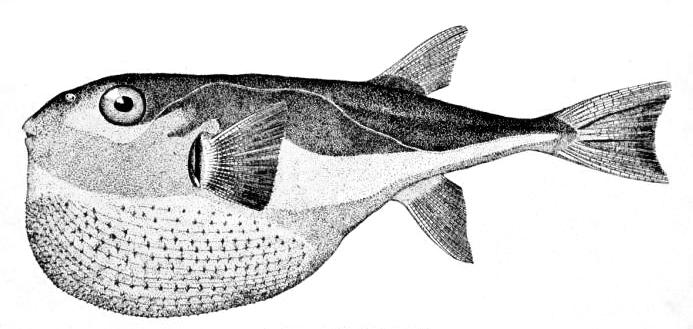
The Silver-cheeked toadfish has a grey or brown back with darker spots, a white belly, and a characteristic silver band along its sides. It has a more elongated body and a symmetrical caudal fin compared with the oceanic pufferfish.[1][2]
It can reach a maximum length of 40 centimetres.[3]
Habitat
In its native Red Sea range, the species inhabits rocky bottoms in shallow coastal waters. It occurs at depths reaching 250 metres in this range.[4][5]
Diet
The Silver-cheeked toadfish preys on benthic invertebrates.[6]
Reproduction and life cycle
The eggs and larvae of the species are found in the pelagic zone.[7]
Behaviour
The species feeds on benthic invertebrates.[8]
Conservation
FishBase reports moderate vulnerability for the species, with a vulnerability score of 40 out of 100. Its estimated minimum population doubling time is 1.4–4.4 years.[9][10]
Uses
FishBase reports an average protein content of 18.9%, with an estimated range of 16.7–21.1%.[11]
The estimated calcium content is 18.1 mg per 100 grams, with a range of 7.7–40.9 mg. The estimated iron content is 0.452 mg per 100 grams, with a range of 0.237–0.911 mg.[12][13]
The estimated omega-3 content is 0.128 grams per 100 grams, with a range of 0.060–0.249 grams. The estimated selenium content is 50.1 micrograms per 100 grams, with a range of 26.9–98.3 micrograms.[14][15]
The estimated vitamin A content is 53.4 micrograms per 100 grams, with a range of 20.0–144.7 micrograms. The estimated zinc content is 0.9 mg per 100 grams, with a range of 0.6–1.3 mg.[16][17]
Classification of the Silver-cheeked Toadfish
| Kingdom | Animalia |
|---|---|
| Phylum | Chordata |
| Subphylum | Vertebrata |
| Infraphylum | Gnathostomata |
| Parvphylum | Osteichthyes |
| Gigaclass | Actinopterygii |
| Superclass | Actinopteri |
| Class | Teleostei (Teleost) |
| Order | Tetraodontiformes |
| Suborder | Tetraodontoidei |
| Family | Tetraodontidae (Blowfishes) |
| Genus | Lagocephalus (Rabbitfishes) |
| Species | Lagocephalus sceleratus (Gmelin, 1789) |
Where the Silver-cheeked Toadfish is found
Checklists and occurrence records place Lagocephalus sceleratus in 38 countries. GBIF holds 5,371 georeferenced records of it.
Countries
- Albania 8
- Algeria 30
- Australia 3,661
- China 4
- Croatia 13
- Cyprus 41
- Egypt 199
- Greece 661
- India 6
- Indonesia 23
- Israel 169
- Italy 29
- Japan 100
- Lebanon 4
- Libya 11
- Madagascar 3
- Malaysia 61
- Malta 6
- Mauritius 4
- Montenegro 4
- Mozambique 15
- New Caledonia 6
- New Zealand 5
- Papua New Guinea 3
- Philippines 38
- Reunion 4
- Saudi Arabia 3
- Seychelles 4
- South Africa 12
- Spain 7
- Sri Lanka 4
- Syria 5
- Taiwan 46
- Tanzania 4
- Thailand 20
- Tunisia 37
- Turkey 109
- Vietnam 12
Regions and cities with the most records
- Tel Aviv, Israel 73
- Bat Yam, Israel 68
- Givatayim, Israel 68
- H̱olon, Israel 64
- Ramat Gan, Israel 64
- Ramat HaSharon, Israel 57
- Bnei Brak, Israel 56
- Rhodes, Greece 56
- Giv'at Shmuel, Israel 55
- Herzliya, Israel 55
- Or Yehuda, Israel 54
- Rishon LeTsiyyon, Israel 54
- Kiryat Ono, Israel 53
- Hod HaSharon, Israel 48
- Ness Ziona, Israel 48
- Be’er Ya‘aqov, Israel 47
- Ra'anana, Israel 46
- Ganei Tikva, Israel 44
- Kfar Saba, Israel 43
- Petaẖ Tiqva, Israel 42
- Yavné, Israel 42
- Reẖovot, Israel 40
- Yehud-Monosson, Israel 39
- Qiryat Bialik, Israel 38
- Qiryat Motsqin, Israel 38
- Qiryat Yam, Israel 38
- Even Yehuda, Israel 37
- Nesher, Israel 37
- Haifa, Israel 36
- Yehud Monosson, Israel 36
- Kadima Zoran, Israel 35
- Qiryat Ata, Israel 34
- Acre, Israel 32
- Netanya, Israel 32
- Daliyat al Karmel, Israel 31
- Tirat Karmel, Israel 30
1 more country has a few records outside this range
These countries hold a few records of Lagocephalus sceleratus but lie outside the range the checklists give for it. Such records are often zoo or garden specimens, museum material or vagrants, so the species is not counted as occurring there.
A number beside a place is its count of GBIF occurrence records. A place without a number comes from a checklist alone. Records show where a species has been observed or collected, which can include escapes and vagrants.
Common names
English
- Silver-cheeked Toadfish
- Giant Toadfish
- Giant Toado
- North-west Blowfish
- Silver Puffer
- Silver Pufferfish
- Silver Toadfish
- Silver-checked Toadfish
- Silver-stripe Pufferfish
- Silvercheek Blaasop
- Silverstripe Blaasop
Names in 17 other languages
- Arabic
- سمك الضفدع فضي الخدين, ينفوخ فضي, ينفوخ فضي الشريط
- Catalan
- Peix bola platejat
- Chinese
- 仙人河魨, 凶兔頭魨, 圓斑扁尾魨, 有毒兔頭魨, 氣規, 沙規仔, 規仔
- Czech
- čtverzubec stříbropásý
- Dutch
- Oceanische kogelvis, zilveren kogelvis
- Finnish
- hopeaposkipallokala
- French
- Ballon à bande argentée, Poisson-ballon à bande argentée
- German
- Hasenkopf-Kugelfisch, Silber-Kugelfisch
- Greek
- Ασημένιος λαγοκέφαλος, Λαγοκέφαλος
- Hebrew
- לגינון, לגינון מוארך
- Italian
- Pesce palla argenteo
- Japanese
- センニンフグ
- Korean
- 은띠복
- Portuguese
- Baiacu-prateado
- Russian
- Серебристый иглобрюх
- Turkish
- Gümüşşeritli Balon
- frr
- Haashood-Kuugelfask
Synonyms
17 other scientific names have been used for this species and are now treated as synonyms of Lagocephalus sceleratus.
- Fugu sceleratus (Gmelin, 1789)
- Gastrophysis sceleratus (Gmelin, 1789)
- Gastrophysus sceleratus (Gmelin, 1789)
- Gastrophysus scleratus (Gmelin, 1789)
- Lagocephalus scleratus (Gmelin, 1789)
- Lagocephalus scleratus Gmelin, 1789
- Pleudranacanthus sceleratus (Gmelin, 1789)
- Pleuranacanthus sceleratus (Gmelin, 1789)
- Spheroides sceleratus (Gmelin, 1789)
- Sphoeroides sceleratus (Gmelin, 1789)
- Sphoeroides scleratus (Gmelin, 1789)
- Tetraodon argenteus Lacepède, 1804
- Tetraodon bicolor Brevoort, 1856
- Tetraodon blochii Castelnau, 1861
- Tetraodon sceleratus Gmelin, 1789
- Tetrodon argenteus Lacepède, 1804
- Tetrodon sceleratus Gmelin, 1789
Related species
-
 Smooth PufferLagocephalus laevigatus
-
 Oceanic PufferLagocephalus lagocephalus
-
 Half-smooth Golden PufferLagocephalus spadiceus
-
 Lunartail PufferLagocephalus lunaris
-
 Suez PufferLagocephalus suezensis
-
 Smooth Golden PufferLagocephalus inermis
- Diamondback PufferLagocephalus guentheri
- Brown-backed ToadfishLagocephalus gloveri
Compare
Questions and answers
What is the scientific name of the Silver-cheeked Toadfish?
The scientific name of the Silver-cheeked Toadfish is Lagocephalus sceleratus. Written with its author, the full name is Lagocephalus sceleratus (Gmelin, 1789).
Which family does the Silver-cheeked Toadfish belong to?
Lagocephalus sceleratus belongs to the family Tetraodontidae, in the order Tetraodontiformes and the class Teleostei.
Where is the Silver-cheeked Toadfish found?
Checklists and occurrence records place Lagocephalus sceleratus in 38 countries, including Australia, Greece, Egypt, Israel, Turkey and Japan.
What is the conservation status of the Silver-cheeked Toadfish?
The IUCN Red List category recorded for Lagocephalus sceleratus is Least Concern (LC).
What other names does the Silver-cheeked Toadfish have?
Lagocephalus sceleratus is also known in English as Giant Toadfish, Giant Toado, North-west Blowfish, Silver Puffer, Silver Pufferfish and Silver Toadfish.
Is fugu poison curable?
The toxin can cause paralysis of involuntary muscles, respiratory failure, or heart failure in affected humans. No information about a cure is provided.[18]
How many fugu deaths per year?
Fatal intoxications involving the Silver-cheeked toadfish have been reported in Egypt, Israel, and Turkey. No annual death count is provided.[19]
What is the diet of a pufferfish?
The Silver-cheeked toadfish preys on benthic invertebrates.[6]
Sources
Passages the profile rests on
- The species has a grey or brown back with darker spots, a white belly, and a characteristic silver band along its sides. Source passage: “Its back is grey or brown with darker spots and it has a white belly. A characteristic silver band runs along the sides of the fish.” — English Wikipedia
- The species has a more elongated body and a symmetrical caudal fin compared with the oceanic pufferfish. Source passage: “The silver-cheeked toadfish is very similar to the oceanic pufferfish but more elongated and with a symmetrical caudal (tail) fin.” — English Wikipedia
- The species can reach a maximum length of 40 centimetres. Source passage: “The silver-cheeked toadfish can measure up to 40 centimetres (16 in).” — English Wikipedia
- In its native Red Sea range, the species inhabits rocky bottoms in shallow coastal waters. Source passage: “In its native range (in the Red Sea) the silver-cheeked toadfish lives on rocky bottoms from shallow coastal waters down to a 250 m depth (820 ft).” — English Wikipedia
- The species occurs at depths reaching 250 metres in its native Red Sea range. Source passage: “lives on rocky bottoms from shallow coastal waters down to a 250 m depth (820 ft).” — English Wikipedia
- The species preys on benthic invertebrates. Source passage: “The silver-cheeked toadfish preys upon benthic invertebrates.” — English Wikipedia
- The eggs and larvae of this species are found in the pelagic zone. Source passage: “Eggs and larvae are found in the pelagic zone.” — English Wikipedia
- The species feeds on benthic invertebrates. Source passage: “The silver-cheeked toadfish preys upon benthic invertebrates.” — English Wikipedia
- FishBase reports moderate vulnerability for the species, with a vulnerability score of 40 out of 100. Source passage: “Moderate vulnerability (40 of 100).” — fishbase.se
- FishBase estimates the species' minimum population doubling time at 1.4–4.4 years. Source passage: “Medium, minimum population doubling time 1.4 - 4.4 years (tmax=7; tm=3; K=0.099-0.3;).” — fishbase.se
- FishBase reports an average protein content of 18.9% for the species, with an estimated range of 16.7–21.1%. Source passage: “Protein = 18.9 [16.7, 21.1] %;” — fishbase.se
- FishBase reports an estimated calcium content of 18.1 mg per 100 grams of the species, with a range of 7.7–40.9 mg. Source passage: “Calcium = 18.1 [7.7, 40.9] mg/100g;” — fishbase.se
- FishBase reports an estimated iron content of 0.452 mg per 100 grams of the species, with a range of 0.237–0.911 mg. Source passage: “Iron = 0.452 [0.237, 0.911] mg/100g;” — fishbase.se
- FishBase reports an estimated omega-3 content of 0.128 grams per 100 grams of the species, with a range of 0.060–0.249 grams. Source passage: “Omega3 = 0.128 [0.060, 0.249] g/100g;” — fishbase.se
- FishBase reports an estimated selenium content of 50.1 micrograms per 100 grams of the species, with a range of 26.9–98.3 micrograms. Source passage: “Selenium = 50.1 [26.9, 98.3] μg/100g;” — fishbase.se
- FishBase reports an estimated vitamin A content of 53.4 micrograms per 100 grams of the species, with a range of 20.0–144.7 micrograms. Source passage: “VitaminA = 53.4 [20.0, 144.7] μg/100g;” — fishbase.se
- FishBase reports an estimated zinc content of 0.9 mg per 100 grams of the species, with a range of 0.6–1.3 mg. Source passage: “Zinc = 0.9 [0.6, 1.3] mg/100g (wet weight);” — fishbase.se
- The toxin can cause paralysis of involuntary muscles, respiratory failure, or heart failure in affected humans. Source passage: “This deadly substance causes paralysis of involuntary muscles, which may cause its victims to stop breathing or induce heart failure.” — English Wikipedia
- Fatal intoxications involving this species have been reported in Egypt, Israel, and Turkey. Source passage: “Fatal intoxications have been reported in Egypt, Israel and Turkey.” — English Wikipedia
Data
- Catalogue of Life, 2026-10-16 XR cc by
- Global Biodiversity Information Facility CC BY 4.0
- Wikidata CC0
- GeoNames CC BY 4.0
- Wikimedia Commons per image; credit shown with each image
- Within the Catalogue of Life, this name comes from World Register of Marine Species cc by
This species in other databases
- Catalogue of Life 3RX8X
- Wikidata Q913943
- iNaturalist 132368
- WoRMS urn:lsid:marinespecies.org:taxname:219954
- ITIS 646294
Page built on 27 November 2026. See how the catalog is made and all sources and licences.
Cite this page
ScientificNames.org. (2026). Lagocephalus sceleratus (Silver-cheeked Toadfish). Retrieved November 27, 2026, from https://scientificnames.org/species/lagocephalus-sceleratus
“Lagocephalus sceleratus (Silver-cheeked Toadfish).” ScientificNames.org, 2026, scientificnames.org/species/lagocephalus-sceleratus. Accessed 27 Nov. 2026.
ScientificNames.org. “Lagocephalus sceleratus (Silver-cheeked Toadfish).” Accessed November 27, 2026. https://scientificnames.org/species/lagocephalus-sceleratus.
@misc{scientificnames_lagocephalus_sceleratus_silver_cheeked_toadfish,
  author = {{ScientificNames.org}},
  title = {Lagocephalus sceleratus (Silver-cheeked Toadfish)},
  year = {2026},
  url = {https://scientificnames.org/species/lagocephalus-sceleratus},
  note = {Accessed 2026-11-27}
}