Species · Flowering plants
White Deadnettle Lamium album
The scientific name of the White Deadnettle is Lamium album. It is a species of flowering plant in the family Lamiaceae (mint family), order Lamiales.
- Scientific name
- Lamium album L.
- Common name
- White Deadnettle
- Genus
- Lamium
- Family
- Lamiaceae (Mint Family)
- Order
- Lamiales
- Class
- Magnoliopsida
- Recorded in
- 66 countries
- Name status
- accepted in the Catalogue of Life

Overview
The species is native to Eurasia, extending from Ireland in the west to Japan in the east, and has been introduced to eastern Ireland and North America. It is distinguished by white flowers growing in whorls and leaves resembling those of stinging nettle that do not produce a sting.
Written 26 November 2026 from the sources listed below. Each statement was checked against the passage it cites; statements that could not be supported were removed.
Appearance
White Deadnettle has green stems with four distinct angles. Its triangular leaves have rounded bases, soft hairs and serrated margins.[1][2]
The leaves resemble those of stinging nettle but do not produce a sting. The white flowers grow in whorls on the upper portions of the stems.[3][4]
The plant can grow up to 70 cm tall. Its leaves measure 3–8 cm long and 2–5 cm wide, and their petioles can reach 5 cm in length.[5][6][7]
Individual flowers measure 1.5–2.5 cm long.[8]
Habitat
White Deadnettle grows in open grassland and woodland, generally in moist, fertile soils.[9][10]
Behaviour
The flowers attract various insects, particularly those with long tongues. Bumblebees are especially attracted to them.[11][12]
Reproduction and life cycle
The flowers provide an early-season source of nectar and pollen.[13]
Uses
The young shoots and leaves can be cooked and eaten as a vegetable. The flowers contain chlorophyll and other plant pigments that were used by Mikhail Tsvet.[14][15]
The flowers contain several polyphenolic glycosides, including lamalboside and verbascoside. The plant also contains the iridoid glycosides lamalbid, alboside A and B, and caryoptoside.[16][17]
Classification of the White Deadnettle
| Kingdom | Plantae |
|---|---|
| Subkingdom | Pteridobiotina |
| Phylum | Tracheophyta |
| Class | Magnoliopsida |
| Order | Lamiales |
| Family | Lamiaceae (Mint Family) |
| Subfamily | Lamioideae |
| Tribe | Lamieae |
| Genus | Lamium (Deadnettle) |
| Species | Lamium album L. |
Where the White Deadnettle is found
Checklists and occurrence records place Lamium album in 66 countries across Asia, Europe, North America and Oceania. GBIF holds 553,226 georeferenced records of it.
Countries where it is native or its origin is not stated
- Afghanistan 3
- Aland Islands 217
- Andorra 17
- Armenia 153
- Austria 3,091
- Azerbaijan 45
- Belarus 628
- Belgium 35,732
- Bulgaria 2
- China 1,338
- Croatia 22
- Czechia 4,979
- Denmark 6,104
- Estonia 2,628
- Finland 6,114
- France 86,126
- Georgia 296
- Germany 57,293
- Greece 7
- Guernsey
- Hungary 110
- India 93
- Iran 123
- Iraq 20
- Ireland 269
- Isle of Man 82
- Italy 960
- Japan 2,151
- Jersey 1
- Kazakhstan 155
- Kosovo 1
- Kyrgyzstan 31
- Latvia 375
- Liechtenstein 2
- Lithuania 826
- Luxembourg 1,743
- Moldova 9
- Mongolia 20
- Montenegro 1
- Nepal 40
- North Korea 72
- Norway 2,212
- Pakistan 96
- Poland 5,870
- Portugal 8
- Romania 185
- Russia 15,760
- Serbia 10
- Slovakia 794
- Slovenia 41
- South Korea 1,603
- Spain 708
- Sweden 16,448
- Switzerland 3,428
- Tajikistan 7
- The Netherlands 84,349
- Turkey 136
- Turkmenistan 4
- Ukraine 1,164
- Uzbekistan 9
Countries where it has been introduced
Regions and cities with the most records
- England, United Kingdom 192,189
- Bavaria, Germany 21,768
- Hauts-de-France, France 21,349
- Île-de-France, France 17,910
- Gelderland, The Netherlands 12,380
- Scotland, United Kingdom 10,336
- Grand Est, France 10,205
- Auvergne-Rhône-Alpes, France 10,172
- North Rhine-Westphalia, Germany 10,080
- Bourgogne-Franche-Comté, France 9,312
- Benthuizen, The Netherlands 8,912
- Berkel en Rodenrijs, The Netherlands 8,690
- Bergschenhoek, The Netherlands 8,599
- Pijnacker, The Netherlands 8,471
- Zoetermeer, The Netherlands 8,452
- Hoensbroek, The Netherlands 8,280
- Limburg, The Netherlands 8,193
- Maastricht, The Netherlands 8,165
- Nootdorp, The Netherlands 7,977
- Zeeland, The Netherlands 7,832
- Delft, The Netherlands 7,722
- Kingswood, United Kingdom 7,694
- Voorschoten, The Netherlands 7,654
- Keynsham, United Kingdom 7,619
- Ypenburg, The Netherlands 7,611
- Waddinxveen, The Netherlands 7,602
- Rotterdam, The Netherlands 7,522
- Voorburg, The Netherlands 7,400
- Capelle aan den IJssel, The Netherlands 7,201
- Schiedam, The Netherlands 7,192
- Boskoop, The Netherlands 7,102
- Geleen, The Netherlands 6,994
- Bath, United Kingdom 6,993
- Wassenaar, The Netherlands 6,985
- Leiderdorp, The Netherlands 6,941
- Krimpen aan den IJssel, The Netherlands 6,895
2 more countries have a few records outside this range
These countries hold a few records of Lamium album but lie outside the range the checklists give for it. Such records are often zoo or garden specimens, museum material or vagrants, so the species is not counted as occurring there.
A number beside a place is its count of GBIF occurrence records. A place without a number comes from a checklist alone. Records show where a species has been observed or collected, which can include escapes and vagrants.
Common names
English
- White Deadnettle
- White Dead-nettle
- White Henbit
- White Nettle
- White-nettle
Names in 11 other languages
- Danish
- Døvnælde
- Dutch
- Witte dovenetel
- Finnish
- valkopeippi
- French
- lamier blanc, marachemin, ortie blanche
- German
- weiße Taubnessel
- Northern Sami
- vilgesčotteš
- Norwegian Bokmål
- daunesle, dauvnesle, døvnesle
- Portuguese
- urtiga-branca
- Scottish Gaelic
- deanntag bhàn, deanntagan bàna, teanga mhìn, teangan mìne
- Swedish
- vitplister
- Welsh
- Archangel Fair, Danadlen Fud Gwyn, Danadlen Gwyn, Danhadlen Ddall, Danhadlen Wen, Dryned Marw Gwyn, Dynaid Blodeuwyn, Marddanhadlen Gwyn
Subspecies and varieties
- Lamium album subsp. album subspecies
- Lamium album subsp. barbatum subspecies
- Lamium album subsp. crinitum subspecies
Related species
-
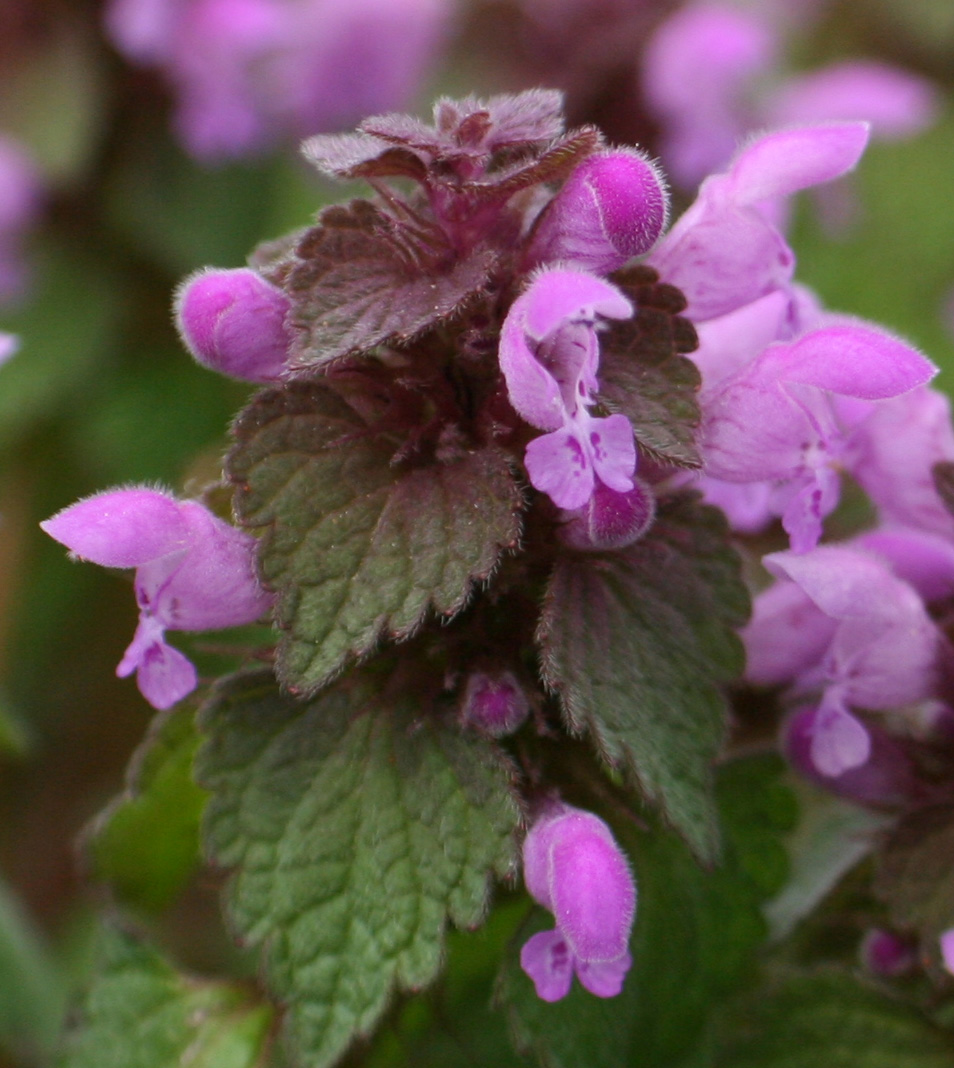 Purple Dead-nettleLamium purpureum
-
 Yellow ArchangelLamium galeobdolon
-
 HenbitLamium amplexicaule
-
 Spotted Dead-nettleLamium maculatum
-
 Cut-leaved Dead NettleLamium hybridum
-
 Balm-leaved ArchangelLamium orvala
-
 Monte Gargano Dead-nettleLamium garganicum
- Lamium argentatum
Compare
Questions and answers
What is the scientific name of the White Deadnettle?
The scientific name of the White Deadnettle is Lamium album. Written with its author, the full name is Lamium album L..
Which family does the White Deadnettle belong to?
Lamium album belongs to the family Lamiaceae, in the order Lamiales and the class Magnoliopsida.
Where is the White Deadnettle found?
Checklists and occurrence records place Lamium album in 66 countries, including France, The Netherlands, Germany, Belgium, Sweden and Russia.
What other names does the White Deadnettle have?
Lamium album is also known in English as White Dead-nettle, White Henbit, White Nettle and White-nettle.
Can humans eat henbit?
The young shoots and leaves of White Deadnettle can be cooked and eaten as a vegetable.[14]
Is henbit dead nettle edible?
The young shoots and leaves of White Deadnettle can be cooked and eaten as a vegetable.[14]
Sources
Passages the profile rests on
- The plant has green stems with four distinct angles. Source passage: “with green, four-angled stems.” — English Wikipedia
- Its triangular leaves have rounded bases, soft hairs and serrated margins. Source passage: “triangular with a rounded base, softly hairy, and with a serrated margin” — English Wikipedia
- The leaves resemble those of the stinging nettle but do not produce a sting. Source passage: “they appear superficially similar to those of the stinging nettle Urtica dioica but do not sting” — English Wikipedia
- The flowers are white and grow in whorls on the upper portions of the stems. Source passage: “The flowers are white, produced in whorls ('verticillasters') on the upper part of the stem” — English Wikipedia
- The plant can grow up to 70 cm tall. Source passage: “growing to 70 cm (28 in) tall” — English Wikipedia
- Its leaves measure 3–8 cm long and 2–5 cm wide. Source passage: “The leaves are 3–8 cm (1–3 in) long and 2–5 cm (3⁄4–2 in) broad” — English Wikipedia
- Its leaf petioles can reach 5 cm in length. Source passage: “a petiole up to 5 cm (2 in) long” — English Wikipedia
- Individual flowers measure 1.5–2.5 cm long. Source passage: “the individual flowers 1.5–2.5 cm (5⁄8–1 in) long.” — English Wikipedia
- The species grows in open grassland and woodland. Source passage: “growing in a variety of habitats from open grassland to woodland” — English Wikipedia
- The species generally grows in moist, fertile soils. Source passage: “generally on moist, fertile soils.” — English Wikipedia
- The flowers attract various insects, particularly those with long tongues. Source passage: “The flowers are visited by many types of insects, but mostly by long-tongued insects, like bees.” — English Wikipedia
- Bumblebees are especially attracted to the flowers. Source passage: “Bumblebees are especially attracted to the flowers” — English Wikipedia
- The flowers provide an early-season source of nectar and pollen. Source passage: “which are a good source of early nectar and pollen” — English Wikipedia
- The young shoots and leaves can be cooked and eaten as a vegetable. Source passage: “The young shoots and leaves can be cooked as a vegetable.” — English Wikipedia
- The flowers contain chlorophyll and other plant pigments that were used by Mikhail Tsvet. Source passage: “L.album was a source of chlorophyll and other plant pigments for Mikhail Tsvet” — English Wikipedia
- The flowers contain several polyphenolic glycosides, including lamalboside and verbascoside. Source passage: “Various polyphenolic glycosides such as Lamalboside and Verbascoside” — English Wikipedia
- The plant contains the iridoid glycosides lamalbid, alboside A and B, and caryoptoside. Source passage: “The plant also contains the iridoid glycosides lamalbid, alboside A and B, and caryoptoside” — English Wikipedia
Data
- Catalogue of Life, 2026-10-16 XR cc by
- Global Biodiversity Information Facility CC BY 4.0
- Wikidata CC0
- GeoNames CC BY 4.0
- Wikimedia Commons per image; credit shown with each image
- Within the Catalogue of Life, this name comes from Synonymic Checklists of the Vascular Plants of the World cc by
References
- L. where the name was published
This species in other databases
Page built on 28 November 2026. See how the catalog is made and all sources and licences.
Cite this page
ScientificNames.org. (2026). Lamium album (White Deadnettle). Retrieved November 28, 2026, from https://scientificnames.org/species/lamium-album
“Lamium album (White Deadnettle).” ScientificNames.org, 2026, scientificnames.org/species/lamium-album. Accessed 28 Nov. 2026.
ScientificNames.org. “Lamium album (White Deadnettle).” Accessed November 28, 2026. https://scientificnames.org/species/lamium-album.
@misc{scientificnames_lamium_album_white_deadnettle,
  author = {{ScientificNames.org}},
  title = {Lamium album (White Deadnettle)},
  year = {2026},
  url = {https://scientificnames.org/species/lamium-album},
  note = {Accessed 2026-11-28}
}