Species · Fishes
Opah Lampris guttatus
The scientific name of the Opah is Lampris guttatus. It is a species of fish in the family Lampridae (opahs), order Lampriformes. The name dates from 1788.
- Scientific name
- Lampris guttatus (Brünnich, 1788)
- Common name
- Opah
- Genus
- Lampris
- Family
- Lampridae (Opahs)
- Order
- Lampriformes
- Class
- Teleostei
- Red List category
- LC Least Concern
- Environment
- marine
- Recorded in
- 1 country
- Name status
- accepted in the Catalogue of Life

Overview
The opah is a pelagic species recorded in the Atlantic, Pacific and Indian oceans, the Mediterranean Sea and occasionally the Southern Ocean. The opah can maintain its entire body core approximately 5 °C warmer than the surrounding environment.
Written 26 November 2026 from the sources listed below. Each statement was checked against the passage it cites; statements that could not be supported were removed.
Appearance
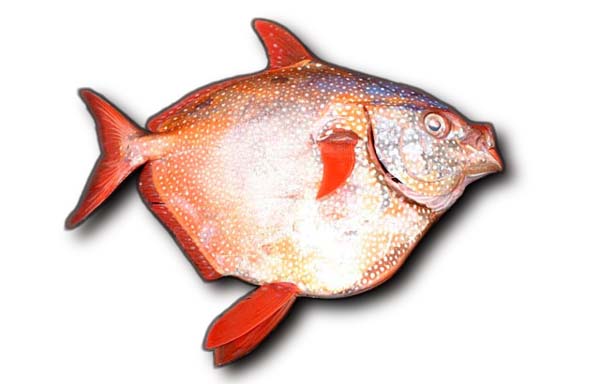
The opah has a large, deeply keeled, disc-shaped body. Its back is steely blue, becoming rosy toward the belly, with irregular rows of white spots along the flanks.[1][2]
Its median and paired fins and jaws are bright vermillion. Its large eyes are surrounded by golden-yellow rings.[3][4][5]
Its body is covered with minute cycloid scales and a silvery, iridescent guanine coating. Its pectoral fins are long, curved and positioned approximately horizontally.[6][7]
Its caudal fin is broadly crescent-shaped, forked and emarginated. Its pelvic fins are slightly longer than its pectoral fins and have approximately 14–17 rays.[8][9]
Its anterior dorsal fin is greatly elongated and has approximately 50–55 rays. Its anal fin has approximately 34–41 rays.[10][11]
Its snout is pointed and its terminal mouth is small and toothless. The species can reach a maximum recorded length of 2 metres.[12][13]
Its maximum reported weight is 86 kg, although some reports describe specimens weighing up to 270 kg.[14]
Habitat
The opah is pelagic and is presumed to spend its entire life in the open ocean. Its presumed principal habitat is the mesopelagic zone at depths of 50–500 metres.[15][16]
It typically occurs in water temperatures between 8 and 22 °C. Tagged specimens in the central North Pacific occupied depths of 50–100 metres at night and 100–400 metres during the day.[17][18]
In the western Atlantic, the species has been recorded from the Grand Banks south to Argentina. Its eastern Atlantic range extends from Norway and Greenland to Senegal and south to Angola, and it also occurs in the Mediterranean Sea.[19][20][21]
In the eastern Pacific, its distribution extends from the Gulf of Alaska to southern California. It also occurs in temperate waters of the Indian Ocean and makes occasional incursions into the Southern Ocean.[22][23][24]
Diet
Squid and krill constitute the bulk of the diet of specimens caught off Hawaii. The species also consumes small fish.[25][26]
Moroteuthis ingens was the most common prey identified in specimens collected along the Patagonian Shelf.[27]
Behaviour
The opah is apparently solitary but sometimes schools with tuna and other scombrid fishes. It exhibits vertical movements through the water column.[28][29]
It swims using a lift-based propulsion method powered by its pectoral fins. Its swimming speed can exceed 25 centimetres per second, and one observed individual reached a burst speed of 4 metres per second.[30][31][32]
The opah can maintain its entire body core approximately 5 °C warmer than the surrounding environment. It generates heat through continuous movements of its pectoral fins, while its gill blood vessels form a countercurrent heat exchanger that conserves internal body heat.[33][34][35]
Reproduction and life cycle
The opah probably spawns during spring. Its planktonic larvae lack dorsal and pelvic fins.[36][37]
Newly hatched individuals undergo a rapid transformation from a slender body shape to a deep-bodied form. This transformation is complete by 10.6 mm standard length.[38][39]
Conservation
The opah is considered a valuable incidental catch in tuna and swordfish fisheries.[40]
Uses
The opah is commonly used to prepare sashimi. Its meat is described as having a rich and creamy flavor.[41][42]
The species is commonly served in restaurants in Hawaii.[43]
Classification of the Opah
| Kingdom | Animalia |
|---|---|
| Phylum | Chordata |
| Subphylum | Vertebrata |
| Infraphylum | Gnathostomata |
| Parvphylum | Osteichthyes |
| Gigaclass | Actinopterygii |
| Superclass | Actinopteri |
| Class | Teleostei (Teleost) |
| Order | Lampriformes |
| Family | Lampridae (Opahs) |
| Genus | Lampris (Opah) |
| Species | Lampris guttatus (Brünnich, 1788) |
Where the Opah is found
Checklists and occurrence records place Lampris guttatus in 1 country. GBIF holds 6,649 georeferenced records of it.
Countries
22 more countries have a few records outside this range
These countries hold a few records of Lampris guttatus but lie outside the range the checklists give for it. Such records are often zoo or garden specimens, museum material or vagrants, so the species is not counted as occurring there.
A number beside a place is its count of GBIF occurrence records. A place without a number comes from a checklist alone. Records show where a species has been observed or collected, which can include escapes and vagrants.
Common names
English
- Opah
- Arokura
- Cravo
- Glacefish
- Glancefish
- Gudlax
- Jerusalem Haddock
- Kingfish
- Mariposa
- Mariposa Fish
- North Atlantic Opah
- Ocean Moonfish
- Opah Or Moonfish
- Opal Fish
- San Pedrofish
- Spotted Moonfish
- Spotted Opah
- Moonfish
- Sunfish
Names in 28 other languages
- Afrikaans
- Gespikkelde opah
- Catalan
- Llampuga reial
- Chinese
- 斑點月魚, 月魚, 紅皮刀, 花點三角仔
- Croatian
- Nevjesta
- Czech
- leskyně skvrnitá
- Danish
- Almindelig glansfisk, glansfisk
- Dutch
- koningsvis
- Faroese
- Laksastyrja
- Finnish
- Kiiltolahna
- French
- Lampris royal, Poisson-lune, Saumon des Dieux, lampris, opah, poisson lune, poisson royal
- German
- Glanzfisch, Gotteslachs, Mondfisch
- Greek
- Lampropsaro, Λαμπρόψαρο
- Hungarian
- Tündöklőhal
- Icelandic
- Guðlax, gulðax
- Italian
- Pesce luna, Pesce re, Pesce ré, pescire
- Japanese
- Akamanbô, Mandal, アカマンボウ
- Norwegian
- laksestørje
- Norwegian Bokmål
- Laksestjørje, laksestørje
- Norwegian Nynorsk
- laksestørje
- Polish
- Strojnik
- Portuguese
- Joaninha, Opá, Peixe-cravo, Peixe-papagaio, Peixe-sol, Peixe-sol-comum, Sol, Sô
- Russian
- Krasnopyoriy opakh, Красноперый (обыкновенный) опах, Обыкновенный опах, Опах обыкновеннный, солнечная рыба
- Samoan
- Koko
- Spanish
- Epromar, Pez Sol, luna real, opah, pez mariposa
- Swedish
- glansfisk
- Turkish
- Parlak
- Welsh
- Opaod, opa
- sco
- Jerusalem haddie
Synonyms
13 other scientific names have been used for this species and are now treated as synonyms of Lampris guttatus.
- Lampris lauta Lowe, 1838
- Lampris luna (Gmelin, 1789)
- Lampris regius (Bonnaterre, 1788)
- Scomber gunneri Bloch & Schneider, 1801
- Zeus guttatus Brünnich, 1788
- Zeus imperalis Shaw in Shaw & Nodder, 1793
- Zeus imperialis Shaw, 1793
- Zeus luna Gmelin, 1789
- Zeus opah Berkenhout, 1789
- Zeus opah Shaw, 1803
- Zeus regius Bonnaterre, 1788
- Zeus stroemii Walbaum, 1792
- Scomber pelagicus Gunnerus, 1768 ambiguous synonym
Related species
- Southern Spotted OpahLampris australensis
- Southern OpahLampris immaculatus
- Smalleye Pacific OpahLampris incognitus
-
 Bigeye Pacific OpahLampris megalopsis
Compare
Questions and answers
What is the scientific name of the Opah?
The scientific name of the Opah is Lampris guttatus. Written with its author, the full name is Lampris guttatus (Brünnich, 1788).
Which family does the Opah belong to?
Lampris guttatus belongs to the family Lampridae, in the order Lampriformes and the class Teleostei.
Where is the Opah found?
Checklists and occurrence records place Lampris guttatus in 1 country: Chile.
What is the conservation status of the Opah?
The IUCN Red List category recorded for Lampris guttatus is Least Concern (LC).
What other names does the Opah have?
Lampris guttatus is also known in English as Arokura, Cravo, Glacefish, Glancefish, Gudlax and Jerusalem Haddock.
What is the scientific name for the Opah fish?
Its scientific name is Lampris guttatus (Brünnich, 1788).[44]
What is unusual about the opah fish?
The opah was identified as the first known fish with whole-body endothermy in 2015. It can maintain its entire body core approximately 5 °C warmer than the surrounding environment through continuous pectoral fin movements and a countercurrent heat exchanger in its gill blood vessels.[33][34][35][45]
What do opah fish eat?
Their diet includes squid, krill and small fish. Moroteuthis ingens was the most common prey identified in specimens collected along the Patagonian Shelf.[25][26][27]
Where do opah fish live?
Opah live in the open ocean and are presumed to inhabit principally the mesopelagic zone at depths of 50–500 metres. They occur in the Atlantic, Pacific and Indian oceans, the Mediterranean Sea and occasionally the Southern Ocean.[15][16][19][20][21][22][23][24]
Sources
Passages the profile rests on
- The species has a large, deeply keeled, disc-shaped body. Source passage: “Lampris guttatus is a large discoid and deeply keeled fish with a conspicuous coloration.” — English Wikipedia
- Its body is steely blue on the back, becoming rosy toward the belly, with irregular rows of white spots along the flanks. Source passage: “The body is a deep steely blue grading to rosy on the belly, with white spots in irregular rows covering the flanks.” — English Wikipedia
- Its median and paired fins are bright vermillion. Source passage: “Both the median and paired fins are a bright vermillion.” — English Wikipedia
- Its jaws are vermillion in color. Source passage: “Jaws are vermillion, too.” — English Wikipedia
- Its large eyes are surrounded by golden-yellow rings. Source passage: “The large eyes stand out as well, ringed with golden yellow.” — English Wikipedia
- Its body is covered with minute cycloid scales and a silvery, iridescent guanine coating. Source passage: “The body is covered in minute cycloid scales and its silvery, iridescent guanine coating is easily abraded.” — English Wikipedia
- Its pectoral fins are long, curved and positioned approximately horizontally. Source passage: “They have long falcated pectoral fins inserted (more or less) horizontally.” — English Wikipedia
- Its caudal fin is broadly crescent-shaped, forked and emarginated. Source passage: “The caudal fins are broadly lunated, forked, and emarginated.” — English Wikipedia
- Its pelvic fins are slightly longer than its pectoral fins and have approximately 14–17 rays. Source passage: “The pelvic fins are similar but a little longer than pectoral fins, with about 14–17 rays.” — English Wikipedia
- Its anterior dorsal fin is greatly elongated and has approximately 50–55 rays. Source passage: “The anterior portion of a dorsal fin (with about 50–55 rays) is greatly elongated” — English Wikipedia
- Its anal fin has approximately 34–41 rays. Source passage: “The anal fin (34–41 rays) is about as high and as long as the shorter portion of the dorsal fin” — English Wikipedia
- Its snout is pointed and its terminal mouth is small and toothless. Source passage: “The snout is pointed and the mouth small, toothless, and terminal.” — English Wikipedia
- The species can reach a maximum recorded length of 2 metres. Source passage: “They can reach a maximum length of 2 m (6.6 ft)” — English Wikipedia
- Its maximum reported weight is 86 kg, although some reports describe specimens weighing up to 270 kg. Source passage: “a maximum weight of 86 kg (190 lb), although there are reports of the fish reaching up to 270 kg (600 lb).” — English Wikipedia
- The species is pelagic and is presumed to spend its entire life in the open ocean. Source passage: “This species is presumed to live out its entire life in the open ocean” — English Wikipedia
- Its presumed principal habitat is the mesopelagic zone at depths of 50–500 metres. Source passage: “at mesopelagic depths of 50–500 m (160–1,640 ft)” — English Wikipedia
- It typically occurs in water temperatures between 8 and 22 °C. Source passage: “Typically, it is found within water at 8 to 22 °C.” — English Wikipedia
- Tagged specimens in the central North Pacific occupied depths of 50–100 metres at night and 100–400 metres during the day. Source passage: “inhabiting depths of 50–100 m during the night and 100–400 m during the day.” — English Wikipedia
- The species has been recorded from the Grand Banks south to Argentina in the western Atlantic. Source passage: “from the Grand Banks to Argentina in the Western Atlantic” — English Wikipedia
- Its eastern Atlantic range extends from Norway and Greenland to Senegal and south to Angola. Source passage: “from Norway and Greenland to Senegal and south to Angola” — English Wikipedia
- The species occurs in the Mediterranean Sea. Source passage: “in the Mediterranean” — English Wikipedia
- Its eastern Pacific distribution extends from the Gulf of Alaska to southern California. Source passage: “from the Gulf of Alaska to southern California in the Eastern Pacific” — English Wikipedia
- It occurs in temperate waters of the Indian Ocean. Source passage: “in temperate waters of the Indian Ocean” — English Wikipedia
- The species makes occasional incursions into the Southern Ocean. Source passage: “and rare forays into the Southern Ocean.” — English Wikipedia
- Squid and krill constitute the bulk of the diet of specimens caught off Hawaii. Source passage: “Based on those caught off the Hawaiian coast, squid and krill make up the bulk of their diet” — English Wikipedia
- The species also consumes small fish. Source passage: “though they also consume small fish.” — English Wikipedia
- Moroteuthis ingens was the most common prey identified in specimens collected along the Patagonian Shelf. Source passage: “the most common of which was the deepwater onychotenhid squid (Moroteuthis ingens).” — English Wikipedia
- The species is apparently solitary but sometimes schools with tuna and other scombrid fishes. Source passage: “They are apparently solitary, but are known to school with tuna and other scombrids.” — English Wikipedia
- The species exhibits vertical movements through the water column. Source passage: “Like many other large pelagic visual predators, such as swordfish and big-eye tuna, they exhibit vertical behavior.” — English Wikipedia
- It swims using a lift-based propulsion method powered by its pectoral fins. Source passage: “They propel themselves by a lift-based mode of swimming using their pectoral fins.” — English Wikipedia
- Its swimming speed can exceed 25 centimetres per second. Source passage: “They are able to swim at over 25 cm/s” — English Wikipedia
- One observed individual reached a burst speed of 4 metres per second. Source passage: “one was even observed reaching 4 m/s (14 km/h; 8.9 mph) in a burst of speed.” — English Wikipedia
- It can maintain its entire body core approximately 5 °C warmer than the surrounding environment. Source passage: “It can consistently keep its body core approximately 5 °C warmer than its environment.” — English Wikipedia
- The species generates heat through continuous movements of its pectoral fins. Source passage: “The fish generates heat as well as propulsion with continuous movements of its pectoral fins” — English Wikipedia
- Its gill blood vessels form a countercurrent heat exchanger that conserves internal body heat. Source passage: “the vasculature of its gill tissue is arranged to conserve heat by a process of countercurrent heat exchange” — English Wikipedia
- The species probably spawns during spring. Source passage: “They probably spawn in the spring.” — English Wikipedia
- Its planktonic larvae lack dorsal and pelvic fins. Source passage: “Their planktonic larvae lack dorsal and pelvic fins.” — English Wikipedia
- Newly hatched individuals undergo a rapid transformation from a slender body shape to a deep-bodied form. Source passage: “The slender hatchlings undergo a marked and rapid transformation from a slender to deep-bodied form” — English Wikipedia
- The transformation into the deep-bodied form is complete by 10.6 mm standard length. Source passage: “this transformation is complete by 10.6 mm standard length.” — English Wikipedia
- The species is considered a valuable incidental catch in tuna and swordfish fisheries. Source passage: “opah are valuable bycatch of many tuna or swordfish fisheries within their range.” — fws.gov
- The species is commonly used to prepare sashimi. Source passage: “and are commonly used in sashimi.” — English Wikipedia
- Its meat is described as having a rich and creamy flavor. Source passage: “It has been described to have a rich and creamy flavor” — English Wikipedia
- The species is commonly served in restaurants in Hawaii. Source passage: “It is common in restaurants in Hawaii.” — English Wikipedia
- The species was described by Danish zoologist Morten Thrane Brünnich in 1788. Source passage: “Danish zoologist Morten Thrane Brünnich described the species in 1788.” — English Wikipedia
- The species was identified as the first known fish with whole-body endothermy in 2015. Source passage: “In May 2015, L. guttatus was shown to maintain its entire body core above ambient temperature, becoming the first known fish with this trait ('whole-body endothermy').” — English Wikipedia
Data
- Catalogue of Life, 2026-10-16 XR cc by
- Global Biodiversity Information Facility CC BY 4.0
- Wikidata CC0
- GeoNames CC BY 4.0
- Wikimedia Commons per image; credit shown with each image
- iNaturalist per image; credit shown with each image
- Within the Catalogue of Life, this name comes from World Register of Marine Species cc by
This species in other databases
- Catalogue of Life 3S3ZH
- Wikidata Q2021864
- iNaturalist 122916
- WoRMS urn:lsid:marinespecies.org:taxname:126522
- ITIS 166326
Page built on 27 November 2026. See how the catalog is made and all sources and licences.
Cite this page
ScientificNames.org. (2026). Lampris guttatus (Opah). Retrieved November 27, 2026, from https://scientificnames.org/species/lampris-guttatus
“Lampris guttatus (Opah).” ScientificNames.org, 2026, scientificnames.org/species/lampris-guttatus. Accessed 27 Nov. 2026.
ScientificNames.org. “Lampris guttatus (Opah).” Accessed November 27, 2026. https://scientificnames.org/species/lampris-guttatus.
@misc{scientificnames_lampris_guttatus_opah,
  author = {{ScientificNames.org}},
  title = {Lampris guttatus (Opah)},
  year = {2026},
  url = {https://scientificnames.org/species/lampris-guttatus},
  note = {Accessed 2026-11-27}
}