Species · Insects
Lasionycta coracina
Lasionycta coracina has no English name on record in the checklists used here. It is a species of insect in the family Noctuidae (cutworms), order Lepidoptera. The name dates from 2009.
- Scientific name
- Lasionycta coracina Crabo & Lafontaine, 2009
- Genus
- Lasionycta
- Family
- Noctuidae (Cutworms)
- Order
- Lepidoptera
- Class
- Insecta
- Recorded in
- 1 country
- Name status
- accepted in the Catalogue of Life

Overview
The species occurs in the Richardson and British Mountains in northern Yukon, adjacent Northwest Territories, and Cape Thompson in northwestern Alaska. Adults are active during the day, with peak activity in the late afternoon and during cloudy conditions.
Written 28 November 2026 from the sources listed below. Each statement was checked against the passage it cites; statements that could not be supported were removed.
Appearance
Male adults have a wingspan of 23–30 mm. Female adults have a wingspan of 24–31 mm.[1][2]
Habitat
In the Richardson Mountains, the species inhabits sparsely vegetated gravel tundra slopes with Dryas stripes.[3]
Diet
Adult moths feed on plants belonging to the genus Saxifraga.[4]
Behaviour
Adults are active during the day, with peak activity in the late afternoon and during cloudy conditions.[5]
Adults are present on the wing from late June through early August.[6]
Classification of Lasionycta coracina
| Kingdom | Animalia |
|---|---|
| Phylum | Arthropoda |
| Subphylum | Hexapoda |
| Class | Insecta (Insect) |
| Order | Lepidoptera |
| Superfamily | Noctuoidea |
| Family | Noctuidae (Cutworms) |
| Subfamily | Noctuinae |
| Tribe | Eriopygini |
| Genus | Lasionycta |
| Species | Lasionycta coracina Crabo & Lafontaine, 2009 |
Origin of the name. Etymology. Coracina is Latin and means raven-like, a reference to the dark appearance and northern distribution of this species.
Where Lasionycta coracina is found
Checklists and occurrence records place Lasionycta coracina in 1 country. GBIF holds 3 georeferenced records of it.
Countries
A number beside a place is its count of GBIF occurrence records. A place without a number comes from a checklist alone. Records show where a species has been observed or collected, which can include escapes and vagrants.
Related species
-
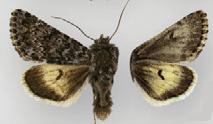 Small Tundra ArchesLasionycta leucocycla
-
 Lasionycta staudingeri
-
 Lasionycta phaea
-
 Lasionycta impingens
-
 Lasionycta skraelingia
-
 Lasionycta luteola
-
 Lasionycta mono
-
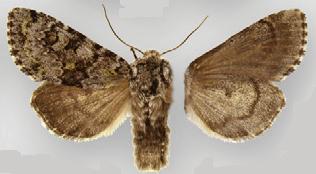 Lasionycta mutilata
Compare
Questions and answers
When are adults present on the wing?
Adults are present on the wing from late June through early August.[6]
When are adults most active?
Adults are active during the day, with peak activity in the late afternoon and during cloudy conditions.[5]
What do adult moths feed on?
Adult moths feed on plants belonging to the genus Saxifraga.[4]
Sources
Passages the profile rests on
- Male adults have a wingspan of 23–30 mm. Source passage: “The wingspan is 23–30 mm for males” — English Wikipedia
- Female adults have a wingspan of 24–31 mm. Source passage: “24–31 mm for females.” — English Wikipedia
- In the Richardson Mountains, the species inhabits sparsely vegetated gravel tundra slopes with Dryas stripes. Source passage: “The habitat in the Richardson Mountains is sparsely vegetated gravel tundra slopes with Dryas stripes.” — English Wikipedia
- Adult moths feed on plants belonging to the genus Saxifraga. Source passage: “The adults feed on Saxifraga species.” — English Wikipedia
- Adults are active during the day, with peak activity in the late afternoon and during cloudy conditions. Source passage: “The moths are diurnal, most active in the late afternoon and when cloudy.” — English Wikipedia
- Adults are present on the wing from late June through early August. Source passage: “Adults are on wing from late June to early August.” — English Wikipedia
Data
- Catalogue of Life, 2026-10-16 XR cc by
- Global Biodiversity Information Facility CC BY 4.0
- Wikidata CC0
- GeoNames CC BY 4.0
- Wikimedia Commons per image; credit shown with each image
- Within the Catalogue of Life, this name comes from Global Lepidoptera Index cc by
References
- Crabo, Lars G. and Lafontaine, J. Donald. (2009). A Revision of Lasionycta Aurivillius (Lepidoptera: Noctuidae) for North America and notes on Eurasian species, with descriptions of 17 new species, 6 new subspecies, a new genus, and two new species of Tricholita Grote. ZooKeys, 30, 1–156. https://doi.org/10.3897/zookeys.30.308 Link where the name was published
This species in other databases
Page built on 28 November 2026. See how the catalog is made and all sources and licences.
Cite this page
ScientificNames.org. (2026). Lasionycta coracina. Retrieved November 28, 2026, from https://scientificnames.org/species/lasionycta-coracina
“Lasionycta coracina.” ScientificNames.org, 2026, scientificnames.org/species/lasionycta-coracina. Accessed 28 Nov. 2026.
ScientificNames.org. “Lasionycta coracina.” Accessed November 28, 2026. https://scientificnames.org/species/lasionycta-coracina.
@misc{scientificnames_lasionycta_coracina,
  author = {{ScientificNames.org}},
  title = {Lasionycta coracina},
  year = {2026},
  url = {https://scientificnames.org/species/lasionycta-coracina},
  note = {Accessed 2026-11-28}
}