Species · Insects
Eucalyptus Stem Gall Wasp Leptocybe invasa
The scientific name of the Eucalyptus Stem Gall Wasp is Leptocybe invasa. It is a species of insect in the family Eulophidae (eulophids), order Hymenoptera. The name dates from 2004.
- Scientific name
- Leptocybe invasa Fisher & La Salle, 2004
- Common name
- Eucalyptus Stem Gall Wasp
- Genus
- Leptocybe
- Family
- Eulophidae (Eulophids)
- Order
- Hymenoptera
- Class
- Insecta
- Recorded in
- 22 countries
- Name status
- accepted in the Catalogue of Life

Overview
The Eucalyptus Stem Gall Wasp (Leptocybe invasa) is an insect in the family Eulophidae. It is native to Queensland, Australia, and has been recorded in Africa, Europe, southern South America, Mexico and the United States. It is the sole member of the genus Leptocybe.
Written 26 November 2026 from the sources listed below. Each statement was checked against the passage it cites; statements that could not be supported were removed.
Appearance
The adult wasp has a brown body with slight blue-to-green iridescence and partially yellowish legs. It measures slightly more than one millimeter in length.[1][2]
The spherical gall formed before adult emergence can reach 2.7 millimeters in width.[3]
Habitat
The species develops galls on eucalyptus leaf midribs, petioles and stems. Individual leaves typically develop three to six galls during an infestation, although as many as 65 have been recorded.[4][5]
Recorded host trees include bangalay (Eucalyptus botryoides), apple box (Eucalyptus bridgesiana), Tasmanian blue gum (Eucalyptus globulus), cider gum (Eucalyptus gunnii), flooded gum (Eucalyptus grandis) and swamp mahogany (Eucalyptus robusta).[6][7]
Additional recorded host trees include Sydney blue gum (Eucalyptus saligna), forest red gum (Eucalyptus tereticornis) and manna gum (Eucalyptus viminalis).[8]
The species is native to Queensland, Australia. It has been recorded as invasive in northern, eastern and southern Africa, and has spread into Europe as far north as the United Kingdom.[9][10][11]
The species has also been recorded in southern South America, Mexico and the United States. It was first reported in Brazil in 2007 on hybrid clones of Eucalyptus grandis and Eucalyptus camaldulensis in northeastern Bahia.[12][13][14]
The species had been reported in 39 countries by the time of the cited study.[15]
Diet
In laboratory experiments, adult females fed with a 50% honey solution at 14 or 18 °C exhibited the greatest longevity and survival.[16]
Behaviour
Gall formation can deform eucalyptus leaves and terminal shoots, causing defoliation and drying of shoots. Heavy infestations can cause the death of newly developing eucalyptus buds.[17][18]
Reproduction and life cycle
Adult females deposit small eggs in a line within the epidermis of new eucalyptus leaf buds. Females can reproduce asexually through thelytokous reproduction.[19][20]
The species can produce two to three adult generations annually in temperate regions and up to six in tropical regions.[21]
The larval developmental period inside the gall lasts approximately three to four months before adult emergence. The developmental period from egg deposition to adult emergence was reported as 132.6 days.[22][23]
Classification of the Eucalyptus Stem Gall Wasp
| Kingdom | Animalia |
|---|---|
| Phylum | Arthropoda |
| Subphylum | Hexapoda |
| Class | Insecta (Insect) |
| Order | Hymenoptera (Ants) |
| Suborder | Apocrita (Ants) |
| Infraorder | Terebrantes |
| Superfamily | Chalcidoidea |
| Family | Eulophidae (Eulophids) |
| Subfamily | Tetrastichinae |
| Genus | Leptocybe |
| Species | Leptocybe invasa Fisher & La Salle, 2004 |
This name was added to the Catalogue of Life from a contributing dataset by automated merging and has not yet been reviewed by its editors.
Where the Eucalyptus Stem Gall Wasp is found
Checklists and occurrence records place Leptocybe invasa in 22 countries. GBIF holds 815 georeferenced records of it.
Countries
- Australia 172
- China 20
- Egypt 7
- France 4
- Ghana 8
- Greece 16
- Israel 93
- Italy 63
- Kenya 51
- Madagascar 26
- Malaysia 9
- Mozambique 36
- Pakistan 4
- Portugal 4
- Reunion 8
- South Africa 58
- Spain 24
- Thailand 65
- Tunisia 6
- Turkey 11
- Uganda 23
- United States 107
Regions and cities with the most records
- Northern Territory, Australia 114
- California, United States 103
- Bang Pakong, Thailand 65
- Chachoengsao, Thailand 65
- Chachoengsao, Thailand 65
- Northern District, Israel 53
- Bet She’an, Israel 52
- Janīn, Palestinian Territory 52
- Isiolo County, Kenya 49
- Bastia umbra, Italy 38
- Foligno, Italy 38
- Kimberley, South Africa 38
- Northern Cape, South Africa 38
- Umbria, Italy 38
- Tete, Mozambique 36
- As Samū‘, Palestinian Territory 33
- Az̧ Z̧āhirīyah, Palestinian Territory 33
- Banī Na‘īm, Palestinian Territory 33
- Dūrā, Palestinian Territory 33
- Hebron, Palestinian Territory 33
- Idhnā, Palestinian Territory 33
- Sa‘īr, Palestinian Territory 33
- Surif City, Palestinian Territory 33
- West Bank, Palestinian Territory 33
- Yaţţā, Palestinian Territory 33
- Ḩalḩūl, Palestinian Territory 33
- Moreno Valley, United States 25
- Highland, United States 24
- Loma Linda, United States 24
- Redlands, United States 24
- San Bernardino, United States 23
- Simi Valley, United States 21
- Victoria, Australia 21
- Santa Clarita, United States 20
- Stevenson Ranch, United States 20
- Agoura, United States 19
2 more countries have a few records outside this range
These countries hold a few records of Leptocybe invasa but lie outside the range the checklists give for it. Such records are often zoo or garden specimens, museum material or vagrants, so the species is not counted as occurring there.
A number beside a place is its count of GBIF occurrence records. A place without a number comes from a checklist alone. Records show where a species has been observed or collected, which can include escapes and vagrants.
Common names
English
- Eucalyptus Stem Gall Wasp
Names in 2 other languages
- Arabic
- دبور قرح ساق الأوكالبتوس
- Thai
- หนอนปมใบยูคาลิปตัส
Related species
-
 Euderus set
-
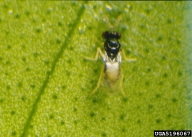 Tamarixia radiata
- Aprostocetus hagenowii
- Skoka femorata
-
 Eucalyptus Gall WaspOphelimus maskelli
-
 Erythrina Gall WaspQuadrastichus erythrinae
-
 Melittobia australica
-
 Pediobius foveolatus
Compare
Questions and answers
What is the scientific name of the Eucalyptus Stem Gall Wasp?
The scientific name of the Eucalyptus Stem Gall Wasp is Leptocybe invasa. Written with its author, the full name is Leptocybe invasa Fisher & La Salle, 2004.
Which family does the Eucalyptus Stem Gall Wasp belong to?
Leptocybe invasa belongs to the family Eulophidae, in the order Hymenoptera and the class Insecta.
Where is the Eucalyptus Stem Gall Wasp found?
Checklists and occurrence records place Leptocybe invasa in 22 countries, including Australia, United States, Israel, Thailand, Italy and South Africa.
Is gall wasp bad?
Gall formation can deform eucalyptus leaves and terminal shoots, causing defoliation and drying of shoots. Heavy infestations can cause the death of newly developing eucalyptus buds.[17][18]
Are gall wasps good or bad?
The Eucalyptus Stem Gall Wasp can damage eucalyptus trees by deforming leaves and terminal shoots, causing defoliation and drying of shoots. Heavy infestations can cause the death of newly developing eucalyptus buds.[17][18]
What do gall wasps eat?
In laboratory experiments, adult females fed with a 50% honey solution at 14 or 18 °C exhibited the greatest longevity and survival.[16]
Sources
Passages the profile rests on
- The adult wasp has a brown body with a slight blue-to-green iridescence and partially yellowish legs. Source passage: “Its body is brown with a slight blue to green iridescence. Parts of the legs are yellowish in color.” — English Wikipedia
- The adult wasp measures slightly more than one millimeter in length. Source passage: “This tiny wasp is just over one millimeter in length.” — English Wikipedia
- The spherical gall formed before adult emergence can reach 2.7 millimeters in width. Source passage: “the gall is spherical and up to 2.7 millimeters wide.” — English Wikipedia
- The species develops galls on eucalyptus leaf midribs, petioles and stems. Source passage: “causes galls on Eucalyptus spp. leaf midribs, petioles and stems.” — pmc.ncbi.nlm.nih.gov
- Individual leaves typically develop three to six galls during an infestation, although as many as 65 have been recorded. Source passage: “During an infestation there are usually 3 to 6 galls per leaf, but up to 65 have been observed on a single leaf.” — English Wikipedia
- The species attacks bangalay (Eucalyptus botryoides), apple box (Eucalyptus bridgesiana) and Tasmanian blue gum (Eucalyptus globulus). Source passage: “Host species include bangalay (Eucalyptus botryoides), apple box (E. bridgesiana), Tasmanian blue gum (E. globulus)” — English Wikipedia
- Additional recorded host trees include cider gum (Eucalyptus gunnii), flooded gum (Eucalyptus grandis) and swamp mahogany (Eucalyptus robusta). Source passage: “cider gum (E. gunnii), flooded gum (E. grandis), swamp mahogany (E. robusta)” — English Wikipedia
- Additional recorded host trees include Sydney blue gum (Eucalyptus saligna), forest red gum (Eucalyptus tereticornis) and manna gum (Eucalyptus viminalis). Source passage: “Sydney blue gum (E. saligna), forest red gum (E. tereticornis), and manna gum (E. viminalis).” — English Wikipedia
- The species is native to Queensland, Australia. Source passage: “Leptocybe invasa is native to Queensland, Australia” — English Wikipedia
- The species has been recorded as invasive in northern, eastern and southern Africa. Source passage: “in northern, eastern and southern Africa” — English Wikipedia
- The species has spread into Europe as far north as the United Kingdom. Source passage: “Europe as far north as the United Kingdom” — English Wikipedia
- The species has been recorded in southern South America. Source passage: “southern South America” — English Wikipedia
- The species has been recorded in Mexico and the United States. Source passage: “Mexico and the United States.” — English Wikipedia
- The species was first reported in Brazil in 2007 on hybrid clones of Eucalyptus grandis and Eucalyptus camaldulensis in northeastern Bahia. Source passage: “In Brazil, L. invasa was found for the first time on Eucalyptus grandis × Eucalyptus camaldulensis hybrid clones in northeastern Bahia in 2007” — pmc.ncbi.nlm.nih.gov
- The species had been reported in 39 countries by the time of the cited study. Source passage: “and later in 39 countries (Nugnes et al., 2015).” — pmc.ncbi.nlm.nih.gov
- In laboratory experiments, adult females fed with a 50% honey solution at 14 or 18 °C exhibited the greatest longevity and survival. Source passage: “Leptocybe invasa fed with 50% honey solution and reared at 14 or 18 °C showed the greatest longevity and survival.” — pmc.ncbi.nlm.nih.gov
- Heavy infestations can cause the death of newly developing eucalyptus buds. Source passage: “Heavy wasp infestations can kill new buds on the trees.” — English Wikipedia
- Gall formation can deform eucalyptus leaves and terminal shoots, causing defoliation and drying of shoots. Source passage: “These galls deform leaves and terminal shoots, resulting in defoliation and drying of shoots” — pmc.ncbi.nlm.nih.gov
- Adult females deposit small eggs in a line within the epidermis of new eucalyptus leaf buds. Source passage: “The adult female injects a neat line of minute eggs in the epidermis of new leaf buds on eucalyptus trees.” — English Wikipedia
- Females can reproduce asexually through thelytokous reproduction. Source passage: “The females can reproduce asexually by thelytokous reproduction” — English Wikipedia
- The species can produce two to three adult generations annually in temperate regions and up to six in tropical regions. Source passage: “In temperate areas there may be 2-3 generations of adults in a year but in the tropics there can be as many as 6 generations.” — English Wikipedia
- The larval developmental period inside the gall lasts approximately three to four months before adult emergence. Source passage: “The adult wasps emerge from the galls after growing inside for 3–4 months.” — English Wikipedia
- The developmental period from egg deposition to adult emergence was reported as 132.6 days. Source passage: “developmental time from oviposition to emergence was 132.6 days” — pmc.ncbi.nlm.nih.gov
- Adult females can live for up to seven days. Source passage: “live for up to 7 days” — English Wikipedia
- At 25 °C, the mean survival period of wasps supplied with honey and water was 6.5 days. Source passage: “Mean survival period for wasps fed with honey and water was 6.5 days” — pmc.ncbi.nlm.nih.gov
- At 25 °C, wasps without food survived for an average of three days. Source passage: “and for three days without food at 25 °C” — pmc.ncbi.nlm.nih.gov
Data
- Catalogue of Life, 2026-10-16 XR cc by
- Global Biodiversity Information Facility CC BY 4.0
- Wikidata CC0
- GeoNames CC BY 4.0
- Wikimedia Commons per image; credit shown with each image
- Within the Catalogue of Life, this name comes from TAXREF cc by
References
- Victorian Entomologist. (2004). v.34:no.4 (2004:Aug). https://www.biodiversitylibrary.org/item/276051 Link where the name was published
This species in other databases
Page built on 27 November 2026. See how the catalog is made and all sources and licences.
Cite this page
ScientificNames.org. (2026). Leptocybe invasa (Eucalyptus Stem Gall Wasp). Retrieved November 27, 2026, from https://scientificnames.org/species/leptocybe-invasa
“Leptocybe invasa (Eucalyptus Stem Gall Wasp).” ScientificNames.org, 2026, scientificnames.org/species/leptocybe-invasa. Accessed 27 Nov. 2026.
ScientificNames.org. “Leptocybe invasa (Eucalyptus Stem Gall Wasp).” Accessed November 27, 2026. https://scientificnames.org/species/leptocybe-invasa.
@misc{scientificnames_leptocybe_invasa_eucalyptus_stem_gall_wasp,
  author = {{ScientificNames.org}},
  title = {Leptocybe invasa (Eucalyptus Stem Gall Wasp)},
  year = {2026},
  url = {https://scientificnames.org/species/leptocybe-invasa},
  note = {Accessed 2026-11-27}
}