Species · Reptiles
Banded Cat-eyed Snake Leptodeira annulata
The scientific name of the Banded Cat-eyed Snake is Leptodeira annulata. It is a species of reptile in the family Colubridae (colubrid), order Squamata. The name dates from 1758.
- Scientific name
- Leptodeira annulata (Linnaeus, 1758)
- Common name
- Banded Cat-eyed Snake
- Genus
- Leptodeira
- Family
- Colubridae (Colubrid)
- Order
- Squamata
- Class
- Reptilia
- Red List category
- LC Least Concern
- Recorded in
- 23 countries
- Name status
- accepted in the Catalogue of Life
Overview
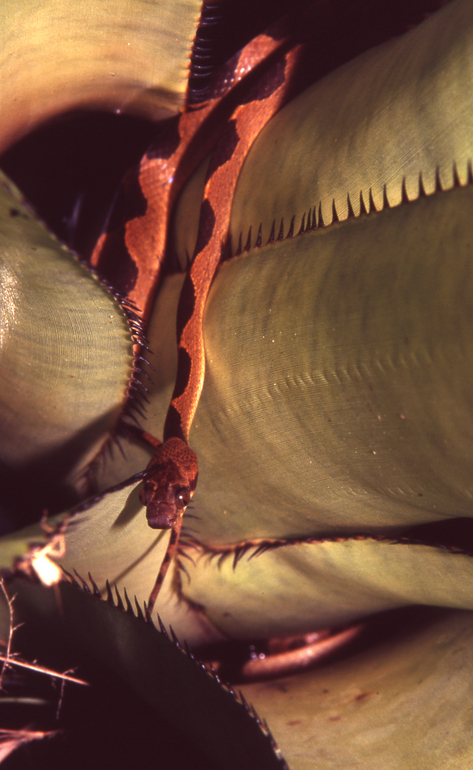
Leptodeira annulata inhabits moist and dry forests, forest edges, vegetated urban areas adjacent to forests, and riparian environments. It has a very slender body, large eyes with vertically elliptical pupils, and dark spots that may form a wavy or zigzag stripe.
Written 26 November 2026 from the sources listed below. Each statement was checked against the passage it cites; statements that could not be supported were removed.
Appearance
Adults have a very slender body, a head distinct from the neck, and large eyes with vertically elliptical pupils. The dorsal surface is yellowish or brown, with dark brown or blackish spots that may merge into a wavy or zigzag stripe.[1][2]
Habitat
The species inhabits moist environments, including both moist and dry forests. It occurs near forest edges, including vegetated urban areas adjacent to forests, and is frequently associated with riparian environments and the edges of swamps and marshes.[3][4][5]
It has been documented across elevations ranging from sea level to 1,100 m.[6]
Diet
The Banded Cat-eyed Snake primarily consumes small frogs and other amphibian life stages, including eggs and tadpoles. A dietary study reported that its diet mainly includes small frogs.[7][8]
It also feeds on small reptiles, including anoles and smaller snakes, and may occasionally consume fledgling birds.[9][10]
Behaviour
The species is nocturnal and exhibits semi-arboreal habits. It hunts and feeds both in trees and on the ground.[11][12][13]
It is considered non-aggressive. When threatened, it may enlarge its head, hide its head, and coil its body.[14][15]
The species is rear-fanged, with enlarged, grooved teeth at the rear of its upper jaws, and produces mild venom.[16][17]
Reproduction and life cycle
The genus Leptodeira is oviparous, and its species sometimes exhibit delayed fertilization. Eggs of the genus have been found in the fungus gardens of Acromyrmex and Atta colombica ants.[18][19]
Classification of the Banded Cat-eyed Snake
| Kingdom | Animalia |
|---|---|
| Phylum | Chordata |
| Subphylum | Vertebrata |
| Infraphylum | Gnathostomata |
| Parvphylum | Osteichthyes |
| Megaclass | Tetrapoda |
| Class | Reptilia (Reptile) |
| Order | Squamata (Snakes) |
| Suborder | Serpentes (Snakes) |
| Infraorder | Alethinophidia |
| Family | Colubridae (Colubrid) |
| Subfamily | Dipsadinae |
| Genus | Leptodeira (Cat-eyed Snakes) |
| Species | Leptodeira annulata (Linnaeus, 1758) |
Where the Banded Cat-eyed Snake is found
Checklists and occurrence records place Leptodeira annulata in 23 countries across North America and South America. GBIF holds 6,931 georeferenced records of it.
Countries
- Argentina 11
- Belize 9
- Bolivia 195
- Brazil 1,491
- Canada 3
- Colombia 1,769
- Costa Rica 187
- Dominican Republic 3
- Ecuador 449
- El Salvador 40
- French Guiana 105
- Guatemala 177
- Guyana 64
- Honduras 131
- Mexico 829
- Nicaragua 67
- Panama 258
- Paraguay 24
- Peru 494
- Suriname 151
- Trinidad and Tobago 66
- United States 4
- Venezuela 404
Regions and cities with the most records
- Cesar Department, Colombia 265
- Antioquia, Colombia 147
- Santander Department, Colombia 146
- La Jagua de Ibirico, Colombia 133
- Pará, Brazil 125
- Portuguesa, Venezuela 123
- La Guajira Department, Colombia 115
- Ituango, Colombia 112
- Becerril, Colombia 110
- Oaxaca, Mexico 107
- Casanare Department, Colombia 98
- Guanacaste Province, Costa Rica 97
- Michoacán, Mexico 94
- Mato Grosso, Brazil 85
- Madre de Dios, Peru 81
- Meta Department, Colombia 78
- Guerrero, Mexico 76
- Albania, Colombia 75
- Nueva Italia de Ruiz, Mexico 74
- Pastaza Province, Ecuador 71
- Sucumbíos, Ecuador 69
- Rio de Janeiro, Brazil 68
- Magdalena Department, Colombia 67
- Santa Cruz Department, Bolivia 66
- Amazonas, Brazil 65
- Hatonuevo, Colombia 63
- Mato Grosso do Sul, Brazil 61
- Caquetá, Colombia 54
- Morona-Santiago Province, Ecuador 52
- Veracruz, Mexico 50
- Nueva Loja, Ecuador 45
- Beni Department, Bolivia 44
- Barrancas, Colombia 43
- Cañas, Costa Rica 41
- Minas Gerais, Brazil 41
- Orellana Province, Ecuador 41
Range as the checklists state it
Panama, Colombia (incl. Valle del Cauca), Venezuela, French Guiana, Guyana, Brazil (Paraná [HR 27: 216], Amapá, Amazonas, Pará, Rondonia, Roraima, Espírito Santo, Bahia, S Ceará, Rio de Janeiro, Acre, Rio Grande do Norte, Pernambuco, Piauí, Sergipe), Bolivia (Beni), Paraguay, N Peru (Pasco etc.)
A number beside a place is its count of GBIF occurrence records. A place without a number comes from a checklist alone. Records show where a species has been observed or collected, which can include escapes and vagrants.
Common names
English
- Banded Cat-eyed Snake
- Annulated Cat-eyed Snake
- South American Banded Cat-eyed Snake
Names in 7 other languages
- Danish
- Sydamerikansk Båndet Katteøjesnog
- French
- Diane maculée, Leptodeire annelée, Leptodeire annelée (La), Serpent coco
- German
- Bananennatter
- Italian
- Colubro occhi di gatto fasciato
- Portuguese
- Cacaual, Cobra-Cipó, Cobra-Olho-de-Gato, Dormideira, Jararaca, Jararaca-de-Parede, Jararaca-de-Patioba, Jararaca-de-Tabuleiro
- Russian
- Кольчатый кошачьеглазый уж
- Spanish
- Culebra ojo de gato bandada, Culebra-ojo de gato bandada, Escombrera, Falsa mapanare, Serpiente escombrera, culebra bandeada con ojos de gato
Synonyms
10 other scientific names have been used for this species and are now treated as synonyms of Leptodeira annulata.
- Coluber annulatus Linnaeus, 1758
- Eteirodipsas annulata var. rhomboidalis Jan, 1863
- Eteirodipsas wieneri Sauvage, 1884
- Leptodeira albofusca Boulenger, 1896
- Leptodeira polysticta Günther, 1895
- Leptodira nycthemera Werner, 1901
- Dipsas approximans Günther, 1872 ambiguous synonym
- Dipsas septentrionalis Kennicott ex Baird, 1859 ambiguous synonym
- Leptodeira ocellata Günther, 1895 ambiguous synonym
- Leptodeira rhombifera Günther, 1895 ambiguous synonym
Subspecies and varieties
- Leptodeira annulata annulata subspecies
Related species
-
 Northern Cat-eyed SnakeLeptodeira septentrionalis
-
 Mayan Cat-eyed SnakeLeptodeira frenata
- Aruban Cat-eyed SnakeLeptodeira bakeri
- Northern Cat-eyed SnakeLeptodeira ornata
-
 Southwestern Cat-eyed SnakeLeptodeira maculata
- Mangrove Cat-eyed SnakeLeptodeira rubricata
- Black-banded Cat-eyed SnakeLeptodeira nigrofasciata
- Banded Cat-eyed SnakeLeptodeira ashmeadii
Compare
Questions and answers
What is the scientific name of the Banded Cat-eyed Snake?
The scientific name of the Banded Cat-eyed Snake is Leptodeira annulata. Written with its author, the full name is Leptodeira annulata (Linnaeus, 1758).
Which family does the Banded Cat-eyed Snake belong to?
Leptodeira annulata belongs to the family Colubridae, in the order Squamata and the class Reptilia.
Where is the Banded Cat-eyed Snake found?
Checklists and occurrence records place Leptodeira annulata in 23 countries, including Colombia, Brazil, Mexico, Peru, Ecuador and Venezuela.
What is the conservation status of the Banded Cat-eyed Snake?
The IUCN Red List category recorded for Leptodeira annulata is Least Concern (LC).
What other names does the Banded Cat-eyed Snake have?
Leptodeira annulata is also known in English as Annulated Cat-eyed Snake and South American Banded Cat-eyed Snake.
Sources
Passages the profile rests on
- Adults have a very slender body, a head distinct from the neck, and large eyes with vertically elliptical pupils. Source passage: “Adults of L. annulata have a total length (tail included) of about 750 mm (30 in) and are very slender. The head is distinct from the neck, and the large eyes have vertically elliptic pupils.” — English Wikipedia
- The dorsal surface is yellowish or brown and bears dark brown or blackish spots that may merge into a wavy or zigzag stripe. Source passage: “The back is yellowish or brown with a series of dark brown or blackish spots often confluent into an undulous or zigzag stripe.” — English Wikipedia
- The species inhabits moist environments, including both moist and dry forests. Source passage: “L. annulata inhabits moist areas. It tends to be found in forest (moist and dry forest)” — English Wikipedia
- The species occurs near forest edges, including vegetated urban areas adjacent to forests. Source passage: “as well as in areas near forest edge, including well vegetated urbanized areas near the forest edge.” — English Wikipedia
- The species is frequently associated with riparian environments and the edges of swamps and marshes. Source passage: “It is often associated with riparian zones, as well as the margins of swamps and marshes.” — English Wikipedia
- The species has been documented across elevations ranging from sea level to 1,100 m. Source passage: “inhabiting low and high altitudes (from the sea level to 1,100 m elevation)” — pmc.ncbi.nlm.nih.gov
- The species primarily consumes small frogs and other amphibian life stages, including eggs and tadpoles. Source passage: “L. annulata preys on frogs, frog eggs, tadpoles, salamanders” — English Wikipedia
- A dietary study reported that the species' diet mainly includes small frogs. Source passage: “the diet of Leptodeira annulata mainly includes small frogs” — academia.edu
- The species feeds on small reptiles, including anoles and smaller snakes. Source passage: “and small reptiles such as lizards (including anoles) and smaller snakes” — English Wikipedia
- The species may occasionally consume fledgling birds. Source passage: “It may also feed on fledgling birds.” — English Wikipedia
- The species is nocturnal. Source passage: “L. annulata is nocturnal.” — English Wikipedia
- The species hunts and feeds both in trees and on the ground. Source passage: “It hunts and feeds in trees and on the ground.” — English Wikipedia
- The species exhibits semi-arboreal habits. Source passage: “Leptodeira annulata is an opisthoglyphous Dipsadidae snake with semi-arboreal and nocturnal habits.” — pmc.ncbi.nlm.nih.gov
- The species is considered non-aggressive. Source passage: “Leptodeira annulata is considered a non-aggressive snake” — pmc.ncbi.nlm.nih.gov
- When threatened, the species may enlarge its head, hide its head, and coil its body. Source passage: “the specimen showed passive behaviors such as head enlargement (Figure 3A; 3B), followed by a combination of head hiding and body coiling (Figure 3C).” — pmc.ncbi.nlm.nih.gov
- The species is rear-fanged and possesses enlarged, grooved teeth at the rear of its upper jaws. Source passage: “L. annulata has a pair of enlarged, grooved teeth at the rear of each upper jaw (maxilla)” — English Wikipedia
- The species produces mild venom. Source passage: “and produces a mild venom.” — English Wikipedia
- The genus Leptodeira is oviparous, and its species sometimes exhibit delayed fertilization. Source passage: “Snakes of the genus Leptodeira are oviparous, sometimes exhibiting delayed fertilization.” — English Wikipedia
- Eggs of the genus Leptodeira have been found in the fungus gardens of Acromyrmex and Atta colombica ants. Source passage: “Their eggs have been found in the fungus gardens of Acromyrmex and Atta colombica ants.” — English Wikipedia
Data
- Catalogue of Life, 2026-10-16 XR cc by
- Global Biodiversity Information Facility CC BY 4.0
- Wikidata CC0
- GeoNames CC BY 4.0
- Wikimedia Commons per image; credit shown with each image
- Within the Catalogue of Life, this name comes from The Reptile Database cc by
References
- Linnaeus C. 1758. Systema naturae per regna tria naturae, secundum classes, ordines, genera, species, cum characteribus, differentiis, synonymis, locis. Tomus I. Editio decima, reformata. Laurentii Salvii, Holmiae. DOI where the name was published
- Linné, C. [= Linnaeus, C.]. (1758). Systema naturæ per regna tria naturæ, secundum classes, ordines, genera, species, cum characteribus, differentiis, synonymis, locis. Tomus I. Editio decima, reformata. Laurentii Salvii, Holmiæ. 10th Edition: 824 Pp.
- Jan, G. (1863). Elenco Sistematico degli Ofidi descriti e disegnati per l’Iconografia Generale. Milano, A. Lombardi. Vii + 143 Pp.
- Cope, E. D. (1866). Fourth contribution lo the herpetology of tropical America. Proc. Acad. Nat. Sci. Philadelphia, 18: 123-132.
- Günther, A. (1872). Seventh account of new species of snakes in the collection of the British Museum. Ann. Mag. Nat. Hist. (4) 9: 13-37 [OCR Errors].
- Cope, E. D. (1875). On the Batrachia and Reptilia collected by Dr. John M. Bransford during the Nicaraguan Canal Survey of 1874. Jour. Acad. Nat. Sci. Philad. 8 (2): 155-157 + 6 Plates [Presumably Published in 1875, Not 1876].
- Cope, E. D. (1878). Synopsis of the cold blooded Vertebrata, procured by Prof. James Orton, during his exploration of Peru in 1876-77. Proc. Amer. Philos. Soc. 17: 33-49 [1877].
- Sauvage, H.-E. (1884). Sur quelques Reptiles de la collection du Muséum d’Histoire Naturelle. Bull. Soc. Philom. Paris (7) 8: 142-146.
- Günther, A. C. L. G. (1885). Reptilia and Batrachia. Biologia Centrali-Américana. Taylor, & Francis, London, 326 Pp. [Published in Parts from 1885-1902; Reprint by the SSAR 1987].
- Cope, E. D. (1893). Second addition to the knowledge of the Batrachia and Reptilia of Costa Rica. Proc. Amer. Philos. Soc. 31: 333-347.
- Werner, F. (1901). Ueber Reptilien und Batrachier aus Ecuador und Neu-Guinea. Verh. Zool.-Bot. Ges. Wien 51: 593-614.
- Griffin, & Lawrence Edmonds. (1917). Leptodeira albofusca (Lacépéde) a synonym of Leptodeira annulata (Linnaeus). Annals of the Carnegie Museum 11 (1-2): 321-326.
- Stejneger, & Leonhard. (1926). Identity of Hallowell’s snake genera Megalops and Aepidea. Proc. US. Natl. Mus. 69 (16): 1-3.
- Barbour, T., & Amaral, A. D. (1927). Studies on African Ophidia. Bull. Antivenin Inst. America 1 (1): 25-27.
- Amaral, & do, A. (1929). Contribuicao ao conhecimento dos ophidios do Brasil. IV. Lista remissiva dos ophidios do Brasil. Mem. Inst. Butantan, Sao Paulo, 4: 71-125.
- Stuart, L. C. (1935). A contribution to a knowledge of the herpetology of a portion of the savanna region of Central Peten, Guatemala. University of Michigan Museum of Zoology Miscellaneous Publications 29: 1-56.
- Schmidt, K. P, & ANDREWS, E. W. (1936). Notes on snakes from Yucatán. Field Mus. Nat Hist. Zool. Ser. 20: 167-187.
- Haines, T. P. (1940). Delayed Fertilization in Leptodeira annulata polysticta. Copeia 1940 (2): 116-118.
- Prado, & Alcides. (1941). Notas ofiológicas 5. Observações sobre serpentes da Colombia. Mem. Inst. Butantan 14: 1-11 [1940].
- Smith, Hobart M. (1944). Snakes of the Hoogstraal Expeditions to northern Mexico. Zoological Series of Field Museum of Natural History 29 (8): 135-152.
- Ditmars, R. L. (1946). The Reptiles of North America. Doubleday, N.Y., 478 Pp. [1949?].
- Beebe, & William. (1946). Field notes on the snakes of Kartabo, British Guiana, and Caripito, Venezuela. Zoologica 31: 11-52.
- Taylor, E. H. (1949). A preliminary account of the herpetology of the state of San Luis Potosi, Mexico. Univ. Kansas Sci. Bull. 33 (2): 169-215. Link
- Shreve, B. (1949). On Venezuelan reptiles and amphibians collected by Dr. H.G. Kugler. Bull. Mus. Comp. Zool. Harvard 99 [1947]: 519-537.
- Roze, J. A. (1952). Colección de reptiles del Profesor Scorza, de Venezuela. Acta Biologica Venezuelica 1 (5): 93-114.
This species in other databases
Page built on 26 November 2026. See how the catalog is made and all sources and licences.
Cite this page
ScientificNames.org. (2026). Leptodeira annulata (Banded Cat-eyed Snake). Retrieved November 26, 2026, from https://scientificnames.org/species/leptodeira-annulata
“Leptodeira annulata (Banded Cat-eyed Snake).” ScientificNames.org, 2026, scientificnames.org/species/leptodeira-annulata. Accessed 26 Nov. 2026.
ScientificNames.org. “Leptodeira annulata (Banded Cat-eyed Snake).” Accessed November 26, 2026. https://scientificnames.org/species/leptodeira-annulata.
@misc{scientificnames_leptodeira_annulata_banded_cat_eyed_snake,
  author = {{ScientificNames.org}},
  title = {Leptodeira annulata (Banded Cat-eyed Snake)},
  year = {2026},
  url = {https://scientificnames.org/species/leptodeira-annulata},
  note = {Accessed 2026-11-26}
}