Species · Insects
Western Conifer Seed Bug Leptoglossus occidentalis
The scientific name of the Western Conifer Seed Bug is Leptoglossus occidentalis. It is a species of insect in the family Coreidae (leatherbugs), order Hemiptera. The name dates from 1910.
- Scientific name
- Leptoglossus occidentalis Heidemann, 1910
- Common name
- Western Conifer Seed Bug
- Genus
- Leptoglossus
- Family
- Coreidae (Leatherbugs)
- Order
- Hemiptera
- Class
- Insecta
- Environment
- terrestrial
- Recorded in
- 69 countries
- Name status
- accepted in the Catalogue of Life

Overview
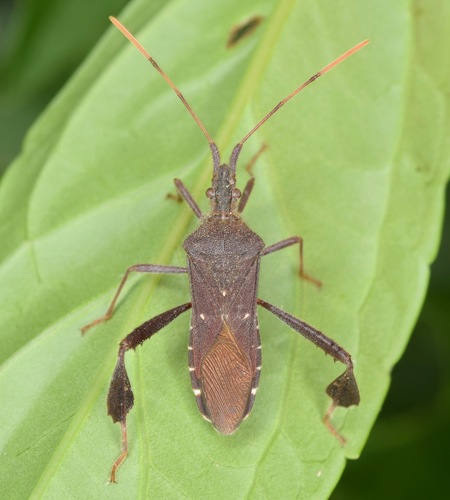
The Western Conifer Seed Bug is an insect in the family Coreidae, order Hemiptera, and class Insecta. It is native to temperate regions of the Pacific Coast of western North America and has spread throughout the United States and southern Canada. Adults have reddish-brown to dark brown coloration, expanded hindleg tibiae, and alternating light and dark bands along the outer edges of their wings.
Written 24 November 2026 from the sources listed below. Each statement was checked against the passage it cites; statements that could not be supported were removed.
Appearance
Adults have reddish-brown to dark brown coloration. Their forewings have dark brown membranous sections that form a diamond at the rear.[1][2]
The outer edges of the abdomen display alternating yellow or light orange and black patches. A thin, jagged pale line often runs along the insect's back.[3][4]
The species has expanded hindleg tibiae, alternating light and dark bands along the outer edges of its wings, and sucking mouthparts. Young nymphs are orange and become reddish brown as they grow.[5][6][7]
Adults typically measure approximately 19 millimetres in length, with an average body length ranging from 16 to 20 millimetres. Eggs measure approximately 2 millimetres in length.[8][9][10]
Habitat
The species is native to temperate regions of the Pacific Coast of western North America. Its native distribution extends from California to British Columbia and eastward to Idaho, Minnesota, and Nevada.[11][12]
Adults overwinter in protected locations, including beneath bark, in bird and rodent nests, and beneath building siding. They commonly overwinter in the walls of residences and other buildings.[13][14]
Diet
The species feeds on developing conifer cones and their seeds. Its host plants include Douglas-fir, ponderosa pine, lodgepole pine, and white spruce.[15][16]
Outside its native range, it also feeds on eastern white pine and red pine. European host plants include mountain pine, black pine, Scots pine, and pistachio.[17][18]
The species can feed on flowering plants when necessary, although it appears to prefer resin-producing plants. First-instar nymphs feed on conifer needles and tender cone-scale tissue, while older nymphs feed on developing conifer seeds.[19][20][21]
Adult males feed on flowers and one-year-old cones during spring.[22]
Behaviour
Adults can fly and produce a buzzing sound while airborne. Disturbed individuals emit an unpleasant-smelling defensive substance.[23][24]
Adults move toward sheltered locations in early fall to overwinter. They commonly enter buildings during autumn to find protection from cold and drying winds.[25][26]
The species does not construct nests indoors but hides in cracks and crevices. It is not known to reproduce indoors.[27][28]
Reproduction and life cycle
Females lay eggs in chains or groups on conifer needles and on the needles or leaf stems of host plants. Eggs hatch approximately ten days after being laid.[29][30][31]
Nymphs undergo five developmental stages before becoming adults. The species produces one generation annually in North America.[32][33]
Populations in tropical Mexico can produce up to three generations annually. Populations in southern Europe can complete two generations annually.[34][35]
Conservation
The species is considered a minor tree pest in North America. Consumption of conifer seeds can damage as much as 80 percent of a seed crop, and the species can be a serious pest in conifer seed orchards.[36][37][38]
Feeding by this species does not generally affect the health of host trees. Most individuals do not survive the winter, although some survive overwintering.[39][40]
Similar species
Leptoglossus phyllopus is identified as a similar leaf-footed bug. The Western Conifer Seed Bug is sometimes confused with the wheel bug, Arilus cristatus, and is often confused with brown marmorated stink bugs.[41][42][43]
Classification of the Western Conifer Seed Bug
| Kingdom | Animalia |
|---|---|
| Phylum | Arthropoda |
| Subphylum | Hexapoda |
| Class | Insecta (Insect) |
| Order | Hemiptera |
| Suborder | Heteroptera |
| Infraorder | Pentatomomorpha |
| Superfamily | Coreoidea |
| Family | Coreidae (Leatherbugs) |
| Subfamily | Coreinae |
| Tribe | Anisoscelini (Leaf-footed Bugs) |
| Genus | Leptoglossus (Leaf-footed Bugs) |
| Species | Leptoglossus occidentalis Heidemann, 1910 |
Where the Western Conifer Seed Bug is found
Checklists and occurrence records place Leptoglossus occidentalis in 69 countries across Africa, Asia, Europe, North America and South America. GBIF holds 195,070 georeferenced records of it.
Countries
- Albania 14
- Algeria 2
- Andorra 7
- Argentina 83
- Armenia 9
- Austria 4,734
- Belarus 23
- Belgium 31,434
- Bosnia and Herzegovina 21
- Brazil 15
- Bulgaria 117
- Canada 13,599
- Chile 40
- China 233
- Costa Rica
- Croatia 332
- Cyprus 8
- Czechia 1,566
- Denmark 3,293
- Estonia 3
- Finland 34
- France 8,287
- Georgia 56
- Germany 37,597
- Greece 191
- Guatemala
- Guernsey 18
- Hong Kong 3
- Hungary 585
- Ireland 5
- Isle of Man 11
- Israel 10
- Italy 1,499
- Japan 292
- Jersey 22
- Kazakhstan 16
- Kosovo 8
- Kyrgyzstan 5
- Lebanon 10
- Liechtenstein 14
- Lithuania 80
- Luxembourg 377
- Mexico 10
- Moldova 22
- Montenegro 14
- North Macedonia 10
- Norway 50
- Poland 1,932
- Portugal 505
- Romania 279
- Russia 185
- Serbia 322
- Slovakia 181
- Slovenia 283
- South Africa 14
- South Korea 646
- Spain 2,271
- Sweden 704
- Switzerland 931
- Syria 1
- Taiwan 5
- The Netherlands 41,977
- Tunisia 1
- Turkey 180
- Ukraine 571
- United Kingdom 11,316
- United States 27,983
- Uruguay 20
- Uzbekistan 4
Regions and cities with the most records
- England, United Kingdom 10,734
- Gelderland, The Netherlands 8,467
- North Rhine-Westphalia, Germany 7,089
- Ontario, Canada 6,111
- Lower Saxony, Germany 5,743
- Bavaria, Germany 5,291
- Baden-Wurttemberg, Germany 4,197
- British Columbia, Canada 3,892
- Deurne, Belgium 3,839
- Eindhoven, The Netherlands 3,784
- Borgerhout, Belgium 3,737
- Merksem, Belgium 3,730
- Leuven, Belgium 3,671
- Arnhem, The Netherlands 3,618
- Antwerp, Belgium 3,567
- Mechelen, Belgium 3,461
- Ede, The Netherlands 3,441
- Zeist, The Netherlands 3,417
- Veenendaal, The Netherlands 3,373
- Soest, The Netherlands 3,322
- Nijmegen, The Netherlands 3,302
- Amersfoort, The Netherlands 3,266
- Limburg, The Netherlands 3,260
- Utrecht, The Netherlands 3,242
- Utrecht, The Netherlands 3,226
- Helmond, The Netherlands 3,207
- Genk, Belgium 3,041
- Hesse, Germany 2,915
- Rheinland-Pfalz, Germany 2,838
- New York, United States 2,777
- Hilversum, The Netherlands 2,742
- Massachusetts, United States 2,717
- Gent, Belgium 2,587
- Beveren, Belgium 2,580
- Overijssel, The Netherlands 2,565
- Washington, United States 2,553
A number beside a place is its count of GBIF occurrence records. A place without a number comes from a checklist alone. Records show where a species has been observed or collected, which can include escapes and vagrants.
Common names
English
- Western Conifer Seed Bug
- Pine Seed Bug
- Western Conifer-Seed Bug
Names in 22 other languages
- Catalan
- Xinxa americana del pi
- Czech
- vroubenka americká
- Danish
- Amerikansk fyrretæge, Amerikansk nåletræfrøtæge, Vestlig nåletræs-frøtæge, Vestlig nåletræs-randtæge
- Dutch
- Bladpootrandwants, Bladpootwants
- Finnish
- mäntyvaltari
- French
- La punaise américaine, La punaise du pin, Punaise américaine, Punaise américaine du pin, Punaise des pins, Punaise occidentale des cônes
- German
- Amerikanische Kiefernwanze, Amerikanische Zapfenwanze
- Hungarian
- Nyugati levéllábú poloska
- Italian
- Cimice dei pini
- Japanese
- マツヘリカメムシ
- Korean
- 소나무허리노린재
- Lithuanian
- Pušinė kampuotblakė
- Polish
- Wtyk amerykański
- Portuguese
- Sugador-de-pinhas
- Russian
- Сосновый семенной клоп
- Slovak
- obrubnica americká
- Slovenian
- Storževa Listonožka
- Spanish
- chinche americana del pino
- Swedish
- västlig barrkantskinnbagge
- Turkish
- Çam Kozalağı Emici Böcek
- Ukrainian
- Крайовик сосновий американський
- bos
- Sjeverno-američka stjenica
Synonyms
2 other scientific names have been used for this species and are now treated as synonyms of Leptoglossus occidentalis.
- Narnia anaticula Brailovsky & Barrera, 2013
- Theognis occidentalis (Heidemann, 1910)
Related species
- Eastern Leaf-footed BugLeptoglossus phyllopus
-
 Northern Leaf-Footed BugLeptoglossus oppositus
-
 Large-Legged BugLeptoglossus zonatus
- Western Leaf-footed BugLeptoglossus clypealis
- Southern Pine Seed BugLeptoglossus corculus
- Magnolia Leaf-footed BugLeptoglossus fulvicornis
- Citron BugLeptoglossus gonagra
- Leptoglossus brevirostris
Compare
Questions and answers
What is the scientific name of the Western Conifer Seed Bug?
The scientific name of the Western Conifer Seed Bug is Leptoglossus occidentalis. Written with its author, the full name is Leptoglossus occidentalis Heidemann, 1910.
Which family does the Western Conifer Seed Bug belong to?
Leptoglossus occidentalis belongs to the family Coreidae, in the order Hemiptera and the class Insecta.
Where is the Western Conifer Seed Bug found?
Checklists and occurrence records place Leptoglossus occidentalis in 69 countries, including The Netherlands, Germany, Belgium, United States, Canada and United Kingdom.
What other names does the Western Conifer Seed Bug have?
Leptoglossus occidentalis is also known in English as Pine Seed Bug and Western Conifer-Seed Bug.
Are western conifer seed bugs harmful?
The species is considered a minor tree pest in North America and can be a serious pest in conifer seed orchards. Consumption of conifer seeds can damage as much as 80 percent of a seed crop, although feeding does not generally affect the health of host trees.[36][37][38][39]
What attracts western conifer seed bugs?
Adults commonly enter buildings during autumn to find protection from cold and drying winds. They move toward sheltered locations in early fall to overwinter.[25][26]
Are western conifer seed bugs the same as stink bugs?
No. The Western Conifer Seed Bug belongs to the true bugs in the family Coreidae and is often confused with brown marmorated stink bugs.[43][44]
What do western conifer seedbugs eat?
They feed on developing conifer cones and their seeds, as well as conifer needles and tender cone-scale tissue during the first nymphal stage. They can also feed on flowering plants when necessary.[15][19][20][21]
Do western conifer seed bugs bite humans?
Adults generally do not bite humans and are not considered a medical risk.[45]
Do western conifer seed bugs stink?
Disturbed individuals emit an unpleasant-smelling defensive substance.[24]
Sources
Passages the profile rests on
- Adults have reddish-brown to dark brown coloration. Source passage: “Adults are 3/4 inch (19 mm) long and reddish-brown to dark brown” — extension.psu.edu
- The forewings have dark brown membranous sections that form a diamond at the rear. Source passage: “The membranous halves of the forewings are dark brown and form a diamond at the rear (posterior).” — extension.psu.edu
- The outer edges of the abdomen display alternating yellow or light orange and black patches. Source passage: “The upper (dorsal) side of the abdomen is visible along the edge of the wings and has alternating patches of yellow/light orange and black.” — extension.psu.edu
- A thin, jagged pale line often runs along the insect's back. Source passage: “There is often a thin, jagged while line along the back, although this may be darker in color or even absent.” — extension.psu.edu
- Young nymphs are orange and become reddish brown as they grow. Source passage: “The young nymphs are orange and become reddish brown as they grow larger” — extension.psu.edu
- The species has expanded hindleg tibiae and alternating light and dark bands along the outer edges of its wings. Source passage: “recognized by the expanded hindleg tibiae and by the alternating light and dark bands which run along the outer wing edges” — English Wikipedia
- The species has sucking mouthparts. Source passage: “Distinctive Features: sucking mouthparts” — cals.cornell.edu
- Adults typically measure approximately 19 millimetres in length. Source passage: “Adults are 3/4 inch (19 mm) long” — extension.psu.edu
- The average body length ranges from 16 to 20 millimetres. Source passage: “The average length is 16–20 millimetres (0.63–0.79 in)” — English Wikipedia
- Eggs measure approximately 2 millimetres in length. Source passage: “The eggs are laid in chains on conifer needles and are measure about 0.08 inches (2 mm) long.” — extension.psu.edu
- The species is native to temperate regions of the Pacific Coast of western North America. Source passage: “Western conifer seed bugs are native to temperate areas of the Pacific Coast in western North America.” — extension.psu.edu
- The native distribution extends across western North America from California to British Columbia and eastward to Idaho, Minnesota, and Nevada. Source passage: “California to British Columbia, east to Idaho, Minnesota, and Nevada” — English Wikipedia
- Adults overwinter in protected locations including beneath bark, in bird and rodent nests, and beneath building siding. Source passage: “seek overwintering sites in protected areas, such as under bark, in bird and rodent nests, under building siding, and in homes.” — extension.psu.edu
- Adults commonly overwinter in the walls of residences and other buildings. Source passage: “Western conifer seed bugs are common home invaders and often overwinter in the walls of residences and buildings.” — urbanipm.montana.edu
- The species feeds on developing conifer cones and their seeds. Source passage: “feeds on the sap of developing conifer cones throughout its life” — English Wikipedia
- Its host plants include Douglas-fir, ponderosa pine, lodgepole pine, and white spruce. Source passage: “include conifers such as Douglas-fir (Pseudotsuga menziesii), ponderosa pine (Pinus ponderosa), lodgepole pine (Pinus contorta), and white spruce (Picea glauca).” — English Wikipedia
- The species also feeds on eastern white pine and red pine outside its native range. Source passage: “eastern white pine (P. strobus) and red pine (P. resinosa) in eastern North America and Europe” — English Wikipedia
- European host plants include mountain pine, black pine, Scots pine, and pistachio. Source passage: “mountain pine (P. mugo), black pine (P. nigra), Scots pine (P. sylvestris) and pistachio (Pistacia vera) in Europe.” — English Wikipedia
- The species can feed on flowering plants when necessary, although it appears to prefer resin-producing plants. Source passage: “even adaptable enough to feed on angiosperms if it has to, though it seems to prefer resiniferous plants” — English Wikipedia
- First-instar nymphs feed on conifer needles and tender cone-scale tissue. Source passage: “First instar nymphs feed on the needles and tender tissue of cone scales.” — extension.psu.edu
- Older nymphs feed on developing conifer seeds. Source passage: “Older nymphs feed on developing seeds.” — extension.psu.edu
- Adult males feed on flowers and one-year-old cones during spring. Source passage: “The males feed on fowers and one-year old cones in the spring.” — urbanipm.montana.edu
- Adults can fly and produce a buzzing sound while airborne. Source passage: “They are able to fly, making a buzzing noise when airborne.” — English Wikipedia
- Disturbed individuals emit an unpleasant-smelling defensive substance. Source passage: “Their primary defense is to emit an unpleasant-smelling alarm pheromone” — English Wikipedia
- Adults move toward sheltered locations in early fall to overwinter. Source passage: “Adults feed on ripening seeds until early fall and then seek overwintering sites in protected areas” — extension.psu.edu
- Adults commonly enter buildings during autumn to find protection from cold and drying winds. Source passage: “In the fall, they enter structures for protection against the cold and desiccating wind.” — cals.cornell.edu
- The species does not construct nests indoors but hides in cracks and crevices. Source passage: “they do not build a nest indoors or cause structural damage, but rather hide in cracks and crevices.” — cals.cornell.edu
- The species is not known to reproduce indoors. Source passage: “They are not currently known to reproduce indoors” — urbanipm.montana.edu
- Females lay eggs in chains on conifer needles. Source passage: “The eggs are laid in chains on conifer needles” — extension.psu.edu
- Females lay eggs in groups on the needles or leaf stems of host plants. Source passage: “The eggs are laid in small groups on the needles or leaf stems of its host plants” — English Wikipedia
- Eggs hatch approximately ten days after being laid. Source passage: “Eggs are laid on conifer needles and hatch in approximately 10 days.” — extension.psu.edu
- Nymphs undergo five developmental stages before becoming adults. Source passage: “The nymphs go through 5 instar stages before moulting into adults.” — English Wikipedia
- The species produces one generation annually in North America. Source passage: “In North America, western conifer seed bugs have a single generation per year” — extension.psu.edu
- Populations in tropical Mexico can produce up to three generations annually. Source passage: “in more tropical areas, such as Mexico, they can have up to three generations per year.” — extension.psu.edu
- Populations in southern Europe can complete two generations annually. Source passage: “in southern Europe, it completes two generations a year” — English Wikipedia
- The species is considered a minor tree pest in North America. Source passage: “It is therefore considered a minor tree pest in North America” — English Wikipedia
- Consumption of conifer seeds can damage as much as 80 percent of a seed crop. Source passage: “Consumption of conifer seeds can damage up to 80% of a seed crop” — extension.psu.edu
- The species can be a serious pest in conifer seed orchards. Source passage: “western conifer seed bugs are a serious pest in conifer seed orchards” — extension.psu.edu
- Feeding by this species does not generally affect the health of host trees. Source passage: “Because they feed primarily on developing cones and seeds and do not affect the health of the host tree” — extension.psu.edu
- Most individuals do not survive the winter, although some survive overwintering. Source passage: “Most of them don’t survive the winter, but some do.” — urbanipm.montana.edu
- Leptoglossus phyllopus is identified as a similar leaf-footed bug. Source passage: “the similar Leptoglossus phyllopus and Acanthocephala femorata” — English Wikipedia
- The western conifer seed bug is sometimes confused with the wheel bug, Arilus cristatus. Source passage: “Western conifer seed bugs are somewhat similar in appearance to the wheel bug Arilus cristatus” — English Wikipedia
- The species is often confused with brown marmorated stink bugs. Source passage: “Western conifer seed bugs are often confused with brown marmorated stink bugs” — cals.cornell.edu
- The species belongs to the true bugs in the family Coreidae. Source passage: “is a species of true bug (Hemiptera) in the family Coreidae.” — inaturalist.org
- Adults generally do not bite humans and are not considered a medical risk. Source passage: “Western conifer seed bugs do not generally bite people and are not considered a medical risk.” — extension.psu.edu
Data
- Catalogue of Life, 2026-10-16 XR cc by
- Global Biodiversity Information Facility CC BY 4.0
- Wikidata CC0
- GeoNames CC BY 4.0
- Wikimedia Commons per image; credit shown with each image
- iNaturalist per image; credit shown with each image
- Within the Catalogue of Life, this name comes from Coreoidea Species File cc by
References
- Heidemann, O. (1910) New species of Leptoglossus from North America (Hemiptera: Coreidae). Proceedings of the Entomological Society of Washington, 12(4), 191–197, pls 7–8. Available at http://www.biodiversitylibrary.org/item/20247#229 where the name was published
This species in other databases
Page built on 24 November 2026. See how the catalog is made and all sources and licences.
Cite this page
ScientificNames.org. (2026). Leptoglossus occidentalis (Western Conifer Seed Bug). Retrieved November 24, 2026, from https://scientificnames.org/species/leptoglossus-occidentalis
“Leptoglossus occidentalis (Western Conifer Seed Bug).” ScientificNames.org, 2026, scientificnames.org/species/leptoglossus-occidentalis. Accessed 24 Nov. 2026.
ScientificNames.org. “Leptoglossus occidentalis (Western Conifer Seed Bug).” Accessed November 24, 2026. https://scientificnames.org/species/leptoglossus-occidentalis.
@misc{scientificnames_leptoglossus_occidentalis_western_conifer_seed_bug,
  author = {{ScientificNames.org}},
  title = {Leptoglossus occidentalis (Western Conifer Seed Bug)},
  year = {2026},
  url = {https://scientificnames.org/species/leptoglossus-occidentalis},
  note = {Accessed 2026-11-24}
}