Species · Other invertebrates
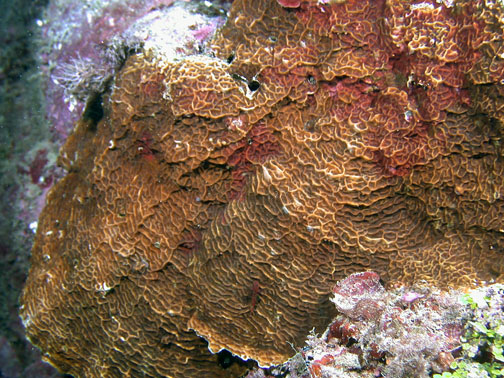
Porcelain Coral Leptoseris foliosa
The scientific name of the Porcelain Coral is Leptoseris foliosa. It is a species of animal in the family Agariciidae, order Scleractinia. The name dates from 1980.
- Scientific name
- Leptoseris foliosa Dinesen, 1980
- Common name
- Porcelain Coral
- Genus
- Leptoseris
- Family
- Agariciidae
- Order
- Scleractinia
- Class
- Anthozoa
- Red List category
- LC Least Concern
- Environment
- marine
- Recorded in
- 6 countries
- Name status
- accepted in the Catalogue of Life

Overview
Wikidata describes Leptoseris foliosa as “species of cnidarian”.
Classification of the Porcelain Coral
| Kingdom | Animalia |
|---|---|
| Phylum | Cnidaria |
| Class | Anthozoa |
| Subclass | Hexacorallia |
| Order | Scleractinia |
| Suborder | Refertina |
| Family | Agariciidae |
| Genus | Leptoseris (Leaf Coral) |
| Species | Leptoseris foliosa Dinesen, 1980 |
Where the Porcelain Coral is found
Checklists and occurrence records place Leptoseris foliosa in 6 countries. GBIF holds 89 georeferenced records of it.
Countries
Regions and cities with the most records
- East New Britain Province, Papua New Guinea 3
- Port Moresby, Papua New Guinea 3
- Queensland, Australia 3
- Western Australia, Australia 3
1 more country has a few records outside this range
These countries hold a few records of Leptoseris foliosa but lie outside the range the checklists give for it. Such records are often zoo or garden specimens, museum material or vagrants, so the species is not counted as occurring there.
A number beside a place is its count of GBIF occurrence records. A place without a number comes from a checklist alone. Records show where a species has been observed or collected, which can include escapes and vagrants.
Common names
English
- Porcelain Coral
- Encrusting Coral
Names in 1 other language
- Japanese
- ウスイタセンベイサンゴ
Related species
-
 Porcelain CoralLeptoseris mycetoseroides
-
 Porcelain CoralLeptoseris yabei
-
 Porcelain CoralLeptoseris gardineri
-
 Porcelain CoralLeptoseris incrustans
-
 Porcelain CoralLeptoseris scabra
-
 Porcelain CoralLeptoseris hawaiiensis
- Porcelain CoralLeptoseris explanata
- Porcelain CoralLeptoseris papyracea
Compare
Questions and answers
What is the scientific name of the Porcelain Coral?
The scientific name of the Porcelain Coral is Leptoseris foliosa. Written with its author, the full name is Leptoseris foliosa Dinesen, 1980.
Which family does the Porcelain Coral belong to?
Leptoseris foliosa belongs to the family Agariciidae, in the order Scleractinia and the class Anthozoa.
Where is the Porcelain Coral found?
Checklists and occurrence records place Leptoseris foliosa in 6 countries: Australia, New Caledonia, American Samoa, Papua New Guinea, Japan and Indonesia.
What is the conservation status of the Porcelain Coral?
The IUCN Red List category recorded for Leptoseris foliosa is Least Concern (LC).
What other names does the Porcelain Coral have?
Leptoseris foliosa is also known in English as Encrusting Coral.
Sources
Data
- Catalogue of Life, 2026-10-16 XR cc by
- Global Biodiversity Information Facility CC BY 4.0
- Wikidata CC0
- GeoNames CC BY 4.0
- Wikimedia Commons per image; credit shown with each image
- Within the Catalogue of Life, this name comes from World List of Scleractinia cc by
References
- Dinesen, Z. D. (1980). A revision of the coral genus Leptoseris (Scleractinia: Fungina: Agariciidae). Memoirs of the Queensland Museum, 20: 182–235. where the name was published
This species in other databases
- Catalogue of Life 6PJ87
- Wikidata Q3937340
- iNaturalist 104349
- WoRMS urn:lsid:marinespecies.org:taxname:207286
- ITIS 53046
Page built on 28 November 2026. See how the catalog is made and all sources and licences.
Cite this page
ScientificNames.org. (2026). Leptoseris foliosa (Porcelain Coral). Retrieved November 28, 2026, from https://scientificnames.org/species/leptoseris-foliosa
“Leptoseris foliosa (Porcelain Coral).” ScientificNames.org, 2026, scientificnames.org/species/leptoseris-foliosa. Accessed 28 Nov. 2026.
ScientificNames.org. “Leptoseris foliosa (Porcelain Coral).” Accessed November 28, 2026. https://scientificnames.org/species/leptoseris-foliosa.
@misc{scientificnames_leptoseris_foliosa_porcelain_coral,
  author = {{ScientificNames.org}},
  title = {Leptoseris foliosa (Porcelain Coral)},
  year = {2026},
  url = {https://scientificnames.org/species/leptoseris-foliosa},
  note = {Accessed 2026-11-28}
}